1 The Mole
After studying this chapter, you should be able to:
- Define the mole and state Avogadro’s constant
- Convert between mass, amount of substance (moles), and number of particles
- Apply the concept of molar volume to calculate gas volumes at STP
- Prepare solutions and calculate molar concentrations
- Interpret and write thermochemical equations, and calculate heats of reaction
The mole is a fundamental unit in the International System of Units (SI), representing the amount of substance. The mole is widely used in scientific research, industrial and agricultural production, and many other fields. In high school chemistry, the mole is applied to calculations involving the number of particles, the mass of substances, the volume of gases, the concentration of solutions, and the heat changes in reactions.
The concepts developed in this chapter will be applied throughout the remainder of the book.
1.1 Section 1: The Mole
The Mole Concept
In junior high school chemistry, we learned about atoms, molecules, ions, and other particles that make up matter. We know that individual particles of this kind are invisible to the naked eye and are difficult to weigh. However, substances used in the laboratory — whether elements or compounds — must be visible and weighable. In industrial production, the quantities of substances used are even larger, often measured in tons. Chemical reactions between substances proceed according to definite numbers of invisible atoms, molecules, or ions, yet in practice, reactions are carried out with weighable quantities of substances. Therefore, there is a great need to establish a connection between individual particles and weighable quantities of matter.
How can this connection be made? By establishing a fundamental unit for the amount of substance — a unit that represents a collection containing the same number of atoms, molecules, ions, and so on. Science has already established such a unit that links individual particles to collections of particles. The question then becomes: how large should this collection be to serve as the unit of amount of substance?
In recent years, science has adopted \(12\ \text{g}\) of \(\ce{^{12}C}\) (or \(0.012\ \text{kg}\) of \(\ce{^{12}C}\)) as the standard for measuring collections of carbon atoms. \(\ce{^{12}C}\) is a carbon atom whose nucleus contains 6 protons and 6 neutrons. Experimental measurements have determined that \(12\ \text{g}\) of \(\ce{^{12}C}\) contains a number of atoms equal to Avogadro’s constant.1 Avogadro’s constant has been measured experimentally with considerable precision. Here, we adopt the approximate value of \(6.02 \times 10^{23}\).
The mole is the unit for expressing the amount of substance. Each mole of a substance contains Avogadro’s constant number of particles.
For example:
- \(1\ \text{mol}\) of carbon atoms contains \(6.02 \times 10^{23}\) carbon atoms,
- \(1\ \text{mol}\) of hydrogen atoms contains \(6.02 \times 10^{23}\) hydrogen atoms,
- \(1\ \text{mol}\) of oxygen molecules contains \(6.02 \times 10^{23}\) oxygen molecules,
- \(1\ \text{mol}\) of water molecules contains \(6.02 \times 10^{23}\) water molecules,
- \(1\ \text{mol}\) of carbon dioxide molecules contains \(6.02 \times 10^{23}\) carbon dioxide molecules,
- \(1\ \text{mol}\) of hydrogen ions contains \(6.02 \times 10^{23}\) hydrogen ions,
- \(1\ \text{mol}\) of hydroxide ions contains \(6.02 \times 10^{23}\) hydroxide ions.
Avogadro’s constant is an enormously large number, yet the mole as a unit of amount of substance is extremely convenient to use. Since experiments have determined that the mass of \(1\ \text{mol}\) of \(\ce{^{12}C}\) is \(12\ \text{g}\), i.e., the mass of \(6.02 \times 10^{23}\) carbon atoms, we can calculate the mass of \(1\ \text{mol}\) of any atom.
The atomic weight of an element is determined by comparing the mass of its atoms to \(\frac{1}{12}\) of the mass of a \(\ce{^{12}C}\) atom. For example, the atomic weight of oxygen is 16, the atomic weight of hydrogen is 1, the atomic weight of iron is 55.85, and so on. The ratio of the mass of one carbon atom to one oxygen atom is \(12:16\). Since \(1\ \text{mol}\) of carbon atoms and \(1\ \text{mol}\) of oxygen atoms contain the same number of atoms — both \(6.02 \times 10^{23}\) — and since \(1\ \text{mol}\) of carbon atoms has a mass of \(12\ \text{g}\), it follows that \(1\ \text{mol}\) of oxygen atoms has a mass of \(16\ \text{g}\). By the same reasoning, the mass of \(1\ \text{mol}\) of any atom, expressed in grams, is numerically equal to the atomic weight of that atom. From this we can directly deduce:
- Hydrogen has an atomic weight of 1; the mass of \(1\ \text{mol}\) of hydrogen atoms is \(1\ \text{g}\).
- Iron has an atomic weight of 55.85; the mass of \(1\ \text{mol}\) of iron atoms is \(55.85\ \text{g}\).
Furthermore, when we use the mole to measure substances composed of diatomic or polyatomic molecules, we can similarly deduce that the mass of \(1\ \text{mol}\) of any molecule, expressed in grams, is numerically equal to the formula weight of that molecule.2
- The formula weight of hydrogen gas is 2; the mass of \(1\ \text{mol}\) of \(\ce{H2}\) is \(2\ \text{g}\).
- The formula weight of oxygen gas is 32; the mass of \(1\ \text{mol}\) of \(\ce{O2}\) is \(32\ \text{g}\).
- The formula weight of carbon dioxide is 44; the mass of \(1\ \text{mol}\) of \(\ce{CO2}\) is \(44\ \text{g}\).
- The formula weight of water is 18; the mass of \(1\ \text{mol}\) of \(\ce{H2O}\) is \(18\ \text{g}\).
When the mole is applied to ions, the mass of \(1\ \text{mol}\) of ions can be deduced in the same way. Since the mass of an electron is negligibly small, the mass of electrons gained or lost can be disregarded.
- The mass of \(1\ \text{mol}\) of \(\ce{H+}\) is \(1\ \text{g}\).
- The mass of \(1\ \text{mol}\) of \(\ce{OH-}\) is \(17\ \text{g}\).
- The mass of \(1\ \text{mol}\) of \(\ce{Cl-}\) is \(35.5\ \text{g}\).
For ionic compounds, the same reasoning applies: the mass of \(1\ \text{mol}\) of \(\ce{NaCl}\) is \(58.5\ \text{g}\).
In summary, the mole acts like a bridge, linking individual invisible particles to large collections of particles — to weighable quantities of matter.
Using the mole to measure the amount of substance brings great convenience to science and technology. From the ratios of atoms, molecules, and other particles among the reactants and products in a chemical reaction, we can directly determine the mole ratios between them:3
\[ \begin{array}{rclcl} \ce{C} & + & \ce{O2} & = & \ce{CO2} \\ 1\ \text{mol} & & 1\ \text{mol} & & 1\ \text{mol} \\[8pt] \ce{Mg} & + & \ce{2HCl} & = & \ce{MgCl2} + \ce{H2}{\uparrow} \\ 1\ \text{mol} & & 2\ \text{mol} & & 1\ \text{mol} \quad\;\; 1\ \text{mol} \end{array} \]
Calculations Involving Molar Mass
The mass of \(1\ \text{mol}\) of a substance is commonly called the molar mass of that substance. The unit of molar mass is \(\text{g/mol}\).4 The relationship among the amount of substance, the mass of the substance, and the molar mass can be expressed as:
\[ \frac{\text{Mass of substance (g)}}{\text{Molar mass (g/mol)}} = \text{Amount of substance (mol)} \qquad(1.1)\]
How many moles of water molecules are equivalent to \(90\ \text{g}\) of water?
Solution: The formula weight of water is 18, so the molar mass of water is \(18\ \text{g/mol}\).
\[ \frac{90\ \text{g}}{18\ \text{g/mol}} = 5\ \text{mol} \]
Answer: \(90\ \text{g}\) of water is equivalent to \(5\ \text{mol}\) of water.
What is the mass of \(2.5\ \text{mol}\) of copper atoms in grams?
Solution: The atomic weight of copper is 63.5, so the molar mass of copper is \(63.5\ \text{g/mol}\).
\[ \text{Mass of } 2.5\ \text{mol Cu} = 63.5\ \text{g/mol} \times 2.5\ \text{mol} = 158.8\ \text{g} \]
Answer: The mass of \(2.5\ \text{mol}\) of copper atoms is \(158.8\ \text{g}\).
How many sulfuric acid molecules are contained in \(4.9\ \text{g}\) of sulfuric acid?
Solution: The formula weight of sulfuric acid is 98, so the molar mass of sulfuric acid is \(98\ \text{g/mol}\).
\[ \frac{4.9\ \text{g}}{98\ \text{g/mol}} = 0.05\ \text{mol} \]
\[ \text{Number of molecules in } 4.9\ \text{g}\ \ce{H2SO4} = 6.02 \times 10^{23}\ \text{mol}^{-1} \times 0.05\ \text{mol} = 3.01 \times 10^{22} \]
Answer: \(4.9\ \text{g}\) of sulfuric acid contains \(3.01 \times 10^{22}\) molecules.
- The mole is the SI unit for amount of substance; 1 mol contains \(6.02 \times 10^{23}\) particles (Avogadro’s constant).
- Molar mass (g/mol) is numerically equal to the atomic weight, formula weight, or ionic mass of the substance.
- The mole bridges the gap between invisible individual particles and weighable quantities of matter.
Exercises for Section 1
What is the difference between 2 oxygen molecules, \(2\ \text{g}\) of oxygen gas, and \(2\ \text{mol}\) of oxygen molecules?
Choose the correct answer. \(0.5\ \text{mol}\) of hydrogen gas contains ( )
A. 0.5 hydrogen molecules B. 1 hydrogen atom C. \(6.02 \times 10^{23}\) hydrogen atoms D. \(3.01 \times 10^{23}\) hydrogen molecules E. \(3.01 \times 10^{12}\) hydrogen molecules
Calculate the mass of \(1\ \text{mol}\) of each of the following substances.
- Helium, magnesium, chlorine atoms, phosphorus atoms.
- Nitric acid, ammonium nitrate, sucrose (\(\ce{C12H22O11}\)).
How many moles does each of the following amounts correspond to?
- \(1\ \text{kg}\) of sulfur atoms, \(0.5\ \text{kg}\) of aluminum atoms, \(0.25\ \text{kg}\) of zinc atoms.
- \(22\ \text{g}\) of carbon dioxide, \(500\ \text{g}\) of sodium chloride, \(1.5\ \text{kg}\) of sucrose.
List the molar masses of aluminum, iron, and lead. Given that at \(20\,{}^{\circ}\text{C}\), the densities of aluminum, iron, and lead are 2.70, 7.86, and \(11.3\ \text{g/cm}^3\) respectively, calculate the volume of \(1\ \text{mol}\) of each.
At \(15\,{}^{\circ}\text{C}\), the density of sucrose is \(1.588\ \text{g/cm}^3\). Calculate the volume of \(1\ \text{mol}\) of sucrose.
When decomposing potassium chlorate to produce oxygen, how many moles of potassium chlorate are needed to produce \(0.6\ \text{mol}\) of oxygen?
How many moles of each of the following acids are needed to react with a solution containing \(4\ \text{g}\) of sodium hydroxide to form a normal salt?
- \(\ce{HCl}\) (2) \(\ce{HNO3}\) (3) \(\ce{H2SO4}\) (4) \(\ce{H3PO4}\) (5) \(\ce{HClO3}\)
Ammonium sulfate, ammonium nitrate, diammonium hydrogen phosphate (\(\ce{(NH4)2HPO4}\)), and urea can all be used as nitrogen fertilizers. Calculate:
- The mass of \(1\ \text{mol}\) of each substance in grams.
- How many moles of nitrogen atoms are contained in \(1\ \text{mol}\) of each substance.
1.2 Section 2: Molar Volume of Gases
Molar Volume of Gases
For solid or liquid substances, the volume of \(1\ \text{mol}\) of different substances is not the same. For example, at \(20\,{}^{\circ}\text{C}\), the volume of \(1\ \text{mol}\) of iron is \(7.1\ \text{cm}^3\), the volume of \(1\ \text{mol}\) of aluminum is \(10\ \text{cm}^3\), and the volume of \(1\ \text{mol}\) of lead is \(18.3\ \text{cm}^3\) (Figure 1.1); the volume of \(1\ \text{mol}\) of water is \(18.0\ \text{cm}^3\), the volume of \(1\ \text{mol}\) of pure sulfuric acid is \(54.1\ \text{cm}^3\), and the volume of \(1\ \text{mol}\) of sucrose is \(215.5\ \text{cm}^3\) (Figure 1.2).
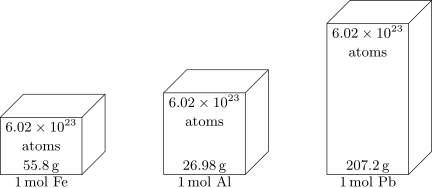
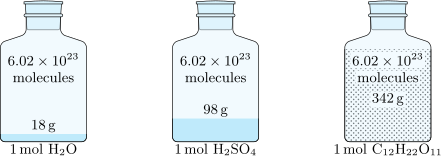
Why do the volumes of \(1\ \text{mol}\) of different solid or liquid substances differ? For solid and liquid substances, the distances between the particles that compose them are very small, so the volume of \(1\ \text{mol}\) of a substance is mainly determined by the size of the atoms, molecules, or ions. Since the atoms, molecules, or ions of different substances have different sizes, the volumes of \(1\ \text{mol}\) of different substances also differ.
However, for gases, the situation is very different.
Let us calculate the volume of \(1\ \text{mol}\) of hydrogen, oxygen, and carbon dioxide at standard conditions (STP).5 The molar mass of hydrogen is \(2\ \text{g/mol}\), that of oxygen is \(32\ \text{g/mol}\), and that of carbon dioxide is \(44\ \text{g/mol}\). Their densities at STP are 0.0899, 1.429, and \(1.977\ \text{g/L}\), respectively. From these values we can calculate the volume occupied by each gas at STP:
\[ \text{Molar volume of } \ce{H2} = \frac{2.016\ \text{g/mol}}{0.0899\ \text{g/L}} = 22.4\ \text{L/mol} \]
\[ \text{Molar volume of } \ce{O2} = \frac{32.0\ \text{g/mol}}{1.429\ \text{g/L}} = 22.4\ \text{L/mol} \]
\[ \text{Molar volume of } \ce{CO2} = \frac{44.0\ \text{g/mol}}{1.977\ \text{g/L}} = 22.3\ \text{L/mol} \]
From the examples above, we can see that at STP, the volume of \(1\ \text{mol}\) of each of these three gases is approximately \(22.4\ \text{L}\). Moreover, extensive experiments have confirmed that the volume occupied by \(1\ \text{mol}\) of any gas at STP is approximately 22.4 L (Figure 1.3).
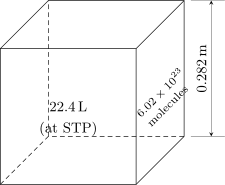
At standard conditions, the volume occupied by \(1\ \text{mol}\) of any gas is approximately 22.4 L. This volume is called the molar volume of a gas.
At STP, the molar volume of a gas is approximately \(22.4\ \text{L/mol}\).
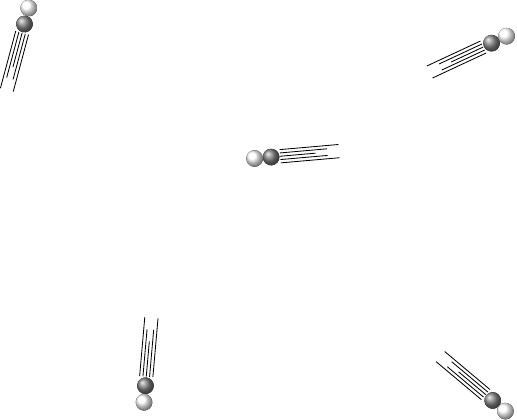
Why do \(1\ \text{mol}\) quantities of different solids and liquids have different volumes, while \(1\ \text{mol}\) of any gas at STP occupies the same volume? The answer lies in the structure of gaseous matter. Gas molecules move rapidly through a relatively large space (Figure 1.4). Under ordinary conditions, the volume of a gaseous substance is about 1000 times greater than its volume in the liquid or solid state, because gas molecules are separated by large distances. Typically, the diameter of a gas molecule is about \(4 \times 10^{-10}\ \text{m}\), while the average distance between molecules is about \(4 \times 10^{-9}\ \text{m}\) — roughly 10 times the molecular diameter (Figure 1.5). From this we can deduce that the volume of a gas is mainly determined by the average distance between molecules, rather than by the size of the molecules themselves (as is the case for liquids and solids). At STP, the average distances between molecules of different gases are nearly equal, which is why the molar volume of any gas is approximately \(22.4\ \text{L/mol}\).
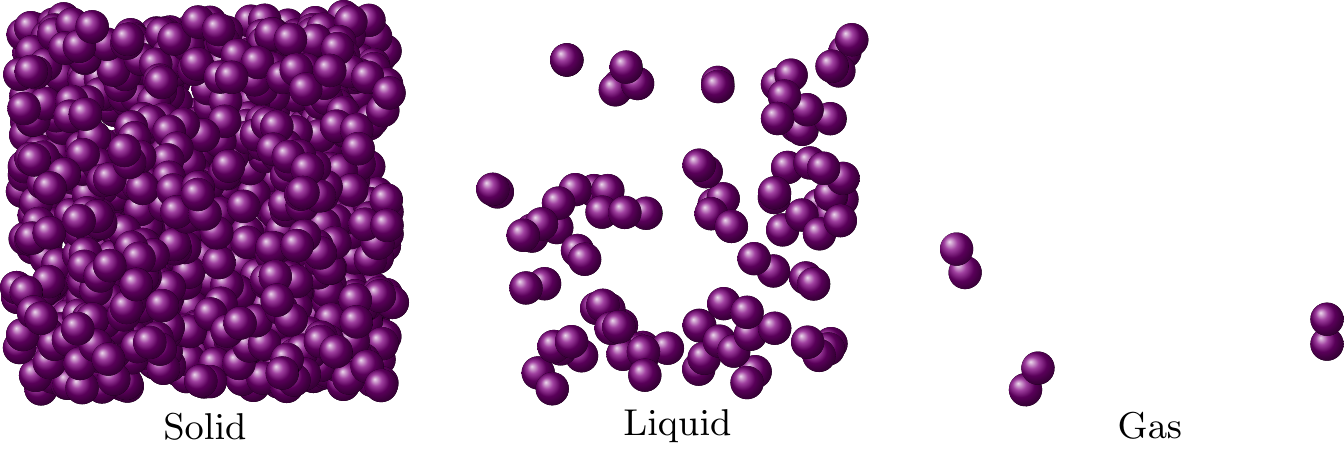
Why must we specify “at standard conditions” when stating that the molar volume of a gas is approximately \(22.4\ \text{L/mol}\)? This is because the volume of a gas is significantly affected by temperature and pressure. When the temperature rises, the average distance between gas molecules increases; when the temperature drops, the average distance decreases. When pressure increases, the average distance between gas molecules decreases; when pressure decreases, the average distance increases. At a given temperature and pressure, the average distance between molecules of all gases is the same. Under these conditions, the volume of a gas changes only with the number of molecules — equal volumes contain equal numbers of molecules. This has been confirmed by numerous facts from both industrial practice and scientific experiments.
At the same temperature and pressure, equal volumes of any gas contain the same number of molecules.
Given that the chemical formula of water is \(\ce{H2O}\), can we use the fact that hydrogen and oxygen combine to form water vapor in a volume ratio of \(2:1:2\), together with Avogadro’s Law, to prove that one oxygen molecule contains 2 oxygen atoms?
Calculations Involving Molar Volume of Gases
\(5.5\ \text{g}\) of ammonia corresponds to how many moles, and what volume would it occupy at STP?
Solution: The formula weight of ammonia is 17, so the molar mass of ammonia is \(17\ \text{g/mol}\).
\[ \frac{5.5\ \text{g}}{17\ \text{g/mol}} = 0.32\ \text{mol} \]
\[ \text{Volume of } 5.5\ \text{g}\ \ce{NH3} = 22.4\ \text{L/mol} \times 0.32\ \text{mol} = 7.2\ \text{L} \]
Answer: \(5.5\ \text{g}\) of ammonia corresponds to \(0.32\ \text{mol}\), and at STP its volume is \(7.2\ \text{L}\).
In the laboratory, dilute hydrochloric acid reacts with zinc to produce \(3.36\ \text{L}\) of hydrogen gas at STP. Calculate how many moles of \(\ce{HCl}\) and zinc are needed.
Solution: Let \(x\) be the required moles of zinc and \(y\) be the required moles of \(\ce{HCl}\).
\[ \underset{1\ \text{mol}}{\ce{Zn}} + \underset{2\ \text{mol}}{\ce{2HCl}} = \ce{ZnCl2} + \underset{22.4\ \text{L}}{\ce{H2}{\uparrow}} \]
\[ x = \frac{1\ \text{mol} \times 3.36\ \text{L}}{22.4\ \text{L}} = 0.15\ \text{mol} \]
\[ y = \frac{2\ \text{mol} \times 3.36\ \text{L}}{22.4\ \text{L}} = 0.30\ \text{mol} \]
Answer: \(0.15\ \text{mol}\) of zinc and \(0.30\ \text{mol}\) of \(\ce{HCl}\) are needed.
At STP, a \(0.20\ \text{L}\) container holds \(0.25\ \text{g}\) of carbon monoxide. Calculate the formula weight of carbon monoxide.
Based on the molar volume, we can calculate the molar mass of carbon monoxide, and the numerical value of the molar mass equals the formula weight.
Solution:
\[ \text{Molar mass of } \ce{CO} = \text{density} \times \text{molar volume} = \frac{0.25\ \text{g}}{0.20\ \text{L}} \times 22.4\ \text{L} = 28\ \text{g/mol} \]
Answer: The formula weight of carbon monoxide is 28.
- At STP (\(0\,{}^{\circ}\text{C}\), \(1\ \text{atm}\)), the molar volume of any gas is approximately \(22.4\ \text{L/mol}\).
- Gas volume depends on intermolecular distances (not molecular size), which are nearly equal for all gases at a given temperature and pressure.
- Avogadro’s Law: At the same temperature and pressure, equal volumes of any gas contain equal numbers of molecules.
Exercises for Section 2
Correct any errors in the following statements, and explain your reasoning.
- The volume of \(1\ \text{mol}\) of any gas is \(22.4\ \text{L}\).
- The mass of \(1\ \text{mol}\) of hydrogen gas is \(1\ \text{g}\), and it occupies a volume of \(22.4\ \text{L}\).
- At STP, \(1\ \text{mol}\) of any substance occupies a volume of approximately \(22.4\ \text{L}\).
- \(1\ \text{mol}\) of hydrogen gas and \(1\ \text{mol}\) of water contain the same number of molecules and at STP both occupy approximately \(22.4\ \text{L}\).
At STP, approximately how many nitrogen molecules are contained in \(1\ \text{L}\) of nitrogen gas?
At STP, is the volume occupied by \(15\ \text{g}\) of fluorine gas larger or smaller than the volume occupied by \(1\ \text{g}\) of hydrogen gas?
At STP, what mass of oxygen gas has the same volume as \(4.4\ \text{g}\) of carbon dioxide?
When preparing hydrogen gas in the laboratory, \(0.1\ \text{mol}\) of zinc reacts with excess dilute hydrochloric acid. Calculate the volume of hydrogen gas produced (at STP).
The density of nitrogen gas at STP is \(1.25\ \text{g/L}\). The density of liquid nitrogen at \(-195.8\,{}^{\circ}\text{C}\) is \(0.808\ \text{g/cm}^3\). The density of solid nitrogen at \(-232.5\,{}^{\circ}\text{C}\) is \(1.026\ \text{g/cm}^3\). Compare the volume occupied by \(1\ \text{mol}\) of nitrogen in the gaseous, liquid, and solid states.
At STP, \(235\ \text{mL}\) of a certain gas has a mass of \(0.406\ \text{g}\). Calculate the formula weight of this gas.
1.3 Section 3: Molar Concentration
Molar Concentration
In junior high school chemistry, we learned about percentage concentration, a method that allows us to determine and calculate the mass of solute contained in a given mass of solution. However, in many situations when we take a sample of a solution, we generally measure its volume rather than weigh its mass. At the same time, when substances react, the mole ratios between reactants and products follow definite relationships; knowing how many moles of solute are contained in a given volume of solution makes calculations very convenient. For these reasons, molar concentration is an important and commonly used method for expressing solution concentration in both industry and scientific research.
Molar concentration is the concentration of a solution expressed as the number of moles of solute per liter of solution, commonly denoted by \(M\).6
\[ \text{Molar concentration}\ (M) = \frac{\text{Amount of solute (mol)}}{\text{Volume of solution (L)}} \qquad(1.2)\]
A solution containing \(1\ \text{mol}\) of solute per liter is a \(1\ \text{mol/L}\) solution, usually written as \(1\ M\). For example, the molar mass of sucrose is \(342\ \text{g/mol}\). Dissolving \(342\ \text{g}\) of sucrose in enough water to make \(1\ \text{L}\) of solution gives a solution with a molar concentration of \(1\ M\). If \(1\ \text{L}\) of solution contains \(171\ \text{g}\) of sucrose, the molar concentration is \(0.5\ M\). Similarly, the molar mass of sodium chloride is \(58.5\ \text{g/mol}\). Dissolving \(58.5\ \text{g}\) of \(\ce{NaCl}\) in enough water to make \(1\ \text{L}\) of solution gives a \(1\ M\) \(\ce{NaCl}\) solution. A solution containing \(29.3\ \text{g}\) of \(\ce{NaCl}\) per liter has a concentration of \(0.5\ M\).
Solutions expressed in molar concentration are commonly referred to as “molar solutions.”
Weigh \(29.3\ \text{g}\) of sodium chloride on a balance. Dissolve the weighed \(\ce{NaCl}\) in a beaker with an appropriate amount of distilled water until completely dissolved. Carefully pour the solution into a \(1000\ \text{mL}\) volumetric flask (Figure 1.6). Rinse the inside of the beaker twice with distilled water, pouring each rinse into the volumetric flask. Swirl the solution in the flask to mix it thoroughly. Then carefully add distilled water directly to the flask until the liquid level approaches the calibration mark by \(2\text{–}3\ \text{cm}\). Switch to a dropper to add water to the neck of the flask until the meniscus is exactly level with the calibration mark. Stopper the flask and invert it repeatedly to mix thoroughly.
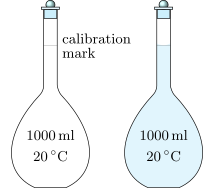
The solution prepared in this way is a \(0.5\ M\) sodium chloride solution.
Number of Solute Particles in Molar Solutions
Since \(1\ \text{mol}\) of any substance contains \(6.02 \times 10^{23}\) particles, \(1\ \text{L}\) of a \(1\ M\) sucrose solution contains \(6.02 \times 10^{23}\) sucrose molecules. For non-electrolytes, equal volumes of solutions with the same molar concentration contain the same number of solute molecules.
However, for electrolytes — ionic compounds or covalent compounds that completely dissociate in water — the situation is more complex. For example, sodium chloride dissociates into \(\ce{Na+}\) and \(\ce{Cl-}\) when dissolved in water. Therefore, \(1\ \text{L}\) of a \(1\ M\) \(\ce{NaCl}\) solution contains \(6.02 \times 10^{23}\) \(\ce{Na+}\) ions and \(6.02 \times 10^{23}\) \(\ce{Cl-}\) ions. Similarly, \(1\ \text{L}\) of \(1\ M\) \(\ce{NaOH}\) solution contains \(6.02 \times 10^{23}\) \(\ce{Na+}\) and \(6.02 \times 10^{23}\) \(\ce{OH-}\); \(1\ \text{L}\) of \(1\ M\) \(\ce{CaCl2}\) solution contains \(6.02 \times 10^{23}\) \(\ce{Ca^2+}\) and \(2 \times 6.02 \times 10^{23}\) \(\ce{Cl-}\). Likewise, \(1\ \text{L}\) of \(1\ M\) \(\ce{HCl}\) solution contains \(6.02 \times 10^{23}\) \(\ce{H+}\) and \(6.02 \times 10^{23}\) \(\ce{Cl-}\).
Calculations Involving Molar Concentration
1. Given the mass of solute and volume of solution, calculate the molar concentration
A \(200\ \text{mL}\) sample of dilute hydrochloric acid contains \(0.73\ \text{g}\) of \(\ce{HCl}\). Calculate the molar concentration of the solution.
Since molar concentration represents the number of moles of solute per liter of solution, we need to calculate how many moles of \(\ce{HCl}\) are in \(1\ \text{L}\) of solution.
Solution: The formula weight of \(\ce{HCl}\) is 36.5, so its molar mass is \(36.5\ \text{g/mol}\). \(0.73\ \text{g}\) of \(\ce{HCl}\) corresponds to:
\[ \frac{0.73\ \text{g}}{36.5\ \text{g/mol}} = 0.02\ \text{mol} \]
The amount of \(\ce{HCl}\) in \(1000\ \text{mL}\) of solution:
\[ 0.02\ \text{mol} \times \frac{1000\ \text{mL}}{200\ \text{mL}} = 0.1\ \text{mol} \]
Answer: The concentration of this dilute hydrochloric acid is \(0.1\ M\).
2. Given the molar concentration, calculate the mass of solute in a given volume
Calculate the mass of \(\ce{NaOH}\) needed to prepare \(500\ \text{mL}\) of a \(0.1\ M\) \(\ce{NaOH}\) solution.
Solution: The formula weight of \(\ce{NaOH}\) is 40, so its molar mass is \(40\ \text{g/mol}\).
The mass of \(0.1\ \text{mol}\) of \(\ce{NaOH}\) \(= 40\ \text{g/mol} \times 0.1\ \text{mol} = 4\ \text{g}\)
The mass of \(\ce{NaOH}\) in \(500\ \text{mL}\) of \(0.1\ M\) solution:
\[ \frac{500\ \text{mL} \times 4\ \text{g}}{1000\ \text{mL}} = 2\ \text{g} \]
Answer: Preparing \(500\ \text{mL}\) of \(0.1\ M\) \(\ce{NaOH}\) solution requires \(2\ \text{g}\) of \(\ce{NaOH}\).
3. Dilution calculations using molar concentration
\(200\ \text{g}\) of a \(20\%\) sucrose solution is diluted with water to \(1\ \text{L}\). Calculate the molar concentration of the diluted sucrose solution.
Solution: The formula weight of sucrose (\(\ce{C12H22O11}\)) is 342, so its molar mass is \(342\ \text{g/mol}\).
Mass of sucrose in the solution: \(200\ \text{g} \times 20\% = 40\ \text{g}\)
\[ \frac{40\ \text{g}}{342\ \text{g/mol}} = 0.117\ \text{mol} \]
Since this is dissolved in \(1\ \text{L}\) of solution, the concentration is \(0.117\ \text{mol}\) per liter.
Answer: The molar concentration of the sucrose solution is \(0.117\ M\).
Calculate how many milliliters of concentrated sulfuric acid (density \(1.836\ \text{g/cm}^3\), \(98\%\) \(\ce{H2SO4}\)) are needed to prepare \(500\ \text{mL}\) of \(1\ M\) sulfuric acid solution.
When concentrated sulfuric acid is diluted, the mass of \(\ce{H2SO4}\) remains unchanged. Therefore, the moles of \(\ce{H2SO4}\) in the dilute solution equal the moles of \(\ce{H2SO4}\) taken from the concentrated acid. We first calculate the moles of \(\ce{H2SO4}\) in the dilute solution, then the molar concentration of the concentrated acid, and from these determine the required volume.
Solution: Moles of \(\ce{H2SO4}\) in the dilute solution:
\[ \frac{500\ \text{mL}}{1000\ \text{mL}} \times 1\ \text{mol} = 0.5\ \text{mol} \]
Molar mass of \(\ce{H2SO4} = 98\ \text{g/mol}\)
Mass of \(\ce{H2SO4}\) in \(1000\ \text{mL}\) of concentrated sulfuric acid:
\[ 1000\ \text{mL} \times 1.836\ \text{g/mL} \times \frac{98}{100} = 1799\ \text{g} \]
Moles of \(\ce{H2SO4}\) in \(1000\ \text{mL}\) of concentrated acid:
\[ \frac{1799\ \text{g}}{98\ \text{g/mol}} = 18.4\ \text{mol} \]
Volume of concentrated acid containing \(0.5\ \text{mol}\) of \(\ce{H2SO4}\):
\[ \frac{0.5\ \text{mol}}{18.4\ \text{mol/L}} = 0.0272\ \text{L} = 27.2\ \text{mL} \]
Answer: \(27.2\ \text{mL}\) of concentrated sulfuric acid (\(98\%\) \(\ce{H2SO4}\)) is needed.
4. Given the molar concentrations and one volume, calculate the other volume
How many liters of \(1\ M\) \(\ce{H2SO4}\) solution are needed to neutralize \(1\ \text{L}\) of \(0.5\ M\) \(\ce{NaOH}\) solution?
Solution:
\[ \underset{2\ \text{mol}}{\ce{2NaOH}} + \ce{H2SO4} = \ce{Na2SO4} + \ce{2H2O} \]
Moles of \(\ce{NaOH}\) in \(1\ \text{L}\) of \(0.5\ M\) solution:
\[ 1\ \text{L} \times 0.5\ \text{mol/L} = 0.5\ \text{mol} \]
Moles of \(\ce{H2SO4}\) needed to neutralize \(0.5\ \text{mol}\) \(\ce{NaOH}\):
\[ 0.5\ \text{mol} \times \frac{1}{2} = 0.25\ \text{mol} \]
Volume of \(1\ M\) \(\ce{H2SO4}\) solution containing \(0.25\ \text{mol}\):
\[ \frac{0.25\ \text{mol}}{1\ \text{mol/L}} = 0.25\ \text{L} \]
Answer: \(0.25\ \text{L}\) of \(1\ M\) \(\ce{H2SO4}\) solution is needed.
- Molar concentration (\(M\)) = moles of solute per liter of solution.
- For electrolytes, the number of ions in solution depends on the dissociation of the solute (e.g., \(1\ M\) \(\ce{CaCl2}\) contains \(1\ \text{mol}\) \(\ce{Ca^2+}\) and \(2\ \text{mol}\) \(\ce{Cl-}\) per liter).
- Dilution problems use the principle that \(n_{\text{solute}}\) stays constant: \(c_1 V_1 = c_2 V_2\).
Exercises for Section 3
To prepare \(50\ \text{mL}\) of a \(0.2\ M\) solution of each of the following substances, how many grams of each are needed?
- \(\ce{HClO3}\) (2) \(\ce{H2SO4}\) (3) \(\ce{Na2SO4}\) (4) \(\ce{FeSO4.7H2O}\)
How many milliliters of each of the following solutions are needed to obtain \(1\ \text{g}\) of solute?
- \(0.1\ M\) \(\ce{H2SO4}\) solution
- \(3\ M\) \(\ce{KOH}\) solution
- \(0.2\ M\) \(\ce{BaCl2}\) solution
- \(0.5\ M\) \(\ce{Na2SO4}\) solution
Are the following statements correct? Explain your reasoning.
- Solutions of any substance with the same volume and molar concentration contain the same number of molecules.
- \(10\ \text{mL}\) of \(1\ M\) sulfuric acid has a lower concentration than \(100\ \text{mL}\) of \(1\ M\) sulfuric acid.
- When \(100\ \text{mL}\) of \(0.1\ M\) sulfuric acid and \(50\ \text{mL}\) of \(1\ M\) sulfuric acid each react separately with \(10\ \text{mL}\) of \(1\ M\) \(\ce{BaCl2}\) solution, the former produces more \(\ce{BaSO4}\) precipitate.
Neutralizing \(4\ \text{g}\) of sodium hydroxide requires \(25\ \text{mL}\) of hydrochloric acid. Calculate the molar concentration of this hydrochloric acid.
\(25\ \text{mL}\) of a \(\ce{NaOH}\) solution of unknown concentration is treated with \(20\ \text{mL}\) of \(1\ M\) \(\ce{H2SO4}\) solution, making the mixture acidic. An additional \(1.5\ \text{mL}\) of \(1\ M\) \(\ce{KOH}\) solution is then needed to reach neutralization. Calculate the molar concentration of the original \(\ce{NaOH}\) solution.
What is the molar concentration of \(37\%\) hydrochloric acid (density \(1.19\ \text{g/cm}^3\))?
Concentrated nitric acid commonly used in the laboratory is \(65\%\) with a density of \(1.4\ \text{g/cm}^3\). Calculate its molar concentration. How many milliliters of this concentrated nitric acid are needed to prepare \(100\ \text{mL}\) of \(3\ M\) nitric acid?
1.4 Section 4: Reaction Heat
This section uses kilocalories (kCal) as the unit of energy, faithful to the original Chinese edition. Modern chemistry uses kilojoules (kJ) as the SI unit of energy. The conversion is: \(1\ \text{kCal} = 4.184\ \text{kJ}\).
Additionally, this textbook writes heat directly in the chemical equation with \(+\) for exothermic and \(-\) for endothermic reactions (e.g., \(\ce{C} + \ce{O2} = \ce{CO2} + 94\ \text{kCal}\)). Modern thermochemistry uses enthalpy notation (\(\Delta H\)), with the sign convention reversed: \(\Delta H < 0\) for exothermic and \(\Delta H > 0\) for endothermic. For example, the above would be written today as: \(\ce{C(s)} + \ce{O2(g)} \to \ce{CO2(g)},\ \Delta H = -393\ \text{kJ/mol}\).
Thermochemical Equations
All chemical reactions are accompanied by energy changes, usually manifested as heat changes — that is, exothermic or endothermic phenomena. The heat released or absorbed during a reaction is called the heat of reaction. In ancient times, our ancestors gathered around bonfires to roast food and keep warm on cold nights — this was the use of heat released by combustion. In modern times, the scale of utilizing chemical reaction heat has expanded enormously. Coal, petroleum, natural gas, and other energy sources have been developed as fuels and power sources to drive trains, automobiles, airplanes, tractors, combine harvesters, and all manner of factory machinery, as well as for everyday cooking and heating. Today, these energy sources are being utilized on an even greater scale. In short, the thermal energy released by chemical reactions is of the utmost importance to us.
In chemical reactions, atoms recombine in new ways. The heat released or absorbed during the reaction process is associated with the breaking and forming of bonds between atoms. For example, in the reaction of carbon with oxygen, the combination of carbon atoms with oxygen atoms from oxygen molecules leads to the production of heat. Scientists commonly use the mole as the unit of amount of substance to calculate the heat released or absorbed by weighable quantities of matter during reactions. This is an example of linking particles to measurable heat.
Through experiments, it has been determined that \(1\ \text{mol}\) of carbon (\(6.02 \times 10^{23}\) carbon atoms) reacting with \(1\ \text{mol}\) of oxygen (\(6.02 \times 10^{23}\) oxygen molecules) to produce \(1\ \text{mol}\) of carbon dioxide (\(6.02 \times 10^{23}\) \(\ce{CO2}\) molecules) releases \(94\ \text{kCal}\) of heat. Similarly, \(2\ \text{mol}\) of hydrogen reacting with \(1\ \text{mol}\) of oxygen to produce \(2\ \text{mol}\) of water vapor releases \(115.6\ \text{kCal}\) of heat.
\[ \begin{array}{rcl} \ce{C(s)} + \ce{O2(g)} &=& \ce{CO2(g)} + 94\ \text{kCal} \\[4pt] \ce{2H2(g)} + \ce{O2(g)} &=& \ce{2H2O(g)} + 115.6\ \text{kCal} \end{array} \]
The reactions above are exothermic. Some reactions, however, are endothermic. When water vapor comes into contact with red-hot carbon, the reaction absorbs heat:
\[ \ce{C(s)} + \ce{H2O(g)} \rightleftharpoons \ce{CO(g)} + \ce{H2(g)} - 31.4\ \text{kCal} \]
\(1\ \text{mol}\) of carbon reacting with \(1\ \text{mol}\) of water vapor absorbs \(31.4\ \text{kCal}\) of heat.
Why are the states (solid, liquid, gas) indicated next to each substance in the chemical equation? We know that the state in which a substance exists is related to the energy it contains. For precision, the states of reactants and products must be specified to determine exactly how much heat is released or absorbed. For example:
\[ \begin{array}{rcl} \ce{2H2(g)} + \ce{O2(g)} &=& \ce{2H2O(g)} + 115.6\ \text{kCal} \\[4pt] \ce{2H2(g)} + \ce{O2(g)} &=& \ce{2H2O(l)} + 136.6\ \text{kCal} \end{array} \]
Heat released is indicated by a “+” sign, and heat absorbed is indicated by a “−” sign. A chemical equation that specifies the heat released or absorbed by the reaction is called a thermochemical equation.
Thermochemical equations can be used to calculate heat changes in industrial processes. For example, we can calculate the heat released by the combustion of methane. In industrial production, great attention is paid to the full utilization of heat released by reactions.
The combustion of \(1\ \text{mol}\) of methane, producing liquid water and carbon dioxide, releases \(212.8\ \text{kCal}\) of heat. Calculate the heat produced by burning \(1000\ \text{L}\) (at STP) of methane.
Solution:
\[ \text{Heat from } 1000\ \text{L of } \ce{CH4} = \frac{1000\ \text{L}}{22.4\ \text{L}} \times 212.8\ \text{kCal} = 9.50 \times 10^3\ \text{kCal} \]
Answer: Burning \(1000\ \text{L}\) (at STP) of methane releases \(9.50 \times 10^3\ \text{kCal}\) of heat.
Heat of Combustion
Depending on the type of reaction, heat of reaction can be classified into many kinds, such as heat of combustion, heat of neutralization, etc. Here we introduce only the heat of combustion.
Many elements and compounds release heat when they burn, producing stable substances such as carbon dioxide, water, hydrogen chloride, and so on.
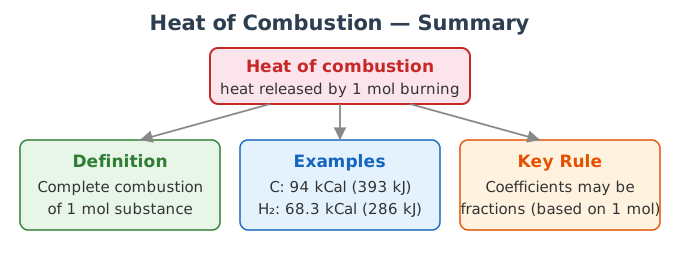
The heat of combustion is the heat released when \(1\ \text{mol}\) of a substance undergoes complete combustion. The heat of combustion is usually determined experimentally.
For example, experiments show that \(1\ \text{mol}\) of carbon undergoes complete combustion and releases \(94\ \text{kCal}\) of heat. This is the heat of combustion of carbon.
\[ \ce{C(s)} + \ce{O2(g)} = \ce{CO2(g)} + 94\ \text{kCal} \]
Experiments show that \(1\ \text{mol}\) of hydrogen gas burns to form liquid water, releasing \(68.3\ \text{kCal}\). Therefore, \(68.3\ \text{kCal}\) is the heat of combustion of hydrogen.
\[ \ce{H2(g)} + \tfrac{1}{2}\,\ce{O2(g)} = \ce{H2O(l)} + 68.3\ \text{kCal} \]
When calculating the heat of combustion, the combustible substance is taken as \(1\ \text{mol}\) as the standard. Therefore, the coefficients in thermochemical equations may be fractions.
Experiments show that \(1\ \text{mol}\) of gaseous carbon monoxide burns to form gaseous carbon dioxide, releasing \(67.6\ \text{kCal}\):
\[ \ce{CO(g)} + \tfrac{1}{2}\,\ce{O2(g)} = \ce{CO2(g)} + 67.6\ \text{kCal} \]
The heat of combustion of carbon monoxide is \(67.6\ \text{kCal}\).
Studying the concept of reaction heat helps us understand the heat changes in reactions and is also a starting point for understanding the properties of substances and their reaction processes through energy changes.
- All chemical reactions involve energy changes, typically as heat released (exothermic) or absorbed (endothermic).
- A thermochemical equation specifies the states of all substances and the heat of reaction.
- Heat of combustion is the heat released when \(1\ \text{mol}\) of a substance undergoes complete combustion; the combustible substance is always taken as \(1\ \text{mol}\).
Exercises for Section 4
If \(2.5\ \text{mol}\) of carbon is burned in excess oxygen to produce carbon dioxide, how many kilocalories of heat are released?
How many moles of hydrogen gas must be burned to form liquid water in order to obtain \(1000\ \text{kCal}\) of heat?
Compare the heat released by burning \(1\ \text{kg}\) each of hydrogen (producing liquid water) and carbon (producing carbon dioxide).
Burning \(1\ \text{g}\) of methane (\(\ce{CH4}\), gas) to produce liquid water and carbon dioxide releases \(13.3\ \text{kCal}\). Calculate the heat released by burning \(5\ \text{mol}\) of methane.
Burning \(1\ \text{g}\) of acetylene (\(\ce{C2H2}\), gas) to produce liquid water and carbon dioxide releases \(11.9\ \text{kCal}\). Calculate the heat released by burning \(3\ \text{mol}\) of acetylene. When equal moles of methane and acetylene are burned, which gas releases more heat?
Burning \(0.11\ \text{g}\) of ethanol (\(\ce{C2H5OH}\), liquid) to produce liquid water and carbon dioxide releases enough heat to raise the temperature of \(100\ \text{g}\) of water by \(7.12\,{}^{\circ}\text{C}\). Calculate the heat released by burning \(1\ \text{mol}\) of ethanol. (The specific heat capacity of water is \(1\ \text{Cal/(g}\cdot{}^{\circ}\text{C)}\).)
From the following data, calculate the heat of combustion of magnesium, aluminum, and sulfur, and write the thermochemical equations.
- \(1\ \text{g}\) of magnesium undergoes complete combustion, releasing \(6.0\ \text{kCal}\).
- \(3\ \text{g}\) of aluminum undergoes complete combustion, releasing \(21.4\ \text{kCal}\).
- \(5\ \text{g}\) of sulfur undergoes complete combustion to form sulfur dioxide, releasing \(11.1\ \text{kCal}\).
1.5 Chapter Summary
I. The Mole
The mole is the unit for expressing the amount of substance. Each mole of a substance contains Avogadro’s constant number of particles (molecules, atoms, ions, etc.).
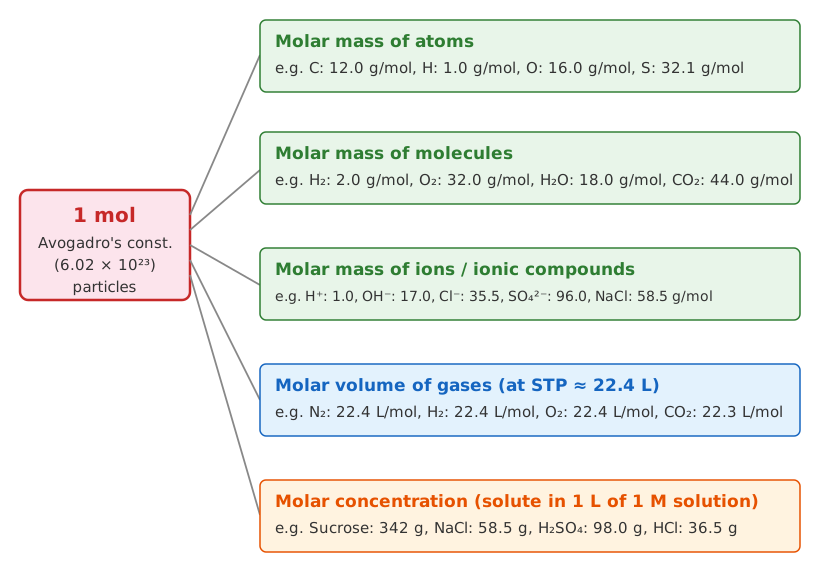
The diagram above shows that 1 mol of any substance contains Avogadro’s constant (\(6.02 \times 10^{23}\)) particles, and connects to the following quantities:
| Category | Quantity | Examples |
|---|---|---|
| Molar mass of atoms | Mass of 1 mol of atoms | C: 12.0 g/mol, H: 1.0 g/mol, O: 16.0 g/mol, S: 32.1 g/mol |
| Molar mass of molecules | Mass of 1 mol of molecules | \(\ce{H2}\): 2.0 g/mol, \(\ce{O2}\): 32.0 g/mol, \(\ce{H2O}\): 18.0 g/mol, \(\ce{CO2}\): 44.0 g/mol |
| Molar mass of ions/ionic compounds | Mass of 1 mol of ions or formula units | \(\ce{H+}\): 1.0 g/mol, \(\ce{OH-}\): 17.0 g/mol, \(\ce{Cl-}\): 35.5 g/mol, \(\ce{SO4^{2-}}\): 96.0 g/mol, \(\ce{NaCl}\): 58.5 g/mol |
| Molar volume of gases | Volume of 1 mol of gas at STP \(\approx\) 22.4 L | \(\ce{N2}\): 22.4 L/mol, \(\ce{H2}\): 22.4 L/mol, \(\ce{O2}\): 22.4 L/mol, \(\ce{CO2}\): 22.3 L/mol |
| Molar concentration | Mass of solute in 1 L of 1 M solution | Sucrose: 342 g, \(\ce{NaCl}\): 58.5 g, \(\ce{H2SO4}\): 98.0 g, \(\ce{HCl}\): 36.5 g |
The key relationships are:
\[ \text{Amount of substance (mol)} = \frac{\text{Mass of substance (g)}}{\text{Molar mass (g/mol)}} \]
\[ \text{Amount of gas (mol)} = \frac{\text{Volume of gas (L)}}{\text{Molar volume (22.4 L/mol at STP)}} \]
\[ \text{Molar concentration}\ (M) = \frac{\text{Amount of solute (mol)}}{\text{Volume of solution (L)}} \]
II. Reaction Heat
Thermochemical equation: A chemical equation that indicates the heat released or absorbed by the reaction.
Heat of combustion: The heat released when \(1\ \text{mol}\) of a substance undergoes complete combustion. Calculations of heat of combustion are based on \(1\ \text{mol}\) of the combustible substance (fuel).
Review Problems
Are the following statements correct? Explain your reasoning.
- At the same temperature and pressure, equal masses of gas always occupy the same volume.
- Molar concentration refers to the number of moles of solute in \(1\ \text{L}\) of water.
- When \(1\ \text{mol}\) of \(\ce{NaCl}\) dissociates in water, it produces \(0.5\ \text{mol}\) of \(\ce{Na+}\) and \(0.5\ \text{mol}\) of \(\ce{Cl-}\).
At STP, we have \(11\ \text{g}\) of carbon dioxide, \(0.5\ \text{mol}\) of hydrogen gas, and \(10\ \text{L}\) of nitrogen gas. Answer the following:
- Which substance has the greatest mass? Which has the least?
- Which substance contains the most molecules? Which contains the fewest?
- Which substance occupies the greatest volume? Which occupies the least?
\(2\ \text{g}\) of ammonium sulfate fertilizer is mixed with concentrated alkali solution and heated. \(600\ \text{mL}\) of ammonia (at STP) is collected. Calculate the percentage of nitrogen in the fertilizer.
\(250\ \text{mL}\) of waste sulfuric acid with a concentration of \(15\%\) and a density of \(1.2\ \text{g/cm}^3\) (containing no iron compounds or other acids) is allowed to react completely with excess iron filings. Calculate:
- The molar concentration of this waste sulfuric acid.
- The volume of hydrogen gas produced (at STP).
- If the resulting iron(II) sulfate is made into \(400\ \text{mL}\) of solution, what is the molar concentration of that solution?
To a solution containing sodium sulfate and sodium carbonate, excess barium chloride solution is added, producing \(3.5\ \text{g}\) of precipitate. The precipitate is then treated with excess nitric acid solution, releasing \(150\ \text{mL}\) of carbon dioxide gas (at STP). Calculate the number of moles of sodium sulfate and sodium carbonate in the original solution.
Calculate how many grams of hydrogen gas must be burned (producing liquid water) to release the same amount of heat as burning \(1\ \text{kg}\) of carbon (producing carbon dioxide).
\(1.721\ \text{g}\) of a hydrated calcium sulfate crystal (\(\ce{CaSO4.xH2O}\)) is heated until all crystal water is lost. The mass of anhydrous calcium sulfate is \(1.360\ \text{g}\). Calculate the number of water molecules of crystallization (\(x\)).7
The solubility of KCl at \(24\,{}^{\circ}\text{C}\) is \(33.2\ \text{g}\). Calculate the percentage concentration of a saturated KCl solution at \(24\,{}^{\circ}\text{C}\). Given that the density of this solution is \(1.16\ \text{g/cm}^3\), calculate its molar concentration.
Translator’s note: Named after Italian scientist Amedeo Avogadro (1776–1856). The modern accepted value of Avogadro’s constant is \(N_A = 6.02214076 \times 10^{23}\ \text{mol}^{-1}\), as redefined by the 26th General Conference on Weights and Measures (CGPM) in 2018. This textbook uses the older approximate value \(6.02 \times 10^{23}\).↩︎
Translator’s note on terminology: This textbook uses “atomic weight” (原子量) and “formula weight” (式量) following the original Chinese edition. In modern IUPAC nomenclature, the preferred terms are “relative atomic mass” (\(A_r\)) for atoms and “relative molecular mass” (\(M_r\)) or “relative formula mass” for molecules and ionic compounds respectively. “Molar mass” (\(M\), in g/mol) refers to the mass per mole of substance. The numerical values are the same; only the terminology and units differ.↩︎
Translator’s note on equation notation: Chinese chemistry notation uses the equals sign (\(=\)) in chemical equations, whereas international convention uses a right arrow (\(\to\)) for irreversible reactions and equilibrium arrows (\(\rightleftharpoons\)) for reversible reactions. This translation preserves the original notation.↩︎
Translator’s note: The unit \(\text{g/mol}\) (grams per mole) is used throughout this text. In SI, molar mass is formally expressed in \(\text{kg/mol}\), but \(\text{g/mol}\) is universally used in chemistry for convenience, since it makes molar mass numerically equal to relative atomic or formula weight.↩︎
Translator’s note: In this textbook, “standard conditions” or STP (Standard Temperature and Pressure) refers to \(0\,{}^{\circ}\text{C}\) (\(273.15\ \text{K}\)) and \(1\ \text{atm}\) (\(101.325\ \text{kPa}\)). Note that IUPAC redefined STP in 1982 as \(0\,{}^{\circ}\text{C}\) and exactly \(100\ \text{kPa}\) (\(1\ \text{bar}\)), under which the molar volume of an ideal gas is \(22.711\ \text{L/mol}\) rather than \(22.414\ \text{L/mol}\). This text uses the older convention.↩︎
Translator’s note: The notation \(M\) for \(\text{mol/L}\) (e.g., \(1\ M\) meaning \(1\ \text{mol/L}\)) was widely used historically and remains common in practice. However, modern IUPAC recommendations prefer the explicit notation \(\text{mol/L}\) or \(\text{mol}\cdot\text{dm}^{-3}\), and use the symbol \(c\) for molar concentration (e.g., \(c(\text{NaCl}) = 1\ \text{mol/L}\)). This textbook retains the \(M\) notation for readability.↩︎
Translator’s errata: In some printings of the original Chinese edition, the mass of the hydrated crystal is misprinted as the same value as the anhydrous mass. The correct values are \(1.721\ \text{g}\) for the hydrate and \(1.360\ \text{g}\) for the anhydrous salt, yielding \(x = 2\) (i.e., \(\ce{CaSO4.2H2O}\), gypsum).↩︎