2 Halogens
After studying this chapter, you should be able to:
- Describe the physical and chemical properties of chlorine gas, and explain its lab preparation
- Explain the properties and preparation of hydrogen chloride and hydrochloric acid
- Define oxidation–reduction reactions in terms of electron transfer and changes in oxidation state
- Identify oxidizing agents and reducing agents in chemical reactions
- Compare the atomic structures and properties of the halogen family (F, Cl, Br, I)
- Relate trends in halogen reactivity to atomic radius and nuclear charge
- Describe the properties and uses of selected halogen compounds (\(\ce{HF}\), \(\ce{AgBr}\), \(\ce{AgI}\))
In junior high school chemistry, we learned about the electron configurations of fluorine and chlorine atoms — both have 7 electrons in their outermost shell. Among all elements,1 the atoms of bromine, iodine, and astatine also have structures similar to those of fluorine and chlorine, with 7 electrons in their outermost shell. Fluorine, chlorine, bromine, iodine, and astatine2 share similar chemical properties and form a family called the halogen family, or simply the halogens. Astatine is extremely rare in nature. In this chapter, we will focus primarily on chlorine, and then use our understanding of chlorine as a foundation for studying fluorine, bromine, and iodine.
2.1 Section 1: Chlorine Gas
Properties of Chlorine Gas
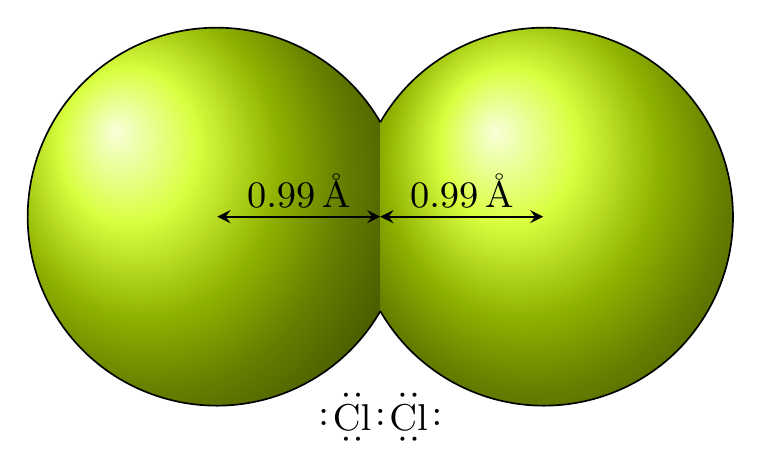
The molecule of chlorine gas (\(\ce{Cl2}\)) is a diatomic molecule composed of two chlorine atoms (Figure 2.1). Like a hydrogen molecule, the shared electron pair in a chlorine molecule is located between the two atomic nuclei. Chlorine gas is a nonmetallic element in its elemental form. Under normal conditions, chlorine gas is yellow-green in color. At 1 atm, it liquefies to form liquid chlorine when cooled to \(-34.6\,{}^{\circ}\text{C}\), and solidifies when further cooled to \(-101\,{}^{\circ}\text{C}\).
Display a bottle of chlorine gas, with a sheet of white paper placed behind the bottle so that the color of the chlorine gas can be clearly observed.
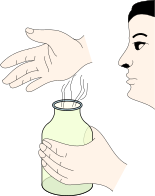
Chlorine gas is toxic and extremely irritating. Inhaling a small amount of chlorine gas causes irritation of the mucous membranes in the nose and throat, leading to chest pain and coughing. Inhaling large amounts can be fatal. In the laboratory, when smelling chlorine gas, one must exercise great caution — gently fan the air above the bottle opening with your hand so that only a trace amount of chlorine reaches your nose (Figure 2.2).
We already know that the outermost electron shell of a chlorine atom has 7 electrons, so in chemical reactions it readily gains one electron to achieve the stable 8-electron configuration. The chemical properties of chlorine gas are very reactive — it is an active nonmetal.
1. Reaction of Chlorine with Metals
The reaction of chlorine gas with sodium metal is very vigorous, as we observed in junior high school chemistry. Chlorine not only combines directly with active metals like sodium, but can also react with heated, less active metals such as copper.
Heat a bundle of fine copper wires until red-hot, then immediately lower it into a gas collection bottle filled with chlorine gas (Figure 2.3). Observe the phenomenon that occurs. Pour a small amount of water into the gas collection bottle, cover the mouth with a frosted glass plate, and shake. Observe the color of the resulting solution.
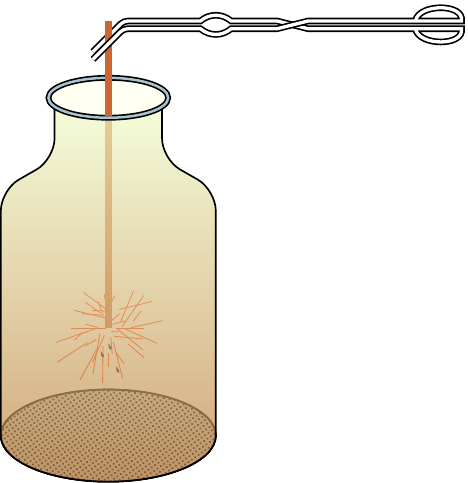
The red-hot copper wire burns vigorously in the chlorine gas. The gas collection bottle fills with brown smoke — these are crystals of copper(II) chloride. This reaction can be represented by the following chemical equation:
\[ \ce{Cu + Cl2 ->[\Delta] CuCl2} \]
Copper(II) chloride dissolves in water to form a green copper(II) chloride solution.
2. Reaction of Chlorine with Nonmetals
Collect one bottle of chlorine gas and one bottle of hydrogen gas separately (the gases may be collected in transparent or translucent plastic bottles). Place the two bottles mouth-to-mouth, remove the glass plate between them, and invert several times to mix the chlorine and hydrogen thoroughly. Take one bottle of the chlorine–hydrogen mixture for the experiment; cover it with a plastic plate. At a distance of approximately \(10\ \text{cm}\) from the bottle, ignite a magnesium ribbon. When the intense light illuminates the gas mixture, a rapid combination of chlorine and hydrogen occurs, causing an explosion that pushes the plastic plate upward (Figure 2.4).
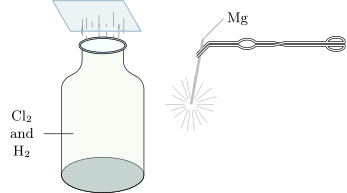
Chlorine gas reacts with hydrogen gas to produce hydrogen chloride gas, releasing a large amount of heat and resulting in an explosion.
\[ \ce{H2(g) + Cl2(g) ->[\text{light}] 2HCl(g)} + 44.1\ \text{kCal} \]
This textbook uses kilocalories (kCal) for heats of reaction, which was standard practice in China in the early 1980s. The modern SI unit is the kilojoule (kJ). The conversion is: \(1\ \text{kCal} = 4.184\ \text{kJ}\). For example, \(44.1\ \text{kCal} = 184.5\ \text{kJ}\).
Place red phosphorus in a deflagrating spoon, ignite it, and then lower it into a gas collection bottle filled with chlorine gas. The phosphorus burns vigorously (Figure 2.5). Observe the phenomenon.
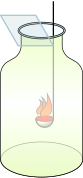
Chlorine gas reacts with phosphorus to produce phosphorus trichloride and phosphorus pentachloride. The white fumes that appear are a mixture of phosphorus trichloride and phosphorus pentachloride.
\[ \ce{2P + 3Cl2 ->[\text{ignite}] 2PCl3} \]
\[ \ce{PCl3 + Cl2 -> PCl5} \]
Phosphorus trichloride is a colorless liquid and an important chemical raw material used in manufacturing many phosphorus compounds, such as the pesticide trichlorfon and various other agrochemicals.
3. Reaction of Chlorine with Water
Chlorine gas dissolves in water. At room temperature, 1 volume of water can dissolve approximately 2 volumes of chlorine gas. The aqueous solution of chlorine gas is called chlorine water. The dissolved chlorine reacts with water to produce hydrochloric acid and hypochlorous acid (\(\ce{HClO}\)).
\[ \ce{Cl2 + H2O -> HCl + HClO} \]
Hypochlorous acid is unstable and readily decomposes, releasing oxygen gas. When chlorine water is exposed to sunlight, the decomposition of hypochlorous acid accelerates.
When sunlight strikes an apparatus containing chlorine water as shown in Figure 2.6, gas bubbles are soon observed escaping from the solution.
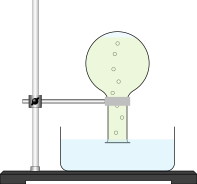
\[ \ce{2HClO ->[\text{light}] 2HCl + O2}{\uparrow} \]
Hypochlorous acid is a strong oxidizing agent that can kill bacteria in water. For this reason, tap water is commonly disinfected with chlorine gas (approximately \(0.002\ \text{g}\) of \(\ce{Cl2}\) per liter of water). Hypochlorous acid can also decolorize dyes and organic pigments, and can be used as a bleaching agent.
Take one dry and one moist piece of colored fabric and place them in the apparatus shown in Figure 2.7. Observe what happens.
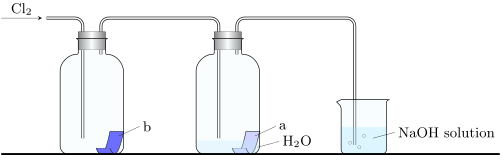
The moist colored fabric becomes decolorized, while the dry fabric does not. This demonstrates that it is hypochlorous acid — not chlorine gas itself — that acts as the bleaching agent.
4. Reaction of Chlorine with Bases
Chlorine gas reacts relatively quickly with bases such as sodium hydroxide, so excess chlorine can be absorbed using an alkaline solution when preparing chlorine gas in the laboratory.
\[ \ce{2NaOH + Cl2 -> NaCl + NaClO + H2O} \]
Because hypochlorite salts are more stable than hypochlorous acid and easier to store, industry uses chlorine gas and slaked lime to produce bleaching powder. The effective component of bleaching powder is calcium hypochlorite. The reaction for making bleaching powder can be simply represented as follows:
\[ \ce{2Ca(OH)2 + 2Cl2 -> Ca(ClO)2 + CaCl2 + 2H2O} \]
When bleaching powder is used for bleaching, the calcium hypochlorite reacts with dilute acid or with carbon dioxide and water vapor from the air, producing hypochlorous acid.
\[ \ce{Ca(ClO)2 + 2HCl -> CaCl2 + 2HClO} \]
\[ \ce{Ca(ClO)2 + CO2 + H2O -> CaCO3}{\downarrow} + \ce{2HClO} \]
Uses of Chlorine Gas
In addition to its use in disinfection and the manufacture of hydrochloric acid and bleaching powder, chlorine gas is also used to produce various pesticides and organic solvents such as chloroform. Chlorine gas is therefore an important chemical raw material.
Laboratory Preparation of Chlorine Gas
In the laboratory, chlorine gas can be prepared by reacting concentrated hydrochloric acid with manganese dioxide.
Assemble the apparatus as shown in Figure 2.8. Check the gas-tightness of the system. Add a small amount of powdered manganese dioxide to the flask. Slowly add concentrated hydrochloric acid (density \(1.19\ \text{g/cm}^3\)) from the separating funnel. Gently heat to accelerate the reaction, and chlorine gas will be released at a steady rate. Collect the gas by upward displacement of air. Absorb excess chlorine gas with a sodium hydroxide solution.
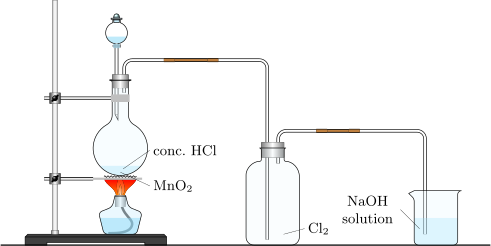
This reaction can be represented by the following chemical equation:3
\[ \ce{4HCl + MnO2 ->[\Delta] MnCl2 + 2H2O + Cl2}{\uparrow} \]
- Chlorine gas (\(\ce{Cl2}\)) is a yellow-green, toxic gas. It is a reactive nonmetal that readily gains electrons.
- Chlorine reacts vigorously with metals (Na, Cu) to form metal chlorides, and with nonmetals (\(\ce{H2}\), P) to form covalent compounds.
- Chlorine dissolves in water to form chlorine water, reacting to produce \(\ce{HCl}\) and \(\ce{HClO}\).
- Hypochlorous acid (\(\ce{HClO}\)) is unstable, decomposes in light, and is the actual bleaching and disinfecting agent.
- Chlorine reacts with bases to form hypochlorite salts; bleaching powder contains \(\ce{Ca(ClO)2}\) as its effective component.
- Lab preparation: \(\ce{MnO2}\) + concentrated \(\ce{HCl}\) \(\xrightarrow{\Delta}\) \(\ce{Cl2}\).
Exercises for Section 1
Which of the following statements is correct?
- A chlorine atom and a chloride ion have the same properties.
- A chloride ion has one more electron than a chlorine atom.
- Chloride ions are yellow-green in color.
How does freshly prepared chlorine water differ in composition from chlorine water that has been standing for a long time?
Write the chemical equations for the reactions of chlorine gas with zinc, aluminum, and iron.
When solid phosphorus reacts with chlorine gas to produce \(1\ \text{mol}\) of gaseous phosphorus trichloride, \(73.2\ \text{kCal}\) of heat is released. When gaseous phosphorus trichloride further reacts with chlorine gas to produce \(1\ \text{mol}\) of gaseous phosphorus pentachloride, \(22.1\ \text{kCal}\) of heat is released. Write the thermochemical equations for both reactions.
Starting with \(150\ \text{g}\) of pyrolusite ore containing \(78\%\ \ce{MnO2}\), calculate the mass of chlorine gas (in grams) that can be obtained by reaction with excess concentrated hydrochloric acid.
2.2 Section 2: Hydrogen Chloride and Hydrochloric Acid
Hydrogen Chloride
Place a small amount of table salt (sodium chloride) in a round-bottom flask (Figure 2.9). Add concentrated sulfuric acid through a separating funnel, and heat simultaneously. Collect the hydrogen chloride in a dry container. Collect a portion of the hydrogen chloride using water.
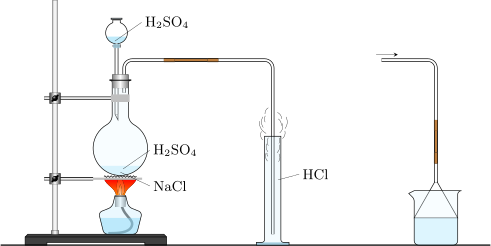
Sodium chloride reacts with concentrated sulfuric acid. Without heating or with only gentle heating, sodium hydrogen sulfate and hydrogen chloride are produced.
\[ \ce{NaCl + H2SO4}(\text{conc.}) \ce{-> NaHSO4 + HCl}{\uparrow} \]
At \(500 \sim 600\,{}^{\circ}\text{C}\), the reaction continues to produce sodium sulfate and hydrogen chloride.
\[ \ce{NaHSO4 + NaCl ->[\Delta] Na2SO4 + HCl}{\uparrow} \]
The overall chemical equation can be written as:
\[ \ce{2NaCl + H2SO4 ->[\Delta] Na2SO4 + 2HCl}{\uparrow} \]
Hydrogen chloride is a colorless gas with a pungent odor. It is very soluble in water — at \(0\,{}^{\circ}\text{C}\), approximately 500 volumes of hydrogen chloride dissolve in 1 volume of water.
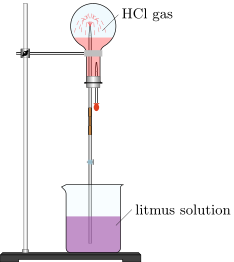
Fill a dry round-bottom flask with hydrogen chloride. Seal the flask with a stopper fitted with a glass tube and a dropper (the dropper is pre-filled with water). Immediately invert the flask and place the glass tube into a beaker containing litmus solution. Squeeze the rubber bulb to release a few drops of water. The solution from the beaker jets up into the flask through the glass tube, forming a beautiful fountain (Figure 2.10).
Hydrochloric Acid and Metal Chlorides
The aqueous solution of hydrogen chloride is acidic and is called hydrochloric acid (also known historically as muriatic acid). We have already studied the properties of hydrochloric acid in junior high school chemistry: it can change the color of acid-base indicators, undergo displacement reactions with metals that precede hydrogen in the activity series, undergo neutralization reactions with bases, and undergo double displacement reactions with salts to produce insoluble or volatile products. When hydrochloric acid reacts with metals, bases, or salts, metal chlorides are formed.
Metal chlorides are widely distributed in nature and are extensively used in daily life, agriculture, and industry. Important examples include sodium chloride, potassium chloride, magnesium chloride, and zinc chloride. Here, we introduce only sodium chloride.
Sodium chloride, commonly known as table salt, is essential for the normal physiological functions of humans and higher animals. We consume salt daily to replenish the sodium chloride lost through urine and perspiration. Table salt is abundantly distributed in nature. Seawater is rich in salt. Due to geological changes, salt is also found in salt lakes, salt wells, and salt mines. China possesses extremely abundant salt resources, producing sea salt, well salt, lake salt, and rock salt.
Seawater and salt lakes contain abundant resources. In addition to producing table salt, their comprehensive utilization can yield potassium fertilizers and many other salts, as well as bromine and other products. These products are indispensable raw materials for agriculture and many industries.
Whether evaporating seawater to obtain salt or boiling brine drawn from salt wells, the purpose is the same: to evaporate water until the salt solution reaches saturation, then continue evaporating so that sodium chloride continuously crystallizes out. The salt crystals obtained in this way still contain relatively many impurities and are commonly called crude salt. Crude salt can be purified through recrystallization to obtain refined salt.
Pure sodium chloride crystals are cubic in shape. They melt at \(801\,{}^{\circ}\text{C}\) and boil at \(1413\,{}^{\circ}\text{C}\). Pure sodium chloride does not deliquesce in air, but crude salt easily deliquesces because it contains impurities such as magnesium chloride and calcium chloride.
The uses of table salt are extensive. In daily life, it is used for seasoning and for pickling vegetables, fish, meat, eggs, and so on. In medicine, physiological saline is a \(0.9\%\) sodium chloride solution. Table salt is an important chemical raw material, used to produce sodium metal, chlorine gas, sodium hydroxide, soda ash, and other chemical products.
- Hydrogen chloride (\(\ce{HCl}\)) is a colorless, pungent gas that is extremely soluble in water (500 : 1 by volume at \(0\,{}^{\circ}\text{C}\)).
- Lab preparation: \(\ce{NaCl}\) + concentrated \(\ce{H2SO4}\) \(\xrightarrow{\Delta}\) \(\ce{HCl}{\uparrow}\).
- The aqueous solution of \(\ce{HCl}\) is hydrochloric acid, a strong acid that reacts with metals, bases, and salts.
- Sodium chloride (table salt) is the most important metal chloride — used in food, medicine, and as a key chemical raw material.
Exercises for Section 2
Calculate: \(11.2\ \text{L}\) of chlorine gas and \(11.2\ \text{L}\) of hydrogen gas react. How many liters of hydrogen chloride gas are produced (all gas volumes measured at STP; see Section 1.2.1)? If all the hydrogen chloride produced is dissolved in \(328.5\ \text{g}\) of water to form hydrochloric acid with a density of \(1.047\ \text{g/cm}^3\), calculate the molar concentration (see Section 1.3.1) of this hydrochloric acid.
Write the chemical equations for the reactions of hydrochloric acid with the following substances.
- \(\ce{Mg}\)
- \(\ce{MgO}\)
- \(\ce{Mg(OH)2}\)
- \(\ce{Mg(HCO3)2}\)
- \(\ce{MgCO3}\)
If \(11.7\ \text{g}\) of sodium chloride reacts with \(10\ \text{g}\) of \(98\%\) sulfuric acid, how many grams of hydrogen chloride are produced with gentle heating? How many additional grams of hydrogen chloride are produced when heating is continued to \(600\,{}^{\circ}\text{C}\)?
\(1\ \text{g}\) of zinc and \(1\ \text{g}\) of iron each react separately with excess dilute hydrochloric acid. Calculate the volume of hydrogen gas produced in each case (at STP).
If \(1.5\ \text{mL}\) of hydrochloric acid with a density of \(1.028\ \text{g/cm}^3\) (\(6\%\ \ce{HCl}\)) reacts with excess silver nitrate solution, calculate the mass of the silver chloride precipitate formed.
Why do both sunshine and wind promote the crystallization of salt during the solar evaporation of seawater?
Why is lowering the temperature of the solution not a practical method for producing table salt?
2.3 Section 3: Oxidation–Reduction Reactions
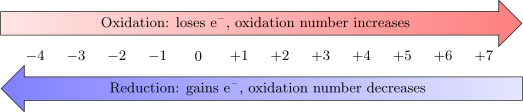
In junior high school chemistry, we studied oxidation–reduction reactions and learned that oxidation and reduction are not limited to reactions involving the gain or loss of oxygen. Instead, we can analyze oxidation–reduction reactions from the perspective of changes in oxidation states (valences). In a reaction, when the oxidation state of an element in a substance increases, the process is called oxidation; when the oxidation state decreases, it is called reduction. A substance whose element’s oxidation state increases is a reducing agent, and a substance whose element’s oxidation state decreases is an oxidizing agent. Let us now use this framework to analyze several oxidation–reduction reactions studied in this chapter.
Consider the reaction of hydrogen gas with chlorine gas:
\[ \ce{H2 + Cl2 -> 2HCl} \]
In this reaction, each hydrogen atom goes from an oxidation state of 0 in \(\ce{H2}\) to +1 in \(\ce{HCl}\) (oxidation state increases — oxidized), while each chlorine atom goes from 0 in \(\ce{Cl2}\) to −1 in \(\ce{HCl}\) (oxidation state decreases — reduced).
We already know from junior high school chemistry that sodium chloride is composed of chloride ions and sodium ions. A sodium atom loses 1 electron to become a sodium ion, and a chlorine atom gains 1 electron to become a chloride ion. We can now analyze several oxidation–reduction reactions from the perspective of electron transfer.
We know that chlorine gas reacts with sodium or copper to produce sodium chloride and copper(II) chloride, respectively. During these reactions, copper atoms — like sodium atoms — lose electrons to become copper ions. In the chemical equations below, “e” represents an electron, and arrows indicate whether atoms of the same element gain or lose electrons.
In the reaction \(\ce{2Na + Cl2 -> 2NaCl}\), sodium is +1 and chlorine is −1. During the reaction, each sodium atom loses 1 electron — its oxidation state rises from 0 to +1. Each chlorine atom gains 1 electron — its oxidation state falls from 0 to −1.
Similarly, in \(\ce{Cu + Cl2 -> CuCl2}\), each copper atom loses 2 electrons — its oxidation state rises from 0 to +2. Each chlorine atom gains 1 electron — its oxidation state falls from 0 to −1.
The increase in an element’s oxidation state is caused by the loss of electrons, and the number of units it increases equals the number of electrons lost. The decrease in an element’s oxidation state is caused by the gain of electrons, and the number of units it decreases equals the number of electrons gained. The changes in oxidation state are therefore a direct consequence of atoms losing or gaining electrons. We can now give a more precise definition of oxidation–reduction reactions.
A reaction in which a substance loses electrons is an oxidation reaction; a reaction in which a substance gains electrons is a reduction reaction.
In an oxidation–reduction reaction, when one substance loses electrons, another substance must simultaneously gain electrons. The number of electrons lost by one substance always equals the number of electrons gained by another. The substance that gains electrons is the oxidizing agent; the substance that loses electrons is the reducing agent.
\[ \begin{array}{rcl} \ce{2Na} + \ce{Cl2} &=& \ce{2NaCl} \\ \text{reducing agent} & & \text{oxidizing agent} \end{array} \]
\[ \begin{array}{rcl} \ce{Cu} + \ce{Cl2} &=& \ce{CuCl2} \\ \text{reducing agent} & & \text{oxidizing agent} \end{array} \]
However, in some reactions — such as the reaction of hydrogen gas with chlorine gas to produce hydrogen chloride — the product (\(\ce{HCl}\)) is a covalent compound. We already learned in junior high school chemistry that in the \(\ce{HCl}\) molecule, the shared electron pair is shifted toward the chlorine atom and away from the hydrogen atom.
In this type of electron transfer, no electrons are completely lost or gained. Instead, the shared electron pair is displaced (shifted). Such reactions are still classified as oxidation–reduction reactions. In this reaction, chlorine gas is the oxidizing agent and hydrogen gas is the reducing agent.
The relationships among electron transfer (gain/loss or displacement), changes in oxidation state, and oxidation/reduction in an oxidation–reduction reaction can be summarized in Figure 2.11.
Analyze the reaction of magnesium with dilute hydrochloric acid. For the magnesium and hydrogen elements, determine the electron transfer, oxidation state changes, and the oxidation/reduction relationship before and after the reaction. Which substance is the oxidizing agent and which is the reducing agent?
Solution: Write the chemical equation and analyze the electron transfer for magnesium and hydrogen:
\[ \ce{Mg + 2HCl -> MgCl2 + H2}{\uparrow} \]
- Magnesium: oxidation state changes from \(0\) to \(+2\) (loses 2 electrons — oxidized). \(\ce{Mg}\) is the reducing agent.
- Hydrogen: oxidation state changes from \(+1\) in \(\ce{HCl}\) to \(0\) in \(\ce{H2}\) (gains 2 electrons — reduced). \(\ce{HCl}\) is the oxidizing agent.
Answer: \(\ce{Mg}\) is the reducing agent; \(\ce{HCl}\) is the oxidizing agent.
Based on the analysis of many examples, we can conclude that any reaction in which there is no electron transfer — that is, no change in oxidation states — is not an oxidation–reduction reaction.
Oxidation–reduction reactions are encountered frequently in industrial and agricultural production, scientific research, and daily life. They constitute a very important class of chemical reactions.
- Oxidation = loss of electrons = increase in oxidation state. Reduction = gain of electrons = decrease in oxidation state.
- In every redox reaction, the total electrons lost equals the total electrons gained.
- The oxidizing agent gains electrons (is reduced); the reducing agent loses electrons (is oxidized).
- Electron transfer includes both complete transfer (ionic compounds) and displacement of shared electron pairs (covalent compounds).
- A reaction without any change in oxidation state is not an oxidation–reduction reaction.
Exercises for Section 3
For each of the following reactions, identify the oxidation, reduction, and the changes in oxidation states.
- \(\ce{2P + 3Cl2 -> 2PCl3}\)
- \(\ce{C + O2 -> CO2}\)
- \(\ce{2Sb + 5Cl2 -> 2SbCl5}\)
- \(\ce{2KClO3 -> 2KCl + 3O2}\)
How do you understand the relationship between oxidation–reduction reactions and electron transfer? Explain with examples.
Analyze the changes in oxidation states in the following reactions and explain the electron transfer involved.
- \(\ce{2Mg + O2 -> 2MgO}\)
- \(\ce{Zn + 2HCl -> ZnCl2 + H2}{\uparrow}\)
For each of the following oxidation–reduction reactions, analyze the electron transfer. Which substance is the oxidizing agent and which is the reducing agent?
- \(\ce{Zn + H2SO4 -> ZnSO4 + H2}{\uparrow}\)
- \(\ce{Fe + 2HCl -> FeCl2 + H2}{\uparrow}\)
Write chemical equations for the reactions of chlorine gas with potassium and with calcium, respectively. In each reaction, identify the electron transfer between different elements, and state which substance is the oxidizing agent and which is the reducing agent.
2.4 Section 4: The Halogen Family
We have already studied the elemental form of chlorine and some of its important compounds. Now we will learn about fluorine, bromine, and iodine, and compare them with chlorine to see what similarities and differences exist in their properties and atomic structures. (A similar comparative study of the oxygen family — O, S, Se, Te — appears in Section 3.6.)
Atomic Structure and Physical Properties of the Halogens
In nature, all halogens exist in the combined state; their elemental forms can be produced artificially. The elemental forms of all halogens are diatomic molecules. Table 2.1 lists the atomic structures and physical properties of each element.
| Element | Symbol | Nuclear charge | Electron shell structure | Elemental form | Color and state | Density | Melting point | Boiling point | Solubility (per 100 g water) |
|---|---|---|---|---|---|---|---|---|---|
| Fluorine | F | 9 | 2, 7 | \(\ce{F2}\) | Pale yellow-green gas | \(1.69\ \text{g/L}\) | \(-219.6\,{}^{\circ}\text{C}\) | \(-188.1\,{}^{\circ}\text{C}\) | Reacts with water |
| Chlorine | Cl | 17 | 2, 8, 7 | \(\ce{Cl2}\) | Yellow-green gas | \(3.214\ \text{g/L}\) | \(-101\,{}^{\circ}\text{C}\) | \(-34.6\,{}^{\circ}\text{C}\) | \(226\ \text{cm}^3\) |
| Bromine | Br | 35 | 2, 8, 18, 7 | \(\ce{Br2}\) | Deep reddish-brown liquid | \(3.119\ \text{g/cm}^3\) | \(-7.2\,{}^{\circ}\text{C}\) | \(58.78\,{}^{\circ}\text{C}\) | \(4.17\ \text{g}\) |
| Iodine | I | 53 | 2, 8, 18, 18, 7 | \(\ce{I2}\) | Purple-black solid | \(4.93\ \text{g/cm}^3\) | \(113.5\,{}^{\circ}\text{C}\) | \(184.4\,{}^{\circ}\text{C}\) | \(0.029\ \text{g}\) |
Note: Density and solubility values are given for room temperature.
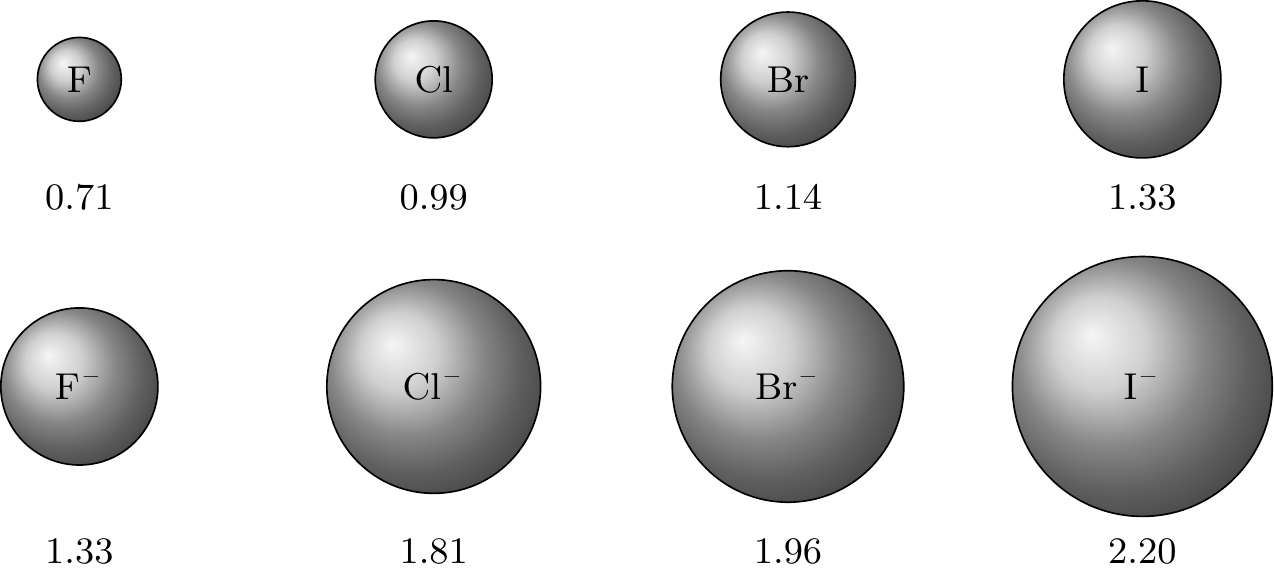
From Table 2.1, we can see that the outermost electron shells of fluorine, chlorine, bromine, and iodine all contain the same number of electrons — 7 — but the number of electron shells differs. Therefore, both their atomic radii and ionic radii4 increase as the number of electron shells increases (Figure 2.12). The halide ions, having each gained one electron, are larger than their corresponding atoms.
From Table 2.1 we can also observe that the physical properties of the halogens differ considerably. At room temperature, fluorine and chlorine are gases, bromine is a liquid, and iodine is a solid. Their boiling and melting points increase progressively, and their colors deepen from pale yellow-green to purple-black.
Open the cap of a bottle containing bromine. What phenomenon occurs? Observe liquid and gaseous bromine.
One can observe that liquid bromine evaporates readily to form bromine vapor.
Observe the color, state, and luster of iodine. Place a small amount of iodine crystals in a beaker, and set a flask of cold water on top of the beaker. Heat gently (Figure 2.13). Observe the phenomenon.
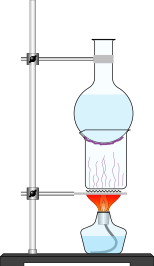
One can observe that when iodine is heated under normal pressure, it converts directly from a solid to purple vapor without melting. When the vapor meets the cold surface, it re-solidifies. This phenomenon — a solid converting directly to a gas without passing through the liquid phase — is called sublimation.
Pour water into a test tube containing a small amount of bromine. Shake; the aqueous solution appears orange (Figure 2.14, I). Pour the upper orange solution into another test tube, then add a small amount of colorless gasoline (or benzene, or carbon tetrachloride) (Figure 2.14, II). Shake vigorously and let the mixture stand. Observe the colors of the organic layer and the aqueous layer.
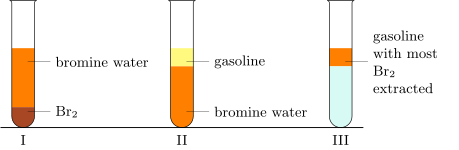
Pour water and alcohol into two separate test tubes, each about one-third full. Add a small amount of iodine crystals to each and shake. Compare the solubility of iodine in the two liquids. Pour the iodine–water solution into another empty test tube, then add a small amount of colorless gasoline (or benzene, or carbon tetrachloride). Shake, let stand, and observe the colors of the organic layer and the aqueous solution.
Both bromine and iodine dissolve more readily in organic solvents such as gasoline, benzene, carbon tetrachloride, and alcohol. The medicinal product tincture of iodine (iodine tincture) is an alcoholic solution of iodine.
Chemical Properties of the Elemental Halogens
We know that chlorine is chemically very reactive. Its atom has 7 electrons in the outermost shell and readily gains one electron to achieve the stable 8-electron configuration. The atoms of fluorine, bromine, and iodine also have 7 outermost electrons, so their chemical properties show great similarity to those of chlorine.
1. Halogens React with Metals to Form Halides
Place \(0.5\ \text{g}\) of zinc powder in an iron crucible and add \(0.5\ \text{g}\) of iodine powder. After mixing, add 1–2 drops of water as a catalyst and observe the phenomenon.
Fluorine, bromine, and iodine — like chlorine — all react with metals such as sodium. In nature, many metal halide compounds exist, including calcium fluoride, sodium chloride, magnesium chloride, potassium bromide, potassium iodide, and other halides.
2. Halogens React with Hydrogen to Form Hydrogen Halides
Fluorine is more reactive than chlorine. Fluorine gas combines with hydrogen gas violently — even in the dark, without light — and explodes.
\[ \ce{H2(g) + F2(g) -> 2HF(g)} + 128.4\ \text{kCal} \]
Bromine is less reactive than chlorine. Bromine reacts with hydrogen relatively slowly at temperatures around \(500\,{}^{\circ}\text{C}\).
\[ \ce{H2(g) + Br2(g) -> 2HBr(g)} + 17.3\ \text{kCal} \]
Iodine is less reactive than bromine. Iodine reacts with hydrogen slowly only under continuous heating, and the hydrogen iodide produced is quite unstable and decomposes simultaneously.
\[ \ce{H2(g) + I2(s) ->[\Delta] 2HI(g)} - 12.4\ \text{kCal} \]
Halogens can also react with nonmetals such as phosphorus.
3. Reactions of Halogens with Water
Fluorine reacts vigorously with water, producing hydrogen fluoride and oxygen gas.
\[ \ce{2H2O + 2F2 -> 4HF + O2}{\uparrow} \]
The reaction of bromine with water is weaker than that of chlorine with water, and iodine reacts with water only very slightly.
4. Comparison of Halogen Reactivity
Add a small amount of chlorine water separately to two test tubes containing sodium bromide solution and potassium iodide solution. Shake vigorously, then add a small amount of colorless gasoline (or carbon tetrachloride). Shake and observe the color changes in the organic layer and in the solution.
Add a small amount of bromine water to a test tube containing potassium iodide solution. Shake vigorously and observe the color change of the solution.
The color changes demonstrate that chlorine can displace bromine or iodine from their compounds, and bromine can displace iodine from its compounds.
\[ \begin{array}{l} \ce{2NaBr + Cl2 -> 2NaCl + Br2} \\[4pt] \ce{2KI + Cl2 -> 2KCl + I2} \\[4pt] \ce{2KI + Br2 -> 2KBr + I2} \end{array} \]
This proves that among chlorine, bromine, and iodine, chlorine is more reactive than bromine, and bromine is more reactive than iodine. Experiments demonstrate that fluorine is even more reactive than chlorine, bromine, and iodine — it can displace chlorine and others from their halide compounds.
Fluorine is exceptionally reactive. It can even react with the noble gases xenon and krypton,5 forming xenon and krypton fluorides such as \(\ce{XeF2}\), \(\ce{XeF4}\), \(\ce{XeF6}\), and \(\ce{KrF2}\). These are all white solids at room temperature.
5. The Iodine–Starch Reaction
Iodine turns starch blue. This characteristic reaction can be used to detect the presence of iodine.
Pour a small amount of starch solution into a test tube and add a few drops of iodine water. The solution displays a distinctive blue color.
From the chemical properties of the halogens, we can see that they share many similarities but also differ (Table 2.2). All halogen atoms have 7 outermost electrons and a strong ability to attract additional electrons, making them active nonmetallic elements. Halogens readily gain electrons and are reduced — they are strong oxidizing agents. However, the nuclear charges, electron shell numbers, and atomic and ionic sizes of F, Cl, Br, and I all differ, so the attractive force each nucleus exerts on its outer electrons is also different. Atomic size has a very close relationship with nonmetallic reactivity. Fluorine has the smallest atom, so its outer electrons experience the strongest nuclear attraction. Its ability to gain electrons is the greatest, making it the most reactive nonmetal. Thus, hydrogen fluoride is the most stable hydrogen halide; its synthesis releases the most heat and proceeds most vigorously. Iodine has the largest atom, so its outermost electrons experience a weaker nuclear attraction. Its ability to gain electrons is weaker, and its nonmetallic character is weaker. Hydrogen iodide is unstable, and its synthesis is endothermic. Chlorine and bromine fall between these two extremes, with chlorine being somewhat more reactive than bromine. Overall, the halogens are reactive nonmetallic elements, and their reactivity decreases with increasing nuclear charge, increasing number of electron shells, and increasing atomic radius.
From what perspectives can we compare the similarities and differences in the properties of fluorine, chlorine, bromine, and iodine?
| Formula | Reaction with \(\ce{H2}\) and stability of hydrogen halide | Reaction with water | Comparison of halogen reactivity |
|---|---|---|---|
| \(\ce{F2}\) | Combines explosively in the cold and dark. \(\ce{HF}\) is very stable. | Rapidly decomposes water, releasing \(\ce{O2}\). | F is the most reactive; displaces Cl, Br, I from their compounds. |
| \(\ce{Cl2}\) | Combines explosively under intense light. \(\ce{HCl}\) is relatively stable. | Slowly releases \(\ce{O2}\) under sunlight. | Cl is next; displaces Br, I from their compounds. |
| \(\ce{Br2}\) | Combines slowly at high temperature. \(\ce{HBr}\) is relatively unstable. | Reacts more weakly than Cl. | Br is next; displaces I from its compounds. |
| \(\ce{I2}\) | Combines slowly under continuous heating. \(\ce{HI}\) is very unstable and decomposes simultaneously. | Reacts only very slightly. | I is the least reactive. |
Some Halogen Compounds
1. Hydrogen Fluoride and Calcium Fluoride
Calcium fluoride, commonly known as fluorite, is a relatively widespread fluorine compound found in nature.
Hydrogen fluoride is produced by reacting concentrated sulfuric acid with fluorite in a lead vessel.
\[ \ce{CaF2 + H2SO4 -> CaSO4 + 2HF}{\uparrow} \]
Like hydrogen chloride, hydrogen fluoride fumes in air (forming white mist). Hydrogen fluoride is highly toxic. The aqueous solution of hydrogen fluoride is hydrofluoric acid.
Hydrogen fluoride is used for etching glass and for manufacturing plastics, rubber, pharmaceuticals, and other products. It is also used for preparing elemental fluorine and refining uranium. Hydrogen fluoride is used to manufacture sodium fluoride and other fluoride compounds. Sodium fluoride is a pesticide used to kill underground pests.
2. Silver Bromide and Silver Iodide
Add a small amount of silver nitrate solution separately to two test tubes containing sodium bromide solution and potassium iodide solution. In the sodium bromide test tube, a pale yellow precipitate of silver bromide forms. In the potassium iodide test tube, a yellow precipitate of silver iodide forms. Add a small amount of dilute nitric acid to each test tube — neither precipitate dissolves.
\[ \ce{NaBr + AgNO3 -> AgBr}{\downarrow} + \ce{NaNO3} \]
\[ \ce{KI + AgNO3 -> AgI}{\downarrow} + \ce{KNO3} \]
Both silver bromide and silver iodide are photosensitive — they decompose under the action of light. For example:
\[ \ce{2AgBr ->[\text{light}] 2Ag + Br2} \]
Photographic film is made by evenly coating a gelatin emulsion containing silver bromide onto film or glass plates in a darkroom. Photography exploits the photosensitivity of silver bromide: after the film is exposed, it is treated with a reducing agent (developer) and a fixer to produce a negative with light and dark areas reversed from the original subject. Exposing photographic paper through the negative and repeating the developing and fixing processes produces a photograph with the same light and dark distribution as the original subject.
Silver iodide can be used in cloud seeding for artificial rainmaking. Finely ground silver iodide powder is launched to altitudes of several thousand meters using small rockets or anti-aircraft shells, where it causes water vapor in the air to condense into rain.
- The halogen family (F, Cl, Br, I) all have 7 outermost electrons, giving them similar chemical properties — but differences in atomic size and nuclear charge produce a gradient of reactivity: F > Cl > Br > I.
- Physical properties show clear trends: state changes from gas to liquid to solid; color deepens; melting and boiling points increase down the group.
- Displacement reactions demonstrate the reactivity order: a more reactive halogen displaces less reactive ones from their compounds.
- Fluorine is the most reactive nonmetal — it even reacts with noble gases (Xe, Kr).
- The iodine–starch test (blue color) is a specific test for iodine.
- Silver halides (\(\ce{AgBr}\), \(\ce{AgI}\)) are photosensitive, with applications in photography and cloud seeding.
Exercises for Section 4
Write the chemical equations for the reactions of fluorine, bromine, and iodine with sodium metal.
Three test tubes contain solutions of sodium chloride, sodium bromide, and potassium iodide, respectively. If chlorine water is added to each, what reactions occur? If gasoline is then added and the tubes are shaken, what phenomena are observed?
Which chemical properties demonstrate that fluorine is the most reactive element among the halogens?
What happens when sunlight strikes each of the following substances? Explain why and write the chemical equations.
- Chlorine water
- A mixture of chlorine gas and hydrogen gas
- Silver bromide
How can you distinguish between elemental iodine (\(\ce{I2}\)) and iodide ions (\(\ce{I-}\))?
Given the five substances: manganese dioxide, potassium chloride, potassium bromide, concentrated sulfuric acid, and water, how can you prepare hydrochloric acid, chlorine gas, and bromine from them? Write the chemical equations for all reactions involved.
Calcium fluoride reacts with concentrated sulfuric acid to produce hydrogen fluoride. Write the chemical equation. Why can this reaction not be carried out in glass apparatus?
2.5 Chapter Summary
I. The Halogen Family
The halogens are a family of nonmetallic elements. Their atomic structures share the common feature of having 7 electrons in the outermost shell, making them readily able to gain electrons in chemical reactions. The differences lie in their nuclear charges, number of electron shells, and atomic radii. These differences give rise to properties that are both similar and distinct. Their chemical properties are dominated by strong nonmetallic character — their elemental forms are all strong oxidizing agents. Among the halogens, fluorine has the smallest atom and the strongest nonmetallic character, while chlorine, bromine, and iodine show progressively weaker nonmetallic character as atomic size increases.
II. Chemical Properties of the Halogens
The chemical properties of the halogens include:
- Reactions with metals — forming metal halides.
- Reactions with hydrogen — forming hydrogen halides.
- Reactions with water — forming hydrohalic acids and hypohalous acids.
- Reactions with hydroxides — forming metal halides and related products.
- Reactions with other halide compounds — more reactive halogens displace less reactive ones from their halide solutions.
III. Oxidation–Reduction Reactions
A reaction in which a substance loses electrons is an oxidation reaction; a reaction in which a substance gains electrons is a reduction reaction. Oxidation and reduction always occur simultaneously.
Review Problems
Determine whether each of the following statements is correct. If incorrect, make the necessary correction.
- Potassium chlorate contains oxygen gas, which is why heating it releases oxygen.
- All halogen elemental substances can act as oxidizing agents.
- \(1\ \text{mol}\) of liquid \(\ce{HCl}\) occupies approximately \(22.4\ \text{L}\) at STP.
Can chlorine gas be collected under the following conditions? Explain the reason and write the chemical equations for any reactions that may occur.
- Collection by displacement of water
- Collection by displacement of potassium hydroxide solution
- Collection by displacement of potassium iodide solution
Both the production of oxygen from potassium chlorate and the production of chlorine from concentrated hydrochloric acid use manganese dioxide. Does \(\ce{MnO2}\) play the same role in both reactions? What role does it play in each?
Hydrochloric acid is used in the laboratory preparation of hydrogen gas, chlorine gas, and carbon dioxide. What role does the hydrochloric acid play in the preparation of each of these three gases?
From the perspective of electron transfer: among the types of chemical reactions we have studied, all displacement reactions are oxidation–reduction reactions; some combination reactions and decomposition reactions are oxidation–reduction reactions; and all double displacement reactions are not oxidation–reduction reactions. Do you think this conclusion is reasonable? Explain with examples.
A packet of white solid may be one, two, or all three of the following substances: \(\ce{CaCl2}\), \(\ce{Na2CO3}\), \(\ce{NaI}\). When the white solid is dissolved in water, a white precipitate is observed. After filtering, the filtrate is colorless.
The precipitate on the filter paper is transferred to a test tube. Upon adding hydrochloric acid, a gas is produced. When the gas is passed into clear limewater, the limewater turns turbid.
The filtrate is divided into two portions. To one portion, a few drops of silver nitrate solution are added, producing a white precipitate. Upon adding dilute nitric acid, the white precipitate does not dissolve. Under light, this precipitate gradually turns black. To the other portion of the filtrate, a few drops of chlorine water are added, followed by a small amount of carbon tetrachloride. After shaking, the carbon tetrachloride layer does not turn purple.
Analyze and determine which substances are present in the white solid. Write the chemical equations for all reactions.
Excess concentrated sulfuric acid is mixed with \(11.7\ \text{g}\) of sodium chloride and gently heated. The hydrogen chloride gas produced is passed into \(45\ \text{g}\) of \(10\%\) sodium hydroxide solution. If a few drops of litmus solution are added to the final solution, what color will it show?
Concentrated hydrochloric acid reacts with manganese dioxide. The chlorine gas produced can displace \(1.27\ \text{g}\) of iodine from a sodium iodide solution. Calculate the minimum number of moles of \(\ce{HCl}\) and \(\ce{MnO2}\) needed.
Filter paper soaked in a solution of starch and potassium iodide and then dried produces what is commonly known as starch–potassium iodide test paper. What change occurs when this moistened test paper is exposed to chlorine gas? Why?
Translator’s note: The original text states “107 elements,” reflecting the number of confirmed elements as of 1983. As of 2024, 118 elements have been confirmed.↩︎
Translator’s note: The Chinese name 卤素 (halogens) literally means “salt-forming elements.” The name “halogen” derives from Greek hals (salt) + gennan (to produce), reflecting the same etymology.↩︎
Translator’s note on equation notation: Chinese chemistry uses the equals sign (\(=\)) in balanced equations, whereas international convention typically uses an arrow (\(\to\)). The symbol \(\xrightarrow{\Delta}\) indicates that heating is required. This translation preserves the original notation but uses \(\xrightarrow{\Delta}\) for heated reactions.↩︎
Translator’s note: The original text references figure data in units of \(10^{-10}\ \text{m}\), which equals 1 ångström (Å). Modern chemistry commonly uses picometers (pm): \(1\ \text{Å} = 100\ \text{pm}\).↩︎
Translator’s note: The original text calls xenon and krypton “inert gases” (惰性气体). In modern chemistry, the preferred term is “noble gases,” reflecting the discovery that some noble gases — particularly xenon — do form compounds.↩︎