5 Atomic Structure and the Periodic Law
After studying this chapter, you should be able to:
- Describe the composition of the atom (protons, neutrons, electrons) and explain the relationships among nuclear charge number, mass number, and neutron number
- Define isotopes and calculate average atomic weights from natural isotope abundances
- Explain the concept of the electron cloud and describe how electron motion differs from macroscopic objects
- Describe the four aspects of an electron’s motion state: shell, subshell, spatial orientation, and spin
- State the Pauli exclusion principle, the Aufbau principle, and Hund’s rule, and apply them to write electron configurations for elements \(Z = 1\)–\(36\)
- Explain the periodic variation of electron configuration, atomic radius, first ionization energy, and valence with increasing atomic number
- Describe the structure of the periodic table (periods, groups, blocks) and relate element position to atomic structure and properties
- Use position in the periodic table to predict metallic/nonmetallic character, oxide acidity/basicity, and formulas of hydrides
- Outline the historical discovery of the periodic law and its significance for chemistry
Up to now, we have studied elements such as oxygen, the noble gases, hydrogen, carbon, the halogens (see Section 2.4), the oxygen family (see Section 3.6), and the alkali metals (see Section 4.3), along with some of their compounds. We know that the properties of elements and compounds are closely related to their structures. Only by understanding structures can we deeply appreciate the patterns governing properties and chemical change. Therefore, building on the introductory knowledge of matter structure acquired in junior high school, we will further study the structure of matter. In this chapter, we begin with atomic structure and the periodic law that reveals the internal connections among the elements. Other aspects of matter structure will be studied in subsequent courses.
5.1 Section 1: The Atomic Nucleus
The Atomic Nucleus
An atom consists of a positively charged nucleus at its center and negatively charged electrons surrounding it. Because the total positive charge of the nucleus equals the total negative charge of the electrons, the atom as a whole is electrically neutral. Atoms are very small, and the nucleus is far smaller still — its radius is roughly one ten-thousandth that of the atom, and its volume is only a few trillionths of the atom’s volume. The nucleus is composed of protons and neutrons. Each proton carries one unit of positive charge, while neutrons are electrically neutral; hence, the nuclear charge number is determined by the number of protons. The nuclear charge number is denoted by the symbol \(Z\).
\[ \text{Nuclear charge number}\ (Z) = \text{number of protons} = \text{number of electrons} \]
The mass of a proton is \(1.6726 \times 10^{-27}\ \text{kg}\), and the mass of a neutron is slightly larger, \(1.6748 \times 10^{-27}\ \text{kg}\). The mass of an electron is extremely small — only about 1/1836 that of a proton — so the mass of an atom is concentrated almost entirely in its nucleus. Because the masses of protons and neutrons are so tiny, it is inconvenient to work with them directly, and we usually use their relative masses instead.
Through scientific experiments, the mass of the carbon atom used as the standard for atomic weights has been measured to be \(1.9927 \times 10^{-26}\ \text{kg}\); one-twelfth of that mass is \(1.6606 \times 10^{-27}\ \text{kg}\). The relative masses of the proton and neutron on this scale are 1.007 and 1.008, respectively — each approximately equal to 1. Evidently, if we neglect the electron mass and round the relative mass of every proton and neutron to the nearest integer and add them up, the result is called the mass number, denoted by \(A\). The neutron number is denoted by \(N\). Then
\[ \text{Mass number}\ (A) = \text{Proton number}\ (Z) + \text{Neutron number}\ (N) \]
Therefore, knowing any two of these three quantities allows us to calculate the third. For example, given that a sulfur atom has nuclear charge number 16 and mass number 32:
\[ \text{Neutron number of sulfur} = A - Z = 32 - 16 = 16 \]
To summarize, if we let \(\ce{^{A}_{Z}X}\) represent an atom of element X with mass number \(A\) and proton number \(Z\), the relationships among the particles composing the atom can be expressed as follows:
\[ \text{Atom}\ {}^A_Z X \begin{cases} \text{Nucleus} \begin{cases} Z\ \text{protons} \\ (A-Z)\ \text{neutrons} \end{cases} \\[6pt] Z\ \text{electrons} \end{cases} \]
Isotopes
We already know that atoms with the same nuclear charge number (i.e., the same number of protons) belong to the same element. In other words, atoms of the same element have identical proton numbers — but are their neutron numbers necessarily the same? Scientific research has shown that they need not be. For example, all hydrogen atoms contain 1 proton, but some hydrogen atoms contain no neutrons, some contain 1 neutron, and others contain 2 neutrons:
- A hydrogen atom with no neutrons is called protium;
- A hydrogen atom with 1 neutron is called deuterium (heavy hydrogen);
- A hydrogen atom with 2 neutrons is called tritium1 (superheavy hydrogen).
To distinguish them conveniently, protium is written \(\ce{^{1}_{1}H}\), deuterium \(\ce{^{2}_{1}H}\) (or D), and tritium \(\ce{^{3}_{1}H}\) (or T). The subscript at the lower left of the element symbol denotes the nuclear charge number, and the superscript at the upper left denotes the mass number.
Atoms of the same element that have the same number of protons but different numbers of neutrons are called isotopes of one another. Many elements have isotopes. The three isotopes of hydrogen described above — \(\ce{^{1}_{1}H}\), \(\ce{^{2}_{1}H}\), and \(\ce{^{3}_{1}H}\) — are an example; \(\ce{^{2}_{1}H}\) and \(\ce{^{3}_{1}H}\) are the materials used to make hydrogen bombs. Uranium has several isotopes, including \(\ce{^{234}_{92}U}\), \(\ce{^{235}_{92}U}\), and \(\ce{^{238}_{92}U}\); \(\ce{^{235}_{92}U}\) is used as fuel in nuclear reactors and as the fissile material in atomic bombs. Carbon has isotopes \(\ce{^{12}_{6}C}\), \(\ce{^{13}_{6}C}\), and \(\ce{^{14}_{6}C}\); \(\ce{^{12}_{6}C}\) is the atom whose mass, divided by 12, defines the atomic mass unit.
Although isotopes of the same element have different mass numbers, their chemical properties are nearly identical. In any naturally occurring sample of an element — whether free or combined — the percentage of each isotope is generally constant. The atomic weight we usually quote for an element is the weighted average calculated from the natural abundances of its isotopes. For example, the element chlorine is a mixture of the isotopes \(\ce{^{35}_{17}Cl}\) and \(\ce{^{37}_{17}Cl}\). From the data in the table below, the atomic weight of chlorine can be calculated:
| Symbol | Isotopic atomic weight | Natural abundance (%) |
|---|---|---|
| \(\ce{^{35}_{17}Cl}\) | 34.969 | 75.77 |
| \(\ce{^{37}_{17}Cl}\) | 36.966 | 24.23 |
\[ 34.969 \times 0.7577 + 36.966 \times 0.2423 = 35.453 \]
That is, the atomic weight of chlorine is 35.453.
Similarly, one can compute approximate atomic weights from isotopic mass numbers.
- An atom consists of a nucleus (protons + neutrons) and extranuclear electrons
- Nuclear charge number \(Z\) = number of protons = number of electrons
- Mass number \(A\) = proton number \(Z\) + neutron number \(N\)
- Isotopes are atoms of the same element with the same proton number but different neutron numbers
- Isotopes of an element have nearly identical chemical properties
- The atomic weight of an element is the weighted average over its naturally occurring isotopes
Exercises for Section 1
Are the following statements correct? If incorrect, make corrections.
Graphite and diamond are two isotopes composed of the element carbon.
Scientists have identified 107 elements, which means 107 kinds of atoms have been discovered.2
For each of the following atoms, determine the number of protons, neutrons, and electrons:
\(\ce{^{12}_{6}C}\) \(\ce{^{13}_{6}C}\) \(\ce{^{16}_{8}O}\) \(\ce{^{17}_{8}O}\) \(\ce{^{18}_{8}O}\) \(\ce{^{19}_{9}F}\) \(\ce{^{24}_{12}Mg}\) \(\ce{^{39}_{19}K}\) \(\ce{^{40}_{19}K}\) \(\ce{^{41}_{19}K}\) \(\ce{^{40}_{20}Ca}\) \(\ce{^{42}_{20}Ca}\) Oxygen has three natural isotopes. Their isotopic atomic weights and natural abundances are listed below:
Symbol Isotopic atomic weight Natural abundance \(\ce{^{16}_{8}O}\) 15.994915 99.759% \(\ce{^{17}_{8}O}\) 16.999133 0.037% \(\ce{^{18}_{8}O}\) 17.99916 0.204% Calculate the atomic weight of oxygen.
Magnesium has three natural isotopes: \(\ce{^{24}_{12}Mg}\) (78.7%), \(\ce{^{25}_{12}Mg}\) (10.13%), and \(\ce{^{26}_{12}Mg}\) (11.17%). Calculate the approximate atomic weight of magnesium.
5.2 Section 2: Electron Motion States
The electron carries a negative charge and has a very small mass — only \(9.1095 \times 10^{-31}\ \text{kg}\). It moves within the atomic-scale space (diameter \({\sim}10^{-10}\ \text{m}\)) at speeds close to the speed of light (\(3 \times 10^{8}\ \text{m/s}\)). Is the motion of the electron the same as that of large, slow-moving everyday objects? Does it follow special laws? Let us now investigate.
The Electron Cloud
In everyday life, we see cars driving along highways and use instruments to observe satellites orbiting the Earth along definite paths. We can measure or calculate their positions at any given moment and trace their trajectories. However, the motion of extranuclear electrons follows very different rules. Electrons do not travel along well-defined orbits; we cannot determine an electron’s exact position at a given instant, nor can we trace its path. When describing an electron’s motion outside the nucleus, we can only state the probability of finding it at various locations in the space around the nucleus. The electron appears within a certain region outside the nucleus, as though a negatively charged cloud or mist surrounds the nucleus — hence the vivid term “electron cloud.”
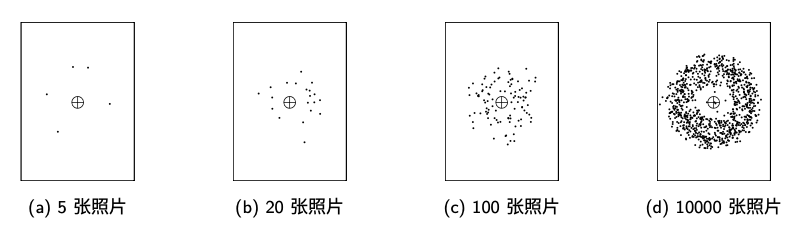
To help explain this concept, let us use an analogy: imagining that we photograph a hydrogen atom. We know that the hydrogen atom has one extranuclear electron. Suppose we have a special camera that can capture instantaneous snapshots of the hydrogen atom, revealing the electron’s position at that instant. We first take five photographs of a particular hydrogen atom, obtaining the different images shown in Figure 5.1. In the figure, \(\oplus\) represents the nucleus, and each small dot indicates one appearance of the electron. We then continue taking thousands upon thousands of photographs.
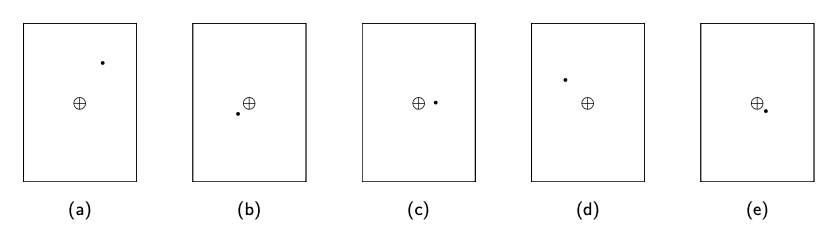
From comparing these photographs, we get the impression that the electron seems to move randomly around the hydrogen nucleus — appearing here at one moment, there the next. If we superimpose these photographs, we obtain images like those in Figure 5.2. The more photographs we superimpose, the stronger the impression of a cloud of charge surrounding the nucleus. This “electron cloud” is spherically symmetric: the density is greatest near the nucleus and decreases with increasing distance. In other words, the closer to the nucleus, the greater the probability of finding the electron per unit volume; the farther from the nucleus, the smaller the probability. In fact, panel (d) of Figure 5.2 is a schematic electron-cloud diagram for the hydrogen atom under normal conditions.
Electron Motion States
1. Electron Shells
We already know that in atoms with many electrons, the electrons do not all have the same energy. Electrons with lower energy generally move in regions closer to the nucleus, while electrons with higher energy generally move in regions farther from the nucleus. Based on these energy differences and the different distances from the nucleus where electrons typically move, extranuclear electrons can be classified into different electron shells.
How do we know that the electrons in a multi-electron atom have different energies? By analyzing ionization energy data for the elements, we can reach this initial conclusion.
What is ionization energy? The energy required to remove an electron from a gaseous atom (or gaseous cation) and convert it to a gaseous cation (or a cation of higher charge) — overcoming the attraction of the nuclear charge — is called the ionization energy, symbolized by \(I\) and commonly measured in electron volts.3
The energy needed to remove one electron from a neutral gaseous atom to form a \(+1\) gaseous cation is called the first ionization energy (\(I_1\)). The energy needed to remove a second electron from the \(+1\) cation to form a \(+2\) cation is the second ionization energy (\(I_2\)), and so on.
Table 5.1 lists ionization energy data for several elements.
| \(Z\) | Symbol | \(I_1\) | \(I_2\) | \(I_3\) | \(I_4\) | \(I_5\) | \(I_6\) | \(I_7\) | \(I_8\) | \(I_9\) |
|---|---|---|---|---|---|---|---|---|---|---|
| 3 | Li | 5.4 | 75.6 | 122.4 | ||||||
| 4 | Be | 9.3 | 18.2 | 153.9 | 217.7 | |||||
| 5 | B | 8.3 | 25.1 | 37.9 | 259.3 | 340.1 | ||||
| 6 | C | 11.3 | 24.4 | 47.9 | 64.5 | 392.0 | 489.8 | |||
| 7 | N | 14.5 | 29.6 | 47.4 | 77.5 | 97.9 | 551.9 | 666.8 | ||
| 8 | O | 13.6 | 35.1 | 54.9 | 77.4 | 113.9 | 138.1 | 739.1 | 871.1 | |
| 9 | F | 17.4 | 35.0 | 62.6 | 87.1 | 114.2 | 157.1 | 185.1 | 953.6 | 1102 |
From the data in the table, we can see that the second ionization energy is always greater than the first, the third is greater than the second, and so on: \(I_1 < I_2 < I_3 < \cdots\). This is easy to understand, because removing an electron from a \(+1\) cation requires overcoming a stronger electrostatic attraction than removing one from a neutral atom, and so on for higher charges. Therefore, successive ionization energies increase — sometimes even by a factor of several. However, the factor of increase varies: some jumps are small, while others are very large. In Table 5.1, the values where the factor of increase is especially large are shown in bold, marking the boundary between shells.
Li has 3 electrons. \(I_3\) is less than twice \(I_2\), but \(I_2\) is more than ten times \(I_1\). This tells us the 3 electrons can be divided into two groups with different energies. The large gap means that 1 electron has relatively high energy and normally moves far from the nucleus (easily removed), while the other 2 have lower energy and move closer to the nucleus.
Be has 4 electrons. Similarly, \(I_2/I_1\) and \(I_4/I_3\) are each less than a factor of 2, but \(I_3\) is several times \(I_2\). Thus, 2 electrons are closer to the nucleus (lower energy) and 2 are farther (higher energy).
Analyzing B, C, N, O, and F in the same way, we find that their electrons also fall into two groups: 2 inner electrons of lower energy, closer to the nucleus, and the remaining electrons (3, 4, 5, 6, or 7) of higher energy, farther from the nucleus.
Analyzing other elements yields similar conclusions. Therefore, in multi-electron atoms, electrons are arranged in distinct layers — the electron shells.
2. Subshells and Electron Cloud Shapes
Scientific research has revealed that within the same electron shell, electrons can have slightly different energies and different electron-cloud shapes. Based on these differences, each shell can be further divided into one or more subshells, denoted by the symbols \(s\), \(p\), \(d\), \(f\), etc.4 The K shell (\(n = 1\)) contains only one subshell: \(s\). The L shell (\(n = 2\)) contains two subshells: \(s\) and \(p\). The M shell (\(n = 3\)) contains three subshells: \(s\), \(p\), and \(d\). The N shell (\(n = 4\)) contains four subshells: \(s\), \(p\), \(d\), and \(f\). Different subshells have different electron-cloud shapes: the \(s\) subshell has a spherical electron cloud centered on the nucleus; the \(p\) subshell has a dumbbell-shaped (spindle-shaped) electron cloud; the shapes of the \(d\) and \(f\) subshells are more complex and will not be discussed here.
Within the same shell, subshell energies increase in the order \(s < p < d < f\). To clearly indicate which shell and subshell an electron occupies (and thus also its approximate energy and cloud shape), we write the shell number \(n\) before the subshell letter. For example, an electron in the \(s\) subshell of the K shell is labeled \(1s\); electrons in the \(s\) and \(p\) subshells of the L shell are labeled \(2s\) and \(2p\); an electron in the \(d\) subshell of the M shell is \(3d\); an electron in the \(f\) subshell of the N shell is \(4f\). Figure 5.3 shows the hydrogen \(1s\) electron cloud.
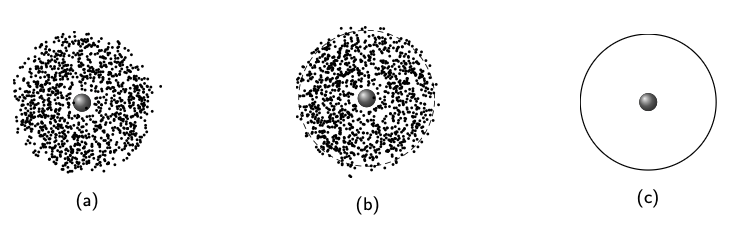
In Figure 5.3, part (b) shows a dashed spherical shell called the boundary surface of the electron cloud. Within this boundary, the probability of finding the electron is highest; outside it, the probability is very small. We commonly use boundary-surface diagrams to represent electron clouds. Part (c) is the boundary-surface diagram for the hydrogen \(1s\) electron cloud, with the individual dots omitted.
3. Spatial Orientation of Electron Clouds
Electron clouds have not only definite shapes but also definite spatial orientations. The \(s\) electron cloud is spherically symmetric and extends equally in all directions. The \(2p\) electron cloud, shown in Figure 5.4, has three mutually perpendicular orientations in space. The \(d\) electron cloud has five orientations, and the \(f\) electron cloud has seven.
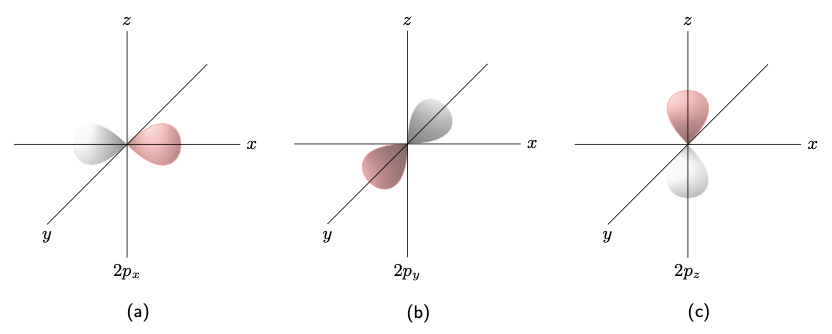
If we define an orbital as the space occupied by an electron cloud of a given shape and orientation on a given shell, then the \(s\), \(p\), \(d\), and \(f\) subshells have 1, 3, 5, and 7 orbitals, respectively. Thus, the maximum number of orbitals for each shell is:
\[ \begin{aligned} n = 1: &\quad s \quad \Rightarrow \quad 1 = 1^2 \\ n = 2: &\quad s,\, p \quad \Rightarrow \quad 1 + 3 = 4 = 2^2 \\ n = 3: &\quad s,\, p,\, d \quad \Rightarrow \quad 1 + 3 + 5 = 9 = 3^2 \\ n = 4: &\quad s,\, p,\, d,\, f \quad \Rightarrow \quad 1 + 3 + 5 + 7 = 16 = 4^2 \end{aligned} \]
In general, the maximum number of orbitals in shell \(n\) is \(n^2\).
4. Electron Spin
In addition to its motion through the space around the nucleus, an electron also undergoes spin. Electron spin has two states, analogous to clockwise and counterclockwise rotation. We conventionally represent these two spin states with an up arrow ↑ and a down arrow ↓.
From the discussion above we can see that the motion state of an electron outside the nucleus is quite complex and must be specified by four aspects: the electron shell, the subshell, the spatial orientation of the electron cloud, and the spin state. The first three aspects determine the electron’s position in space — that is, its orbital. Therefore, to fully specify an electron’s motion state, we must state both which orbital it occupies and which spin state it has.
- The electron cloud is a probability-density picture of where an electron is found around the nucleus — it is spherically symmetric for the hydrogen \(1s\) state and densest near the nucleus
- Electrons are arranged in shells (\(n = 1, 2, 3, \ldots\), labeled K, L, M, \(\ldots\)) based on energy differences, as revealed by ionization energy data
- Each shell is divided into subshells (\(s\), \(p\), \(d\), \(f\)) with different cloud shapes and slightly different energies (\(E_s < E_p < E_d < E_f\) within a given shell)
- Each subshell has a characteristic number of orbitals: \(s = 1\), \(p = 3\), \(d = 5\), \(f = 7\) — giving \(n^2\) orbitals per shell
- Electrons have two spin states (↑ and ↓)
- An electron’s motion state is fully described by four aspects: shell, subshell, spatial orientation, and spin
Exercises for Section 2
How do you understand the three concepts of electron shell, subshell, and electron cloud? A hydrogen atom has only one extranuclear electron — why do we still use the electron cloud to describe its motion?
What is ionization energy? Why can changes in ionization energy be used to conclude that electrons are arranged in layers?
From how many aspects must the motion state of an extranuclear electron be described?
What do \(1s\), \(2p\), \(3d\), and \(4f\) each mean?
How many orbitals do the \(d\) and \(f\) subshells each contain? How many different motion states can electrons have within a single orbital?
What do \(2p_x\), \(2p_y\), and \(2p_z\) each mean?
5.3 Section 3: Electron Configuration of Atoms
In Section 2, we learned about the motion states of extranuclear electrons and saw that electrons are arranged in shells, which are further divided into subshells. Now let us discuss the rules governing how electrons are arranged outside the nucleus.
The Pauli Exclusion Principle
Let us first consider the electron arrangement of lithium. The lithium atom has 3 electrons. Are all 3 in the same orbital, or are they distributed among several orbitals? Experiments show that 2 are in the \(1s\) orbital and 1 is in the \(2s\) orbital. For the 2 electrons in the \(1s\) orbital, are their spins parallel or opposite? Experiments show they are opposite. The electron in the \(2s\) orbital may spin in the same direction as one of the \(1s\) electrons, but it occupies a different orbital. Other elements show similar patterns.5
From this experimentally based discussion we see that: whenever two electrons occupy the same orbital, their spins must be opposite; electrons with the same spin direction must occupy different orbitals. Since an orbital is defined by three aspects — shell, subshell, and spatial orientation — we can draw a general conclusion: within a single atom, no two electrons can have all four aspects of their motion state identical. This is the Pauli exclusion principle.
From this principle, we can calculate the maximum number of electrons each shell can hold. We already know that each shell has at most \(n^2\) orbitals, and each orbital holds at most 2 electrons. Therefore, the maximum number of electrons per shell is \(2n^2\). The maximum electron capacities for shells 1–4 are listed in Table 5.2.
| Shell (\(n\)) | K (1) | L (2) | M (3) | N (4) | |||||||||
|---|---|---|---|---|---|---|---|---|---|---|---|---|---|
| Subshell | \(s\) | \(s\) | \(p\) | \(s\) | \(p\) | \(d\) | \(s\) | \(p\) | \(d\) | \(f\) | |||
| Orbitals in subshell | 1 | 1 | 3 | 1 | 3 | 5 | 1 | 3 | 5 | 7 | |||
| Electrons in subshell | 2 | 2 | 6 | 2 | 6 | 10 | 2 | 6 | 10 | 14 | |||
| Max electrons per shell | 2 | 8 | 18 | 32 |
The Aufbau Principle
Common sense tells us that water flows downhill and stones roll down a mountain — objects in high-energy states are less stable than those in low-energy states. Similarly, under normal conditions, electrons preferentially occupy the lowest-energy orbitals available; only after those are filled do electrons enter higher-energy orbitals. This rule is called the Aufbau principle (building-up principle, or “lowest energy” principle).
Which orbitals have lower energy and which have higher energy?
We know that different shells have different energies, and within each shell, different subshells also have different energies. To represent the energy ordering of electrons in different shells and subshells, we arrange them like a staircase, called energy levels — for example, the \(1s\) level, \(2s\) level, \(2p\) level, and so on. In general, shells closer to the nucleus (smaller \(n\)) have lower energy, and within a given shell, subshell energies increase in the order \(s < p < d < f\). Thus \(2s\) is higher than \(1s\), \(2p\) is higher than \(2s\), and so forth.
However, for elements with many electrons, the situation is more complicated. Why? Because in multi-electron atoms, electrons repel one another. When considering a particular outer electron, we must account for both the nuclear attraction and the repulsion from all other electrons. This repulsion partially shields the nuclear charge from outer electrons, leading to an energy-level crossover phenomenon. Figure 5.5 is an approximate energy-level diagram for multi-electron atoms, where each box represents one orbital.
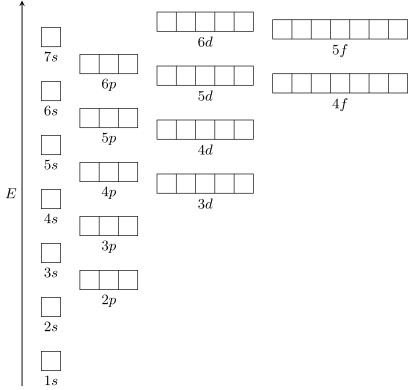
From Figure 5.5 we can see that starting from the third shell, energy-level crossovers occur. For example, although the \(3d\) electrons might seem to belong to a lower shell than \(4s\), in fact \(E_{3d} > E_{4s}\). According to the Aufbau principle, after \(3p\) is filled, electrons enter \(4s\) before \(3d\).
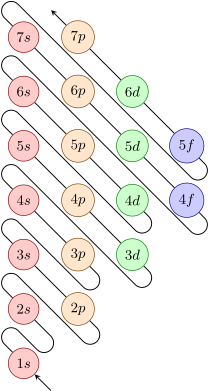
Using the approximate energy-level diagram and the Aufbau principle, we can determine the order in which electrons fill orbitals, as shown in Figure 5.6.
Hund’s Rule
Using the Pauli exclusion principle and the Aufbau principle, let us now discuss the electron configurations of carbon, nitrogen, and oxygen.6
Carbon has nuclear charge 6 — that is, 6 electrons. By the two principles above, 2 electrons (with opposite spins) fill the \(1s\) orbital first, then 2 more fill the \(2s\) orbital. The remaining 2 electrons must enter the \(2p\) orbitals. The \(2p\) subshell has 3 orbitals. Should the 2 electrons pair up with opposite spins in a single \(2p\) orbital, or should they occupy two different \(2p\) orbitals with the same spin direction? A rule called Hund’s rule, derived from experimental evidence, answers this question: within the same subshell, electrons occupy different orbitals as much as possible, and they do so with parallel (same-direction) spins. This arrangement gives the atom the lowest total energy. The electron configurations of C, N, and O are shown in Figure 5.7.
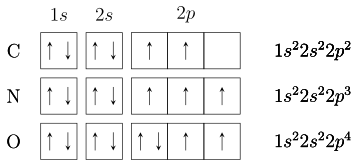
In the orbital diagrams above, each box represents one orbital; the notation \(1s^2 2s^2 2p^2\) is called the electron configuration (or electron-configuration notation). The superscript indicates the number of electrons in that subshell — for example, \(1s^2\) means the \(1s\) orbital contains 2 electrons.
Based on the three principles above and the approximate energy-level diagram, Table 5.3 lists the electron configurations for all elements with \(Z = 1\)–\(36\).
| \(Z\) | Symbol | \(1s\) | \(2s\) | \(2p\) | \(3s\) | \(3p\) | \(3d\) | \(4s\) | \(4p\) |
|---|---|---|---|---|---|---|---|---|---|
| 1 | H | 1 | |||||||
| 2 | He | 2 | |||||||
| 3 | Li | 2 | 1 | ||||||
| 4 | Be | 2 | 2 | ||||||
| 5 | B | 2 | 2 | 1 | |||||
| 6 | C | 2 | 2 | 2 | |||||
| 7 | N | 2 | 2 | 3 | |||||
| 8 | O | 2 | 2 | 4 | |||||
| 9 | F | 2 | 2 | 5 | |||||
| 10 | Ne | 2 | 2 | 6 | |||||
| 11 | Na | 2 | 2 | 6 | 1 | ||||
| 12 | Mg | 2 | 2 | 6 | 2 | ||||
| 13 | Al | 2 | 2 | 6 | 2 | 1 | |||
| 14 | Si | 2 | 2 | 6 | 2 | 2 | |||
| 15 | P | 2 | 2 | 6 | 2 | 3 | |||
| 16 | S | 2 | 2 | 6 | 2 | 4 | |||
| 17 | Cl | 2 | 2 | 6 | 2 | 5 | |||
| 18 | Ar | 2 | 2 | 6 | 2 | 6 | |||
| 19 | K | 2 | 2 | 6 | 2 | 6 | 1 | ||
| 20 | Ca | 2 | 2 | 6 | 2 | 6 | 2 | ||
| 21 | Sc | 2 | 2 | 6 | 2 | 6 | 1 | 2 | |
| 22 | Ti | 2 | 2 | 6 | 2 | 6 | 2 | 2 | |
| 23 | V | 2 | 2 | 6 | 2 | 6 | 3 | 2 | |
| 24 | Cr | 2 | 2 | 6 | 2 | 6 | 5 | 1 | |
| 25 | Mn | 2 | 2 | 6 | 2 | 6 | 5 | 2 | |
| 26 | Fe | 2 | 2 | 6 | 2 | 6 | 6 | 2 | |
| 27 | Co | 2 | 2 | 6 | 2 | 6 | 7 | 2 | |
| 28 | Ni | 2 | 2 | 6 | 2 | 6 | 8 | 2 | |
| 29 | Cu | 2 | 2 | 6 | 2 | 6 | 10 | 1 | |
| 30 | Zn | 2 | 2 | 6 | 2 | 6 | 10 | 2 | |
| 31 | Ga | 2 | 2 | 6 | 2 | 6 | 10 | 2 | 1 |
| 32 | Ge | 2 | 2 | 6 | 2 | 6 | 10 | 2 | 2 |
| 33 | As | 2 | 2 | 6 | 2 | 6 | 10 | 2 | 3 |
| 34 | Se | 2 | 2 | 6 | 2 | 6 | 10 | 2 | 4 |
| 35 | Br | 2 | 2 | 6 | 2 | 6 | 10 | 2 | 5 |
| 36 | Kr | 2 | 2 | 6 | 2 | 6 | 10 | 2 | 6 |
From the table, we can see that element 24 (Cr) and element 29 (Cu) do not follow the expected filling pattern. After filling \(3p^6\), one might expect \(3d^4 4s^2\) and \(3d^9 4s^2\), but experimental data show the actual configurations are \(3d^5 4s^1\) and \(3d^{10} 4s^1\). Similar anomalies occur for other elements. From these observations, an additional rule has been summarized: for a given subshell, configurations that are fully filled, half-filled, or empty are relatively more stable. That is:
- Fully filled: \(p^6\) or \(d^{10}\) or \(f^{14}\)
- Half-filled: \(p^3\) or \(d^5\) or \(f^7\)
- Empty: \(p^0\) or \(d^0\) or \(f^0\)
This is a special case of Hund’s rule. The configurations of Cr and Cu above are examples of the extra stability of half-filled (\(d^5\)) and fully filled (\(d^{10}\)) subshells, respectively.
It should be noted that extranuclear electron configurations are determined experimentally. The three principles discussed above — the Pauli exclusion principle, the Aufbau principle, and Hund’s rule — are generalizations drawn from extensive experimental data. They help us understand the patterns of electron arrangement, but they cannot explain every aspect of electron configuration. These principles are therefore approximate.
- Pauli exclusion principle: No two electrons in the same atom can have identical values of all four quantum descriptors (shell, subshell, orientation, spin). Each orbital holds at most 2 electrons (with opposite spins), giving a maximum of \(2n^2\) electrons per shell.
- Aufbau principle: Electrons fill orbitals in order of increasing energy. Due to energy-level crossover in multi-electron atoms, the filling order is \(1s, 2s, 2p, 3s, 3p, 4s, 3d, 4p, 5s, \ldots\)
- Hund’s rule: Within a subshell, electrons occupy different orbitals with parallel spins as much as possible
- Extra stability of fully filled (\(d^{10}\)), half-filled (\(d^5\)), and empty (\(d^0\)) subshells explains anomalies like Cr (\(3d^5 4s^1\)) and Cu (\(3d^{10} 4s^1\))
Exercises for Section 3
- Explain what each of the following symbols represents:
\[ 1s^2,\quad 3s^1,\quad 2p_x^1,\quad 3p_y^2,\quad 3p^6,\quad 4d^{10},\quad 5f^{14} \]
Using \(E\) to denote energy, arrange the following orbitals in order of increasing energy:
\(E_{3s},\ E_{2s},\ E_{4s},\ E_{1s},\ E_{5s}\)
\(E_{3s},\ E_{3d},\ E_{3p},\ E_{4s},\ E_{4d},\ E_{4p},\ E_{5s}\)
What types of orbitals does the N shell have? How many orbitals are there in total? Write out the symbols for all of these orbitals.
Fill in the blanks:
Orbital Shell number Subshell type Number of orbitals Max. electrons \(2s\) \(3d\) \(5f\) The number of orbitals in each subshell is determined by ______. The maximum number of electrons is determined by ______.
Explain the following:
Why is the electron configuration of element 19 (K) \(1s^2 2s^2 2p^6 3s^2 3p^6 4s^1\) rather than \(1s^2 2s^2 2p^6 3s^2 3p^6 3d^1\)?
Why is the electron configuration of element 24 (Cr) \(1s^2 2s^2 2p^6 3s^2 3p^6 3d^5 4s^1\) rather than \(1s^2 2s^2 2p^6 3s^2 3p^6 3d^4 4s^2\)?
An element has 3 electrons in its \(2p\) subshell. Should these 3 electrons be arranged as ↑↓ ↑ (one paired, one unpaired) or as ↑ ↑ ↑ (all in separate orbitals with parallel spins)? Why?
A certain element has the electron configuration \(1s^2 2s^2 2p^6 3s^2 3p^6 3d^{10} 4s^2 4p^6\). How many electron shells does it have? How many electrons are in each shell? How many electrons does it have in total? What is its nuclear charge number?
Using electron configuration notation, write the electron configurations of aluminum (\(Z = 13\)), chlorine (\(Z = 17\)), iron (\(Z = 26\)), copper (\(Z = 29\)), and krypton (\(Z = 36\)).
5.4 Section 4: The Periodic Law
From junior high school chemistry to the present, we have studied several families of elements — the noble gases, the halogens, the oxygen family, and the alkali metals — and have observed that elements within the same family have similar properties, while elements in different families differ. This shows that a systematic pattern exists among the elements.
To explore this regularity, we list the electron configurations, atomic radii, first ionization energies, and principal valences of elements \(Z = 1\)–\(18\) in a table (Table 5.5) for discussion. For convenience, elements are numbered in order of increasing nuclear charge; this serial number is called the element’s atomic number. Clearly, the atomic number equals the nuclear charge number.
| H | He | Li | Be | B | C | N | O | F | Ne | Na | Mg | Al | Si | P | S | Cl | Ar | |
|---|---|---|---|---|---|---|---|---|---|---|---|---|---|---|---|---|---|---|
| Atomic number | 1 | 2 | 3 | 4 | 5 | 6 | 7 | 8 | 9 | 10 | 11 | 12 | 13 | 14 | 15 | 16 | 17 | 18 |
| Outermost config. | \(1s^1\) | \(1s^2\) | \(2s^1\) | \(2s^2\) | \(2s^2 2p^1\) | \(2s^2 2p^2\) | \(2s^2 2p^3\) | \(2s^2 2p^4\) | \(2s^2 2p^5\) | \(2s^2 2p^6\) | \(3s^1\) | \(3s^2\) | \(3s^2 3p^1\) | \(3s^2 3p^2\) | \(3s^2 3p^3\) | \(3s^2 3p^4\) | \(3s^2 3p^5\) | \(3s^2 3p^6\) |
| Radius (\(10^{-10}\) m) | 0.37 | — | 1.52 | 0.89 | 0.82 | 0.77 | 0.75 | 0.74 | 0.71 | — | 1.86 | 1.60 | 1.43 | 1.17 | 1.10 | 1.02 | 0.99 | — |
| \(I_1\) (eV) | 13.60 | 24.48 | 5.39 | 9.32 | 8.30 | 11.26 | 14.53 | 13.61 | 17.42 | 21.56 | 5.14 | 7.64 | 5.98 | 8.15 | 10.48 | 10.36 | 13.01 | 15.76 |
| Valence | +1 | 0 | +1 | +2 | +3 | +4, −4 | +5, −3 | −2 | −1 | 0 | +1 | +2 | +3 | +4, −4 | +5, −3 | +6, −2 | +7, −1 | 0 |
The atomic radii in Table 5.4 are covalent radii for most elements. Noble gas radii are measured differently (van der Waals radii), which is why they are not directly comparable and are omitted from the trend discussion.
Periodicity of Electron Configuration
Let us examine the electron configurations of elements \(Z = 1\)–\(18\) in Table 5.5. From hydrogen (\(Z = 1\)) to helium (\(Z = 2\)), there is one shell, and the configuration changes from \(1s^1\) to \(1s^2\) — from 1 to 2 electrons, reaching a stable configuration. From lithium (\(Z = 3\)) to neon (\(Z = 10\)), there are two shells, with the outermost-shell configuration changing from \(2s^1\) to \(2s^2 2p^6\) — outermost electrons increasing from 1 to 8, again reaching a stable configuration. From sodium (\(Z = 11\)) to argon (\(Z = 18\)), there are three shells, with the outermost configuration going from \(3s^1\) to \(3s^2 3p^6\) — outermost electrons once more increasing from 1 to 8 to reach a stable configuration.
If we continue examining elements beyond \(Z = 18\), we find the same pattern repeating: at regular intervals, the outermost electron count goes from 1 back up to 8. In other words, with increasing atomic number, the outermost electron configuration of atoms varies periodically.
Periodic Variation of Atomic Radius
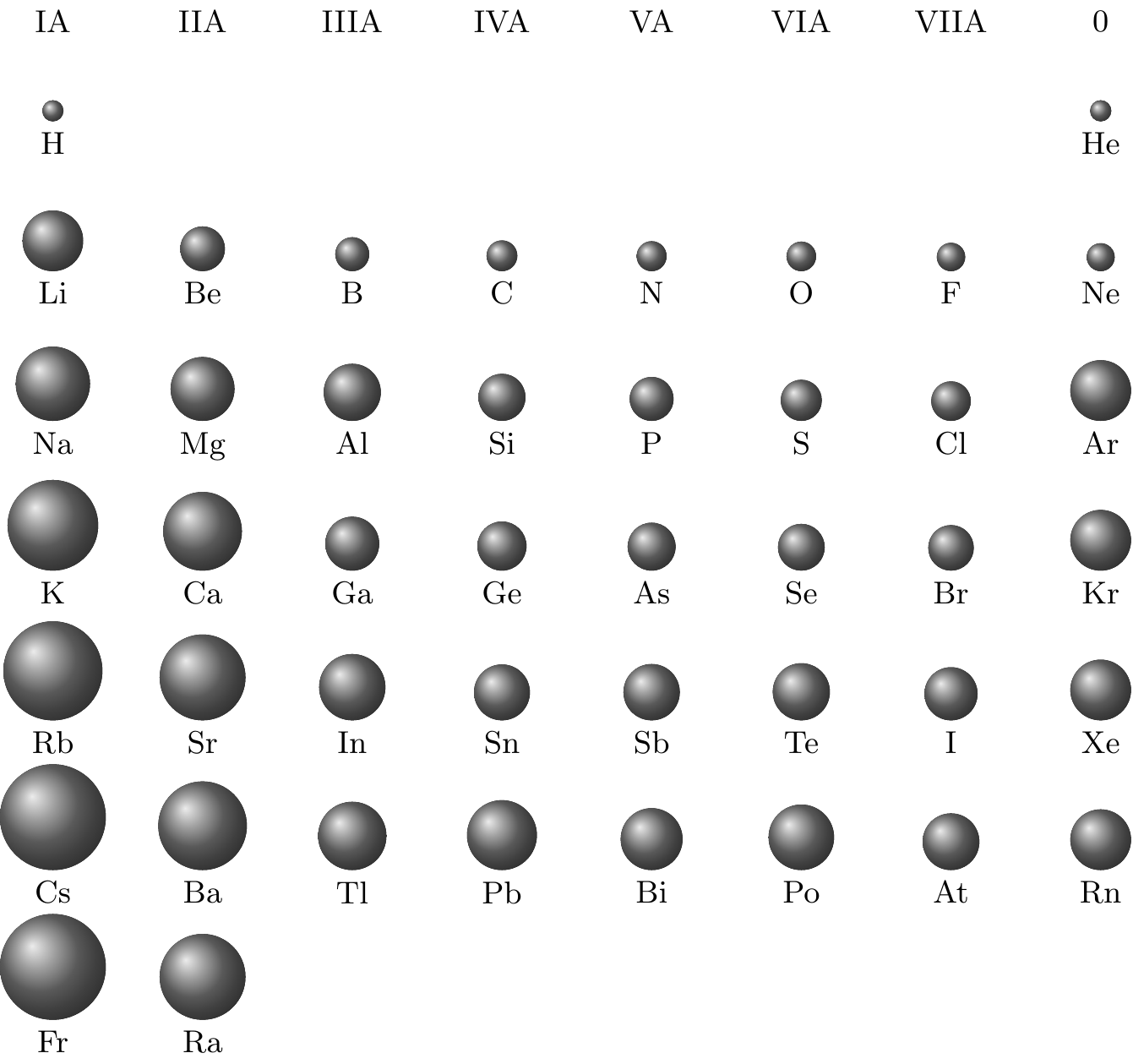
From Table 5.5, we can see that going from the alkali metal lithium to the halogen fluorine, as atomic number increases, atomic radius decreases from \(1.52 \times 10^{-10}\ \text{m}\) to \(0.71 \times 10^{-10}\ \text{m}\). Again from sodium to chlorine, atomic radius decreases from \(1.86 \times 10^{-10}\ \text{m}\) to \(0.99 \times 10^{-10}\ \text{m}\). If all elements are arranged in order of increasing atomic number, atomic radii show periodic variation. Figure 5.8 illustrates this for seven groups and the noble gases.
Periodic Variation of First Ionization Energy
The magnitude of an element’s ionization energy reflects how easily its atoms lose electrons — the smaller the ionization energy, the more easily the atom loses an electron. Therefore, the first ionization energy serves as a measure of an element’s metallic activity.
Examining the first ionization energies for elements \(Z = 1\)–\(18\), we find that from H to He, from Li to Ne, and from Na to Ar, the general trend is an increase from small to large values. Extending the analysis beyond \(Z = 18\) yields the same conclusion. Figure 5.9 plots the first ionization energies of elements \(Z = 1\)–\(18\) as a curve, clearly showing the periodic variation.
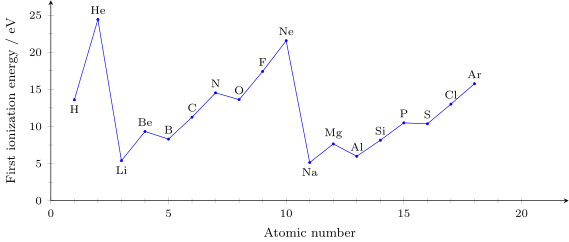
How can we explain the fact that the first ionization energies of nitrogen, beryllium, neon, and magnesium are higher than those of their immediately neighboring elements?
Periodic Variation of Valence
From Table 5.5, we can see that elements 11–18 largely repeat the valence pattern of elements 3–10: positive valences increase from \(+1\) (Na) to \(+7\) (Cl), and starting from the middle elements, negative valences appear, going from \(-4\) (Si) to \(-1\) (Cl). Studying elements beyond \(Z = 18\) reveals the same periodic repetition. That is, element valence varies periodically with increasing atomic number.
Atomic radius, first ionization energy, and principal valence are all important properties of elements. Through the investigations above, we arrive at the following fundamental law: the properties of elements vary periodically with increasing atomic number. This law is called the periodic law of the elements.
The periodic variation of element properties is a direct consequence of the periodic variation of electron configurations.
- As atomic number increases, the outermost electron configuration repeats periodically: from 1 electron up to 8 electrons (stable configuration), then restarting
- Atomic radius decreases across a period (from alkali metal to halogen), then jumps up at the next alkali metal
- First ionization energy generally increases across a period, with local anomalies at half-filled and fully filled subshells (e.g., \(\ce{N}\), \(\ce{Be}\))
- Valence follows a periodic pattern: positive valence increases from \(+1\) to \(+7\); negative valence appears from mid-period
- The periodic law: Element properties vary periodically with increasing atomic number, as a consequence of periodic changes in electron configuration
Exercises for Section 4
How does atomic radius change as atomic number increases?
How do the first ionization energy and valence of elements change as atomic number increases?
Using the concept of atomic structure, explain why element properties vary periodically with increasing atomic number.
5.5 Section 5: The Periodic Table
According to the periodic law, the currently known elements7 are arranged so that elements with the same number of electron shells are placed in horizontal rows in order of increasing atomic number, and elements in different rows with the same number of outermost electrons are placed in vertical columns in order of increasing shell number.8 The resulting arrangement is called the periodic table of the elements (see Appendix II). The periodic table is the concrete embodiment of the periodic law and reflects the internal connections among elements.
Structure of the Periodic Table
1. Periods
The periodic table has 7 horizontal rows, constituting 7 periods. A series of elements having the same number of electron shells and arranged in order of increasing atomic number is called a period. The period number equals the number of electron shells.
The number of elements in each period is not the same: Period 1 has only 2 elements; Periods 2 and 3 each have 8; Periods 4 and 5 each have 18; Period 6 has 32. Periods 1, 2, and 3, with fewer elements, are called short periods; Periods 4, 5, and 6, with more elements, are called long periods. Period 7 is now complete with 32 elements.9
Except for Period 1, in each period from left to right the number of outermost-shell electrons increases from 1 to 8. Except for Period 1 (which starts with the gaseous element hydrogen) and Period 7, every period begins with a reactive metal — an alkali metal — and progresses through increasingly active nonmetals — the halogens — to end with a noble gas.
In Period 6, elements 57 (lanthanum, La) through 71 (lutetium, Lu) — 15 elements total — have very similar electron configurations and properties and are collectively called the lanthanide series. To keep the table compact, these elements are placed in the same cell and listed separately below the main table.
In Period 7, elements 89 (actinium, Ac) through 103 (lawrencium, Lr) — also 15 elements — similarly have very similar properties and are collectively called the actinide series. They are likewise placed in one cell and listed below the lanthanides. Many of the actinide elements beyond uranium are produced artificially through nuclear reactions and are called transuranium elements.
2. Groups
The periodic table has 18 vertical columns. Columns 8, 9, and 10 together form Group VIII; the remaining 15 columns each constitute one group. Groups are divided into main groups (A groups) and subgroups (B groups). A main group contains elements from both short and long periods; a subgroup consists entirely of long-period elements. Main groups are labeled IA, IIA, …, VIIA; subgroups are labeled IB, IIB, …, VIIB. The noble gas elements, being extremely unreactive, are assigned a valence of 0 and placed in Group 0. Thus the complete table has 7 main groups, 7 subgroups, 1 Group VIII, and 1 Group 0 — 16 groups in total.
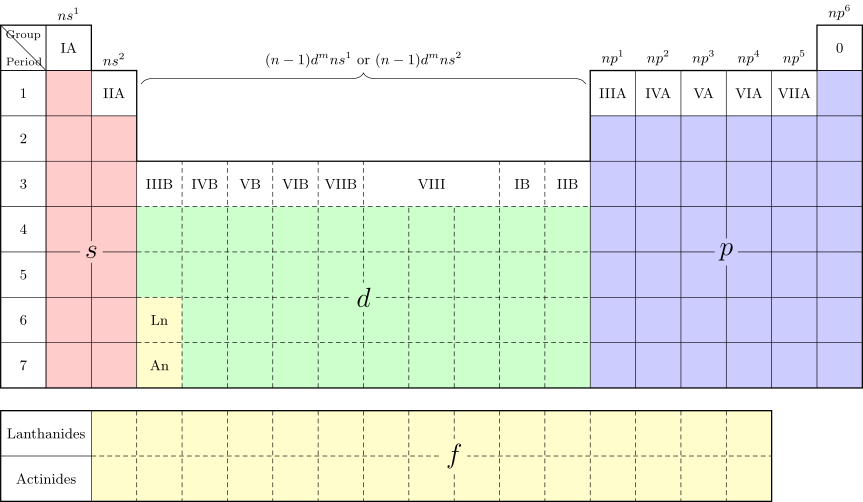
Based on the characteristic features of atomic electron configurations, the periodic table can be divided into four blocks:
(1) The \(s\) block includes Groups IA and IIA. The outermost shell has only 1–2 \(s\) electrons. Characteristic electron configuration: \(ns^x\) (\(x = 1\)–\(2\)).
(2) The \(p\) block includes Groups IIIA–VIIA and Group 0. The outermost shell has 2 \(s\) electrons plus 1–6 \(p\) electrons (He is an exception with no \(p\) electrons). Characteristic configuration: \(ns^2 np^x\) (\(x = 1\)–\(6\)). The noble gas configuration \(ns^2 np^6\) (or \(1s^2\) for He) is especially stable.
(3) The \(d\) block includes the seven B groups (IIIB–VIIB) and Group VIII — all transition elements. The outermost shell has 2 \(s\) electrons (occasionally 1; Pd has no \(5s\) electrons), and the next-to-outermost shell has 1–10 \(d\) electrons. Characteristic configuration: \((n-1)d^x ns^2\) (\(x = 1\)–\(10\)).
(4) The \(f\) block includes the lanthanides and actinides. Characteristic configuration: \((n-2)f^x ns^2\) (\(x = 1\)–\(14\)). These are also transition elements.
The \(s\)-block elements (except hydrogen) are all reactive metals that lose their outermost \(s\) electrons to form \(+1\) or \(+2\) cations. The \(p\)-block elements (except noble gases) include both metals and nonmetals; only their outermost \(s\) and \(p\) electrons participate in reactions. The \(d\)-block elements are all metals; besides the outermost \(s\) electrons, some or all of the next-to-outermost \(d\) electrons may also be lost or shifted. The \(f\)-block elements are also metals, and their reactions may involve outermost \(s\), next-to-outermost \(d\), and even deeper \(f\) electrons.
Relationship Between Element Properties and Atomic Structure
1. Metallic and Nonmetallic Character
Within the same period, although elements have the same number of electron shells, from left to right the nuclear charge increases, atomic radius decreases, ionization energy tends to increase, the ability to lose electrons weakens, and the ability to gain electrons strengthens. Therefore, metallic character weakens and nonmetallic character strengthens across a period.
In general, we can judge the strength of metallic character by how readily an element’s simple substance reacts with water or acid to displace hydrogen, and by the basicity of its hydroxide. We can judge nonmetallic character by the acidity of the element’s highest-oxide hydrate, or by how easily the element combines with hydrogen to form a gaseous hydride. Let us use Period 3 elements as an example.
We already know that sodium (\(Z = 11\)) reacts vigorously with cold water, releasing hydrogen and forming \(\ce{NaOH}\), a strong base (see Section 4.1).
How does magnesium (\(Z = 12\)) react with water?
Take two pieces of magnesium ribbon, sand off the oxide film, place them in a test tube, add \(3\ \text{mL}\) of water and 2 drops of colorless phenolphthalein indicator. Observe. Then heat the test tube until the water boils, and observe again.
The experiment shows that magnesium does not readily react with cold water, but when heated, it reacts with boiling water, producing copious bubbles. After the reaction, the solution turns the phenolphthalein indicator red. The equation is:
\[ \ce{Mg + 2H2O ->[\Delta] Mg(OH)2 + H2}{\uparrow} \]
Magnesium can displace hydrogen from water, indicating it is a reactive metal. However, it reacts easily only with boiling water, and the basicity of \(\ce{Mg(OH)2}\) is weaker than that of \(\ce{NaOH}\), so magnesium’s metallic activity is less than sodium’s.
Now let us examine some properties of aluminum (\(Z = 13\)).
Take a small piece of aluminum and a short piece of magnesium ribbon, sand off the oxide film from each, and place them in separate test tubes. Add \(2\ \text{mL}\) of \(1\ M\) hydrochloric acid to each. Observe.
The experiment shows that both magnesium and aluminum react with hydrochloric acid to displace hydrogen gas:
\[ \ce{Mg + 2HCl -> MgCl2 + H2}{\uparrow} \]
\[ \ce{2Al + 6HCl -> 2AlCl3 + 3H2}{\uparrow} \]
However, aluminum reacts less vigorously with acid than magnesium does — that is, aluminum’s metallic activity is less than magnesium’s.
We learned in junior high school that aluminum oxide (\(\ce{Al2O3}\)) can react with both acids and bases — it is an amphoteric oxide. What about its hydrated form, aluminum hydroxide?
Take a small amount of \(1\ M\) aluminum chloride solution, add \(3\ M\) sodium hydroxide solution until a large amount of white, flocculent aluminum hydroxide precipitate forms. Divide the precipitate into two test tubes. To one tube add \(3\ M\) sulfuric acid; to the other add \(6\ M\) sodium hydroxide solution. Observe.
We observe that the white precipitate in both test tubes disappears. This shows that aluminum hydroxide can react with both acids and bases:
\[ \ce{AlCl3 + 3NaOH -> Al(OH)3 v + 3NaCl} \]
\[ \ce{2Al(OH)3 + 3H2SO4 -> Al2(SO4)3 + 6H2O} \]
\[ \ce{H3AlO3 + NaOH -> NaAlO2 + 2H2O} \]
(When \(\ce{Al(OH)3}\) reacts with a base, its formula can also be written as \(\ce{H3AlO3}\), aluminic acid; the product \(\ce{NaAlO2}\) is sodium aluminate.)
A hydroxide like aluminum hydroxide, which can react with both acids and bases, is called an amphoteric hydroxide. Since \(\ce{Al(OH)3}\) is amphoteric, this indicates that aluminum already exhibits some nonmetallic character.
Element 14, silicon, is a nonmetal. Its oxide \(\ce{SiO2}\) is an acidic oxide; the corresponding hydrated form is silicic acid (\(\ce{H4SiO4}\)), a very weak acid. Silicon reacts with hydrogen to form the gaseous hydride \(\ce{SiH4}\) only at high temperatures.
Element 15, phosphorus, is a nonmetal. Its highest oxide is \(\ce{P2O5}\), whose hydrated form is phosphoric acid (\(\ce{H3PO4}\)), a moderately strong acid. Phosphorus vapor can react with hydrogen to form \(\ce{PH3}\), but only with great difficulty.
Element 16, sulfur, is a fairly reactive nonmetal. Its highest oxide is \(\ce{SO3}\), whose hydrated form is sulfuric acid — a strong acid. When heated, sulfur combines with hydrogen to form hydrogen sulfide (\(\ce{H2S}\)).
Element 17, chlorine, is a very reactive nonmetal. Its highest oxide is \(\ce{Cl2O7}\), whose hydrated form is perchloric acid (\(\ce{HClO4}\)), the strongest known acid. Chlorine gas reacts explosively with hydrogen gas when exposed to light or ignited, forming hydrogen chloride.
Element 18, argon, is a noble gas.
In summary, the trend across Period 3 is:
Studying other periods yields similar conclusions.
Within the same main group, from top to bottom, the number of electron shells increases, atomic radius increases, ionization energy generally decreases, the ability to lose electrons strengthens, and the ability to gain electrons weakens. Therefore, metallic character strengthens and nonmetallic character weakens down a group. This is confirmed by the trends we observed for the alkali metals and the halogens: alkali metal reactivity increases going down the group, while halogen reactivity decreases.
Trends in the subgroup elements are more complex and will not be discussed here.
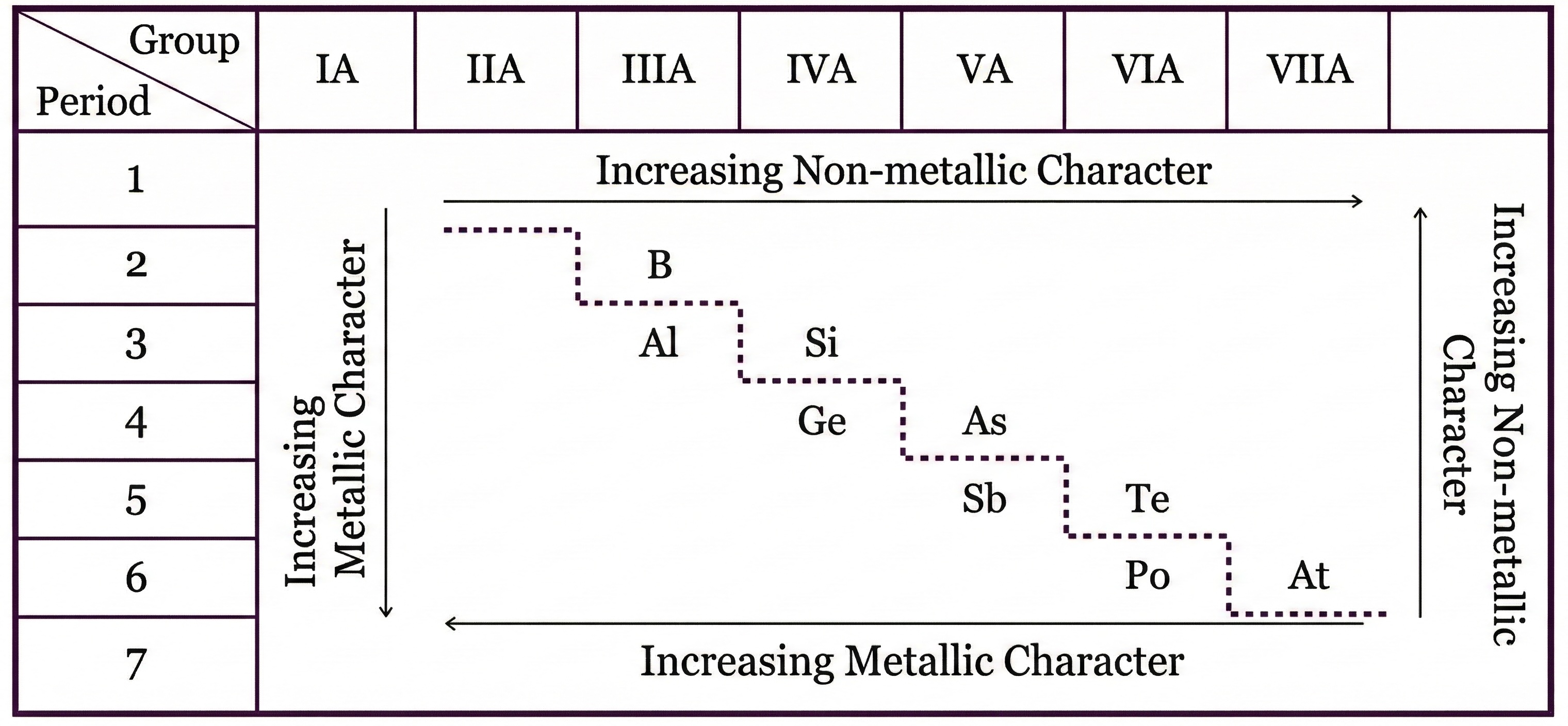
We can also divide the periodic table into metallic and nonmetallic regions (Table 5.6). Drawing a diagonal line between B and Al, Si and Ge, As and Sb, Te and Po, the elements to the left of this line are metals and those to the right are nonmetals. The most strongly metallic elements lie at the lower left, and the most strongly nonmetallic at the upper right. Because there is no sharp boundary between metallic and nonmetallic character, elements near the dividing line exhibit both metallic and nonmetallic properties.
| Period \ Group | IA | IIA | IIIA | IVA | VA | VIA | VIIA |
|---|---|---|---|---|---|---|---|
| 2 | B | ||||||
| 3 | Al | Si | |||||
| 4 | Ge | As | |||||
| 5 | Sb | Te | |||||
| 6 | Po | At |
2. Valence and Atomic Structure
Element valence is closely related to electron configuration, particularly the number of outermost-shell electrons. These outermost electrons are therefore called valence electrons. For some elements, electrons in the next-to-outermost or even deeper shells also participate in bonding and are likewise considered valence electrons.
In the periodic table, the highest positive valence of a main-group element equals its group number, since the number of outermost electrons (valence electrons) matches the group number. For nonmetallic elements, the sum of the absolute values of the highest positive valence and the negative valence equals 8 — because the highest positive valence equals the number of outermost electrons lost or shifted, while the negative valence equals the number of electrons needed to reach the 8-electron stable configuration.
The valences of subgroup and Group VIII elements are more complex. Their \(d\)-subshell electrons (or deeper \(f\)-subshell electrons) are not very stable and may, under appropriate conditions, be lost along with the outermost electrons. In general, the maximum number of electrons they can lose corresponds to their group number.
From the above, we see that element properties are determined by atomic structure, and an element’s position in the periodic table reflects its atomic structure and certain properties. The three aspects — properties, atomic structure, and periodic-table position — are intimately connected. Given an element’s position, we can deduce its structure and properties, and vice versa.
A certain element is located in Period 4, Group VIA. Write its electron configuration, state whether it is a metal or nonmetal, give its highest positive valence, and determine whether the hydrated form of its highest oxide is an acid or a base.
Solution: Let the element be \(X\). Since \(X\) is in Period 4, its atom has 4 electron shells. Since \(X\) is in Group VIA, its outermost shell has 6 electrons. Therefore its electron configuration is:
\[ 1s^2\ 2s^2\ 2p^6\ 3s^2\ 3p^6\ 3d^{10}\ 4s^2\ 4p^4 \]
From this configuration, we can see that in chemical reactions this atom readily gains 2 electrons to achieve the 8-electron stable structure, showing a \(-2\) valence. It is therefore a nonmetal. Its highest positive valence is \(+6\). The highest oxide is \(\ce{XO3}\), and its hydrated form is \(\ce{H2XO4}\) — an acid.
A certain element has atomic number 32. Determine which period and group it belongs to, and identify the element.
Solution: The element has atomic number 32, meaning 32 electrons. The first four periods contain \(2 + 8 + 8 + 18 = 36\) elements. Element 36 is the noble gas krypton (Kr), with outermost configuration \(4s^2 4p^6\). Our element has \(36 - 32 = 4\) fewer electrons than Kr. Its electron configuration is:
\[ 1s^2\ 2s^2\ 2p^6\ 3s^2\ 3p^6\ 3d^{10}\ 4s^2\ 4p^2 \]
From this configuration, it is in Period 4, Group IVA. Consulting the periodic table, the element is germanium (Ge).
Note: When solving such problems, one must first analyze and reason to determine the element’s position in the periodic table, then consult the table for its name. Never simply look up the answer directly from the atomic number.
- The periodic table has 7 periods (rows based on number of electron shells) and 16 groups (7 main, 7 sub, Group VIII, Group 0)
- Across a period (left to right): metallic character weakens, nonmetallic character strengthens
- Down a main group: metallic character strengthens, nonmetallic character weakens
- The metal–nonmetal boundary runs diagonally from B/Si/As/Te/At through the periodic table
- Main-group highest positive valence = group number; for nonmetals, |highest positive valence| + |negative valence| = 8
- An element’s position, atomic structure, and properties are three interconnected aspects
Exercises for Section 5
Using knowledge of atomic structure, explain how periods and groups in the periodic table are defined. What is a main group? What is a subgroup?
For elements in the same period and the same main group, how do metallic and nonmetallic character change? How are metals and nonmetals distributed in the periodic table?
A certain element \(A\) has the highest oxide formula \(\ce{AO3}\), and its gaseous hydride contains \(2.489\%\) hydrogen. What is the element?
A certain element \(B\) has equal absolute values for its highest positive and negative valences. In its gaseous hydride, element \(B\) accounts for \(87.5\%\). What is the atomic weight of this element, and what element is it?
Based on position in the periodic table, determine which compound in each pair has the more acidic or more basic aqueous solution:
\(\ce{H2CO3}\) and \(\ce{H3BO3}\) (boric acid)
\(\ce{H3PO4}\) and \(\ce{HNO3}\)
\(\ce{Ca(OH)2}\) and \(\ce{Mg(OH)2}\)
\(\ce{Al(OH)3}\) and \(\ce{Mg(OH)2}\)
Given three elements with atomic numbers 11, 33, and 35, determine — without looking at a periodic table — which period and group each belongs to. Explain your reasoning.
Fill in the blanks:
Atomic number Electron configuration Position in table Metal or nonmetal Highest-oxide hydroxide formula and acid/base character Gaseous hydride formula 15 (Note: The original table also contains an entry with incorrect data for verification — \(1s^2 2s^2 2p^6 3s^2 3p^4\) listed as “Period 2, Group VA” — which students should identify and correct.)
Element A has nuclear charge 17. Element B’s \(+2\) ion has the same electron configuration as argon (\(Z = 18\)). Answer the following:
In which period and main group is element A? Write its electron configuration and symbol. What is the formula of the hydrated form of its highest oxide? What class of inorganic compound is it?
In which period and main group is element B? Write its electron configuration and symbol. What is the formula of the hydrated form of its highest oxide? What class of inorganic compound is it?
Compare the nonmetallic character of iodine with that of element A. Compare the metallic character of element B with that of potassium.
5.6 Section 6: Discovery and Significance of the Periodic Law
During the century from the mid-18th to the mid-19th century, new elements were continually being discovered as production and science advanced. By 1869, 63 elements were known. A considerable body of data on their physical and chemical properties had been accumulated, but this information remained disorganized and unstructured — inconvenient for further study. There arose an urgent need to organize and generalize this empirical material, to classify the elements and find the laws connecting them. The periodic law was discovered against this backdrop, through the efforts of many scientists, ultimately achieved by the Russian chemist Mendeleev.
In 1829, the German chemist Döbereiner (1780–1849) proposed the “law of triads” based on similarities in element properties. He identified five triads:
\[ \ce{Li},\, \ce{Na},\, \ce{K} \qquad \ce{Ca},\, \ce{Sr},\, \ce{Ba} \qquad \ce{P},\, \ce{As},\, \ce{Sb} \qquad \ce{S},\, \ce{Se},\, \ce{Te} \qquad \ce{Cl},\, \ce{Br},\, \ce{I} \]
At the time, 54 elements were known, but Döbereiner could only classify 15 of them into triads, failing to reveal the relationships among the majority. Thus the law of triads did not receive widespread attention.
Subsequently, others worked on element classification. Notable efforts include Meyer’s “Six-Element Table” and Newlands’s “Law of Octaves.”
In 1864, the German chemist Meyer (1830–1895) published a six-element table that grouped similar elements in sets of six, but the elements he managed to classify still amounted to less than half of those known.
In 1865, the English chemist Newlands (1837–1898) arranged the known elements in order of increasing atomic weight and observed that every eighth element had properties similar to the first — like notes on a musical octave. He called this the “law of octaves.” However, his table was flawed in many places: he did not consider that some atomic weight measurements might be erroneous, and he rigidly arranged elements by weight without leaving gaps for undiscovered elements.
In 1869, the Russian chemist Mendeleev (Менделеев, 1834–1907) succeeded. Building critically on the work of his predecessors, he corrected, analyzed, and synthesized a vast body of experimental data, concluding that: the properties of elements (and of their simple substances and compounds) vary periodically with increasing atomic weight. This was the periodic law. He also constructed the first periodic table incorporating all 63 known elements, initially completing the task of systematizing the elements. He left gaps in the table and predicted the properties of several undiscovered elements (which he called eka-boron, eka-aluminum, and eka-silicon — later identified as scandium, gallium, and germanium). He pointed out errors in some measured atomic weights, and he did not rigidly follow the order of atomic weights in every case. His predictions were later confirmed, causing a sensation in the scientific community. In his honor, the periodic law and table are called Mendeleev’s periodic law and Mendeleev’s periodic table.
However, due to the limitations of his era, Mendeleev could not identify the fundamental cause of the periodicity. It was not until the 20th century, with deeper understanding of atomic structure, that scientists realized: the root cause of the periodic variation in element properties is not increasing atomic weight, but increasing nuclear charge (atomic number) — that is, the periodic variation in electron configuration. The periodic law was then revised to its modern form, and the periodic table has undergone many improvements.
The discovery of the periodic law has had a profound impact on the development of chemistry.
The periodic table is an important tool for studying and learning chemistry. As a concrete expression of the periodic law, it reflects the internal connections among elements and provides an excellent natural classification. We can use the intimate relationship among an element’s properties, its position in the table, and its atomic structure to guide our study and research.
Mendeleev used the periodic table to predict undiscovered elements, and those predictions were confirmed. Subsequently, the periodic law has guided systematic research into element properties and contributed to the development of theories of matter structure. Moreover, the periodic law provides clues for synthesizing new elements and predicting their structures and properties.
The periodic law also has practical significance for agriculture and industry. Because elements with neighboring positions in the table have similar properties, researchers are guided to search for new substances in specific regions of the table. For example, elements commonly used in pesticides — fluorine, chlorine, sulfur, phosphorus, arsenic — occupy a certain region. Thorough study of elements in that region helps develop new pesticides. To find semiconductor materials, one looks near the metal–nonmetal boundary: silicon, germanium, selenium, etc. Catalysts and high-temperature, corrosion-resistant alloys can be sought among the transition elements.
An important philosophical significance of the periodic law is that it powerfully demonstrates, from the standpoint of natural science, the principle that quantitative change leads to qualitative change.
- The periodic law was discovered in 1869 by Mendeleev, who showed that element properties vary periodically with atomic weight and constructed the first periodic table
- Modern understanding: the root cause of periodicity is increasing nuclear charge (atomic number) and the resulting periodic change in electron configuration
- The periodic table is a powerful tool for predicting unknown elements, guiding research, and finding practical materials (semiconductors, catalysts, pesticides)
5.7 Chapter Summary
I. Atomic Structure
- The relationships among the particles composing an atom are:
\[ \text{Atom}\ {}^A_Z X \begin{cases} \text{Nucleus} \begin{cases} Z\ \text{protons} \\ (A-Z)\ \text{neutrons} \end{cases} \\[6pt] Z\ \text{electrons} \end{cases} \]
Atoms of the same element with the same number of protons but different numbers of neutrons are called isotopes.
The electron moves at high speed in the space outside the nucleus, like a negatively charged cloud surrounding it — the electron cloud.
The energy required to remove an electron from a gaseous atom (or gaseous cation) is called the ionization energy. Changes in ionization energy reveal that electrons are arranged in layers.
An electron’s motion state is determined by four aspects:
- Electron shell — based on energy differences and distance from the nucleus
- Subshell — within the same shell, based on slight energy differences and cloud shapes (\(s\), \(p\), \(d\), \(f\))
- Spatial orientation — \(s\): spherical (1 direction); \(p\): 3 directions; \(d\): 5 directions; \(f\): 7 directions
- Spin — two states, conventionally ↑ and ↓
The space occupied by an electron cloud of definite shape and orientation on a given shell is called an orbital.
Electron configuration rules:
- Pauli exclusion principle: No two electrons in the same atom have identical motion states
- Aufbau principle: Electrons fill the lowest-energy orbitals first
- Hund’s rule: Within a subshell, electrons occupy different orbitals with parallel spins as much as possible
II. The Periodic Law and Periodic Table
The periodic law: Element properties vary periodically with increasing atomic number.
A period is a horizontal row of elements with the same number of electron shells, arranged by increasing atomic number. Each vertical column (or set of columns for Group VIII) is called a group.
Across a period (excluding noble gases), metallic character decreases and nonmetallic character increases. Down a main group, metallic character increases and nonmetallic character decreases.
The highest positive valence of a main-group element equals its group number. For nonmetals, the sum of the highest positive valence and the absolute value of the negative valence equals 8.
The discovery of the periodic law has profoundly influenced the development of chemistry. The periodic table is an essential tool for study and research, and it also guides agricultural and industrial practice.
Review Problems
Which part of atomic structure is each of the following facts related to?
- The ordering of elements in the periodic table
- The magnitude of atomic weight
- The existence of isotopes
- The chemical properties of elements
- The valence of elements
- Which period an element belongs to
- Which group a main-group element belongs to
In nature, \(\ce{^{14}N}\) accounts for \(99.635\%\) and \(\ce{^{15}N}\) accounts for \(0.365\%\). Calculate the approximate atomic weight of nitrogen.
Why is the maximum number of electrons in each shell \(2n^2\)?
A certain element has the electron configuration \(1s^2 2s^2 2p^6 3s^2 3p^6 3d^{10} 4s^2\). How many electron shells does this atom have? How many orbitals and how many electrons are in each shell?
The following elements have the outermost electron configurations shown (inner shells are fully filled): \(3s^1\), \(4s^2 4p^1\), \(3s^2 3p^3\). To which period and group does each belong? What is its highest positive valence?
Given that K and Ca belong to Period 4, Groups IA and IIA respectively, and Ar is in Period 3, Group 0:
Write the electron configurations of K, Ca, and Ar.
Compare the features of their electron-shell structures.
The ionization energies (in eV) for K and Ca are:
\(I_1\) \(I_2\) \(I_3\) K 4.341 31.63 45.72 Ca 6.113 11.87 50.91 Using the electron-shell structure and ionization energy data, explain why K exhibits \(+1\) valence and Ca exhibits \(+2\) valence in chemical reactions.
Design experiments to demonstrate that the metallic activity of Na, Mg, and Al decreases in that order. Write the experimental steps, observations, and relevant chemical equations.
The gaseous hydride of a certain element \(A\) is \(\ce{AH3}\), in which H accounts for \(17.65\%\). The nucleus of element \(A\) contains 7 neutrons. Find:
- The atomic weight of element \(A\).
- Its position in the periodic table and the element’s name.
(Hint: The atomic weight can be used to roughly determine the mass number.)
\(0.9\ \text{g}\) of a certain element \(B\) reacts with dilute hydrochloric acid to produce \(\ce{BCl3}\) and displace \(1.12\ \text{L}\) of hydrogen gas (at STP). The nucleus of \(B\) contains 14 neutrons. Based on your calculations, write the electron configuration of \(B\) and identify the element.
General Review
Fill in the blanks:
\(0.5\ \text{mol}\) of water contains ______ water molecules, a total of ______ atoms, and has a mass of ______ g.
Burning \(8\ \text{g}\) of sulfur powder releases \(17.7\ \text{kCal}\) of heat. Write the thermochemical equation for this reaction.
If 4 volumes of \(\ce{SO2}\) and 3 volumes of \(\ce{O2}\) react under certain conditions, the total volume of the product mixture is ______, and the molar ratio of \(\ce{SO3}\) to \(\ce{O2}\) in it is ______.
\(0.38\ \text{g}\) of a certain halogen has a volume of \(120\ \text{mL}\) at STP. The formula weight of this halogen is ______, and it is ______.
The ionic equation \(\ce{Ba^{2+} + SO4^{2-} -> BaSO4 v}\) represents ______. Write one complete chemical equation that corresponds to this ionic equation: ______.
Choose the correct answer for each.
- Which of the following substances (or solutes in solution) contains the greatest number of molecules? ( )
A. \(22.4\ \text{L}\) of hydrogen gas (at STP) B. \(3.0 \times 10^{23}\) oxygen molecules C. \(9 \times 10^{-3}\ \text{kg}\) of water D. \(600\ \text{mL}\) of \(2\ M\) hydrochloric acid E. \(100\ \text{mL}\) of \(98\%\) concentrated sulfuric acid (density \(1.84\ \text{g/cm}^3\))
- In \(1\ \text{L}\) of aqueous solution containing \(0.1\ \text{mol}\) \(\ce{NaCl}\) and \(0.1\ \text{mol}\) \(\ce{MgCl2}\), the concentration of \(\ce{Cl-}\) is ( )
A. \(0.1\ M\) B. \(0.2\ M\) C. \(0.3\ M\) D. \(0.05\ M\)
- The subshell that can hold the greatest number of electrons is ( )
A. \(4f\) B. \(6s\) C. \(5p\) D. \(4d\)
- The elements listed in order of increasing first ionization energy are ( )
A. Li, Na, K B. Na, Al, S C. P, Si, Al D. Cl, Br, I
Are the following statements correct? Explain.
If a solution produces a white precipitate insoluble in hydrochloric acid when mixed with barium chloride solution, it must be dilute sulfuric acid.
The mass of \(1\ \text{mol}\) of hydrogen gas is \(1.008\ \text{g}\).
If a substance contains Avogadro’s number of particles, its mass is \(1\ \text{mol}\).
Particles with the same number of extranuclear electrons must belong to the same element.
The following electron configurations are all incorrect. State which rule each violates, and correct it.
The orbital diagram of a C atom is written as: \(1s\): ↑↓, \(2s\): ↑↓, \(2p\): ↑↓. This violates ______ and should be corrected to ______.
The electron configuration of Ca is written as \(1s^2 2s^2 2p^6 3s^2 3p^6 3d^2\). This violates ______ and should be corrected to ______.
The orbital diagram of an N atom is written as: \(1s\): ↑↑, \(2s\): ↑↑, \(2p\): ↑ ↑ ↑. This violates ______ and should be corrected to ______.
The table below is a portion of the periodic table. Answer the following questions.
Period \ Group IA IIA IIIA IVA VA VIA VIIA 0 2 ① ② ③ 3 ④ ⑤ ⑥ ⑦ ⑧ 4 ⑨ ⑩ Write the name and symbol of each of these 10 elements.
Which of these elements is the least chemically reactive? Why?
Among the hydrated forms of the highest oxides of the nonmetals, which compound has the strongest acidity? Among the hydrated forms of the metal oxides, which compound has the strongest basicity?
Among elements ④, ⑤, ⑥, and ⑦, which has the smallest atomic radius? Which has the largest?
What is the formula of the hydride of element ③? Write the equation for its reaction with the simple substance of element ④ or ⑨. Compare the vigor of these two reactions and explain why.
What compound is formed by elements ④ and ⑩? When this compound is intensely heated, what color is the flame?
Can simple substance ⑦ displace ⑩ from some of its compounds? Why?
Explain the following:
Iron and aluminum containers can both be used to store concentrated sulfuric acid, and both must be sealed tightly.
Dilute sulfuric acid reacts with iron to produce hydrogen gas, but concentrated sulfuric acid does not. Concentrated sulfuric acid reacts with copper when heated to produce \(\ce{SO2}\), but dilute sulfuric acid does not.
Air containing \(\ce{SO2}\) and water vapor is passed successively through sodium hydroxide solution, concentrated sulfuric acid, and then over heated copper. What gas(es) remain? Write the relevant chemical equations.
Answer the following:
- How would you test whether kerosene contains water?
- How would you determine whether the sulfuric acid in a reagent bottle is concentrated or dilute?
Given four gases \(A\), \(B\), \(C\), and \(D\):
- \(A\) is the lightest gas; \(B\) is yellow-green under normal conditions.
- When each gas is passed into acidified silver nitrate solution, \(A\) and \(D\) immediately produce a white precipitate.
- Igniting magnesium near a flask containing a mixture of \(A\) and \(B\) causes an explosion, producing gas \(D\).
- Limewater turns turbid when exposed to gas \(C\).
Based on these facts:
- Write the chemical formulas of the four gases.
- Write the relevant chemical or ionic equations.
- Write the chemical equations for the laboratory preparation of each gas, draw the experimental apparatus, and describe the collection method for each.
Using two different chemical methods, identify the solids sodium chloride, sodium bromide, and sodium iodide.
How would you confirm that eggshell contains carbonates? How would you show that plant ash contains potassium carbonate? How would you prove that Glauber’s salt is sodium sulfate? Write the experimental steps and the relevant chemical or ionic equations.
A student wants to prepare \(100\ \text{mL}\) of \(1\ M\) \(\ce{NaOH}\) solution. After calculating the required mass of \(\ce{NaOH}\), the student weighs the solid on paper, pours it into a graduated cylinder, adds \(100\ \text{mL}\) of water, and heats the graduated cylinder over an alcohol lamp to dissolve the \(\ce{NaOH}\). What errors did this student make? How should the procedure be corrected?
What precautions should be taken when storing the following reagents in the laboratory? Explain why.
- Metallic sodium
- Sodium hydroxide solution
- Hydrofluoric acid
- Concentrated sulfuric acid
- Iodine
Three elements \(A\), \(B\), and \(C\) have the same number of electron shells. \(B\) has a nuclear charge 2 greater than \(A\), and \(C\) has 4 more protons than \(B\). When \(1\ \text{mol}\) of \(A\) reacts with water, \(1\ \text{g}\) of hydrogen gas is produced, and \(A\) is converted into an ion with the electron configuration of neon. Based on these conditions, determine elements \(A\), \(B\), and \(C\). Write the electron configurations of all three atoms, and give examples illustrating the main chemical properties of substances \(A\) and \(C\).
\(8.4\ \text{g}\) of a certain element \(A\) reacts with hydrochloric acid to form \(\ce{ACl2}\) and displaces \(1.12\ \text{L}\) of hydrogen gas (at STP). Another element \(B\) has highest oxide \(\ce{BO3}\), and in its hydride, \(B\) accounts for \(94.1\%\).
- Calculate the atomic weights of \(A\) and \(B\), and name them.
- Write the chemical equation for the combination of these two simple substances. Show the direction of electron transfer and identify the oxidizing and reducing agents.
- If dilute sulfuric acid is added to the product from (2), what phenomenon occurs? Write the ionic equation. Why should this reaction be carried out in a closed system or fume hood?
Given: \(\ce{CaCO3(s) -> CaO(s) + CO2(g)} - 42.52\ \text{kCal}\); \(\ce{C(s) + O2(g) -> CO2(g)} + 94.0\ \text{kCal}\). How many kilocalories of heat are needed to calcine \(1\ \text{t}\) of limestone into lime? If all this heat is supplied by complete combustion of carbon, how many kilograms of carbon are theoretically required?
A mixture of sodium carbonate and sodium hydrogen carbonate weighing \(6.85\ \text{g}\) is heated until fully decomposed, then reacted with excess hydrochloric acid, releasing \(1.12\ \text{L}\) of \(\ce{CO2}\) (at STP). Calculate the mass of \(\ce{Na2CO3}\) and \(\ce{NaHCO3}\) in the original mixture.
At \(20\,{}^{\circ}\text{C}\), dissolving \(3.16\ \text{g}\) of potassium nitrate in \(10\ \text{g}\) of water gives a saturated solution with density \(1.13\ \text{g/cm}^3\). Calculate the mass-percent concentration and the molar concentration of this saturated solution.
\(50\ \text{mL}\) of \(0.2\ M\) barium chloride solution is mixed with \(15\ \text{g}\) of \(10\%\) sulfuric acid solution (density \(1.07\ \text{g/cm}^3\)). Calculate:
- How many grams of precipitate form?
- Assuming the total volume of the solution remains unchanged, what is the molar concentration of the remaining substance (acid or salt) after the reaction?
A factory burns \(100\ \text{t}\) of coal containing \(1.6\%\) sulfur per day. How many tonnes of \(\ce{SO2}\) are released per year (taking a year as 360 days)? If this \(\ce{SO2}\) were recovered, how many tonnes of \(98\%\) concentrated sulfuric acid could be produced per year?
Translator’s note: The Chinese names for the three hydrogen isotopes are 氕 (piē), 氘 (dāo), and 氚 (chuān). The English names protium, deuterium, and tritium derive from the Greek words for “first,” “second,” and “third,” respectively.↩︎
Translator’s note: As of 2024, 118 elements have been confirmed. The original text reflects the count known in 1983.↩︎
Translator’s note: \(1\ \text{eV} = 1.6022 \times 10^{-19}\ \text{J}\). Modern chemistry typically uses \(\text{kJ/mol}\) as the unit for ionization energies, but eV is used here following the original text.↩︎
Translator’s note: The subshell letters originate from early spectroscopy: s = sharp, p = principal, d = diffuse, f = fundamental — referring to the visual appearance of the corresponding spectral lines.↩︎
Translator’s note: Wolfgang Pauli (1900–1958), Austrian-born Swiss-American physicist, received the Nobel Prize in Physics in 1945 for the discovery of the exclusion principle.↩︎
Translator’s note: Friedrich Hund (1896–1997), German physicist, made fundamental contributions to quantum theory and molecular orbital theory. He is remarkable for having lived 101 years.↩︎
Translator’s note: The original text states “107 known elements,” reflecting the count as of 1983. As of 2024, all 118 elements through oganesson (Og) have been confirmed.↩︎
Translator’s note: The group numbering system used here (IA, IIA, IIIB, etc.) is the traditional CAS (Chemical Abstracts Service) system used in the original Chinese text. The modern IUPAC convention uses numbers 1–18 for the 18 groups.↩︎
Translator’s note: The original text states that Period 7 had “only 21 elements discovered” and was an “incomplete period.” Since the publication of this textbook, all remaining Period 7 elements have been synthesized, and Period 7 is now complete with 32 elements, ending at oganesson (\(Z = 118\)).↩︎