3 Sulfur and Sulfuric Acid
After studying this chapter, you should be able to:
- Describe the physical and chemical properties of sulfur, and its reactions with metals, hydrogen, and oxygen
- Explain the properties of hydrogen sulfide as a reducing agent, and the concept of reversible reactions
- Compare the properties of sulfur dioxide and sulfur trioxide as acidic oxides
- Outline the three stages of the Contact Process for industrial sulfuric acid production
- Describe the oxidizing properties of concentrated sulfuric acid and distinguish them from dilute sulfuric acid
- Write and interpret net ionic equations, and identify the conditions for ionic reactions to occur
- Explain periodic trends in the oxygen family (O, S, Se, Te) and relate them to atomic structure
Sulfur is an important nonmetallic element. The atomic structure and properties of sulfur are very similar to those of oxygen, which we have already studied — the outermost electron shells of both atoms contain 6 electrons. Oxygen (O), sulfur (S), and three other elements with similar atomic structures and properties — selenium (Se), tellurium (Te), and polonium (Po)1 — are collectively known as the oxygen family of elements. This chapter primarily introduces the chemistry of sulfur and its compounds.
3.1 Section 1: Sulfur
In nature, elemental sulfur (in its free state) is found near volcanic vents or in rock formations within the Earth’s crust. Because of the existence of native sulfur, humans have known about sulfur since ancient times. Sulfur in combined form is widely distributed, mainly as sulfides and sulfates — for example, pyrite (\(\ce{FeS2}\)), chalcopyrite (\(\ce{CuFeS2}\)), gypsum (\(\ce{CaSO4 * 2H2O}\)), mirabilite (\(\ce{Na2SO4 * 10H2O}\)), and so forth. Sulfur compounds are also commonly found in volcanic gases and mineral spring waters. Coal and petroleum both contain small amounts of sulfur. Sulfur is also a constituent element of certain proteins and is an element necessary for biological growth.
Physical Properties of Sulfur
Sulfur is usually a pale yellow crystalline solid, commonly known as brimstone. Its density is approximately twice that of water. Sulfur is brittle and easily ground into powder. It is insoluble in water, slightly soluble in alcohol, and readily soluble in carbon disulfide. The melting point of sulfur is \(112.8\,{}^{\circ}\text{C}\), and its boiling point is \(444.6\,{}^{\circ}\text{C}\).
Chemical Properties of Sulfur
The chemical properties of sulfur are fairly reactive. Similar to oxygen, sulfur readily reacts with metals, hydrogen, and other nonmetals.
1. Reactions of Sulfur with Metals
Heat a large test tube containing sulfur powder. When the sulfur boils and produces vapor, use crucible tongs to hold a bundle of polished fine copper wires and insert them into the mouth of the test tube (Figure 3.1). Observe the phenomenon that occurs.
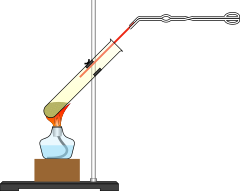
The copper wires burn in the sulfur vapor, producing black copper(I) sulfide.
\[ \ce{2Cu + S ->[\Delta] Cu2S} \]
Place a small amount of a mixture of sulfur powder and iron powder in a test tube, and heat it until red-hot. Immediately remove the alcohol lamp. The heat released by the reaction is sufficient to sustain the reaction. Observe the phenomenon that occurs.
Sulfur reacts with iron to produce black iron(II) sulfide.
\[ \ce{Fe + S ->[\Delta] FeS} \]
Sulfur can also react with other metals. Compounds formed by the combination of sulfur with metals are called metal sulfides.
2. Reactions of Sulfur with Nonmetals
In junior high school chemistry, we already learned that sulfur reacts with oxygen to produce sulfur dioxide, releasing a large amount of heat (for more on thermochemical equations, see Section 1.4.1).
\[ \ce{S(s) + O2(g) -> SO2(g)} + 71\ \text{kCal} \]
This textbook uses kilocalories (kCal) for heats of reaction, following the convention standard in China in the early 1980s. The modern SI unit is the kilojoule (kJ). The conversion is: \(1\ \text{kCal} = 4.184\ \text{kJ}\). For example, \(71\ \text{kCal} = 297.1\ \text{kJ}\).
In addition, sulfur can react with other nonmetals. For example, sulfur vapor combines directly with hydrogen gas to form hydrogen sulfide gas:
\[ \ce{S + H2 ->[\Delta] H2S} \]
Uses of Sulfur
Sulfur has a wide range of uses. It is primarily used to manufacture sulfuric acid. Sulfur is also an important raw material in the production of rubber products. It can be used to make black powder, fireworks, matches, and more. Sulfur is also used as a raw material for manufacturing certain pesticides (such as lime-sulfur mixture). In medicine, sulfur can be used to make sulfur ointment for treating certain skin diseases, and so on.
- Sulfur is a pale yellow, brittle crystalline solid (mp \(112.8\,{}^{\circ}\text{C}\), bp \(444.6\,{}^{\circ}\text{C}\))
- Sulfur is insoluble in water but dissolves readily in \(\ce{CS2}\)
- Sulfur reacts with metals to form metal sulfides (e.g., \(\ce{Cu2S}\), \(\ce{FeS}\))
- Sulfur reacts with \(\ce{O2}\) to form \(\ce{SO2}\) (exothermic) and with \(\ce{H2}\) to form \(\ce{H2S}\)
- Major uses: manufacturing \(\ce{H2SO4}\), rubber vulcanization, pesticides, medicine
Exercises for Section 1
Write the chemical equations for the reactions of sulfur with hydrogen and of sulfur with oxygen.
Calculate the heat released when \(0.32\ \text{kg}\) of sulfur burns to form sulfur dioxide.
If \(21\ \text{g}\) of iron powder is mixed with \(8\ \text{g}\) of sulfur powder and heated, how many grams of iron(II) sulfide can be produced? Which substance is in excess, and by how much?
3.2 Section 2: Hydrogen Sulfide and Sulfur Oxides
Hydrogen Sulfide — the Hydrogen Compound of Sulfur (\(\ce{H2S}\))
1. Laboratory Preparation of Hydrogen Sulfide
In the laboratory, hydrogen sulfide is usually prepared by reacting iron(II) sulfide with dilute hydrochloric acid or dilute sulfuric acid.
\[ \ce{FeS + 2HCl -> FeCl2 + H2S}{\uparrow} \]
\[ \ce{FeS + H2SO4 -> FeSO4 + H2S}{\uparrow} \]
This reaction can be carried out in a Kipp’s generator.
2. Properties of Hydrogen Sulfide
Hydrogen sulfide is a colorless gas with the characteristic odor of rotten eggs. Its density is slightly greater than that of air. Hydrogen sulfide is highly toxic and is an air pollutant. Even trace amounts of hydrogen sulfide in the air can cause headaches, dizziness, and nausea. Inhaling larger quantities can cause unconsciousness or even death. Therefore, when preparing or using hydrogen sulfide, the work must be carried out in a closed system or in a fume hood.
Hydrogen sulfide is soluble in water. At room temperature and atmospheric pressure, 1 volume of water can dissolve 2.6 volumes of hydrogen sulfide.
At higher temperatures, hydrogen sulfide decomposes into hydrogen and sulfur.
\[ \ce{H2S ->[\Delta] H2 + S} \]
Hydrogen sulfide is a combustible gas.
Ignite hydrogen sulfide gas at the tip of a delivery tube. Observe the color of the flame when hydrogen sulfide burns completely. Then hold a dry beaker inverted over the flame. Observe what substance adheres to the inner wall of the beaker. Carefully smell the odor.
When sufficient air is available, hydrogen sulfide burns completely with a pale blue flame, producing water and sulfur dioxide.
\[ \ce{2H2S + 3O2 ->[\text{ignite}] 2H2O + 2SO2} \]
Ignite hydrogen sulfide gas at the tip of a delivery tube. Hold an evaporating dish (or glass plate) so that its bottom is close to the hydrogen sulfide flame. Observe what occurs on the bottom of the evaporating dish.
We can see that a yellow powder is deposited on the bottom of the evaporating dish. This is elemental sulfur produced by the incomplete combustion of hydrogen sulfide.
\[ \ce{2H2S + O2 -> 2H2O + 2S} \]
If hydrogen sulfide and sulfur dioxide gases are thoroughly mixed in a gas collection bottle, before long a yellow powder — sulfur — forms on the walls of the bottle.
\[ \ce{SO2 + 2H2S -> 2H2O + 3S} \]
From this we can see that hydrogen sulfide has reducing properties (recall the concepts of oxidation and reduction from Section 2.3). The sulfur in hydrogen sulfide is in the \(-2\) oxidation state; it can lose electrons and be converted to elemental sulfur (free state) or to compounds containing sulfur in a higher oxidation state.
The aqueous solution of hydrogen sulfide turns litmus solution pale red — it is an acid called hydrosulfuric acid. When this acid is heated, hydrogen sulfide escapes from the water. Hydrosulfuric acid is a weak acid, and it possesses the general properties of acids.
Sulfur Oxides
The most important oxides of sulfur are sulfur dioxide and sulfur trioxide.
1. Sulfur Dioxide (\(\ce{SO2}\))
Sulfur dioxide is a colorless, toxic gas with a pungent, irritating odor. Its density is greater than that of air, and it is easily liquefied (boiling point \(-10\,{}^{\circ}\text{C}\)). It is very soluble in water — at room temperature and atmospheric pressure, approximately 40 volumes of sulfur dioxide dissolve in 1 volume of water.
Sulfur dioxide is an acidic oxide. It combines with water to form sulfurous acid (\(\ce{H2SO3}\)). For this reason, sulfur dioxide is also called sulfurous anhydride.
\[ \ce{SO2 + H2O -> H2SO3} \]
Sulfurous acid is very unstable and readily decomposes into sulfur dioxide and water.
\[ \ce{H2SO3 -> H2O + SO2}{\uparrow} \]
A reaction that proceeds toward the products is generally called a forward reaction, and one that proceeds toward the reactants is called a reverse reaction. A reaction that, under the same conditions, can proceed simultaneously in both the forward and reverse directions is called a reversible reaction. In chemical equations, a reversible reaction is represented by two opposing arrows in place of the equals sign.
\[ \ce{SO2 + H2O <=> H2SO3} \]
The original Chinese textbook uses the equals sign (=) for chemical equations. In international practice, a single arrow (\(\rightarrow\)) is used for reactions that proceed essentially to completion, and the equilibrium symbol (\(\rightleftharpoons\)) is used for reversible reactions. This translation follows the international convention throughout.
At a suitable temperature and in the presence of a catalyst, sulfur dioxide can be oxidized by oxygen to form sulfur trioxide.
\[ \ce{2SO2 + O2 ->[\Delta][\text{catalyst}] 2SO3} \]
Pass sulfur dioxide gas into a test tube containing fuchsin solution. Observe the change in color of the fuchsin solution. Then heat the test tube and observe the change that occurs in the solution.
Sulfur dioxide can bleach certain colored substances. In industry, sulfur dioxide is commonly used to bleach paper pulp, wool, silk, straw braid, and so on. The bleaching action of sulfur dioxide results from its ability to combine with certain colored substances to form unstable colorless compounds. These colorless compounds decompose easily, restoring the original color of the substances. This is why straw braids that have been bleached with sulfur dioxide gradually turn yellow again over time. In addition, sulfur dioxide is also used for sterilization and disinfection.
In the laboratory, sulfur dioxide is often prepared by reacting sulfite salts with sulfuric acid. For example:
\[ \ce{Na2SO3 + H2SO4 -> Na2SO4 + H2SO3} \]
Since sulfurous acid is unstable, it immediately decomposes:
\[ \ce{H2SO3 -> H2O + SO2}{\uparrow} \]
The overall reaction is:
\[ \ce{Na2SO3 + H2SO4 -> Na2SO4 + H2O + SO2}{\uparrow} \]
Sodium sulfite is the sodium salt of sulfurous acid (\(\ce{H2SO3}\)). When a sodium sulfite solution reacts with sulfur, it produces sodium thiosulfate (\(\ce{Na2S2O3}\)).
\[ \ce{Na2SO3 + S ->[\Delta] Na2S2O3} \]
Sodium thiosulfate is the sodium salt of thiosulfuric acid (\(\ce{H2S2O3}\)). Thiosulfuric acid can be considered as the acid formed when one oxygen atom in a sulfuric acid molecule is replaced by a sulfur atom. Sodium thiosulfate pentahydrate (\(\ce{Na2S2O3 * 5H2O}\)), commonly known as “hypo” or “photographer’s fixer,” is a colorless crystalline solid that dissolves in water. In the photography industry, it is commonly used as a fixing agent to dissolve unexposed silver bromide remaining on photographic film or photographic paper.
2. Sulfur Trioxide (\(\ce{SO3}\))
Sulfur trioxide is a colorless solid with a melting point of \(16.8\,{}^{\circ}\text{C}\) and a boiling point of \(44.8\,{}^{\circ}\text{C}\). Sulfur trioxide reacts vigorously with water to form sulfuric acid, releasing a large amount of heat. For this reason, sulfur trioxide is also called sulfuric anhydride.
\[ \ce{SO3 + H2O -> H2SO4} \]
Sulfur dioxide and oxygen, at a certain temperature and in the presence of a catalyst, can produce sulfur trioxide. Sulfur trioxide can also decompose back into sulfur dioxide and oxygen. Therefore, this too is a reversible reaction.
\[ \ce{2SO2 + O2 <=>[\Delta][\text{catalyst}] 2SO3} \]
Sulfur trioxide is an acidic oxide — it reacts with both basic oxides and bases to form sulfates.
- Hydrogen sulfide (\(\ce{H2S}\)): colorless, rotten-egg odor, highly toxic, reducing agent; its aqueous solution (hydrosulfuric acid) is a weak acid
- Sulfur dioxide (\(\ce{SO2}\)): colorless, pungent odor, toxic, acidic oxide; forms \(\ce{H2SO3}\) with water; bleaches certain colored substances
- Sulfur trioxide (\(\ce{SO3}\)): colorless solid, acidic oxide; reacts vigorously with water to form \(\ce{H2SO4}\)
- A reversible reaction is one that, under the same conditions, proceeds simultaneously in both forward and reverse directions: \(\ce{SO2 + H2O <=> H2SO3}\)
- \(\ce{SO2}\) can be oxidized to \(\ce{SO3}\) catalytically, and \(\ce{SO3}\) can decompose back to \(\ce{SO2}\) + \(\ce{O2}\) — a reversible process
Exercises for Section 2
Given sulfur, iron, and hydrochloric acid, describe two methods for preparing hydrogen sulfide. Write the chemical equations for the relevant reactions.
Use examples to illustrate the reducing properties of hydrogen sulfide, and write the relevant chemical equations.
Use examples to explain what a reversible reaction is.
Use examples to explain how the products of reactions of sulfur dioxide and sulfur trioxide with bases and basic oxides differ, and write the relevant chemical equations.
3.3 Section 3: Industrial Production of Sulfuric Acid — the Contact Process
Reaction Principles and Production Process
There are several industrial methods for manufacturing sulfuric acid. The Contact Process is the most important one.
The reaction principles of the Contact Process are: burn sulfur or metal sulfides to produce sulfur dioxide; oxidize the sulfur dioxide to sulfur trioxide at an appropriate temperature and in the presence of a catalyst; then combine the sulfur trioxide with water to produce sulfuric acid.
The name “Contact Process” comes from the fact that sulfur dioxide and oxygen react on the surface of the catalyst — that is, the gases come into contact with the catalyst.
Based on the reaction principles for manufacturing sulfuric acid, the production process can be divided into three main stages:
1. Preparation and Purification of Sulfur Dioxide
In China, sulfur dioxide is most commonly prepared by burning pyrite (whose main component is \(\ce{FeS2}\)). The chemical equation for this reaction is:
\[ \ce{4FeS2 + 11O2 ->[\text{high temp.}] 2Fe2O3 + 8SO2} \]
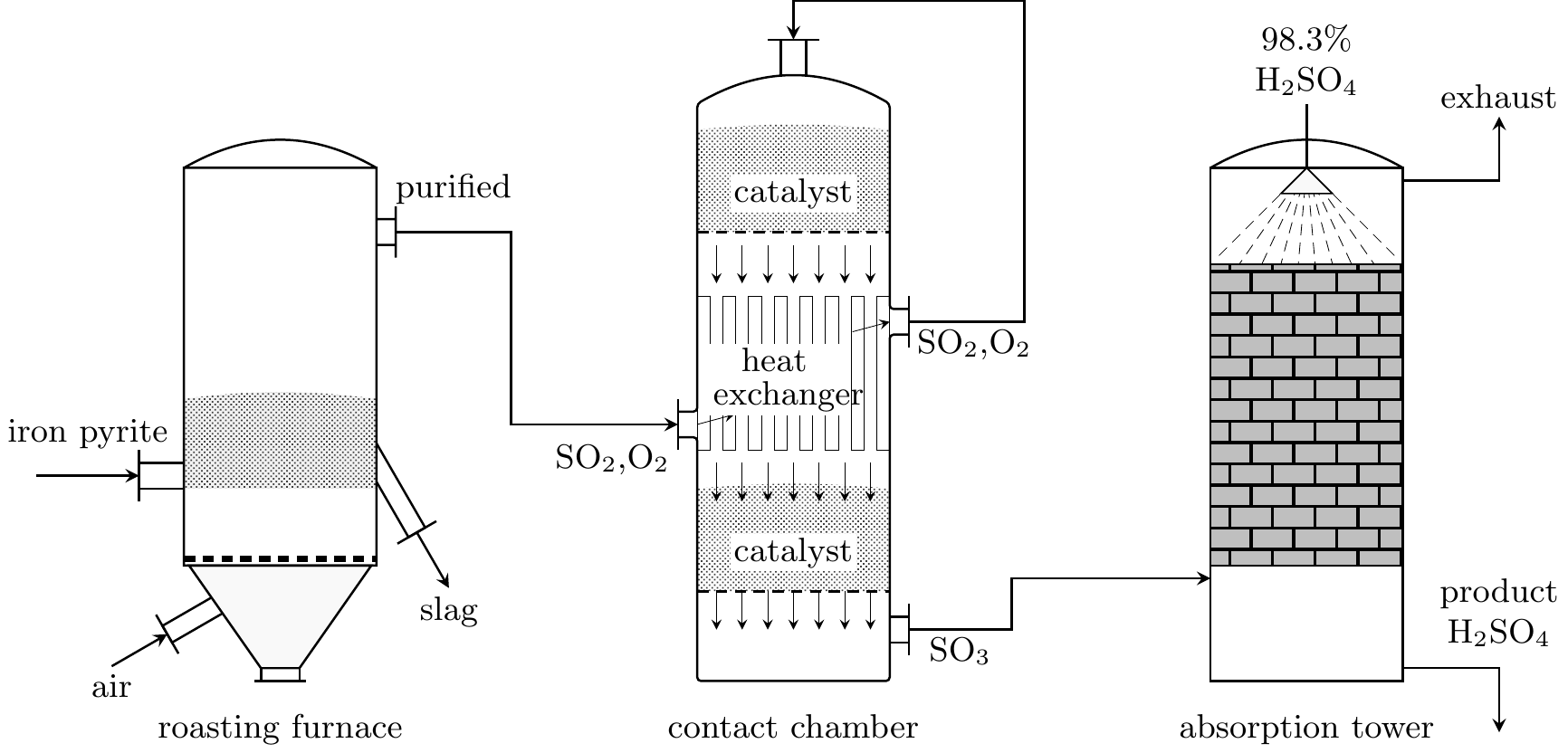
To ensure that the pyrite burns thoroughly and rapidly, in industrial practice the ore is crushed into fine particles before being placed into a specially designed furnace for combustion. Because the crushed ore particles are small, they have a large surface area of contact with air, leading to thorough and rapid combustion. During combustion, a strong stream of air is blown in from the bottom of the furnace, causing the ore particles to tumble vigorously within a certain space inside the furnace, resembling a “boiling liquid.” For this reason, this type of furnace is called a fluidized bed roaster (shown in Figure 3.2).2 Under these fluidized conditions, the ore particles come into thorough contact with air, combustion is rapid, and the reaction is complete, improving the utilization rate of raw materials.
The gas leaving the fluidized bed roaster is called roaster gas. It contains sulfur dioxide, oxygen, nitrogen, water vapor, and impurities such as compounds of arsenic and selenium, as well as mineral dust. These impurities and dust can weaken or destroy the effectiveness of the catalyst — a phenomenon called catalyst poisoning. Water vapor also has adverse effects on equipment and production. Therefore, before the oxidation reaction can proceed, the roaster gas must pass through dust removal (to remove mineral dust), scrubbing (to remove arsenic and selenium compounds), and drying (to remove water vapor) equipment to eliminate these harmful substances. The purified gas mixture consists mainly of sulfur dioxide, oxygen, and nitrogen.
2. Oxidation of Sulfur Dioxide to Sulfur Trioxide
The mixture of sulfur dioxide and oxygen is heated to a certain temperature (\(400 \sim 500\,{}^{\circ}\text{C}\)) and then passed over a suitable catalyst (such as vanadium pentoxide, \(\ce{V2O5}\)). The sulfur dioxide is oxidized by oxygen to sulfur trioxide, releasing a large amount of heat. The thermochemical equation is:
\[ \ce{2SO2(g) + O2(g) ->[\Delta][\text{catalyst}] 2SO3(g)} + 47\ \text{kCal} \]
The original Chinese text at this point has a typographical error, writing the product as “\(\ce{SO2}\) (gas)” instead of “\(\ce{2SO3}\) (gas).” The equation above shows the corrected version. Also note: \(47\ \text{kCal} = 196.6\ \text{kJ}\).
The oxidation of sulfur dioxide to sulfur trioxide takes place in the contact chamber (also called the converter, shown in Figure 3.2). Between the two layers of catalyst there is a heat exchanger, which transfers the heat generated by the reaction to the incoming gas mixture that needs to be preheated, while simultaneously cooling the reacted gas. This type of heat transfer process is commonly used in the chemical industry and is known as the heat exchange process.
Through the heat exchanger, favorable conditions are created for both the catalytic oxidation of sulfur dioxide and the absorption of sulfur trioxide.
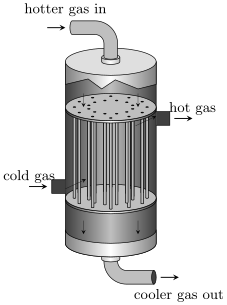
Heat exchangers are widely used heat-transfer equipment in the chemical industry, and they come in various designs. Most heat exchangers contain many parallel tubes or coiled tubes internally, which expand the heat-transfer surface area and improve heat-exchange efficiency. One fluid flows inside the tubes while another fluid flows outside them. The two fluids exchange heat through the tube walls — the hot fluid is cooled while the cold fluid is heated.
Depending on the purpose, heat exchangers can serve as coolers, heaters, condensers, or evaporators, in order to regulate fluid temperatures during reactions and make use of waste heat.
Figure 3.3 shows a common type of heat exchanger.
3. Absorption of Sulfur Trioxide and Formation of Sulfuric Acid
The gas leaving the contact chamber mainly consists of sulfur trioxide and nitrogen, along with residual unreacted oxygen and sulfur dioxide.
Sulfur trioxide combines with water to form sulfuric acid, releasing a large amount of heat.
\[ \ce{SO3 + H2O -> H2SO4} \]
Using the simplest method, calculate how many tonnes of pyrite containing \(70\%\) \(\ce{FeS2}\) would theoretically be required to produce \(50\ \text{t}\) of \(98\%\) concentrated sulfuric acid.
Although sulfuric acid is produced by combining sulfur trioxide with water, industrially, water or dilute sulfuric acid is not used directly to absorb sulfur trioxide. This is because when water or dilute sulfuric acid is used as the absorbent, acid mist readily forms, the absorption rate is slow, and absorption of sulfur trioxide is not efficient. To absorb as much sulfur trioxide as possible and to prevent acid mist formation during the absorption process, industry uses \(98.3\%\) sulfuric acid to absorb the sulfur trioxide.
The absorption process takes place in the absorption tower (Figure 3.2). In the absorption tower, sulfur trioxide enters from the bottom, \(98.3\%\) sulfuric acid is sprayed from the top, and the product sulfuric acid exits from the bottom. After the \(98.3\%\) sulfuric acid absorbs sulfur trioxide, its concentration increases. The sulfuric acid produced in this way is then diluted with water or dilute sulfuric acid to produce sulfuric acid of various concentrations.
The unreacted oxygen, small amounts of sulfur dioxide, and inert nitrogen that exit from the top of the absorption tower are collectively known as tail gas in industry. This tail gas is discharged through the exit pipe at the top of the tower.
Recovery of \(\ce{SO2}\) from Tail Gas and Environmental Protection
The tail gas from the Contact Process still contains small amounts of sulfur dioxide and other pollutants. If released into the atmosphere, they would cause environmental pollution. Sulfur dioxide is one of the main harmful substances responsible for air pollution. Sulfur dioxide released into the atmosphere often combines with particulate matter and, when inhaled into the human body, can cause respiratory diseases. Sulfur dioxide reacts with the moisture of the nasal and pharyngeal mucous membranes to produce acidic substances, causing irritation. When the sulfur dioxide concentration in the atmosphere is high, people may cough, sneeze, and develop runny noses, tearing, and bronchial inflammation. Prolonged indoor exposure to high sulfur dioxide levels can have serious health consequences. Sulfur dioxide can also directly damage crops, reducing yields or even causing complete crop failure. Moreover, sulfur dioxide combines with water vapor in the air to form “acid mist,” which falls to the ground with rain and snow, leading to soil acidification. The toxicity of this “acid mist” is much greater than that of sulfur dioxide alone, and it can be carried by wind over great distances, causing even more harm to humans, organisms, and materials. Therefore, before tail gas is released into the atmosphere, it must be treated and recovered to prevent sulfur dioxide from polluting the air, to protect the environment, and to make full use of raw materials.
The recovery of sulfur dioxide from tail gas commonly uses the ammonia absorption method. In this method, ammonia water is used as the absorbent to remove sulfur dioxide from the tail gas. The chemical equations are:
\[ \ce{SO2 + 2NH3 + H2O -> (NH4)2SO3} \]
The product is ammonium sulfite.
\[ \ce{(NH4)2SO3 + SO2 + H2O -> 2NH4HSO3} \]
The product is ammonium bisulfite.
When the concentration of ammonium bisulfite in the absorption solution reaches a certain level, it is reacted with concentrated sulfuric acid (\(93\%\)) to release sulfur dioxide gas and simultaneously produce an ammonium sulfate solution. The chemical equations are:
\[ \ce{2NH4HSO3 + H2SO4 -> 2SO2}{\uparrow}\ \ce{+ 2H2O + (NH4)2SO4} \]
\[ \ce{(NH4)2SO3 + H2SO4 -> SO2}{\uparrow}\ \ce{+ H2O + (NH4)2SO4} \]
The released sulfur dioxide gas can reach concentrations above \(95\%\) and can be used to produce liquid sulfur dioxide. The ammonium sulfate solution is crystallized, separated, and dried to produce solid ammonium sulfate fertilizer. In this way, the sulfur dioxide in the tail gas can be recovered and utilized.
Sulfuric acid factories release tail gas containing sulfur dioxide, but the sulfur dioxide causing the majority of atmospheric pollution comes from the combustion of sulfur-containing fuels such as coal (including household coal). In addition, carbon monoxide, nitrogen oxides, hydrocarbons, and particulate matter (dust) also pollute the atmosphere.
Environmental pollution includes air pollution, water pollution, soil pollution, food contamination, noise, and more.
The generation and development of environmental pollution are closely linked to human activities. In the struggle with nature, through labor, humans have continuously transformed the natural environment, steadily improving working and living conditions. On the other hand, due to inadequate management systems or limitations in human understanding and scientific and technological capabilities, pollution and destruction of the environment have also occurred.
Pollution from industrial “three wastes” (waste gases, wastewater, and solid waste) is often caused by low levels of comprehensive resource utilization or failure to utilize resources comprehensively. Therefore, we must take active measures to vigorously eliminate and prevent environmental pollution that may accompany economic development, continuously protect and improve the environment, and create a better working and living environment for the people.
- The Contact Process for manufacturing \(\ce{H2SO4}\) has three main stages:
- Prepare \(\ce{SO2}\) by roasting pyrite in a fluidized bed roaster, then purify the gas
- Oxidize \(\ce{SO2}\) to \(\ce{SO3}\) over a catalyst (\(\ce{V2O5}\)) at \(400\text{–}500\,{}^{\circ}\text{C}\)
- Absorb \(\ce{SO3}\) in \(98.3\%\) \(\ce{H2SO4}\) (not water!) to avoid acid mist
- Catalyst poisoning: impurities (As, Se compounds, dust) weaken or destroy catalyst activity
- Heat exchangers transfer heat from the exothermic catalytic reaction to preheat incoming gas
- \(\ce{SO2}\) in tail gas must be recovered before discharge to prevent air pollution and acid rain
Exercises for Section 3
What are the main stages of the Contact Process for producing sulfuric acid? Write the chemical equations for the main reaction in each stage.
Calculate the amount of heat released when \(1\ \text{t}\) of sulfur dioxide is oxidized to sulfur trioxide.
Answer the following questions:
In a fluidized bed roaster, why must the ore be crushed into fine particles before roasting?
Why must the gas mixture entering the contact chamber be purified beforehand?
Why is the tail gas from a sulfuric acid plant not permitted to be discharged directly into the atmosphere without treatment?
If \(1\ \text{t}\) of pyrite containing \(48\%\) sulfur is burned, how many tonnes of \(98\%\) sulfuric acid can theoretically be produced (assuming \(1.5\%\) of the sulfur remains in the slag)?
3.4 Section 4: Sulfuric Acid and Sulfates
Sulfuric Acid
1. Properties of Sulfuric Acid
In aqueous solution, sulfuric acid readily ionizes to produce hydrogen ions.3
\[ \ce{H2SO4 -> 2H+ + SO4^{2-}} \]
In addition to possessing the general properties of acids, sulfuric acid also has some distinctive characteristics.
The boiling point of \(98.3\%\) sulfuric acid is \(338\,{}^{\circ}\text{C}\). Sulfuric acid is a nonvolatile strong acid.
Concentrated sulfuric acid possesses strong hygroscopic (water-absorbing), dehydrating, and oxidizing properties. We already studied the hygroscopic and dehydrating properties of concentrated sulfuric acid in junior high school. Now we will examine its oxidizing properties further.
At room temperature, when concentrated sulfuric acid comes into contact with certain metals such as iron and aluminum, it causes the metal surface to form a thin, dense oxide film that protects the interior metal from further reaction with the sulfuric acid.4 Therefore, concentrated sulfuric acid can be stored in iron or aluminum containers. However, when heated, concentrated sulfuric acid can react not only with iron, aluminum, and similar metals, but also with the vast majority of metals.
Place a piece of copper into a test tube, add a small amount of concentrated sulfuric acid, and heat the test tube. Observe the changes that occur in the test tube. Place a moistened strip of blue litmus paper at the mouth of the test tube to test the gas being released. Observe the color change of the test paper. Pour the solution from the test tube into another test tube containing a small amount of water to dilute the solution. Observe the color of the solution.
From the experiment above, we can see that the reaction of concentrated sulfuric acid with metals is not a displacement reaction and does not produce hydrogen gas. The products of this reaction, in addition to the metal sulfate, generally include sulfur dioxide and water.
The chemical equation for the reaction of concentrated sulfuric acid with copper is:
\[ \ce{2H2SO4}(\text{conc.}) + \ce{Cu ->[\Delta] CuSO4 + 2H2O + SO2}{\uparrow} \]
In this reaction, the concentrated sulfuric acid oxidizes the copper (copper goes from oxidation state 0 to \(+2\)), and the acid itself is reduced to sulfur dioxide (sulfur goes from oxidation state \(+6\) to \(+4\)). The concentrated sulfuric acid is the oxidizing agent, and copper is the reducing agent (see Section 2.3 for the definitions of these terms).
When heated, concentrated sulfuric acid can also undergo oxidation–reduction reactions with certain nonmetals. For example, when concentrated sulfuric acid is heated together with charcoal in a test tube, the carbon in the charcoal is oxidized to carbon dioxide, while the sulfuric acid is reduced to sulfur dioxide.
\[ \ce{2H2SO4}(\text{conc.}) + \ce{C ->[\Delta] CO2}{\uparrow}\ \ce{+ 2H2O + 2SO2}{\uparrow} \]
In this reaction, the concentrated sulfuric acid is the oxidizing agent and carbon is the reducing agent.
From the above, we can see that concentrated sulfuric acid is a strong oxidizing agent — it possesses strong oxidizing properties.
2. Uses of Sulfuric Acid
Sulfuric acid is one of the most important products of the chemical industry. Based on its various properties, sulfuric acid has extremely wide applications in both industry and the laboratory. In the chemical fertilizer industry, sulfuric acid reacts with phosphate rock to produce superphosphate and other phosphate fertilizers; its reaction with ammonia or ammonia water produces the nitrogen fertilizer ammonium sulfate. In metalworking, before electroplating metal products, sulfuric acid’s ability to react with metal oxides can be exploited to remove oxide films from metal surfaces. By using sulfuric acid’s reactions with metals or metal oxides, many practically valuable sulfates can be produced, such as copper sulfate (\(\ce{CuSO4}\)), iron(II) sulfate (\(\ce{FeSO4}\)), and so on. Because sulfuric acid is a high-boiling-point acid, it can be used to prepare various volatile acids — for example, reacting it with calcium fluoride produces hydrogen fluoride, which dissolves in water to form hydrofluoric acid. Sulfuric acid is also used in petroleum refining, and in the manufacture of explosives, pesticides, dyes, and more.
In the chemical laboratory, sulfuric acid is a commonly used reagent. Exploiting the hygroscopic property of concentrated sulfuric acid, it is also commonly used as a drying agent.
Sulfates
There are many types of sulfates, some of which have great practical value. In junior high school chemistry, we already learned about some important sulfates, such as copper sulfate and ammonium sulfate. Now let us learn about a few more important sulfates.
1. Calcium Sulfate (\(\ce{CaSO4}\))
Calcium sulfate is a white solid. Calcium sulfate with two molecules of water of crystallization is called gypsum (\(\ce{CaSO4 * 2H2O}\)). Gypsum exists abundantly in nature as gypsum deposits. When gypsum is heated to \(150\text{–}170\,{}^{\circ}\text{C}\), it loses most of its water of crystallization and becomes plaster of Paris (\(\ce{2CaSO4 * H2O}\)). When plaster of Paris is mixed with water into a paste, it quickly solidifies and transforms back into gypsum. People exploit this property to use gypsum for making various molds. In medicine, it is used for plaster casts. Cement factories also use gypsum to regulate the setting time of cement.
2. Zinc Sulfate (\(\ce{ZnSO4}\))
Zinc sulfate with seven molecules of water of crystallization (\(\ce{ZnSO4 * 7H2O}\)) is a colorless crystalline solid commonly known as white vitriol. In medicine, it is used as an astringent to cause organic tissues to contract and reduce glandular secretions. In railway construction, its solution is used to soak railway ties, serving as a wood preservative. In the printing and dyeing industry, it is used to fix dyes onto fibers, serving as a mordant. Zinc sulfate is also used in manufacturing white pigments (such as lithopone).
3. Barium Sulfate (\(\ce{BaSO4}\))
Barium sulfate can be used as a white pigment. Naturally occurring barium sulfate is called barite. Barite is used as a raw material for manufacturing other barium salts. Barium sulfate is insoluble in water and also insoluble in acids. Exploiting this property and its resistance to X-ray penetration, barium sulfate is commonly used in medicine as an oral contrast agent for X-ray examinations of the gastrointestinal tract, commonly called a “barium meal.”
Detection of the Sulfate Ion
When sulfuric acid and sulfates dissolve in water, they all produce sulfate ions. The insolubility of barium sulfate can be used to test for the presence of sulfate ions.
Into separate test tubes containing sulfuric acid solution, sodium sulfate solution, and sodium carbonate solution, add a few drops of barium chloride solution. White precipitates form in all three test tubes. After the precipitates settle, pour off the supernatant liquid, then add a small amount of hydrochloric acid or dilute nitric acid to each test tube. Shake the test tubes and observe what happens.
When barium chloride solution is added to a sulfuric acid or sodium sulfate solution, a white precipitate of barium sulfate forms.
\[ \ce{BaCl2 + H2SO4 -> BaSO4}{\downarrow}\ \ce{+ 2HCl} \]
\[ \ce{BaCl2 + Na2SO4 -> BaSO4}{\downarrow}\ \ce{+ 2NaCl} \]
When barium chloride solution is added to a sodium carbonate solution, a white precipitate also forms — this is barium carbonate.
\[ \ce{BaCl2 + Na2CO3 -> BaCO3}{\downarrow}\ \ce{+ 2NaCl} \]
From the experiment above, we can also observe that white barium sulfate is insoluble in water, and also insoluble in hydrochloric acid or dilute nitric acid. However, white barium carbonate can dissolve in hydrochloric acid or dilute nitric acid.
\[ \ce{BaCO3 + 2HCl -> BaCl2 + H2O + CO2}{\uparrow} \]
\[ \ce{BaCO3 + 2HNO3 -> Ba(NO3)2 + H2O + CO2}{\uparrow} \]
Many water-insoluble barium salts (such as barium phosphate), like barium carbonate, can also dissolve in hydrochloric acid or dilute nitric acid.
From this, we can see that the presence of sulfate ions can be detected using a soluble barium salt solution and hydrochloric acid (or dilute nitric acid). The procedure is: first add the barium salt solution — if a white precipitate forms, then add hydrochloric acid or dilute nitric acid. If the precipitate does not dissolve, then sulfate ions are confirmed to be present.
- Dilute \(\ce{H2SO4}\) has the general acid properties: reacts with metals, bases, basic oxides, and salts
- Concentrated \(\ce{H2SO4}\) has three special properties: hygroscopic, dehydrating, and oxidizing
- Concentrated \(\ce{H2SO4}\) reacts with Cu (and C) on heating — this is not a displacement reaction; products include \(\ce{SO2}\) (conc. \(\ce{H2SO4}\) is the oxidizing agent)
- Iron and aluminum are passivated by cold concentrated \(\ce{H2SO4}\) (protective oxide film)
- Sulfate ion test: add \(\ce{BaCl2}\) solution → white precipitate; add \(\ce{HCl}\) → precipitate persists = \(\ce{SO4^{2-}}\) confirmed
- Important sulfates: gypsum (\(\ce{CaSO4 * 2H2O}\)), white vitriol (\(\ce{ZnSO4 * 7H2O}\)), barite (\(\ce{BaSO4}\))
Exercises for Section 4
What properties of sulfuric acid are reflected by the following phenomena?
Dropping concentrated sulfuric acid onto sucrose (\(\ce{C12H22O11}\)) in an evaporating dish causes the sucrose to char and turn black.
Sulfuric acid reacts with sodium chloride, potentially producing two salts: \(\ce{NaHSO4}\) and \(\ce{Na2SO4}\).
Leaving concentrated sulfuric acid exposed to air causes its mass to increase.
Adding zinc granules to dilute sulfuric acid produces hydrogen gas.
Adding a copper strip to concentrated sulfuric acid and heating produces sulfur dioxide.
Up to now, what gases have you learned can be prepared in the laboratory using reactions of sulfuric acid with other substances? Write the chemical equations for their preparation.
Why can gypsum be used to make various molds and plaster casts in medicine?
How can barium sulfate and barium carbonate be distinguished? Write the relevant chemical equations.
What method can be used to distinguish potassium sulfide (\(\ce{K2S}\)) from potassium sulfate (\(\ce{K2SO4}\))?
3.5 Section 5: Ionic Reactions and Net Ionic Equations
Ionic Reactions and Net Ionic Equations
In junior high school chemistry, we learned that electrolytes dissolve in water and ionize into ions. Therefore, reactions of electrolytes in solution are essentially reactions between ions. Such reactions are classified as ionic reactions.
The reactions discussed in the previous section — where sulfuric acid or sodium sulfate solution reacts with barium chloride solution — are ionic reactions of electrolytes in solution. Let us now analyze the reaction between sodium sulfate solution and barium chloride solution.
When sodium sulfate solution reacts with barium chloride solution, the products are sodium chloride and a white precipitate of barium sulfate.
\[ \ce{BaCl2 + Na2SO4 -> 2NaCl + BaSO4}{\downarrow} \]
If we write easily soluble and easily ionized substances in ionic form, while representing sparingly soluble substances, weakly ionized substances, or gases with their chemical formulas, we obtain:
\[ \ce{Ba^{2+} + 2Cl- + 2Na+ + SO4^{2-} -> 2Na+ + 2Cl- + BaSO4}{\downarrow} \]
In the solution, four types of ions initially exist. Because \(\ce{Ba^{2+}}\) and \(\ce{SO4^{2-}}\) combine to form the sparingly soluble precipitate \(\ce{BaSO4}\), the concentrations of \(\ce{Ba^{2+}}\) and \(\ce{SO4^{2-}}\) in solution decrease rapidly, driving the reaction forward.
From the equation above, we can see that \(\ce{Na+}\) and \(\ce{Cl-}\) remain unchanged before and after the reaction. Removing them from both sides gives:
\[ \ce{Ba^{2+} + SO4^{2-} -> BaSO4}{\downarrow} \]
This equation shows that when sodium sulfate solution reacts with barium chloride solution, the ions that actually participate in the reaction are \(\ce{Ba^{2+}}\) and \(\ce{SO4^{2-}}\). An equation that uses the symbols of the ions actually participating in the reaction to represent an ionic reaction is called a net ionic equation.
From the above discussion, we know that the reaction between any soluble barium salt and sulfuric acid or any soluble sulfate can all be represented by this same net ionic equation. This is because in all such cases, the same chemical reaction occurs: \(\ce{Ba^{2+}}\) combines with \(\ce{SO4^{2-}}\) to form the precipitate \(\ce{BaSO4}\).
Thus, a net ionic equation differs from a regular chemical equation. A net ionic equation represents not only a specific reaction between particular substances, but all reactions of the same type of ionic reaction.
How do we write net ionic equations? Let us use the reaction between barium nitrate solution and sodium sulfate solution as an example to illustrate the steps.
Step 1. Write the balanced chemical equation:
\[ \ce{Ba(NO3)2 + Na2SO4 -> BaSO4}{\downarrow}\ \ce{+ 2NaNO3} \]
Step 2. Write soluble, easily ionized substances in ionic form. Represent sparingly soluble, weakly ionized substances (such as water), and gases with their chemical formulas.
\[ \ce{Ba^{2+} + 2NO3- + 2Na+ + SO4^{2-} -> BaSO4}{\downarrow}\ \ce{+ 2Na+ + 2NO3-} \]
Step 3. Remove spectator ions (ions that appear unchanged on both sides):
\[ \ce{Ba^{2+} + SO4^{2-} -> BaSO4}{\downarrow} \]
Step 4. Check that the number of atoms of each element and the total charge are equal on both sides of the equation.
Conditions for Ionic Reactions to Occur
The metathesis (double displacement) reactions we have studied are essentially reactions in which two electrolytes in solution exchange ions. The conditions for this type of ionic reaction to occur are:
(1) Formation of a sparingly soluble substance. For example, when silver nitrate solution reacts with sodium chloride solution, \(\ce{Ag+}\) combines with \(\ce{Cl-}\) to form the precipitate silver chloride. The concentrations of \(\ce{Ag+}\) and \(\ce{Cl-}\) in solution decrease rapidly, driving the reaction forward.
\[ \ce{AgNO3 + NaCl -> NaNO3 + AgCl}{\downarrow} \]
Net ionic equation: \(\ce{Ag+ + Cl- -> AgCl}{\downarrow}\)
(2) Formation of a weakly ionized substance (such as water). For example, when sulfuric acid reacts with sodium hydroxide solution, the \(\ce{H+}\) from the acid combines with the \(\ce{OH-}\) from the base to form weakly ionized water. The concentrations of \(\ce{H+}\) and \(\ce{OH-}\) in solution decrease rapidly, driving the reaction forward.
\[ \ce{H2SO4 + 2NaOH -> Na2SO4 + 2H2O} \]
Net ionic equation: \(\ce{H+ + OH- -> H2O}\)
This net ionic equation reveals the essence of the neutralization reaction between an acid and a base — it is the combination of \(\ce{H+}\) and \(\ce{OH-}\) to form \(\ce{H2O}\).
(3) Formation of a volatile substance. For example, when sodium carbonate solution reacts with hydrochloric acid, \(\ce{CO3^{2-}}\) combines with \(\ce{H+}\) to form \(\ce{H2CO3}\). Since \(\ce{H2CO3}\) is unstable and decomposes into water and carbon dioxide gas, the concentrations of \(\ce{CO3^{2-}}\) and \(\ce{H+}\) in solution decrease rapidly, driving the reaction forward.
\[ \ce{Na2CO3 + 2HCl -> 2NaCl + H2O + CO2}{\uparrow} \]
Net ionic equation: \(\ce{CO3^{2-} + 2H+ -> H2O + CO2}{\uparrow}\)
If any one of the above conditions is met, this type of ionic reaction can occur.
What if we mix sodium chloride solution with calcium nitrate solution — does an ionic reaction occur? Let us analyze the situation after mixing:
\[ \ce{2NaCl + Ca(NO3)2 -> 2NaNO3 + CaCl2} \]
\[ \ce{2Na+ + 2Cl- + Ca^{2+} + 2NO3- -> 2Na+ + 2NO3- + Ca^{2+} + 2Cl-} \]
We can see that the same four types of ions appear on both sides of the equation. After mixing, no precipitate, gas, or weakly ionized substance (such as water) is formed — that is, no ionic reaction has occurred.
Ionic reactions include not only the metathesis reactions involving ion exchange discussed above, but also other types of reactions. For example, displacement reactions involving ions are also ionic reactions.
Write the net ionic equation for the reaction of zinc with hydrochloric acid.
Solution: The balanced chemical equation is:
\[ \ce{Zn + 2HCl -> ZnCl2 + H2}{\uparrow} \]
Writing soluble, easily ionized substances in ionic form and canceling spectator ions (\(\ce{Cl-}\)):
Answer: \(\ce{Zn + 2H+ -> Zn^{2+} + H2}{\uparrow}\)
Write the net ionic equation for the reaction of chlorine gas with potassium iodide solution.5
Solution: The balanced chemical equation is:
\[ \ce{Cl2 + 2KI -> 2KCl + I2} \]
Writing soluble, easily ionized substances in ionic form and canceling spectator ions (\(\ce{K+}\)):
Answer: \(\ce{Cl2 + 2I- -> 2Cl- + I2}\)
- Ionic reactions are reactions between ions in solution; they are the essence of reactions between electrolytes in solution
- A net ionic equation uses only the symbols of ions that actually participate in the reaction — it represents an entire class of reactions, not just one specific reaction
- Steps to write a net ionic equation: (1) write the balanced equation → (2) write strong electrolytes as ions, keep precipitates/gases/weak electrolytes as formulas → (3) cancel spectator ions → (4) verify atom and charge balance
- Conditions for metathesis-type ionic reactions: formation of a precipitate, a weakly ionized substance (e.g., \(\ce{H2O}\)), or a volatile substance (e.g., \(\ce{CO2}\))
Exercises for Section 5
Below are six pairs of substances. For those that can react, write the chemical equation (for ionic reactions, also write the net ionic equation; for oxidation–reduction reactions, indicate electron transfer and identify the oxidizing and reducing agents). For those that cannot react, explain why.
Sodium sulfate solution and barium chloride solution
Hydrochloric acid and sodium hydroxide solution
Concentrated sulfuric acid and copper, with heating
Hydrochloric acid and calcium carbonate
Sodium nitrate solution and potassium chloride solution
Iron(II) sulfide and dilute hydrochloric acid
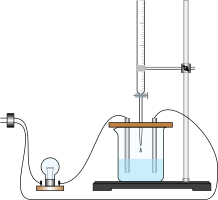
Using the apparatus shown in Figure 3.4, perform the following experiment: First fill the glass vessel halfway with barium hydroxide solution, then use the burette to add sulfuric acid solution into the vessel. As the sulfuric acid is added, the light bulb gradually dims, and eventually goes out completely. Why? If you continue to add sulfuric acid, the light bulb gradually brightens again — why? While adding the sulfuric acid, what phenomenon can you observe in the solution? If hydrochloric acid were used instead of sulfuric acid, would you observe the same phenomenon? Why or why not?
Write chemical equations corresponding to each of the following net ionic equations.
\(\ce{H+ + OH- -> H2O}\)
\(\ce{2H+ + CaCO3 -> Ca^{2+} + H2O + CO2}{\uparrow}\)
Two test tubes contain sodium hydroxide solution and barium hydroxide solution, respectively. How can you distinguish between them? Write the chemical equations and net ionic equations for the reactions involved.
Given five colorless solutions — dilute sulfuric acid, dilute hydrochloric acid, sodium sulfate, sodium carbonate, and sodium chloride — describe a chemical method to identify each one. Write the chemical equations and net ionic equations for all reactions involved.
3.6 Section 6: The Oxygen Family
Oxygen and sulfur are representative elements of the oxygen family.
The other oxygen family elements6 — selenium (Se) and tellurium (Te) — like sulfur, can combine with hydrogen to form gaseous compounds. The aqueous solutions of their hydrides are all acidic. In their hydrides, they all exhibit the \(-2\) oxidation state.
Except for oxygen, sulfur, selenium, and tellurium all form both dioxides and trioxides. In the trioxides, they display their highest oxidation state: \(+6\). The hydrated forms of these oxides are all acids:
| Dioxide | Corresponding acid | Trioxide | Corresponding acid |
|---|---|---|---|
| \(\ce{SO2}\) | \(\ce{H2SO3}\) | \(\ce{SO3}\) | \(\ce{H2SO4}\) |
| \(\ce{SeO2}\) | \(\ce{H2SeO3}\) | \(\ce{SeO3}\) | \(\ce{H2SeO4}\) |
| \(\ce{TeO2}\) | \(\ce{H2TeO3}\) | \(\ce{TeO3}\) | \(\ce{H2TeO4}\) |
The oxygen family elements can combine directly with most metals.
The similarity in properties of the oxygen family elements arises from the very similar electron configurations of their atoms — each has 6 electrons in its outermost shell. In chemical reactions, atoms of the oxygen family elements readily gain two electrons from other atoms, forming compounds in the \(-2\) oxidation state. The 6 or 4 outermost electrons of their atoms can also shift, forming compounds in the \(+6\) or \(+4\) oxidation states.
In addition to the similarities described above, the elemental forms of these four elements also exhibit certain differences in their properties.
From Table 3.1, we can see that the physical properties of the elemental forms of oxygen, sulfur, selenium, and tellurium change systematically with increasing nuclear charge. Their melting points and boiling points increase progressively with increasing nuclear charge, and their densities also increase progressively. Furthermore, sulfur cannot conduct electricity, selenium is a semiconductor, and tellurium can conduct electricity.
The chemical properties of the elemental forms of oxygen, sulfur, selenium, and tellurium also change with increasing nuclear charge. When these four elements combine with hydrogen, oxygen reacts with hydrogen most readily and most vigorously, and the resulting compound is most stable. Sulfur or selenium can only combine with hydrogen at relatively high temperatures, while tellurium generally cannot combine directly with hydrogen at all, and the resulting compound is the least stable. The acidity of the oxyacids of these elements (except oxygen) generally decreases with increasing nuclear charge.
The differences and trends in the properties of oxygen, sulfur, selenium, tellurium, and their compounds are related to their atomic structures. As the nuclear charge increases, the number of electron shells in their atoms increases, and both the atomic and ionic radii increase (Figure 3.5).
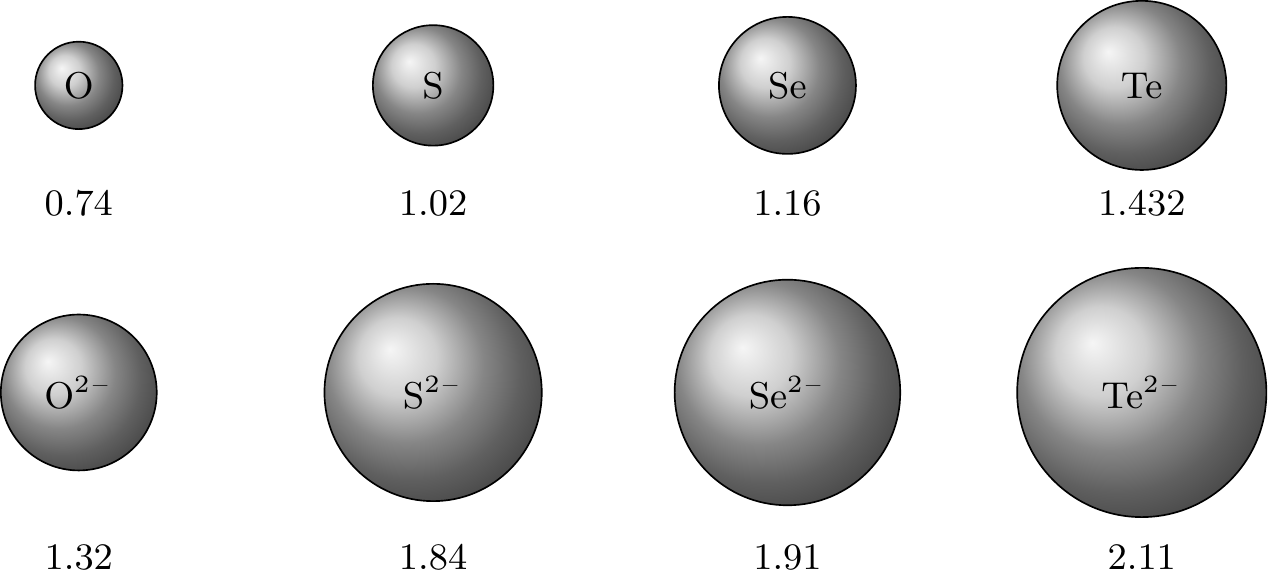
As atomic radius increases progressively, the attraction of the nucleus on the outer electrons weakens, the ability of atoms to gain electrons decreases in order, and the tendency to lose electrons increases in order. In other words, with increasing nuclear charge, the metallic character of oxygen, sulfur, selenium, and tellurium progressively increases, while the nonmetallic character progressively decreases.
| Property | O | S | Se | Te |
|---|---|---|---|---|
| Element symbol | O | S | Se | Te |
| Nuclear charge | 8 | 16 | 34 | 52 |
| Electron configuration | 2, 6 | 2, 8, 6 | 2, 8, 18, 6 | 2, 8, 18, 18, 6 |
| Color | Colorless | Yellow | Gray | Silvery white |
| State (at room temp.) | Gas | Solid | Solid | Solid |
| Melting point (\(\,{}^{\circ}\text{C}\)) | \(-218.4\) | \(112.8\) | \(217\) | \(452\) |
| Boiling point (\(\,{}^{\circ}\text{C}\)) | \(-183\) | \(444.6\) | \(684.9\) | \(1390\) |
| Density (g/cm³) | \(1.43\) (solid) | \(2.07\) | \(4.81\) | \(6.25\) |
| Hydride formula | \(\ce{H2O}\) | \(\ce{H2S}\) | \(\ce{H2Se}\) | \(\ce{H2Te}\) |
| Conditions for hydride formation | Ignite or electric discharge | Heat | Heat | Does not combine directly |
| Hydride stability | Most stable ← | — | — | → Least stable |
| Oxide formulas | — | \(\ce{SO2}\), \(\ce{SO3}\) | \(\ce{SeO2}\), \(\ce{SeO3}\) | \(\ce{TeO2}\), \(\ce{TeO3}\) |
| Hydrated oxides | — | \(\ce{H2SO3}\), \(\ce{H2SO4}\) | \(\ce{H2SeO3}\), \(\ce{H2SeO4}\) | \(\ce{H2TeO3}\), \(\ce{H2TeO4}\) |
- The oxygen family (O, S, Se, Te) all have 6 electrons in their outermost shell
- Common oxidation states: \(-2\), \(+4\), \(+6\) (oxygen typically shows only \(-2\))
- Trends with increasing nuclear charge (O → S → Se → Te):
- Atomic and ionic radii increase
- Melting points, boiling points, and densities increase
- Nonmetallic character decreases; metallic character increases
- Hydride stability decreases; oxyacid strength decreases
- Ease of reaction with \(\ce{H2}\) decreases
Exercises for Section 6
What similarities and differences exist among the properties of oxygen, sulfur, selenium, and tellurium?
What similarities and differences exist between the properties of the oxygen family and the halogen family (see Section 2.4)?
3.7 Chapter Summary
I. The Oxygen Family
The atoms of the oxygen family elements (oxygen, sulfur, selenium, tellurium) have very similar structures — each has 6 electrons in its outermost shell. In chemical reactions, they readily gain electrons, displaying nonmetallic character. As nuclear charge and number of electron shells increase, atomic radius increases; the ability of oxygen, sulfur, selenium, and tellurium atoms to gain electrons decreases in succession. Their metallic character gradually increases, while their nonmetallic character gradually decreases.
II. Chemical Properties of Sulfur
Sulfur reacts with most metals to form metal sulfides.
Sulfur reacts with hydrogen to form hydrogen sulfide.
Hydrogen sulfide is a reducing agent. Its aqueous solution, hydrosulfuric acid, is a weak acid.
Sulfur reacts with oxygen to form sulfur dioxide, etc.
III. Important Oxides of Sulfur
- Sulfur dioxide — \(\ce{SO2}\) dissolves easily in water. It reacts with water to form sulfurous acid. Sulfurous acid is unstable and readily decomposes into sulfur dioxide and water. This is a reversible reaction:
\[ \ce{SO2 + H2O <=> H2SO3} \]
A reversible reaction is one that, under the same conditions, proceeds simultaneously in both the forward and reverse directions.
- Sulfur trioxide — \(\ce{SO2}\) is catalytically oxidized to \(\ce{SO3}\). Sulfur trioxide reacts vigorously with water to form sulfuric acid.
IV. Sulfuric Acid
The main chemical reactions in the Contact Process for manufacturing sulfuric acid:
\(\ce{4FeS2 + 11O2 ->[\text{high temp.}] 2Fe2O3 + 8SO2}\)
\(\ce{2SO2 + O2 ->[\Delta][\text{catalyst}] 2SO3}\)
\(\ce{SO3 + H2O -> H2SO4}\)
Prevent pollution, protect the environment. Industrial waste gases, wastewater, and solid waste — such as tail gas containing \(\ce{SO2}\) from sulfuric acid factories — pollute the environment. They must be treated, recovered, and comprehensively utilized to prevent pollution of air, water, and soil, and to create a better working and living environment for the people.
Special properties of concentrated sulfuric acid: hygroscopicity, dehydrating ability, and oxidizing properties.
Detection of sulfate ions. Use a soluble barium salt solution and hydrochloric acid (or dilute nitric acid) to test for the presence of \(\ce{SO4^{2-}}\).
V. Ionic Reactions and Net Ionic Equations
In secondary school chemistry, the ionic reactions discussed are mainly metathesis (double displacement) reactions involving the exchange of ions. In addition, displacement reactions involving ions are also ionic reactions.
The conditions for metathesis-type ionic reactions to occur are: formation of a sparingly soluble substance, or a weakly ionized substance, or a volatile substance.
A net ionic equation uses the symbols of the ions that actually participate in the reaction to represent the ionic reaction. A net ionic equation represents not only a specific reaction between particular substances, but all reactions of the same type of ionic reaction.
When writing net ionic equations, write the symbols of the ions actually participating in the reaction, and represent sparingly soluble, weakly ionized, and volatile substances with their chemical formulas.
Review Problems
Write the chemical equations for the laboratory preparation of each of the following gases (for ionic reactions, also write the net ionic equation), and describe the method for collecting each gas.
Oxygen (\(\ce{O2}\))
Chlorine (\(\ce{Cl2}\))
Hydrogen chloride (\(\ce{HCl}\))
Hydrogen sulfide (\(\ce{H2S}\))
Sulfur dioxide (\(\ce{SO2}\))
What differences exist between the properties of concentrated sulfuric acid and dilute sulfuric acid?
Answer the following questions:
A Kipp’s generator is commonly used to prepare hydrogen sulfide gas. Why is it not used to prepare sulfur dioxide gas?
Why does a straw hat that has been bleached with sulfur dioxide gradually turn yellow over time?
In a Contact Process sulfuric acid factory, why is \(98.3\%\) sulfuric acid used instead of water to absorb sulfur trioxide?
Among the three substances \(\ce{H2S}\), S, and \(\ce{H2SO4}\), which can serve as an oxidizing agent, which as a reducing agent, and which can serve as either? Give specific reactions as examples.
Write the chemical equations or net ionic equations for the reactions of copper with concentrated sulfuric acid and of iron with dilute sulfuric acid. Identify which substance is reduced and which is oxidized in each reaction.
If pyrite containing \(72\%\) \(\ce{FeS2}\) is roasted, and \(1.5\%\) of the sulfur is lost to the slag, how many tonnes of \(98\%\) sulfuric acid can be produced from \(1\ \text{t}\) of this pyrite?
When iron(II) sulfide reacts with dilute hydrochloric acid, the gas produced is ignited. A piece of moistened blue litmus paper held near the flame turns pale red. When the bottom of a clean evaporating dish is held near the flame, a layer of yellow powder is deposited. Explain the causes of these phenomena and write the relevant chemical equations.
In each of the following reactions, is sulfur dioxide the oxidizing agent or the reducing agent? Why?
\(\ce{2H2S + SO2 -> 3S + 2H2O}\)
\(\ce{Br2 + SO2 + 2H2O -> H2SO4 + 2HBr}\)
Write the chemical equations for each transformation in the following sequence (for ionic reactions, also write the corresponding net ionic equations):
\[ \ce{FeS2 -> SO2 -> SO3 -> H2SO4 -> CuSO4 -> Cu} \]
Translator’s note: Polonium is a radioactive element. The original text uses the Chinese name 钋 (pō). Polonium was discovered by Marie Curie and Pierre Curie in 1898.↩︎
Translator’s note: The Chinese term 沸腾炉 (boiling furnace) is translated here as “fluidized bed roaster,” the standard English term in chemical engineering.↩︎
Translator’s note: More precisely, the first ionization of \(\ce{H2SO4}\) is essentially complete in dilute solution (\(\ce{H2SO4 -> H+ + HSO4-}\)), while the second ionization of the bisulfate ion (\(\ce{HSO4- <=> H+ + SO4^{2-}}\)) is incomplete. The original text simplifies this for the high school level.↩︎
Translator’s note: This phenomenon is known as passivation. The dense oxide layer (\(\ce{Fe2O3}\) or \(\ce{Al2O3}\)) prevents further reaction between the metal and the concentrated acid.↩︎
Translator’s note: The original Chinese text contains a typographical error, writing the reactant as “\(\ce{2KCl}\)” instead of “\(\ce{2KI}\).” The equation above shows the corrected version.↩︎
Translator’s note: The oxygen family is also known as the chalcogens (Group VIA in older notation, Group 16 in modern IUPAC notation). The text does not discuss polonium in detail because it is radioactive and has no stable isotopes.↩︎