4 Alkali Metals
After studying this chapter, you should be able to:
- Describe the physical and chemical properties of sodium, including its reactions with oxygen, sulfur, and water
- Explain the properties and applications of sodium oxide and sodium peroxide
- Compare the properties of sodium carbonate and sodium hydrogen carbonate, and describe methods to distinguish between them
- Identify key sodium compounds (sodium sulfate, sodium carbonate, sodium hydrogen carbonate) and their uses
- Describe atomic structure trends and physical properties across the alkali metal family (Li, Na, K, Rb, Cs)
- Perform and interpret flame tests for identifying alkali metals and other elements
- Explain trends in chemical reactivity of the alkali metals and relate them to atomic structure
We have already studied the halogen family and the oxygen family of elements, gaining some understanding of nonmetallic elements. In this chapter, we will study a family of metallic elements called the alkali metals.1
We already know that the atomic structures of lithium and sodium both have only 1 electron in their outermost shell. Four more elements — potassium, rubidium, cesium, and francium — also share this similar structure. The alkali metals include six elements: lithium (Li), sodium (Na), potassium (K), rubidium (Rb), cesium (Cs), and francium (Fr). Because the hydrated forms of their oxides are bases soluble in water, they are collectively called the alkali metals. This chapter primarily introduces the chemistry of sodium and its compounds.
4.1 Section 1: Sodium
Physical Properties of Sodium
Take a piece of metallic sodium, cut away the outer skin at one end with a knife, and observe the color of sodium.
Metallic sodium is very soft — it can be cut with a knife. After the outer skin is removed, one can see sodium’s “true appearance”: it is silvery-white and has a beautiful metallic luster.
Sodium is an excellent conductor of heat and electricity. Its density is \(0.97\ \text{g/cm}^3\), lighter than water, so it floats on the surface of water. Its melting point is \(97.81\,{}^{\circ}\text{C}\), and its boiling point is \(882.9\,{}^{\circ}\text{C}\).
Chemical Properties of Sodium
The chemical properties of sodium are very reactive.
1. Reaction with Oxygen
Cut open a small piece of sodium with a knife and observe the changes that occur on the freshly exposed, shiny surface. Place the small piece of sodium in a combustion spoon and heat it. Observe the changes that occur.
Sodium is easily oxidized. At room temperature, it readily combines with oxygen in the air to form an oxide. The freshly cut, shiny surface of metallic sodium quickly darkens, mainly because a thin layer of oxide has formed. When heated, sodium can catch fire and burn in air; it burns even more vigorously in pure oxygen, emitting a yellow flame. During the combination of sodium with oxygen, sodium oxide (\(\ce{Na2O}\)) can form first, but sodium oxide is unstable and continues to be oxidized, producing sodium peroxide (\(\ce{Na2O2}\)). Sodium peroxide is relatively stable, so when sodium burns in air, the product is sodium peroxide.
\[ \ce{2Na + O2 -> Na2O2} \]
2. Reaction with Sulfur and Other Nonmetals
In addition to combining directly with chlorine gas, sodium can also combine directly with many other nonmetals. For example, when sodium combines with sulfur, it can even cause an explosion, producing sodium sulfide.
\[ \ce{2Na + S -> Na2S} \]
3. Reaction with Water
Sodium reacts vigorously with water.
Add a few drops of phenolphthalein solution to a beaker of water. Then drop a small piece of sodium (about half the size of a pea) into the beaker. Carefully observe how the sodium reacts with water and how the color of the solution changes. Next, wrap a small piece of sodium in aluminum foil, poke some small holes in the foil, hold it with tweezers, and place it beneath the mouth of an inverted test tube. Collect the gas by water displacement (Figure 4.1). Carefully remove the test tube and bring it near a flame to test whether hydrogen gas has been collected.
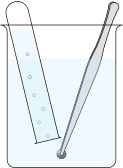
The sodium dropped into the beaker is lighter than water and floats on the surface. The heat released by the reaction of sodium with water immediately melts the sodium into a shiny little ball. The ball darts rapidly in all directions across the water surface, gradually shrinking until it completely disappears. After sodium reacts with water, the water — which contained phenolphthalein solution — changes from colorless to red. This phenomenon shows that a different substance has been produced; that product is sodium hydroxide. The gas collected in the test tube is hydrogen.
\[ \ce{2Na + 2H2O -> 2NaOH + H2}{\uparrow} \]
Because sodium reacts readily with oxygen or water in the air, it is usually stored under kerosene, isolated from air and water.
Occurrence of Sodium
Sodium is very reactive, so it cannot exist in nature in the free state — it exists only in the combined state. Sodium compounds are widely distributed in nature, mainly in the form of sodium chloride (\(\ce{NaCl}\)), but also as sodium sulfate (\(\ce{Na2SO4}\)), sodium carbonate (\(\ce{Na2CO3}\)), sodium nitrate (\(\ce{NaNO3}\)), and others.
Preparation and Uses of Sodium
In industry, sodium can be produced by passing a direct electric current through molten sodium chloride.
Sodium can be used to prepare sodium peroxide and other compounds. An alloy of sodium and potassium (containing \(50\%\)–\(80\%\) potassium) is liquid at room temperature and serves as a heat-transfer agent in nuclear reactors. Sodium is a very strong reducing agent (see Section 2.3) and can reduce metals such as titanium, zirconium, niobium, and tantalum from their molten halides. Sodium is also used in electric light sources. High-pressure sodium lamps emit yellow light with a long range and strong fog-penetrating ability, providing several times the road-surface illumination of high-pressure mercury lamps.
- Sodium is a silvery-white, soft metal (density \(0.97\ \text{g/cm}^3\), mp \(97.81\,{}^{\circ}\text{C}\), bp \(882.9\,{}^{\circ}\text{C}\))
- Sodium is lighter than water and floats on its surface
- Sodium reacts with \(\ce{O2}\) at room temperature to form \(\ce{Na2O}\); when burning, it forms \(\ce{Na2O2}\)
- Sodium reacts with sulfur (even explosively) to form \(\ce{Na2S}\)
- Sodium reacts vigorously with water to produce \(\ce{NaOH}\) and \(\ce{H2}\)
- Sodium must be stored under kerosene to prevent contact with air and water
- Uses: producing \(\ce{Na2O2}\), nuclear reactor coolant (Na–K alloy), strong reducing agent, high-pressure sodium lamps
Exercises for Section 1
How should metallic sodium be stored? Why?
If \(0.2\ \text{mol}\) of sodium reacts with water, how many liters of hydrogen gas (at STP) can be produced?
When sodium catches fire, which of the following substances or equipment should be used to extinguish it? Why?
- Water
- Foam fire extinguisher
- Dry powder fire extinguisher
4.2 Section 2: Sodium Compounds
Oxides of Sodium
The oxides of sodium include sodium oxide and sodium peroxide, among others. Sodium oxide (\(\ce{Na2O}\)) is a white solid that reacts vigorously with water to produce sodium hydroxide.
\[ \ce{Na2O + H2O -> 2NaOH} \]
Sodium peroxide (\(\ce{Na2O2}\)) is a pale yellow solid that also reacts with water, producing sodium hydroxide and oxygen gas.
Add drops of water into a test tube containing solid sodium peroxide. Place a glowing wooden splint at the mouth of the tube to test whether oxygen gas is evolved.
\[ \ce{2Na2O2 + 2H2O -> 4NaOH + O2}{\uparrow} \]
Sodium peroxide is a strong oxidizing agent and can be used to bleach fabrics, straw, feathers, and so on.
Sodium peroxide also reacts with carbon dioxide to produce sodium carbonate and oxygen gas.
\[ \ce{2Na2O2 + 2CO2 -> 2Na2CO3 + O2}{\uparrow} \]
For this reason, sodium peroxide is used in breathing masks and submarines as a source of oxygen.
Other Important Sodium Compounds
In junior high school chemistry, we learned about an important sodium compound — sodium hydroxide. Below we briefly introduce several important sodium salts.
1. Sodium Sulfate
Crystalline sodium sulfate is commonly known as Glauber’s salt2 (\(\ce{Na2SO4 * 10H2O}\)). Sodium sulfate is an important raw material for manufacturing glass and paper (pulp production). It is also used in dyeing, textiles, water glass production, and other industries. In medicine, it is used as a mild laxative. In nature, sodium sulfate is found mainly in salt lakes and seawater. China has abundant Glauber’s salt resources.
2. Sodium Carbonate and Sodium Hydrogen Carbonate
Sodium carbonate (\(\ce{Na2CO3}\)), commonly known as soda ash or washing soda, is a white powder. Sodium carbonate usually contains water of crystallization (\(\ce{Na2CO3 * 10H2O}\)). In air, sodium carbonate crystals readily lose their water of crystallization, causing the surface to lose its luster and gradually become dull, and the crystals slowly crumble into powder. Sodium carbonate that has lost its water is called anhydrous sodium carbonate. Sodium hydrogen carbonate (\(\ce{NaHCO3}\)), commonly known as baking soda, is a fine white crystalline solid. Sodium carbonate dissolves in water more readily than sodium hydrogen carbonate.
Both sodium carbonate and sodium hydrogen carbonate release carbon dioxide when they react with hydrochloric acid.
\[ \ce{Na2CO3 + 2HCl -> 2NaCl + H2O + CO2}{\uparrow} \]
\[ \ce{NaHCO3 + HCl -> NaCl + H2O + CO2}{\uparrow} \]
Add a small amount of hydrochloric acid separately to two test tubes, one containing sodium carbonate and the other containing sodium hydrogen carbonate. Compare the rates at which they release carbon dioxide.
The release of carbon dioxide when sodium hydrogen carbonate reacts with hydrochloric acid is much more vigorous than that of sodium carbonate.
Sodium carbonate is very stable and difficult to decompose by heating. Sodium hydrogen carbonate, however, is not very stable and decomposes easily when heated.
Using the apparatus shown in Figure 4.2, place sodium carbonate in a test tube to about 1/6 of the tube’s volume, and pour limewater into the beaker. Heat the test tube and observe whether the clear limewater changes. Remove the test tube and replace it with one containing the same volume of sodium hydrogen carbonate. Heat again and observe any changes in the clear limewater.
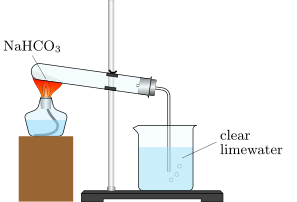
Sodium carbonate shows no change when heated, whereas sodium hydrogen carbonate decomposes upon heating, releasing carbon dioxide.
\[ \ce{2NaHCO3 ->[\Delta] Na2CO3 + H2O + CO2}{\uparrow} \]
This reaction can be used to distinguish between sodium carbonate and sodium hydrogen carbonate.
Sodium carbonate is one of the important products of the chemical industry and has many uses. It is widely used in the glass, soap, paper, and textile industries, and can also be used to prepare other sodium compounds. In daily life, it is commonly used as a cleaning agent. Sodium hydrogen carbonate is one of the main components of the baking powder used in pastry making. In medicine, it is used as an antacid to treat excess stomach acid.
Sodium carbonate occurs naturally. Alkaline soils and certain salt lakes commonly contain sodium carbonate. The salt lakes in the Inner Mongolia Autonomous Region of China produce large quantities of natural soda.
- Sodium oxide (\(\ce{Na2O}\)) is a white solid; reacts with water to form \(\ce{NaOH}\)
- Sodium peroxide (\(\ce{Na2O2}\)) is a pale yellow solid; reacts with water to form \(\ce{NaOH + O2}\); reacts with \(\ce{CO2}\) to form \(\ce{Na2CO3 + O2}\) — used in breathing masks and submarines
- Sodium peroxide is a strong oxidizing agent (bleaching)
- Sodium sulfate (\(\ce{Na2SO4 * 10H2O}\), Glauber’s salt): used in glass, paper, and medicine
- Sodium carbonate (\(\ce{Na2CO3}\), soda ash): stable, does not decompose when heated; used in glass, soap, and as a cleaning agent
- Sodium hydrogen carbonate (\(\ce{NaHCO3}\), baking soda): decomposes when heated (\(\ce{2NaHCO3 ->[\Delta] Na2CO3 + H2O + CO2}{\uparrow}\)); used in baking powder and as an antacid
- \(\ce{NaHCO3}\) reacts with \(\ce{HCl}\) more vigorously than \(\ce{Na2CO3}\) does — can be used to distinguish them
Exercises for Section 2
In breathing masks, sodium peroxide is sometimes used. What property of sodium peroxide does this application rely on?
How can you determine whether a certain powder of sodium carbonate contains sodium hydrogen carbonate? How can you remove sodium hydrogen carbonate that is mixed in with sodium carbonate?
Write the chemical equations for the following conversions (for ionic reactions, also write the corresponding net ionic equations; see Section 3.5).
\[ \ce{Na -> NaOH -> NaCl -> Na2SO4} \]
Air normally contains \(0.05\%\) \(\ce{CO2}\) by mass. Calculate how many liters of air (at STP) can have their carbon dioxide absorbed by \(10\ \text{g}\) of sodium peroxide.
Heat \(410\ \text{g}\) of baking soda until no more gas is evolved. What substance remains? What is its mass?
A mixture of sodium carbonate and sodium hydrogen carbonate weighing \(146\ \text{g}\) is heated until the mass no longer decreases. The remaining residue has a mass of \(137\ \text{g}\). Calculate the percentage of sodium carbonate in the mixture.
4.3 Section 3: The Alkali Metal Family
Atomic Structure and Physical Properties
All alkali metal elements exist in nature in the combined state; their elemental forms are produced artificially. Except for cesium, which has a slight golden luster, all alkali metals are silvery-white. The alkali metals are all relatively soft and malleable. They have low densities and low melting points — cesium becomes liquid when the temperature is slightly elevated. They are all excellent conductors of heat and electricity. Among metals, alkali metals — especially lithium, sodium, and potassium — are among the lightest. Table 4.1 lists the atomic structures and physical properties of each element.
| Property | Li | Na | K | Rb | Cs |
|---|---|---|---|---|---|
| Nuclear charge | 3 | 11 | 19 | 37 | 55 |
| Electron configuration | 2, 1 | 2, 8, 1 | 2, 8, 8, 1 | 2, 8, 18, 8, 1 | 2, 8, 18, 18, 8, 1 |
| Color and state | Silver-white, soft | Silver-white, soft | Silver-white, soft | Silver-white, soft | Silver-white with slight golden luster, soft |
| Density (g/cm³) | 0.534 | 0.97 | 0.86 | 1.532 | 1.879 |
| Melting point | \(180.5\,{}^{\circ}\text{C}\) | \(97.81\,{}^{\circ}\text{C}\) | \(63.65\,{}^{\circ}\text{C}\) | \(38.89\,{}^{\circ}\text{C}\) | \(28.40\,{}^{\circ}\text{C}\) |
| Boiling point | \(1347\,{}^{\circ}\text{C}\) | \(882.9\,{}^{\circ}\text{C}\) | \(774\,{}^{\circ}\text{C}\) | \(688\,{}^{\circ}\text{C}\) | \(678.4\,{}^{\circ}\text{C}\) |
From Table 4.1 we can see that the atoms of lithium, sodium, potassium, rubidium, and cesium all have the same number of electrons in their outermost shell — just one electron. This single electron influences the size of the atom; once this electron is lost and the atom becomes an ion, the ion is significantly smaller than the atom. This can be clearly seen in Figure 4.3.
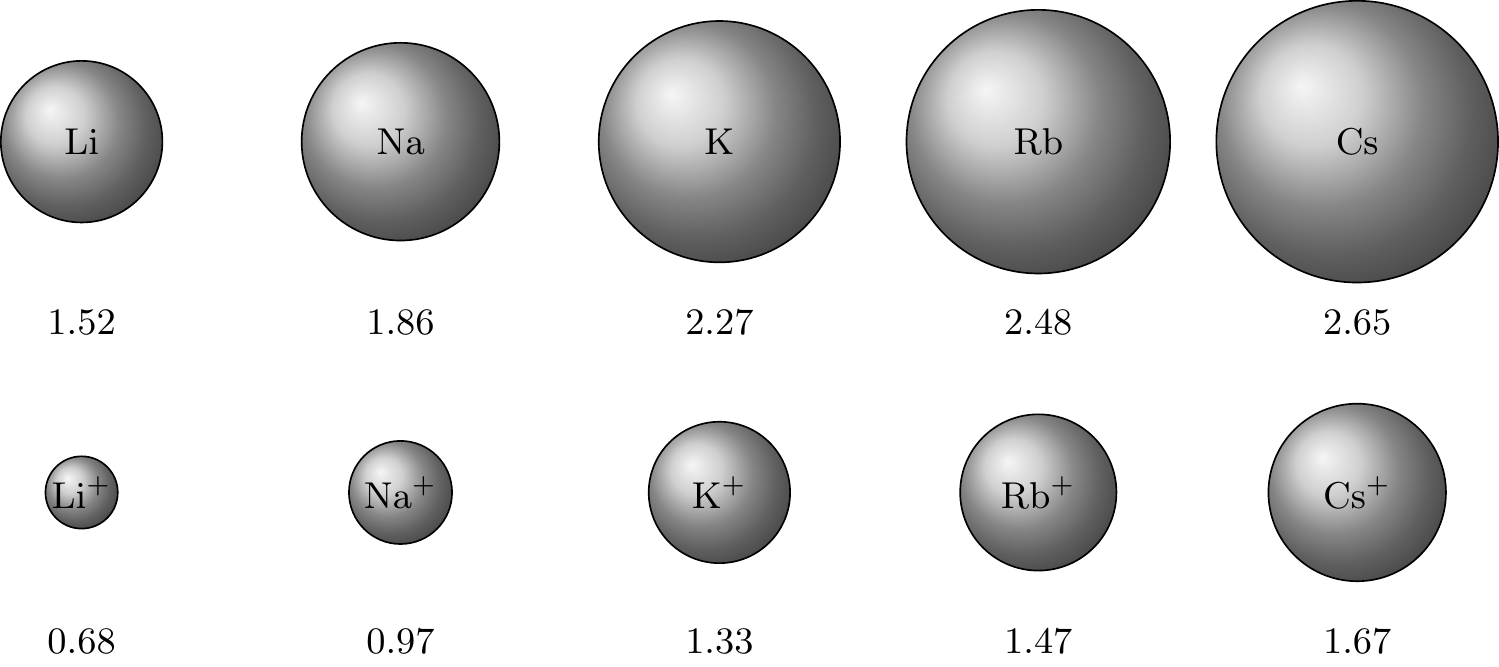
The atomic radii4 or ionic radii of the alkali metals generally increase as the number of electron shells increases. This trend is consistent with what we observed for the halogens (see Section 2.4) and the oxygen family (see Section 3.6). The melting points and boiling points of the alkali metals generally decrease as the number of electron shells increases.
Flame Tests
When we cook, if salt or salt water accidentally splashes onto a coal gas flame or coal fire, the flame turns yellow. This phenomenon of flames displaying colors has a practical application in scientific experiments — it can be used to test for certain metals or metal compounds. Many metals or their compounds produce characteristic flame colors when heated in a flame. In chemistry, this is called a flame test.5
Place a platinum wire6 mounted on a glass rod into an alcohol lamp flame (a Bunsen burner is preferable, as its own flame color is weaker). When the wire shows no color different from the original flame, dip it in sodium carbonate solution, then hold it in the flame. You will see that the flame turns yellow (Figure 4.4). After each test, clean the platinum wire with dilute hydrochloric acid and heat it in the flame until no distinctive color remains. Then repeat the test by dipping in potassium carbonate solution and lithium carbonate solution, observing the flame color in each case. When observing the flame color of potassium, look through blue cobalt glass to filter out the yellow light and avoid interference from sodium impurities in the potassium carbonate.
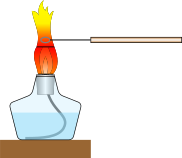
The alkali metals and their compounds all produce distinctive flame colors, known as flame tests. In addition, metals such as calcium, strontium, and barium also produce flame tests. Based on the characteristic color displayed in a flame test, one can detect the presence of certain metals or metal ions. The flame colors of various metals or metal ions are listed below:
| Metal | Flame Color |
|---|---|
| Lithium (Li) | Crimson |
| Sodium (Na) | Yellow |
| Potassium (K) | Pale violet (viewed through blue cobalt glass) |
| Rubidium (Rb) | Violet |
| Calcium (Ca) | Brick red |
| Strontium (Sr) | Magenta |
| Barium (Ba) | Yellow-green |
| Copper (Cu) | Green |
The colorful fireworks displayed on festive evenings owe their brilliant hues to compounds of the alkali metals, strontium, barium, and other metals.
Chemical Properties of the Alkali Metals
We know that sodium is chemically very reactive. Its atom has a single electron in the outermost shell, which is easily lost in chemical reactions. The atoms of lithium, potassium, rubidium, and cesium also each have a single outermost electron that is easily lost. Therefore, all of them are chemically very reactive. Losing electrons is an oxidation reaction, so the alkali metals are strong reducing agents.
1. Reactions with Nonmetals
The reactions of alkali metals with halogens can be very vigorous — a fact we already know.
Like sodium, the other alkali metals also react with oxygen. Lithium reacts with oxygen to produce lithium oxide.
\[ \ce{4Li + O2 -> 2Li2O} \]
Potassium, rubidium, and others react with oxygen to form oxides more complex than peroxides.
The alkali metals can react with most nonmetals, exhibiting very strong metallic character.
2. Reactions with Water
All alkali metals react with water, producing hydroxides and releasing hydrogen gas. These hydroxides all turn phenolphthalein solution red. The reaction of potassium with water is more vigorous than that of sodium, often causing the hydrogen produced to ignite and triggering a mild explosion.
Remove a piece of metallic potassium from kerosene, place it on a dry glass plate, and blot off the kerosene with filter paper. Cut a piece about the size of a mung bean, and drop it into a beaker of cold water. Quickly cover the beaker with a glass plate to prevent spattering from the mild explosion. After the reaction is complete, add a few drops of phenolphthalein solution and observe the color change of the solution.
\[ \ce{2K + 2H2O -> 2KOH + H2}{\uparrow} \]
This reaction involves potassium atoms losing one electron each, while hydrogen ions in the water each gain one electron to become hydrogen atoms, which then combine to form hydrogen molecules.
Among the alkali metals, because the atoms have different numbers of electron shells, the nucleus exerts a weaker attractive force on electrons in atoms with more shells. Therefore, the electrons are more easily lost as the number of shells increases. As the number of electron shells increases and the atomic radius increases, the reactivity of the alkali metals increases. Taking sodium and potassium as examples, potassium reacts more vigorously than sodium with both oxygen and water. These facts illustrate the relationship between atomic structure and properties.
Uses of Lithium, Potassium, Rubidium, and Cesium
The alkali metals have various applications in production and modern science and technology. Lithium is used to prepare catalysts for the organic chemical industry, various alloys, high-strength glass, and other materials. Lithium is also used to produce tritium, a material for thermonuclear reactions. Compounds of potassium such as \(\ce{KCl}\) and \(\ce{K2SO4}\) are important fertilizers. Rubidium and cesium can release electrons when exposed to ordinary light, and are used in manufacturing photoelectric cells and other devices.
Many important potassium compounds — such as potassium chloride, potassium sulfate, and potassium carbonate — are potassium fertilizers. We already learned the basics of potassium fertilizers in junior high school chemistry. The potassium content of soil is not low, but most of it exists in the form of potassium minerals — for example, orthoclase, muscovite,7 and others. These minerals are insoluble in water and cannot be utilized by crops. Only through prolonged weathering (exposure to air, water, and acids in the soil) can they gradually be converted into water-soluble potassium compounds that crops can absorb. Therefore, the potassium in soil often cannot meet the needs of crop growth, and potassium fertilizers must be applied to supplement it.
The potassium fertilizers commonly applied are mainly various potassium salts, such as potassium chloride, potassium sulfate, and potassium carbonate (the main component of wood ash). These potassium salts are all readily soluble in water. In solution, potassium exists in ionic form and is easily absorbed by crops, making these fertilizers fast-acting. However, it is important to note that because they dissolve easily in water, precautions should be taken during application to prevent loss by rainwater.
In scientific farming to achieve high yields, when applying potassium fertilizers, one should adapt to local conditions and ensure a reasonable combination of nitrogen, phosphorus, and potassium fertilizers.
- Alkali metal atoms all have 1 electron in their outermost shell; they easily lose this electron and are strong reducing agents
- Atomic and ionic radii increase with the number of electron shells (Li < Na < K < Rb < Cs)
- Melting and boiling points generally decrease from Li to Cs
- Alkali metals react with nonmetals (halogens, oxygen) and with water; reactivity increases from Li to Cs
- Potassium reacts with water more vigorously than sodium, often igniting the hydrogen produced
- Flame tests: Li = crimson, Na = yellow, K = pale violet (through cobalt glass)
- Applications: Li in alloys and tritium production; K compounds as fertilizers; Rb and Cs in photoelectric devices
Exercises for Section 3
Compare the physical and chemical properties of sodium and potassium.
In the halogen family and the alkali metal family, which family has atoms smaller than their corresponding ions, and which has atoms larger than their corresponding ions? Give examples to illustrate.
Write the chemical equations for the following reactions.
- \(\ce{K2O + H2O ->}\)
- \(\ce{K2O2 + H2O ->}\)
- \(\ce{Li2O + H2O ->}\)
Use the electron-transfer perspective to explain the following oxidation–reduction reactions.
- \(\ce{2K + Cl2 -> 2KCl}\)
- \(\ce{2K + 2H2O -> 2KOH + H2}{\uparrow}\)
Dissolve \(4\ \text{g}\) of sodium hydroxide in water to make a solution. How many milliliters of hydrochloric acid with a density of \(1.19\ \text{g/cm}^3\) can this solution react with?
4.4 Chapter Summary
I. The Alkali Metal Family
The alkali metals are a family of metallic elements. The common feature of their atomic structures is that the second-to-last electron shell has 8 electrons (2 for lithium), and the outermost electron shell has only one electron — which is easily lost in chemical reactions. Therefore, their chemical properties are fundamentally similar. The differences lie in their different nuclear charges, different numbers of electron shells, and different atomic radii. Consequently, the properties of the alkali metal elements are both similar and different.
II. Chemical Properties
The main chemical characteristic of the alkali metals is their strong metallic character, which increases as the atomic radius increases. Their elemental forms are all strong reducing agents.
Chemical properties of the alkali metals:
- Reactions with halogens — producing halides
- Reactions with oxygen — producing oxides, peroxides, and more complex oxides
- Reactions with water — producing hydroxides and releasing hydrogen gas
III. Flame Tests
The alkali metals and their compounds can cause flames to display different colors — these are flame tests. Based on the characteristic color displayed in a flame test, one can determine the presence of certain metals or metal ions.
Review Problems
Answer the following questions:
- Why should you never handle metallic sodium directly with your hands, but instead use tweezers?
- Why must you look through blue cobalt glass when observing the flame color of potassium?
- Why must solid or dissolved sodium hydroxide be stored in sealed containers?
- Sodium and potassium look very similar in appearance. How can you distinguish between them?
If \(1\ \text{mol}\) each of sodium and potassium react with water, are the masses of the hydroxides produced equal? Are the masses of the hydrogen gas produced equal?
Select the correct answer(s) and fill in the parentheses.
Which of the following substances can be used to produce oxygen gas: ( )
A. \(\ce{Na2O2}\) B. \(\ce{CaCO3}\) C. \(\ce{KClO3}\) D. \(\ce{H2SO4}\) E. \(\ce{H2O}\)
The sodium ion ( )
A. releases hydrogen gas upon contact with water B. must be stored in kerosene C. has one more electron than a sodium atom D. produces a yellow color when heated in a colorless flame
Which of the following substances, when placed in water, produces an alkaline solution: ( )
A. \(\ce{Na2O2}\) B. \(\ce{NaCl}\) C. \(\ce{CuO}\) D. K
Write the chemical equations for the following conversions (for ionic reactions, also write the corresponding net ionic equations; see Section 3.5).
\[ \ce{Na -> Na2O2 -> NaOH -> Na2CO3 -> CaCO3 -> Ca(HCO3)2} \]
Translator’s note: The name “alkali” derives from the Arabic word القلي (al-qalī), meaning “ashes of plants,” from which potassium carbonate was historically extracted. The Chinese name 碱金属 (jiǎn jīnshǔ) literally means “base metals,” reflecting the same property — their oxides form soluble bases.↩︎
Translator’s note: Glauber’s salt is named after Johann Rudolf Glauber (1604–1668), a German-Dutch alchemist who first produced sodium sulfate from sulfuric acid and sodium chloride.↩︎
Translator’s note: The unit \(10^{-10}\ \text{m}\) is the ångström (Å), named after Anders Jonas Ångström (1814–1874). In modern practice, the picometre (pm) is preferred: \(1\ \text{Å} = 100\ \text{pm}\).↩︎
The atomic radius here refers to half the internuclear distance between adjacent atoms in the solid metal.↩︎
Translator’s note: The Chinese term 焰色反应 (yànsè fǎnyìng) literally translates as “flame color reaction.”↩︎
A clean, rust-free iron wire, or nickel, chromium, or tungsten wire may also be used.↩︎
Orthoclase: \(\ce{KAlSi3O8}\); muscovite: \(\ce{KH2Al3Si3O12}\).↩︎