Laboratory Experiments
Experiment 1: Properties of Copper and Its Compounds
Objective
To deepen understanding of the properties of copper and its compounds.
Materials
Test tubes, test tube rack, test tube holder, dropper, graduated cylinder, alcohol lamp, sandpaper.
Copper wire, copper pieces, concentrated sulfuric acid, dilute sulfuric acid, concentrated nitric acid, dilute nitric acid, dilute hydrochloric acid, \(0.2\ \text{mol/L}\) \(\ce{AgNO3}\) solution, \(\ce{CuO}\) powder, \(\ce{CuSO4 . 5H2O}\) crystals, \(0.2\ \text{mol/L}\) \(\ce{CuSO4}\) solution, \(2\ \text{mol/L}\) \(\ce{NaOH}\) solution, \(2\ \text{mol/L}\) ammonia solution, \(\ce{BaCl2}\) solution.
Procedure
1. Properties of copper
Take a piece of copper wire, polish one end with sandpaper, heat it in the alcohol lamp flame for several seconds, then remove and cool. Observe what changes occur on the surface of the copper wire. Write the chemical equation for the reaction.
Add \(2\ \text{mL}\) each of dilute sulfuric acid, concentrated sulfuric acid, dilute nitric acid, and concentrated nitric acid to four separate test tubes. Add a small piece of copper to each. Record the observed phenomena. For those test tubes where no reaction occurs, apply gentle heat. Record the observed phenomena again. Explain these phenomena and write the relevant chemical equations.
Add \(2\ \text{mL}\) of \(0.2\ \text{mol/L}\) \(\ce{AgNO3}\) solution to a test tube. Bend a clean copper wire into a spiral and immerse it in the \(\ce{AgNO3}\) solution. Observe the phenomena that occur. Determine what solids are deposited on the copper wire and in the test tube. Design an experiment to verify your identification.
2. Properties of copper compounds
To three test tubes each containing a small amount of \(\ce{CuO}\) powder, add \(2\ \text{mL}\) of dilute hydrochloric acid, dilute sulfuric acid, and dilute nitric acid, respectively. Observe the phenomena in each test tube, then heat and observe again.
Place a small amount of \(\ce{CuSO4 . 5H2O}\) crystals in a dry test tube. Tilt the mouth of the test tube slightly downward and heat the copper sulfate crystals. What happens? After the test tube cools, add a small amount of distilled water to obtain a blue solution. Add \(\ce{BaCl2}\) solution dropwise to the blue solution — a white precipitate forms. Then add dilute nitric acid — the precipitate does not dissolve. Explain this series of experimental phenomena and write the chemical equations for each reaction.
Add \(2\ \text{mL}\) of \(2\ \text{mol/L}\) \(\ce{NaOH}\) solution dropwise to a test tube containing \(2\ \text{mL}\) of \(0.2\ \text{mol/L}\) \(\ce{CuSO4}\) solution. Observe the precipitate that forms. Divide the precipitate among three test tubes. To one, add dilute sulfuric acid dropwise. To another, add \(\ce{NaOH}\) solution dropwise. Heat the third. Observe and explain the phenomena.
Add \(2\ \text{mL}\) of \(2\ \text{mol/L}\) \(\ce{NaOH}\) solution to a test tube containing \(2\ \text{mL}\) of \(0.2\ \text{mol/L}\) \(\ce{CuSO4}\) solution, then add concentrated ammonia solution dropwise. Observe the formation and dissolution of the blue precipitate.
To the resulting solution, add approximately \(2\ \text{mL}\) of \(2\ \text{mol/L}\) \(\ce{NaOH}\) solution. Observe whether any reaction occurs. Explain the phenomena observed above and write the ionic equations for the reactions.
Discussion
Copper can react with concentrated sulfuric acid. Why can’t it react with dilute sulfuric acid? If iron were used in place of copper with concentrated and dilute sulfuric acid, what phenomena would be observed?
What does Experiment 1(3) demonstrate? If \(\ce{Hg(NO3)2}\) or \(\ce{Pb(NO3)2}\) were used instead of \(\ce{AgNO3}\), what phenomena would be observed?
Experiment 2: Laboratory Practical Problems
Objective
To consolidate knowledge of the properties of iron, copper, and coordination compounds.
Problems
Given an unknown solution, how would you experimentally confirm that it is iron(III) chloride?
Design an experiment to distinguish between \(\ce{Fe^{3+}}\) and \(\ce{[Fe(CN)6]^{3-}}\) complex ion.
How would you separate \(\ce{Fe^{3+}}\) and \(\ce{Al^{3+}}\) from solution?
Demonstrate by two methods that \(\ce{Fe^{3+}}\) has oxidizing properties.
How would you use chemical methods to remove iron powder mixed in with copper powder?
Given four solid substances — \(\ce{CuSO4}\), \(\ce{BaCl2}\), \(\ce{NaOH}\), and \(\ce{NaCl}\) — with no other reagent besides distilled water, how would you identify each of them?
Choose appropriate reagents to dissolve each of the following sparingly soluble substances:
\(\ce{Cu(OH)2}\)
\(\ce{AgCl}\)
Using four solutions — \(\ce{CuSO4}\), \(\ce{BaCl2}\), \(\ce{NaOH}\), and ammonia solution — design an experiment to demonstrate that in the coordination compound \(\ce{[Cu(NH3)4]SO4}\), the \(\ce{Cu^{2+}}\) is in the inner sphere and the \(\ce{SO4^{2-}}\) is in the outer sphere.
Discussion
\(\ce{AgCl}\) reacts with excess ammonia solution to form a coordination compound with the formula \(\ce{AgCl . 2NH3}\). How would you experimentally determine its inner and outer spheres?
Experiment 3: Preparation and Properties of Methane
Objective
- Learn the laboratory method for preparing methane.
- Deepen understanding of the properties of methane.
Materials
Test tubes, alcohol lamp, iron stand, water trough, stopper with delivery tube, glass rod, small beaker, spatula.
Anhydrous sodium acetate, soda-lime, granular \(\ce{NaOH}\) solid, limewater, dilute sulfuric acid, \(0.01\ \text{mol/L}\) \(\ce{KMnO4}\) solution.
Procedure
1. Preparation of methane
Assemble the apparatus as shown in Figure 1 and check the setup for gas leaks.
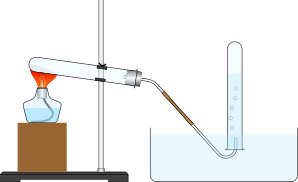
Figure 1: Apparatus for the preparation of methane Take \(2.5\ \text{g}\) of anhydrous sodium acetate and \(1.5\ \text{g}\) of soda-lime, and mix them evenly on paper using a glass rod. Transfer the mixture into the test tube of the apparatus.
Carefully heat the test tube containing the mixture. After the air in the test tube has been expelled, collect one test tube of methane by water displacement. Write the chemical equation for the reaction that produces methane.
2. Properties of methane
Observe the color and physical state of methane, and note its odor.
After checking the purity of the methane, ignite it at the mouth of the delivery tube. Hold a dry beaker inverted above the methane flame. Observe carefully. Then replace it with a beaker whose inner walls have been moistened with limewater. Observe and explain the phenomena. Write the relevant chemical equations.
Remove the curved glass tube from the lower end of the delivery tube and replace it with a straight glass tube. Insert the delivery tube into a test tube containing \(2\ \text{mL}\) of \(0.01\ \text{mol/L}\) \(\ce{KMnO4}\) solution (to which a small amount of sulfuric acid has been added). Pass methane through and observe whether the color of the solution changes.
Discussion
Why should the mouth of the test tube containing the reactants be tilted downward?
Why must anhydrous sodium acetate be used? Why does the experiment often give poor results when old soda-lime is used?
Experiment 4: Preparation and Properties of Ethylene and Acetylene
Objective
- Learn the laboratory methods for preparing ethylene and acetylene.
- Deepen understanding of the properties of ethylene and acetylene.
Materials
Test tubes, alcohol lamp, iron stand, large test tube, separating funnel, stopper with delivery tube.
Calcium carbide, cotton, ethanol–sulfuric acid mixture, broken porcelain pieces, bromine water, acidified \(\ce{KMnO4}\) solution.
Procedure
1. Preparation and properties of ethylene
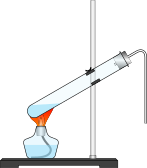
Connect the apparatus as shown in Figure 2 and check for gas leaks.
Pour \(6\)–\(8\ \text{mL}\) of ethanol–sulfuric acid mixture into the test tube. Add a few pieces of broken porcelain to the test tube to prevent bumping. Stopper the test tube with the delivery tube assembly. Heat with an alcohol lamp, rapidly raising the temperature of the mixture — ethylene is produced.
Pass the ethylene into a test tube containing bromine water. Observe the phenomena. Write the chemical equation for the reaction.
Pass the ethylene into acidified \(\ce{KMnO4}\) solution. Observe the phenomena.
Ignite the ethylene at the mouth of the delivery tube. Observe the flame. Write the chemical equation for the reaction.
2. Preparation and properties of acetylene
Assemble the apparatus as shown in Figure 3.
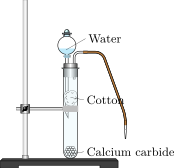
Figure 3: Apparatus for the preparation of acetylene Place several small pieces of calcium carbide in the test tube. Add about \(15\ \text{mL}\) of water to the separating funnel.
Add water dropwise to the test tube. Control the dropping rate so the reaction is not too vigorous. Pass the generated acetylene first through a test tube containing acidified \(\ce{KMnO4}\) solution. Observe the phenomena.
Pass the acetylene into a test tube containing bromine water. Observe the phenomena.
Ignite the generated acetylene. Observe the flame carefully. Write the chemical equation for the reaction.
Discussion
Compare the phenomena observed when ethylene and methane are passed through acidified \(\ce{KMnO4}\) solution, and give a structural explanation.
In the preparation of ethylene, a large amount of concentrated sulfuric acid is used. Consider what property of sulfuric acid, besides its role as a catalyst, is being utilized to promote the reaction.
Experiment 5: Properties of Benzene and Toluene
Objective
To deepen understanding of the properties of benzene and toluene, and to learn the experimental technique for nitration reactions.
Materials
Test tubes, dropper, alcohol lamp, iron stand, large beaker, thermometer.
Benzene, toluene, vegetable oil, bromine water, acidified \(\ce{KMnO4}\) solution, concentrated sulfuric acid, concentrated nitric acid (density \(1.4\ \text{g/cm}^3\)).
Procedure
Add \(1\ \text{mL}\) of benzene to one test tube and \(1\ \text{mL}\) of water to another. Add a few drops of vegetable oil to each and shake. Observe the solubility of the oil in benzene versus water.
Add \(1\ \text{mL}\) of benzene to each of two test tubes. To one, add bromine water; to the other, add acidified \(\ce{KMnO4}\) solution. Shake and observe the phenomena.
Using the same method as in step 2, test the effect of toluene on acidified \(\ce{KMnO4}\) solution. What phenomena are observed?
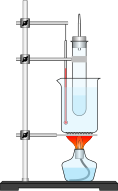
Add \(1.5\ \text{mL}\) of concentrated nitric acid and \(2\ \text{mL}\) of concentrated sulfuric acid to a large test tube. After the mixed acid cools, gradually add \(1\ \text{mL}\) of benzene dropwise while shaking the test tube to ensure thorough mixing. Then place it in a \(60\,{}^{\circ}\text{C}\) water bath (Figure 4) and heat for \(10\ \text{min}\). Pour the contents into a beaker containing a large amount of water. The nitric acid and sulfuric acid dissolve in the water, while the nitrobenzene produced settles as a yellow liquid at the bottom. A bitter almond odor can be detected.
After the experiment, pour the nitrobenzene into the container designated by the teacher.
Discussion
In the nitration experiment, why is a water bath used instead of direct heating with an alcohol lamp? What role does concentrated sulfuric acid play? Why must the mixed acid be allowed to cool before gradually adding benzene?
How would you distinguish between benzene, ethylbenzene (\(\ce{C6H5C2H5}\)), and styrene (\(\ce{C6H5CH=CH2}\))?
Experiment 6: Properties of Ethanol and Phenol
Objective
To deepen understanding of the important properties of ethanol and phenol; to practice assembling simple apparatus and checking gas-tightness.
Materials
Test tubes, test tube holder, alcohol lamp, spatula, single-hole rubber stopper, delivery tube, U-tube, beaker, iron stand.
Ethanol, concentrated sulfuric acid, copper wire, sodium bromide, \(5\%\) \(\ce{NaOH}\) solution, phenol, dilute hydrochloric acid, concentrated bromine water, \(\ce{FeCl3}\) solution.
Procedure
1. Oxidation of ethanol to acetaldehyde
Add \(1\ \text{mL}\) of ethanol to a test tube. Heat a copper wire (with one end bent into a spiral) in the alcohol lamp flame until a thin layer of black copper(II) oxide forms on the surface. Immediately plunge the hot wire into the test tube containing ethanol. Repeat this operation several times. Note the odor of the acetaldehyde produced, and observe the changes on the copper wire surface. Write the chemical equations for the reactions.
2. Reaction of ethanol with hydrobromic acid
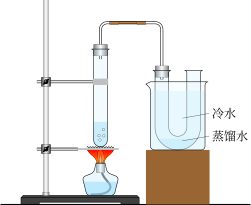
Add \(2\ \text{mL}\) of ethanol and \(2\ \text{mL}\) of water to a large test tube. While shaking continuously and cooling, slowly add \(4\ \text{mL}\) of concentrated sulfuric acid. After the mixture cools to room temperature, add \(3\ \text{g}\) of finely ground \(\ce{NaBr}\). Assemble the apparatus as shown in Figure 5.
Heat gently over asbestos gauze with a small flame. After about \(10\ \text{min}\), bromoethane — which is insoluble in water — begins to appear in the U-tube.
3. Properties of phenol
Place a small amount of phenol crystals in a test tube, add some water, and shake. The water becomes turbid. Heat the phenol–water mixture — the liquid gradually becomes clear. Let the liquid cool and observe the changes. Explain these phenomena.
Add \(5\%\) \(\ce{NaOH}\) solution to the phenol–water mixture and shake. Observe and explain the phenomena. Write the chemical equation for the reaction.
Add a small amount of hydrochloric acid to the solution from step (2). Explain why the solution becomes turbid again. Write the chemical equation.
Add concentrated bromine water to a clear phenol solution until a white turbidity appears. Explain the phenomenon and write the chemical equation.
Add a few drops of \(2\%\) phenol solution to a test tube, then add \(\ce{FeCl3}\) solution dropwise. Observe the phenomenon.
Discussion
In step 1, why must the heating and plunging of the copper wire be repeated several times?
Given a solution of phenol in benzene, how would you extract the phenol?
Experiment 7: Properties of Acetaldehyde
Objective
To deepen understanding of the important chemical properties of acetaldehyde; to learn the water bath heating technique.
Materials
Test tubes, test tube holder, alcohol lamp, beaker.
\(10\%\) \(\ce{NaOH}\) solution, \(2\%\) \(\ce{AgNO3}\) solution, \(2\%\) ammonia solution, dilute acetaldehyde solution, \(2\%\) \(\ce{CuSO4}\) solution.
Procedure
Pour a small amount of \(\ce{NaOH}\) solution into a test tube, heat to boiling, pour out the alkaline solution, and rinse with clean water. This test tube will be used for the experiments below.
Silver mirror reaction. Add \(1\ \text{mL}\) of \(2\%\) \(\ce{AgNO3}\) solution to the cleaned test tube. Add \(2\%\) ammonia solution dropwise while shaking until the precipitate that initially forms just dissolves. Then add 3 drops of dilute acetaldehyde solution along the wall of the test tube. Place the test tube in a beaker of hot water and let it stand for several minutes. Observe what happens on the inner wall of the test tube. Explain the phenomenon and write the chemical equation.
Oxidation of acetaldehyde by copper(II) hydroxide. Add \(2\ \text{mL}\) of \(10\%\) \(\ce{NaOH}\) solution to a test tube, then add \(4\)–\(5\) drops of \(2\%\) \(\ce{CuSO4}\) solution and shake. Then add \(0.5\ \text{mL}\) of acetaldehyde solution. Heat to boiling and observe the phenomena. Explain and write the chemical equation.
Discussion
Why must the test tube be washed with hot \(\ce{NaOH}\) solution before performing the silver mirror reaction?
Experiment 8: Preparation of Ethyl Acetate
Objective
- To deepen understanding of the properties of ethanol and acetic acid, and of esterification reactions.
- To practice assembling simple apparatus.
Materials
Test tubes, test tube holder, iron stand, alcohol lamp, single-hole rubber stopper, delivery tube, pH paper, beaker.
Solid sodium acetate, concentrated sulfuric acid, ethanol, acetic acid, saturated sodium carbonate solution.
Procedure
1. Preparation and properties of acetic acid
Place \(1\)–\(2\ \text{g}\) of solid sodium acetate in a test tube, add \(1\)–\(2\ \text{mL}\) of concentrated sulfuric acid, and stopper with a delivery tube assembly. Clamp the test tube on an iron stand and heat with an alcohol lamp. Vapor is produced; let it condense through the delivery tube and collect the liquid in another test tube (which may be placed in a beaker of cold water). Note the odor of the liquid produced and use pH paper to determine its pH.
2. Esterification — Preparation of ethyl acetate
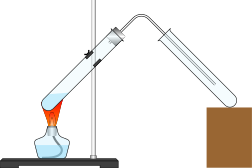
Add \(2\ \text{mL}\) each of ethanol and acetic acid to a test tube, then slowly add \(0.5\ \text{mL}\) of concentrated sulfuric acid. Assemble the apparatus as shown in Figure 6.
Heat the mixture gently. Direct the vapor through the delivery tube to a point \(2\)–\(3\ \text{mm}\) above \(3\ \text{mL}\) of saturated \(\ce{Na2CO3}\) solution in another test tube. Observe the transparent oily liquid that floats on the surface. Remove the collection test tube and stop heating. Shake the test tube containing the sodium carbonate solution and allow it to settle. Observe the upper layer of oily ethyl acetate liquid, and note the fruity aroma. Write the chemical equation for the reaction.
Discussion
Can acetic acid be prepared by reacting sodium acetate with concentrated hydrochloric acid?
In the preparation of ethyl acetate, what roles do concentrated sulfuric acid and sodium carbonate solution play?
Experiment 9: Properties of Glucose, Sucrose, Starch, and Cellulose
Objective
To deepen understanding of the important properties of glucose, sucrose, starch, and cellulose.
Materials
Test tubes, alcohol lamp, beaker, glass rod, test tube holder, dropper.
\(10\%\) glucose solution, \(2\%\) sucrose solution, cotton, silver ammonia solution (Tollens’ reagent), \(\ce{CuSO4}\) solution, \(\ce{NaOH}\) solution, dilute sulfuric acid, concentrated sulfuric acid, starch.
Procedure
1. Reduction reactions of glucose
Add \(3\ \text{mL}\) of silver ammonia solution to a clean test tube. Add \(1\)–\(2\ \text{mL}\) of \(10\%\) glucose solution, mix thoroughly, and heat over an alcohol lamp or in a hot water bath. Observe the phenomena.
In another test tube, add \(1\)–\(2\ \text{mL}\) of \(\ce{NaOH}\) solution, then add \(3\)–\(4\) drops of \(\ce{CuSO4}\) solution. A precipitate of \(\ce{Cu(OH)2}\) can be observed. Add \(2\ \text{mL}\) of \(10\%\) glucose solution. Upon heating, red copper(I) oxide (\(\ce{Cu2O}\)) forms.
From the experiments above, determine what functional group glucose contains.
2. Hydrolysis of sucrose
Prepare \(\ce{Cu(OH)2}\) precipitate in a test tube using the same method as above. Add sucrose solution and heat. Observe whether red \(\ce{Cu2O}\) precipitate forms.
Add a small amount of sucrose solution to a test tube, then add \(3\)–\(5\ \text{mL}\) of dilute sulfuric acid. Boil the mixture for several minutes to hydrolyze the sucrose. Then add \(\ce{NaOH}\) solution to neutralize the \(\ce{H2SO4}\).
In another test tube, prepare \(\ce{Cu(OH)2}\) precipitate, then add the hydrolyzed sucrose solution and heat. Observe the phenomena.
Write the chemical equations for each step.
3. Hydrolysis of starch
Add some finely ground starch to a test tube with a small amount of water. Shake vigorously. Add hot water and boil to prepare a starch solution.
Add \(1\)–\(2\ \text{mL}\) of starch solution to a test tube and add a small amount of freshly prepared \(\ce{Cu(OH)2}\) precipitate. Heat and observe whether red \(\ce{Cu2O}\) forms.
Add \(1\)–\(2\ \text{mL}\) of starch solution to another test tube, add \(3\)–\(5\) drops of dilute sulfuric acid, and boil for \(5\ \text{min}\). Neutralize the acid with base, then add freshly prepared \(\ce{Cu(OH)2}\) precipitate. Heat and observe whether red \(\ce{Cu2O}\) forms.
4. Hydrolysis of cellulose
Place a small ball of absorbent cotton or a small piece of filter paper in a test tube. Carefully add a few drops of concentrated sulfuric acid. Stir with a glass rod until a paste forms. Add \(2\ \text{mL}\) of water and heat the test tube in boiling water for \(5\ \text{min}\) while shaking, until the solution turns light brown. Finally, neutralize with base.
Add freshly prepared \(\ce{Cu(OH)2}\) precipitate to the light-brown liquid and heat to boiling. Observe whether red \(\ce{Cu2O}\) forms.
Explain these phenomena and write the chemical equations.
Discussion
In step 1(1), why must a clean test tube be used? How do you clean it?
Based on the reactions of starch and cellulose hydrolysis products with freshly prepared \(\ce{Cu(OH)2}\), what similarity in composition is demonstrated between starch and cellulose?
Experiment 10: Properties of Proteins
Objective
To consolidate knowledge of protein properties.
Materials
Test tubes, alcohol lamp, test tube holder, glass rod, dropper.
A small piece each of cotton cloth and wool fabric, egg white, saturated ammonium sulfate solution, concentrated nitric acid, \(10\%\) \(\ce{CuSO4}\) solution, distilled water, \(40\%\) formaldehyde solution, \(95\%\) ethanol solution.
Procedure
Burning of proteins. Take cotton thread from the cotton cloth and wool thread from the wool fabric. Burn each separately in a flame. Note the different odors.
Coagulation of proteins by heating. Add egg white solution to a test tube and heat. The protein coagulates into flocs. Remove some of the flocculent protein and place it in water. Observe whether it dissolves.
Effect of ammonium sulfate on protein solubility. Add \(1\)–\(2\ \text{mL}\) of protein solution to a test tube, then add saturated ammonium sulfate solution. Observe that the protein precipitates out. Pour a small amount of the suspension into another test tube containing distilled water. Observe that the precipitated protein redissolves.
Coagulation of proteins by heavy metal salts. Add \(3\ \text{mL}\) of protein solution to a test tube, then immediately add \(3\ \text{mL}\) of \(10\%\) \(\ce{CuSO4}\) solution. Observe that the protein coagulates and precipitates. Place a small amount of the precipitate in a test tube of distilled water — it does not redissolve.
Coagulation of proteins by formaldehyde and ethanol. Add \(3\ \text{mL}\) of protein solution to each of two test tubes. Immediately add \(2\ \text{mL}\) of formaldehyde solution to one and \(2\ \text{mL}\) of ethanol to the other. Observe the coagulation and precipitation. Place small amounts of each precipitate in distilled water and observe whether they dissolve.
Color reaction of proteins. Add a small amount of protein solution to a test tube, then add a few drops of concentrated nitric acid. Heat gently — a yellow precipitate forms. This is the xanthoproteic reaction.
Discussion
What are the practical applications of the coagulation of proteins by formaldehyde and ethanol?
Explain why Bordeaux mixture can kill crop pathogens.
Experiment 11: Preparation of Phenol-Formaldehyde Resin
Objective
To deepen understanding of condensation polymerization and the preparation of phenol-formaldehyde resin; to consolidate knowledge of the properties of phenol and formaldehyde.
Materials
Large test tube, rubber stopper with glass delivery tube, iron stand, alcohol lamp, evaporating dish, beaker, graduated cylinder.
Phenol, \(40\%\) formaldehyde solution, concentrated hydrochloric acid, concentrated ammonia solution, ethanol.
Procedure
Add \(2.5\ \text{g}\) of phenol, \(2.5\ \text{mL}\) of \(40\%\) formaldehyde solution, and \(1\ \text{mL}\) of concentrated hydrochloric acid to a large test tube. Stopper with a glass delivery tube. Heat in a boiling water bath. Before long, vigorous boiling of the mixture can be observed. Remove the test tube from the water bath; when the reaction is no longer vigorous, continue heating (Figure 7) until the mixture forms a resin that is insoluble in water. Remove the test tube, let it cool, pour off the upper liquid, and the lower layer is phenol-formaldehyde resin. Observe the color and state of the resin.
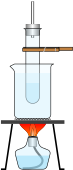
Figure 7: Apparatus for the preparation of phenol-formaldehyde resin Place \(2.5\ \text{g}\) of phenol and \(3\)–\(4\ \text{mL}\) of formaldehyde in a test tube. Heat in a water bath. Add \(1\ \text{mL}\) of concentrated ammonia solution in place of concentrated hydrochloric acid. Carry out the experiment as in step 1. Observe the color and state of the resin.
After the experiment, promptly clean the test tubes. If they are difficult to clean, add a small amount of ethanol, soak for a few minutes, and then wash.
Experiment 12: Determination of Melting Point and Boiling Point of Organic Compounds
Objective
To learn a simple method for determining the melting point and boiling point of organic compounds.
Materials
Test tubes, thermometer, beaker, rubber stopper, boiling chips, tripod, alcohol lamp, asbestos gauze, test tube holder, homemade stirring rod.
Anhydrous ethanol (or acetone), naphthalene.
Procedure
1. Determination of the boiling point of ethanol (or acetone)
Add \(4\)–\(5\ \text{mL}\) of anhydrous ethanol to a test tube. Add a few boiling chips. Insert a thermometer with a stopper (the stopper has a notch — see Figure 8). The thermometer bulb should be \(2\)–\(3\ \text{cm}\) above the liquid surface, as shown.
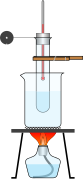
Figure 8: Simple apparatus for boiling point determination 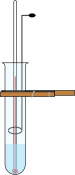
Figure 9: Simple apparatus for melting point determination Figures 8 and 9: Simple apparatuses for boiling point and melting point determination
Immerse the test tube in boiling water so that the portion containing ethanol is just submerged. Observe the ethanol and the thermometer reading carefully. Record the temperature when the ethanol boils (at boiling, the temperature of the liquid and vapor are the same). The temperature remains relatively stable during boiling. After observing for a while, remove the test tube. When the temperature drops about \(10\,{}^{\circ}\text{C}\), reheat and repeat the procedure three times. Each recorded temperature should not differ by more than \(1\,{}^{\circ}\text{C}\). Calculate the average of the three readings — this is the measured boiling point of ethanol.
2. Determination of the melting point of naphthalene
Place \(3\)–\(4\ \text{g}\) of naphthalene in a test tube.
Insert the pre-bent stirring rod and thermometer into the test tube, as shown in Figure 9.
Immerse the bottom of the test tube in boiling water to melt the naphthalene.
Remove the test tube from the boiling water. While moving the stirring rod up and down, observe the naphthalene carefully. When crystals appear, record the temperature. Continue stirring until all the naphthalene has solidified. Pay attention to the temperature changes before and after complete solidification.
Immerse the test tube in boiling water again and repeat the procedure three times as before. Each recorded temperature should not differ by more than \(0.5\,{}^{\circ}\text{C}\). Calculate the average of the three readings — this is the measured melting point of naphthalene.
Discussion
When measuring the boiling point of ethanol, why should the entire test tube not be immersed in water? Why must the stopper have a notch?
When measuring the melting point of naphthalene, why must you stir continuously?
Experiment 13: Laboratory Practical Problems
Objective
To consolidate knowledge of the properties of important organic compounds.
Problems
Given an unknown solution, demonstrate by two methods that it is a phenol solution rather than an alcohol.
Three test tubes contain ethanol, acetaldehyde, and acetic acid, respectively. Identify which is in each test tube.
How would you distinguish benzene, ethanol, and a liquid unsaturated hydrocarbon?
Given two white powders that are either sodium chloride or sodium acetate, how would you distinguish them?
How would you experimentally demonstrate that stearic acid is acidic?
How would you test for the presence of glucose in grapes and ripe apples?
How would you experimentally distinguish between each of the following pairs:
methane and ethylene,
benzene and toluene,
benzene and phenol solution,
acetic acid and phenol solution,
glucose solution and sucrose solution?
Design an experiment to demonstrate that formic acid contains both a carboxyl group and an aldehyde group.
How would you test for the presence of starch in potatoes?
Burn a small piece each of polyethylene, poly(vinyl chloride), and polystyrene. What phenomena are observed for each? Analyze based on the composition of each polymer.
Optional Experiment: Paper Chromatography
Objective
To gain a basic understanding of the paper chromatography technique.
Materials
Petri dish, watch glass (to cover the Petri dish), dropper, circular filter paper.
\(\ce{FeCl3}\)–\(\ce{CuSO4}\) mixed solution, acetone–hydrochloric acid mixture, concentrated ammonia solution, methyl orange–phenolphthalein mixed alcohol solution, n-butanol–ammonia mixture, saturated \(\ce{Na2CO3}\) solution.
Procedure
1. Paper chromatography of \(\ce{Fe^{3+}}\) and \(\ce{Cu^{2+}}\)
Place one drop of the \(\ce{FeCl3}\)–\(\ce{CuSO4}\) mixed solution at the center of the filter paper (spot diameter about \(0.5\ \text{cm}\)). Allow to dry.
Cut a narrow strip (about \(2\)–\(3\ \text{mm}\) wide) from the filter paper, cutting up to the sample spot (as in Figure 10). Fold the strip upward at a right angle.
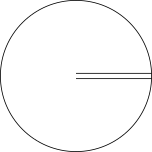
Figure 10: Filter paper preparation for paper chromatography Place the prepared filter paper on a Petri dish containing \(10\ \text{mL}\) of acetone–hydrochloric acid mixture, with the folded strip immersed in the mixture (as in Figure 11).
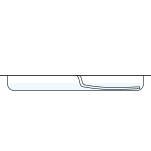
Figure 11: Developing operation for paper chromatography When the sample spot at the center has expanded to about two-thirds of the filter paper diameter, remove the paper and place it on another Petri dish containing concentrated ammonia solution. Expose it to ammonia vapor — do not let the ammonia solution touch the paper directly.
Soon, two colored concentric rings become visible: the outer ring is yellow (iron) and the inner ring is blue (copper).
2. Paper chromatography of methyl orange and phenolphthalein
Place one drop of the methyl orange–phenolphthalein mixed solution at the center of the filter paper (or at several points around the center, about \(1\ \text{cm}\) from the center). Spot diameter about \(0.5\ \text{cm}\). Allow to dry.
Pierce a small hole at the center of the filter paper and insert a paper wick rolled from filter paper.
Place the prepared filter paper on a Petri dish containing the n-butanol–ammonia mixture, with the paper wick dipping into the mixture. As the liquid wicks upward, the yellow sample spot at the center gradually expands outward to form a yellow ring.
When the yellow ring has expanded to about half the radius of the filter paper, remove the paper and pull out the wick. After the paper dries slightly, spray it with saturated \(\ce{Na2CO3}\) solution. A red ring of phenolphthalein appears outside the yellow ring of methyl orange.