3 Hydrocarbon Derivatives
After studying this chapter, you should be able to:
- Define hydrocarbon derivatives and explain the concept of functional groups
- Describe the classification, physical properties, and chemical properties (substitution and elimination reactions) of haloalkanes
- Explain the structure and properties of ethanol, including reactions with metals, hydrogen halides, oxidation, and dehydration
- Describe the classification and properties of alcohols, including monohydric and polyhydric alcohols
- Describe the structure and properties of phenol, including its weak acidity and reactions with bromine water and \(\ce{FeCl3}\)
- Explain the structure and chemical properties of aldehydes (especially acetaldehyde), including addition reactions, the silver mirror test, and reduction of \(\ce{Cu(OH)2}\)
- Describe the properties of acetic acid, including its acidity and esterification reactions
- Classify carboxylic acids and describe the properties of formic acid, higher fatty acids, and benzoic acid
- Explain the structure, hydrolysis, and formation of esters
- Describe the composition, hydrogenation, and saponification of fats and oils
- Distinguish nitro compounds from nitrate esters, and describe the properties and uses of nitrobenzene and TNT
- Describe the structure and properties of amines (especially aniline) and amides
After studying hydrocarbons, we learned that hydrogen atoms in hydrocarbon molecules can be replaced by other atoms or groups to form different substances. For instance, hydrogen atoms in methane molecules can be replaced by chlorine atoms to form chloromethane and other products. Similarly, hydrogen atoms in benzene molecules can be replaced by nitro groups or sulfonic acid groups to form nitrobenzene or benzenesulfonic acid. It is evident that when hydrogen atoms in hydrocarbon molecules are replaced by other atoms or groups, a whole series of new organic compounds can be produced. Structurally, these organic compounds can all be regarded as derived from hydrocarbons, and they are therefore called hydrocarbon derivatives.
Hydrocarbon derivatives have chemical properties different from those of the corresponding hydrocarbons, because the atoms or groups that replace the hydrogen atoms play a very important role in determining the properties of the derivatives. An atom or group that determines the chemical characteristics of a compound is called a functional group. Halogen atoms (\(\ce{-X}\)), the nitro group (\(\ce{-NO2}\)), and the sulfonic acid group (\(\ce{-SO3H}\)) are all functional groups. Carbon–carbon double bonds and carbon–carbon triple bonds are also the functional groups of alkenes and alkynes, respectively.
There are many kinds of hydrocarbon derivatives. In this chapter, we will study several important classes: haloalkanes, alcohols, ethers, phenols, aldehydes, ketones, carboxylic acids, esters, nitro compounds, and amines.1
3.1 Section 1: Haloalkanes
Compounds produced when hydrocarbons react with halogens (chlorine, bromine, etc.) — such as chloromethane (\(\ce{CH3Cl}\)) and dibromoethane (\(\ce{C2H4Br2}\)) — all contain halogen atoms in their molecules. Compounds formed by replacing hydrogen atoms in hydrocarbon molecules with halogen atoms are called haloalkanes (halogenated hydrocarbons).
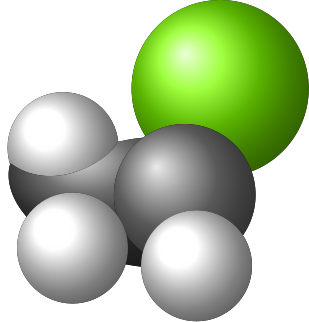
There are many kinds of haloalkanes. Depending on the number of halogen atoms in the molecule, there are monohalogenated and polyhalogenated hydrocarbons. Depending on the type of parent hydrocarbon, there are aliphatic haloalkanes (halogen derivatives of chain hydrocarbons) and aromatic haloalkanes, among others. Here we will mainly study the properties of aliphatic monohalogenated alkanes. Figure 3.1 shows the molecular structure model of chloroethane, illustrating the structure of the alkyl group and how it is bonded to the chlorine atom.
Physical Properties of Haloalkanes
Haloalkanes are insoluble in water but soluble in organic solvents. Their boiling points and densities are both higher than those of the corresponding hydrocarbons. Their densities generally decrease as the number of carbon atoms in the alkyl group increases, while their boiling points rise as the number of carbon atoms increases.
| Name | Condensed structural formula | Density (liquid, g/cm³) | Boiling point (\(\,{}^{\circ}\text{C}\)) |
|---|---|---|---|
| Chloromethane | \(\ce{CH3Cl}\) | 0.9159 | \(-24.2\) |
| Chloroethane | \(\ce{CH3CH2Cl}\) | 0.8978 | 12.27 |
| 1-Chloropropane | \(\ce{CH3CH2CH2Cl}\) | 0.8909 | 46.6 |
| 1-Chlorobutane | \(\ce{CH3CH2CH2CH2Cl}\) | 0.8862 | 78.44 |
| 1-Chloropentane | \(\ce{CH3CH2CH2CH2CH2Cl}\) | 0.8818 | 107.8 |
Chemical Properties of Haloalkanes
1. Substitution Reactions
The halogen atoms in haloalkane molecules can be replaced by various other atoms or groups. For example, chloroethane undergoes hydrolysis in the presence of sodium hydroxide, producing ethanol:
\[\ce{C2H5-Cl + H-OH -> C2H5-OH + HCl}\]
Taking haloalkanes as an example, let us illustrate the relationship between their structure and chemical properties. In a haloalkane molecule, because the electronegativity of the halogen atom is greater than that of the carbon atom, the electron cloud of the C–X bond shifts toward the halogen atom. The carbon atom acquires a partial positive charge (\(\delta+\)) due to the decreased electron cloud density, while the halogen atom acquires a partial negative charge (\(\delta-\)),2 thus forming a rather polar covalent bond:
\[\overset{\delta+}{\ce{-CH2}}\!\!\ce{-}\!\!\overset{\delta-}{\ce{X}}\]
Therefore, in chemical reactions of haloalkanes, the C–X bond breaks relatively easily, and the halogen atom is readily replaced by other atoms or groups, departing as a negative ion.
2. Elimination Reactions
When a haloalkane is heated with a strong base (such as \(\ce{NaOH}\) or \(\ce{KOH}\)) dissolved in an alcohol solvent, it loses a hydrogen halide molecule to form an alkene. For example:
\[\ce{CH3CH(Br)CH3 ->[\text{alcohol}][\Delta] CH3-CH=CH2 + NaBr + H2O}\]
The loss of a hydrogen halide from a haloalkane is called an elimination reaction. An elimination reaction is one in which a small molecule (such as water or a hydrogen halide) is removed from one molecule of an organic compound under appropriate conditions, producing an unsaturated (double-bond or triple-bond) compound. In the elimination reaction above, one \(\ce{HBr}\) molecule is removed from two adjacent carbon atoms.
Halogenated alkenes have some chemical properties similar to those of alkenes — they can undergo addition reactions and addition polymerization. For example, vinyl chloride can undergo addition polymerization to form polyvinyl chloride (PVC):
\[n\ce{CH2=CHCl} \longrightarrow \ce{[-CH2-CHCl-]}_n\]
Exercises for Section 1
When preparing chloroethane in practice, one does not use chlorine gas to react directly with ethane, but instead reacts hydrogen chloride with ethylene. Why?
1-Bromobutane is heated separately with each of the following solutions. What products are obtained in each case? Write the relevant chemical equations and state which type of reaction each belongs to.
Aqueous \(\ce{NaOH}\) solution
\(\ce{NaOH}\) dissolved in ethanol
When \(\ce{AgNO3}\) solution is added dropwise to \(\ce{NaCl}\) solution, a precipitate of \(\ce{AgCl}\) forms. Yet when added to 1-chlorobutane, no reaction occurs. Why? If 1-chlorobutane is boiled with \(\ce{NaOH}\) solution for several minutes, acidified with \(\ce{HNO3}\), and then \(\ce{AgNO3}\) solution is added dropwise, a precipitate of silver chloride forms. Why?
A certain haloalkane has the following percent composition: \(24.259\%\) carbon, \(4.075\%\) hydrogen, and \(71.665\%\) chlorine. At \(100\,{}^{\circ}\text{C}\) and \(740\ \text{mmHg}\) pressure, \(140.2\ \text{mL}\) of its vapor has a mass of \(0.4416\ \text{g}\).3 Write the chemical formula and structural formula of this haloalkane.
3.2 Section 2: Ethanol
Structure and Physical Properties of Ethanol
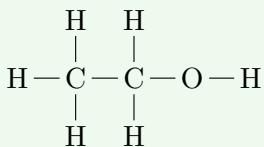
The chemical formula of ethanol (Figure 3.2) is \(\ce{C2H6O}\). Its structural formula is:
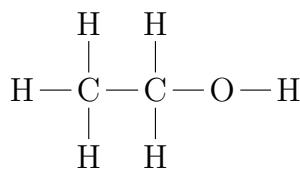
which is abbreviated as \(\ce{CH3CH2OH}\) or \(\ce{C2H5OH}\).
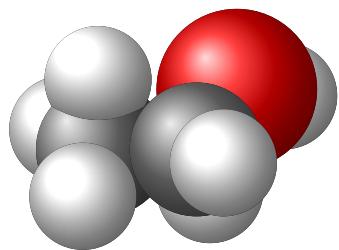
Chinese labels in figure: 乙醇分子的比例模型 = Space-filling model of the ethanol molecule.
Based on the chemical formula of ethanol and the valences of each element, the ethanol molecule could have one of the following two structures:
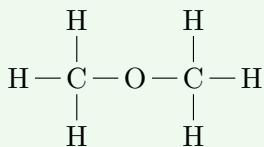
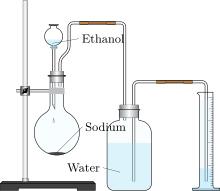
To determine which structural formula is correct, let us examine one property of ethanol: ethanol reacts with sodium to release hydrogen gas. In this reaction, the number of hydrogen atoms that each ethanol molecule loses can be determined experimentally.
The experimental apparatus is shown in Figure 3.3. A few small pieces of sodium are placed in the flask, and a measured amount of ethanol (preferably anhydrous ethanol) is slowly added dropwise through the funnel. The hydrogen gas released from the reaction of ethanol with sodium pushes water from the middle bottle into the graduated cylinder. The volume of hydrogen gas can be measured from the volume of water in the graduated cylinder (which should include the volume of the water column in the tubing from the wide-mouth bottle to the graduated cylinder). If \(0.1\ \text{mol}\) of ethanol is used, approximately \(1.12\ \text{L}\) of hydrogen gas (converted to STP volume) is produced. This means that from \(1\ \text{mol}\) of ethanol, sodium can displace \(1.12\ \text{L}\) of hydrogen gas (\(0.1\ \text{mol}\ \ce{H2}\)), i.e., \(1\ \text{mol}\) of hydrogen atoms. Therefore, sodium can only displace 1 hydrogen atom from each ethanol molecule.
Clearly, one hydrogen atom in the ethanol molecule must be different from the other five. This fact cannot be explained by structure (1), because according to (1), all six hydrogen atoms are identically bonded to carbon atoms. However, structure (2) shows that one hydrogen atom is bonded to an oxygen atom, making it different from the other five. Therefore, the structural formula of ethanol must be structure (2).
Ethanol is commonly called alcohol or grain alcohol. It is a colorless, transparent liquid with a characteristic pleasant odor. It is lighter than water, with a density of \(0.7893\ \text{g/cm}^3\) at \(20\,{}^{\circ}\text{C}\) and a boiling point of \(78.5\,{}^{\circ}\text{C}\). Ethanol is volatile, can dissolve many inorganic and organic substances, and is miscible with water in all proportions. Ethanol molecules can form hydrogen bonds with each other — the hydrogen atom of the \(\ce{-OH}\) group in one ethanol molecule bonds to the oxygen atom of the \(\ce{-OH}\) group in another ethanol molecule through a hydrogen bond. The formation of hydrogen bonds affects the properties of ethanol; for example, ethanol has a relatively high boiling point (whereas the boiling point of ethane is \(-88.63\,{}^{\circ}\text{C}\)).
Industrial alcohol contains about \(96\%\) ethanol (by volume). Alcohol containing \(99.5\%\) or more ethanol is called absolute (anhydrous) alcohol. To prepare anhydrous alcohol, industrial alcohol is usually mixed with freshly prepared quicklime, then heated and distilled.
Various alcoholic beverages contain ethanol. Beer contains \(3\%\)–\(5\%\) alcohol, grape wine contains \(6\%\)–\(20\%\), yellow rice wine (huangjiu) contains \(8\%\)–\(15\%\), and baijiu (white spirits) contains \(50\%\)–\(70\%\).
Chemical Properties of Ethanol
The ethanol molecule consists of an ethyl group (\(\ce{C2H5-}\)) and a hydroxyl group4 (\(\ce{-OH}\)). The hydroxyl group is relatively reactive and determines the main properties of ethanol. The ethanol molecule can be viewed as derived from a water molecule by replacing one hydrogen atom with an ethyl group. In aqueous solution, ethanol is even more difficult to ionize than water. Nevertheless, the hydrogen atom in the hydroxyl group of ethanol can be displaced by active metals.
1. Reaction with Metals
Pour about \(1\ \text{mL}\) of anhydrous ethanol into a test tube, then add a small piece of freshly cut sodium that has been wiped dry with filter paper. Test the gas produced for hydrogen.
Ethanol reacts with metallic sodium to produce sodium ethoxide and hydrogen gas:
\[\ce{2CH3CH2OH + 2Na -> 2CH3CH2ONa + H2 ^}\]
Compared with the reaction of water with metallic sodium, the reaction of ethanol with sodium is much milder.
Other active metals — such as potassium, magnesium, and aluminum — can also displace the hydrogen from the hydroxyl group of ethanol.
2. Reaction with Hydrogen Halides
When ethanol reacts with a hydrogen halide, the carbon–oxygen bond in the ethanol molecule breaks, and the halogen atom replaces the hydroxyl group to form a haloalkane, with water produced simultaneously. For example, when ethanol is mixed with hydrobromic acid (typically prepared as a mixture of sodium bromide and sulfuric acid) and heated, an oily liquid — bromoethane — is obtained:
\[\ce{C2H5OH + HBr ->[\Delta] C2H5Br + H2O}\]
In the ethanol molecule, because the oxygen atom has high electronegativity, the electron cloud of the O–H bond shifts toward the oxygen atom. Therefore, the O–H bond can break during reactions, and the hydrogen atom can be displaced.
Why is the reaction of ethanol with sodium much milder than that of water with sodium? We can explain this as follows: in the ethanol molecule, compared to a hydrogen atom, the ethyl group has an electron-pushing effect that slightly shifts the O–H bond’s electron cloud back toward the hydrogen atom. Therefore, the hydrogen atom in the hydroxyl group of ethanol is more difficult to ionize than the hydrogen atom in water.
Because of the high electronegativity of the oxygen atom, the electron cloud of the C–O bond in the ethanol molecule also shifts toward the oxygen atom. Therefore, the C–O bond can also break during reactions, and the hydroxyl group can be displaced or eliminated. For example, this explains ethanol’s reaction with hydrogen halides.
3. Oxidation Reactions
Ethanol burns in air with a pale blue flame, releasing a large amount of heat. Therefore, ethanol can be used as fuel for internal combustion engines and in laboratories:
\[\ce{C2H5OH(l) + 3O2(g) ->[\text{ignite}] 2CO2(g) + 3H2O(l)}\]
\[\Delta H = -1367\ \text{kJ}\]
When heated in the presence of a catalyst (Cu or Ag), ethanol can be oxidized by air to produce acetaldehyde. Industrially, this principle is used to manufacture acetaldehyde from ethanol:
\[\ce{2CH3CH2OH + O2 ->[\text{catalyst}][\Delta] 2CH3CHO + 2H2O}\]
4. Dehydration Reactions
When ethanol is heated with concentrated sulfuric acid to about \(170\,{}^{\circ}\text{C}\), each ethanol molecule loses one water molecule to form ethylene. This reaction is also an elimination reaction:
\[\ce{CH3CH2OH ->[\ce{H2SO4}(\text{conc.})][\text{170}\,{}^{\circ}\text{C}] CH2=CH2 ^ + H2O}\]
In the laboratory, this method can be used to prepare ethylene.
If ethanol and concentrated sulfuric acid are heated together to about \(140\,{}^{\circ}\text{C}\), then from every two ethanol molecules, one water molecule is removed to form diethyl ether:
\[\ce{C2H5OH + HOC2H5 ->[\ce{H2SO4}(\text{conc.})][\text{140}\,{}^{\circ}\text{C}] C2H5-O-C2H5 + H2O}\]
Diethyl ether is the most important member of the ether class. Any compound in which two alkyl groups are connected through an oxygen atom is called an ether. The general formula for ethers is \(R\ce{-O-}R'\), where R and R’ are alkyl groups that may be the same or different.
Diethyl ether is a colorless, highly volatile liquid with a boiling point of \(34.51\,{}^{\circ}\text{C}\) and a distinctive odor. Inhaling a certain amount of diethyl ether vapor causes general anesthesia, so pure diethyl ether can be used as an anesthetic during surgery. Diethyl ether is slightly soluble in water and readily soluble in organic solvents. It is itself an excellent solvent, capable of dissolving many organic compounds. Diethyl ether vapor ignites very easily, and if air contains diethyl ether vapor, it may explode upon contact with fire. Therefore, one must be especially careful when using diethyl ether.
From the dehydration reactions of ethanol, we can see that ethanol’s ability to undergo dehydration is mainly due to its hydroxyl group. However, because the reaction conditions (here, the temperature) differ, the mode of dehydration also differs, resulting in different products (ethylene or diethyl ether). Therefore, based on the chemical properties of a substance, we can control the reaction conditions according to actual needs, directing the chemical reaction in the desired direction.
Uses of Ethanol
Ethanol has quite extensive uses. It can be used as fuel for internal combustion engines and laboratories — using ethanol as fuel avoids air pollution. Ethanol can be used to manufacture beverages and fragrances. It is also an important raw material for organic chemical industry — for example, ethanol is used to produce acetic acid, diethyl ether, and other products. Ethanol is also an organic solvent, used to dissolve resins and manufacture coatings. In medicine, \(75\%\) alcohol solution is commonly used as a disinfectant.
Industrial Preparation of Ethanol
1. Fermentation Method
The fermentation method is an important way to produce ethanol. The raw materials are various agricultural products rich in sugars, such as sorghum, corn, sweet potatoes, and many wild fruits. Waste molasses is also commonly used. These materials undergo fermentation and then fractional distillation to yield \(95\%\) ethanol.
2. Ethylene Hydration Method
Using ethylene produced from petroleum cracking as the raw material, ethylene reacts with water under conditions of heating, pressurization, and in the presence of a catalyst (sulfuric acid or phosphoric acid) to produce ethanol. This method is called the ethylene hydration method:
\[\ce{CH2=CH2 + H-OH ->[\text{catalyst}][\text{heat, pressure}] CH3CH2OH}\]
Producing ethanol by the ethylene hydration method uses abundant raw materials, has low cost and high output, and saves large quantities of grain. Therefore, with the development of the petrochemical industry, this method has grown rapidly.
The Alcohol Family
Besides ethanol, there are other substances similar in structure and properties, such as methanol (\(\ce{CH3OH}\)) and propanol (\(\ce{CH3CH2CH2OH}\)). Alcohols are compounds whose molecules contain hydroxyl groups bonded to chain hydrocarbon groups.
Methanol is also an important alcohol. It can be used as fuel for internal combustion engines and as a solvent, and is also an important chemical raw material — methanol is used to produce formaldehyde, chloromethane, and other products.
Alcohols are generally named using systematic nomenclature. In systematic nomenclature, the longest carbon chain containing the hydroxyl group is selected as the main chain, with branches as substituents. The carbon atoms of the main chain are numbered starting from the end nearest to the hydroxyl group. The alcohol is named according to the number of carbon atoms in the main chain (as “-ol”), with substituent positions indicated by Arabic numerals before the substituent names, and the hydroxyl position indicated by an Arabic numeral before the alcohol name. For example:
- \(\ce{CH3CH2CH2CH2OH}\) — 1-butanol
- \(\ce{CH3CH(OH)CH2CH3}\) — 2-butanol
- \(\ce{CH3CH(CH3)CH2OH}\) — 2-methyl-1-propanol
- \(\ce{(CH3)3COH}\) — 2-methyl-2-propanol
Alcohols whose molecules contain only one hydroxyl group are called monohydric alcohols. Saturated monohydric alcohols derived from alkanes have the general formula \(\ce{C_{\)n$}H_{\(2n+1\)}OH}$, abbreviated as \(\ce{R-OH}\). Alcohols whose molecules contain two or more hydroxyl groups are called dihydric alcohols and polyhydric alcohols, respectively. Among these, the most important are ethylene glycol and glycerol. Their structural formulas can be represented as follows:
Ethylene glycol is a colorless, viscous, sweet-tasting liquid with a boiling point of \(198\,{}^{\circ}\text{C}\), a melting point of \(-11.5\,{}^{\circ}\text{C}\), and a density of \(1.1088\ \text{g/cm}^3\). It is readily soluble in water and ethanol. Its aqueous solution has a very low freezing point — for example, a \(60\%\) ethylene glycol solution freezes at \(-49\,{}^{\circ}\text{C}\). Therefore, ethylene glycol can be used as an antifreeze for internal combustion engines. It is also an important raw material for manufacturing polyester (Dacron).
Glycerol (commonly called glycerin) is a colorless, viscous, sweet-tasting liquid with a density of \(1.2613\ \text{g/cm}^3\) and a boiling point of \(290\,{}^{\circ}\text{C}\). It has strong hygroscopic properties and is miscible with water and alcohol in all proportions. Aqueous glycerol solutions have very low freezing points.
Glycerol has wide-ranging uses. It is used in large quantities to manufacture nitroglycerin, which is the main component of a powerful explosive used in national defense, mining, and tunnel excavation. Glycerol is also used to manufacture ink, stamp pads, and daily-use chemical products (such as toothpaste and skin cream), as well as in leather processing and as an antifreeze and lubricant.
Exercises for Section 2
Compare the structures of ethane and ethanol — what are the differences? Identify the main physical and chemical properties of ethanol.
How can you prove that ordinary alcohol contains water? How can anhydrous alcohol be prepared?
Ethanol can undergo intramolecular dehydration and intermolecular dehydration at appropriate temperatures. Can both of these dehydration reactions be considered elimination reactions? Why or why not?
Use chemical equations to represent each of the following reactions, noting the conditions required:

Reaction scheme showing transformations of ethanol How much air (by volume at STP) is needed to completely combust \(23\ \text{g}\) of ethanol? How many moles of water and carbon dioxide are produced? How much heat is released?
Write the names of the following substances and state whether they are homologs, structural isomers, or neither:
\(\ce{CH3CH2-O-CH2CH3}\)
\(\ce{CH3CH2CH2CH2OH}\)
When \(0.3\ \text{g}\) of a certain saturated monohydric alcohol reacts with excess sodium, \(56\ \text{mL}\) of hydrogen gas (at STP) is produced. Find the formula mass and chemical formula of this monohydric alcohol, and write the structural formulas and names of all possible structural isomers.
3.3 Section 3: Phenol
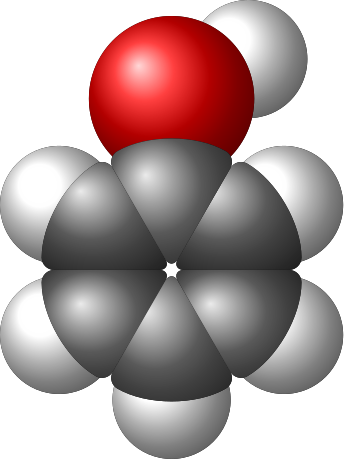
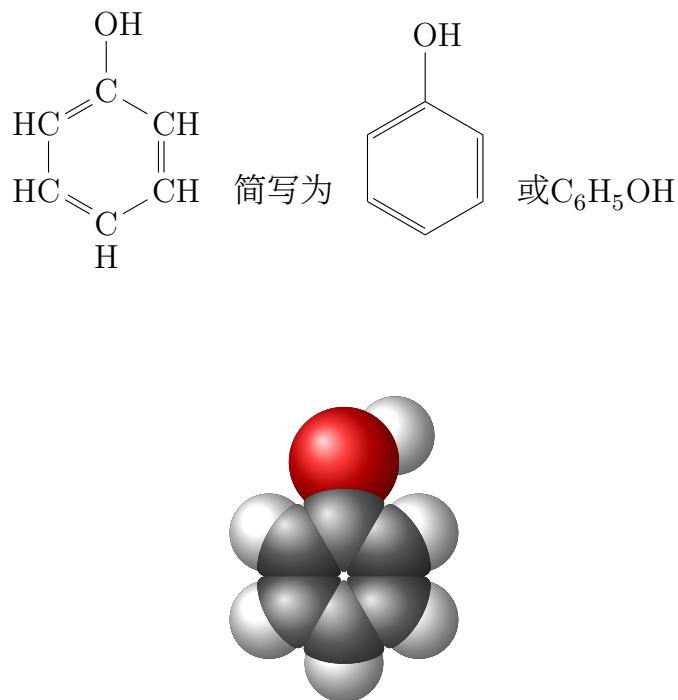
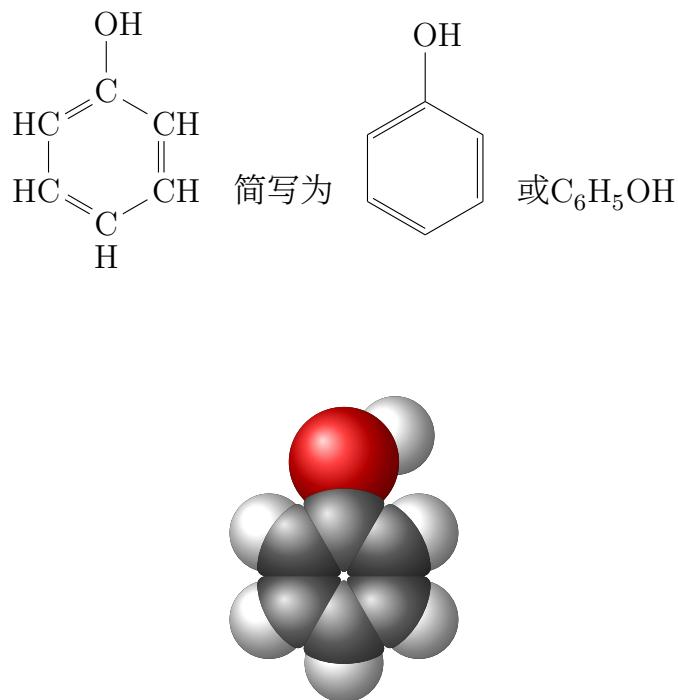
Just as chain hydrocarbons have hydroxyl derivatives, aromatic hydrocarbons also have hydroxyl derivatives. In these compounds, the hydroxyl group may be located on a carbon atom of the side chain, or it may be directly bonded to a carbon atom of the benzene ring. Aromatic compounds with a hydroxyl group on the side chain are called aromatic alcohols, such as benzyl alcohol (\(\ce{C6H5CH2OH}\)). Compounds in which a hydroxyl group is directly bonded to the benzene ring are called phenols. The simplest phenol — formed by replacing just one hydrogen atom in a benzene molecule with a hydroxyl group — is called phenol (often simply referred to as “phenol”), as shown in Figure 3.5. The chemical formula of phenol is \(\ce{C6H6O}\), and its structural formula is:
Chinese labels in figure: 苯酚分子的比例模型 = Space-filling model of the phenol molecule.
Properties and Uses of Phenol
1. Physical Properties of Phenol
Pure phenol is a colorless crystalline solid with a distinctive odor and a melting point of \(43\,{}^{\circ}\text{C}\). When exposed to air, it turns pinkish due to partial oxidation. At room temperature, phenol has limited solubility in water. When the temperature exceeds \(70\,{}^{\circ}\text{C}\), it becomes miscible with water in all proportions. Phenol is readily soluble in ethanol, diethyl ether, and other organic solvents. Phenol is toxic, and its concentrated solutions are strongly corrosive to the skin — handle with care. If phenol accidentally contacts the skin, it should be washed off immediately with alcohol. Industrial wastewater from coking plants, gas works, chemical plants, and petrochemical plants often contains phenolic compounds; if discharged untreated, it pollutes water sources.
2. Chemical Properties of Phenol
(1) Reaction with Bases — The Acidity of Phenol
Place a small amount of phenol crystals in a test tube, add \(2\ \text{mL}\) of water, and shake. Because phenol has limited solubility in water, the solution appears cloudy. Then gradually add dropwise \(5\%\) sodium hydroxide solution while continuing to shake the test tube. You can observe the solution becoming clear and transparent.
Phenol reacts with a base to form sodium phenoxide, which is readily soluble in water:
\[\ce{C6H5OH + NaOH -> C6H5ONa + H2O}\]
In this reaction, phenol exhibits acidity, which is why phenol is commonly called carbolic acid. The O–H bond in phenol can undergo ionization in water:
\[\ce{C6H5OH <=> C6H5O- + H+}\]
However, the acidity of phenol is extremely weak (ionization constant \(K = 1.28 \times 10^{-10}\)). In aqueous solution, it can ionize only a small amount of \(\ce{H+}\) — not even enough to change the color of an indicator. If carbon dioxide is bubbled into an aqueous solution of sodium phenoxide, free phenol is liberated:
\[\ce{C6H5ONa + CO2 + H2O -> C6H5OH + NaHCO3}\]
This demonstrates that phenol is an even weaker acid than carbonic acid (carbonic acid: \(K_1 = 4.3 \times 10^{-7}\)).
In the phenol molecule, the oxygen atom of the hydroxyl group has lone-pair \(p\) electrons. These \(p\) electron clouds can overlap from the side with the delocalized \(\pi\) electron cloud of the benzene ring, causing the \(p\) electron cloud on the oxygen atom to shift toward the benzene ring. As a result, the electron cloud between the hydrogen and oxygen atoms shifts toward the oxygen atom, making the hydrogen atom more readily ionized. This gives phenol its acidic character.
(2) Substitution Reactions on the Benzene Ring
Phenol can undergo substitution reactions on the benzene ring with halogens, nitric acid, sulfuric acid, and other reagents.
Add excess concentrated bromine water to a test tube containing a small amount of phenol solution. You can quickly observe the formation of a white precipitate.
This experiment shows that when bromine water is added to a phenol solution — without heating and without a catalyst — a white precipitate of 2,4,6-tribromophenol forms immediately:
This reaction is very sensitive and is commonly used for qualitative detection and quantitative determination of phenol.
(3) Color Reaction
Add a few drops of \(\ce{FeCl3}\) solution to a test tube containing phenol solution and shake. The solution turns purple.
Phenol reacts with \(\ce{FeCl3}\) solution to produce a purple color.6 This reaction can also be used to detect the presence of phenol.
Compare phenol and ethanol: what are the similarities and differences in their molecular structures and in their properties?
3. Uses of Phenol
Phenol is an important chemical raw material that can be used to manufacture phenol-formaldehyde resin (commonly known as Bakelite), synthetic fibers (such as nylon), pharmaceuticals, dyes, and pesticides. Crude phenol can be used for environmental disinfection. Purified phenol can be formulated into lotions and ointments with bactericidal and analgesic effects. Medicinal soaps also contain small amounts of phenol.
Industrial Preparation of Phenol
In the past, phenol was mainly extracted from coal tar. With the development of chemical production, the demand for phenol grew so large that extraction from coal tar could no longer meet the need. Today, phenol is primarily produced by synthetic methods. There are multiple methods for synthesizing phenol, generally starting from benzene. For example, using \(\ce{FeCl3}\) as a catalyst, benzene can be chlorinated to produce chlorobenzene; then, using Cu as a catalyst at high temperature and pressure, chlorobenzene can be hydrolyzed in alkaline solution to produce phenol.


Chinese labels in figures: 苯 = Benzene; 氯苯 = Chlorobenzene; 苯酚 = Phenol.
Exercises for Section 3
When carbon dioxide is bubbled into a clear solution of sodium phenoxide, the solution becomes cloudy. When sodium hydroxide solution is then added, the solution clears up again. Why? Write the chemical equations for the reactions.
A mixture of phenol and homologs of benzene has been obtained from coal tar. What method can be used to separate them?
How can you distinguish between ethanol solution and phenol solution?
A certain organic compound contains \(76.6\%\) carbon, \(6.38\%\) hydrogen, and \(17.02\%\) oxygen. Its formula mass is 3.13 times that of ethane. Find its chemical formula. An aqueous solution of this compound turns purple upon addition of iron(III) chloride solution. Write its structural formula and name.
3.4 Section 4: Aldehydes and Ketones
Aldehydes and ketones are hydrocarbon derivatives containing the carbonyl7 group. The carbonyl group consists of a carbon atom and an oxygen atom connected by a double bond (\(\ce{C=O}\)). If a hydrogen atom is bonded to the carbon atom of the carbonyl group, this forms an aldehyde group (\(\ce{-CHO}\)). Compounds in which a hydrocarbon group is bonded to an aldehyde group are called aldehydes. The general formula for aldehydes is \(\ce{RCHO}\).
Compounds in which a carbonyl group is bonded to two hydrocarbon groups are called ketones. The carbonyl group in a ketone may also be called a keto group. The general formula for ketones is:
\[R\ce{-CO-}R'\]
Acetaldehyde
1. Physical Properties of Acetaldehyde
Acetaldehyde is a colorless liquid with a pungent odor. It is lighter than water, with a boiling point of \(20.8\,{}^{\circ}\text{C}\). Acetaldehyde is volatile and miscible with water, ethanol, diethyl ether, and chloroform.
The chemical formula of acetaldehyde (Figure 3.7) is \(\ce{C2H4O}\). Its structural formula is:
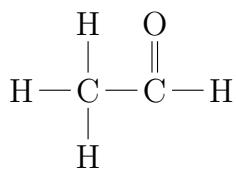
which is abbreviated as \(\ce{CH3CHO}\).
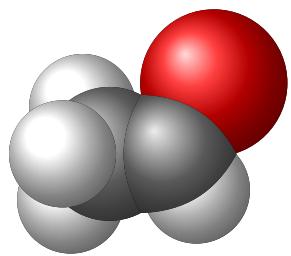
Chinese labels in figure: 乙醛分子的比例模型 = Space-filling model of the acetaldehyde molecule.
2. Chemical Properties of Acetaldehyde
The aldehyde group (\(\ce{-CHO}\)) functional group determines the main chemical properties of acetaldehyde.
(1) Addition Reactions
The carbon–oxygen double bond can undergo addition reactions. For example, when a mixture of acetaldehyde vapor and hydrogen gas is passed over a hot nickel catalyst, an addition reaction occurs and acetaldehyde is reduced to ethanol:
\[\ce{CH3CHO + H2 ->[\text{catalyst}][\Delta] CH3CH2OH}\]
The carbon–oxygen double bond in the carbonyl group, like the carbon–carbon double bond in alkenes, consists of one \(\sigma\) bond and one \(\pi\) bond and can undergo addition reactions.
\[\overset{\delta-}{\ce{O}}\!\!=\!\!\overset{\delta+}{\ce{C}}\ce{H}\]
Because the electronegativity of the oxygen atom in the carbonyl group is high, the electron cloud of the carbon–oxygen double bond — particularly the \(\pi\) bond — is shifted toward the oxygen atom.
When a polar molecule such as HCN undergoes an addition reaction with the carbonyl group, the positively charged atom or group adds to the oxygen atom, and the negatively charged atom or group adds to the carbon atom:
\[\ce{CH3CHO + HCN -> CH3CH(OH)(CN)}\]
(2) Oxidation Reactions
We already know that oxidation–reduction reactions were first understood in terms of gaining or losing oxygen: gaining oxygen is oxidation, and losing oxygen is reduction. In organic chemistry reactions, it is also common to analyze in terms of gaining or losing hydrogen: losing hydrogen is an oxidation reaction, and gaining hydrogen is a reduction reaction. Thus, the addition of hydrogen to acetaldehyde is the reduction of acetaldehyde. Acetaldehyde can also be oxidized by weak oxidizing agents.
Add \(1\ \text{mL}\) of \(2\%\) \(\ce{AgNO3}\) solution to a clean test tube, then, while shaking the test tube, gradually add \(2\%\) dilute ammonia solution dropwise until the precipitate that initially forms just dissolves (the resulting solution is commonly called silver ammonia solution, or Tollens’ reagent). Then add 3 drops of acetaldehyde, shake, and place the test tube in a hot water bath to warm. Before long, a bright mirror-like layer of metallic silver will appear on the inner wall of the test tube.
In this reaction, silver nitrate reacts with ammonia solution to form the silver–ammonia complex ion, which oxidizes acetaldehyde to acetic acid. The acetic acid reacts with ammonia to form ammonium acetate, while the silver ion in the silver–ammonia complex is reduced to metallic silver, which deposits on the inner wall of the test tube forming a silver mirror. This is why the reaction is called the silver mirror reaction:
\[\ce{Ag+ + NH3 * H2O -> AgOH v + NH4+}\]
\[\ce{AgOH + 2NH3 * H2O -> [Ag(NH3)2]+ + OH- + 2H2O}\]
\[\ce{CH3CHO + 2[Ag(NH3)2]+ + 2OH- -> CH3COO- + NH4+ + 2Ag v + 3NH3 + H2O}\]
The silver mirror reaction is commonly used to test for the presence of an aldehyde group. Industrially, this reaction principle is used to deposit silver uniformly onto glass to make mirrors and thermos flask liners (in production, glucose, which contains an aldehyde group, is commonly used as the reducing agent).
Acetaldehyde can also be oxidized by another weak oxidizing agent — freshly prepared copper(II) hydroxide:
Add \(2\ \text{mL}\) of \(10\%\) \(\ce{NaOH}\) solution to a test tube, then add \(4\)–\(6\) drops of \(2\%\) \(\ce{CuSO4}\) solution and shake. Then add \(0.5\ \text{mL}\) of acetaldehyde solution and heat to boiling. Observe the red precipitate that forms in the solution.
Because acetaldehyde has reducing properties, it can reduce the copper(II) hydroxide formed in the reaction to a red precipitate of copper(I) oxide. This is another method for testing for the presence of an aldehyde group:
\[\ce{Cu^{2+} + 2OH- -> Cu(OH)2 v}\]
\[\ce{CH3CHO + 2Cu(OH)2 ->[\Delta] CH3COOH + Cu2O v + 2H2O}\]
3. Uses of Acetaldehyde
Acetaldehyde is an important raw material in organic synthesis, mainly used to produce acetic acid, butanol, and other products. For example, industrially, at a certain temperature and in the presence of a catalyst, acetaldehyde is oxidized by air to produce acetic acid:
\[\ce{2CH3CHO + O2 ->[\text{catalyst}] 2CH3COOH}\]
4. Industrial Preparation of Acetaldehyde
Acetaldehyde was first produced by the ethanol oxidation method, which consumed large amounts of grain. Later, the acetylene hydration method was adopted. In recent years, with the development of the petrochemical industry, the new technology of producing acetaldehyde by the ethylene oxidation method was developed.
(1) Acetylene Hydration Method
Using a mercury salt (such as \(\ce{HgSO4}\)) as a catalyst, acetylene combines with water to produce acetaldehyde:
\[\ce{CH#CH + H2O ->[\text{catalyst}] CH3CHO}\]
The acetaldehyde produced by this method has high purity, but workers are susceptible to mercury poisoning during production. Research is currently underway to replace mercury catalysts with non-mercury catalysts, with preliminary success already achieved.
(2) Ethylene Oxidation Method
At a certain temperature and pressure, using palladium(II) chloride (\(\ce{PdCl2}\)) and copper(II) chloride (\(\ce{CuCl2}\)) as catalysts, ethylene is directly oxidized by air or oxygen to produce acetaldehyde:
\[\ce{2CH2=CH2 + O2 ->[\text{catalyst}][\text{heat, pressure}] 2CH3CHO}\]
Ethylene can be obtained from petroleum cracking gas. The ethylene oxidation method has a simple process, abundant raw materials, low cost, and high yield.
The Aldehyde Family
Besides acetaldehyde, there are other substances with similar molecular structures and chemical properties, such as formaldehyde (\(\ce{HCHO}\)) and propanal (\(\ce{CH3CH2CHO}\)). Because aldehyde molecules all contain the aldehyde group, their chemical properties are quite similar. For example, they can all be reduced to alcohols, oxidized to acids, and undergo the silver mirror reaction.
Among the aldehydes, formaldehyde also has wide applications. Formaldehyde, also called methanal, is a colorless gas with a strong pungent odor. It is highly soluble in water — a \(35\%\)–\(40\%\) aqueous solution of formaldehyde is called formalin. Formaldehyde is an important organic raw material with applications in the plastics industry (e.g., making phenol-formaldehyde resin), the synthetic fiber industry, the leather industry, and other fields. Aqueous formaldehyde solution has bactericidal and preservative properties and is a good disinfectant. In agriculture, dilute formalin solution (\(0.1\%\)–\(0.5\%\)) is often used to soak seeds for disinfection. Formalin is also used to preserve biological specimens.
Phenol-formaldehyde resin was the first synthetic resin to be produced and used. Because it is not easily combustible and has excellent electrical insulation properties, it is still used as a raw material for Bakelite (a type of plastic).
Phenol-formaldehyde resin is usually prepared by reacting phenol with formaldehyde. This reaction can be simply represented as follows:
A reaction in which monomers react with each other to form a macromolecular compound, simultaneously producing small molecules (such as water or ammonia), is called a condensation polymerization (polycondensation) reaction.
Acetone
Acetone is a colorless liquid with an odor, a boiling point of \(56.2\,{}^{\circ}\text{C}\), and a density of \(0.7899\ \text{g/cm}^3\). It is volatile and flammable. Acetone is miscible with water, ethanol, and diethyl ether in all proportions. Acetone can also dissolve fats, resins, rubber, and many other organic substances — it is an important organic solvent.
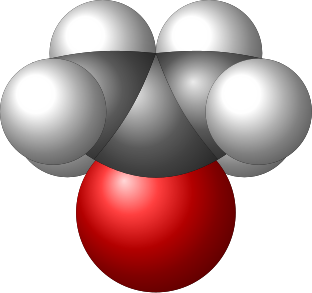
The chemical formula of acetone (Figure 3.9) is \(\ce{C3H6O}\), and its structural formula is:
\[\ce{CH3-CO-CH3}\]
which is abbreviated as \(\ce{CH3COCH3}\).
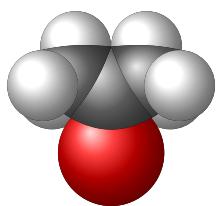
Chinese labels in figure: 丙酮分子的比例模型 = Space-filling model of the acetone molecule.
Acetone does not have reducing properties and does not undergo the silver mirror reaction with silver ammonia solution. In the presence of catalysts (Ni, Co, Pt, Pd, etc.), acetone can undergo addition reactions with hydrogen gas to produce alcohols.
Exercises for Section 4
Which of the following substances can undergo the silver mirror reaction?
Formaldehyde
Ethanol
Glucose (\(\ce{CH2OH(CHOH)4CHO}\))
A certain aldehyde has the composition: \(62.1\%\) carbon, \(10.3\%\) hydrogen, \(27.6\%\) oxygen. Its vapor density is 29 times that of hydrogen. Write the chemical formula, structural formula, and name of this aldehyde.
Write the relevant chemical equations for producing acetaldehyde using petroleum or coke as raw materials, respectively.
What are the similarities and differences between aldehydes and ketones in molecular structure? What is the important difference in their properties? How can you use chemical methods to distinguish between acetaldehyde and acetone?
Among the hydrocarbon derivatives containing carbon, hydrogen, and oxygen that we have studied, there are alcohols, ethers, aldehydes, and ketones. Assuming each contains 3 carbon atoms, write the structural formulas of each type, give their names, and indicate which are structural isomers of each other.
3.5 Section 5: Acetic Acid
Acetic acid (\(\ce{CH3COOH}\)) is an important organic acid. It is the main component of vinegar — ordinary food vinegar contains \(3\%\)–\(5\%\) acetic acid, which is why acetic acid is also called vinegar acid (or ethanoic acid).
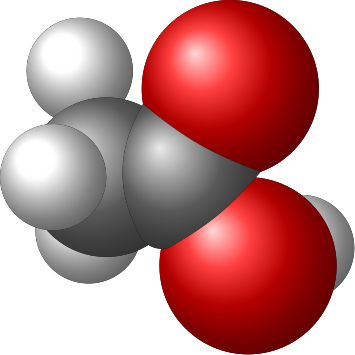
The chemical formula of acetic acid (Figure 3.10) is \(\ce{C2H4O2}\). Its structural formula is \(\ce{CH3-COOH}\), abbreviated as \(\ce{CH3COOH}\).
The functional group \(\ce{-COOH}\) in the acetic acid molecule is called a carboxyl group. It is composed of a carbonyl group (\(\ce{C=O}\)) and a hydroxyl group (\(\ce{-OH}\)).
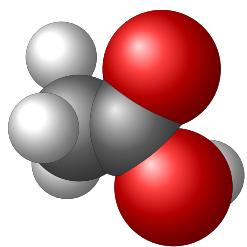
Chinese labels in figure: 乙酸分子的比例模型 = Space-filling model of the acetic acid molecule.
Properties of Acetic Acid
1. Physical Properties of Acetic Acid
Acetic acid is a colorless liquid with a strong, pungent odor. It has a boiling point of \(117.9\,{}^{\circ}\text{C}\) and a melting point of \(16.6\,{}^{\circ}\text{C}\). When the temperature drops below \(16.6\,{}^{\circ}\text{C}\), acetic acid solidifies into ice-like crystals — this is why anhydrous acetic acid is also called glacial acetic acid. Acetic acid is readily soluble in water and ethanol.
2. Chemical Properties of Acetic Acid
(1) Acidity
Acetic acid has pronounced acidity and can ionize in aqueous solution to produce hydrogen ions:
\[\ce{CH3COOH <=> CH3COO- + H+}\]
Acetic acid is a weak acid with an ionization constant \(K = 1.75 \times 10^{-5}\), but it is stronger than carbonic acid. It possesses all the general properties of acids.
The carbonyl group in the carboxyl group is similar to the carbonyl group in the aldehyde group — it also consists of one \(\sigma\) bond and one \(\pi\) bond, with the electron cloud of the carbon–oxygen bond shifted toward the oxygen atom. The oxygen atom in the hydroxyl group has lone-pair \(p\) electrons, and these \(p\) electron clouds can overlap from the side with the \(\pi\) electron cloud of the carbonyl group, causing the hydroxyl oxygen atom’s electron cloud to shift toward the carbonyl group. As a result, the electron cloud between the hydrogen and oxygen atoms shifts toward the oxygen atom, enabling the hydrogen atom to ionize. This is why acetic acid and other compounds with carboxyl groups exhibit acidity.
(2) Esterification Reaction
Under conditions of concentrated sulfuric acid and heating, acetic acid can react with ethanol to produce ethyl acetate.
Add \(3\ \text{mL}\) of ethanol to a test tube, then, while shaking, slowly add \(2\ \text{mL}\) of concentrated sulfuric acid and \(2\ \text{mL}\) of glacial acetic acid. Assemble the apparatus as shown in Figure 3.11. Carefully and evenly heat the test tube with an alcohol lamp for \(3\)–\(5\ \text{min}\). The vapor produced passes through the delivery tube and reaches the surface of a saturated sodium carbonate solution. A transparent oily liquid can be seen forming on the liquid surface, accompanied by a fruity aroma.
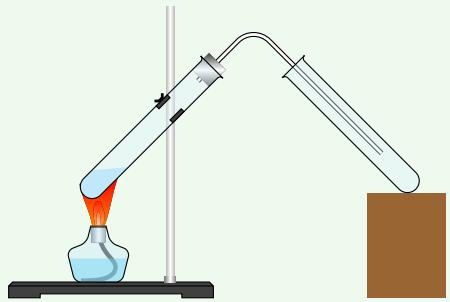
Chinese labels in figure: 乙酸乙酯的制备 = Preparation of ethyl acetate.
This fragrant, colorless, transparent oily liquid is ethyl acetate. Since the ethyl acetate produced under the same conditions can also partially undergo hydrolysis, regenerating acetic acid and ethanol, the reaction is actually reversible.
Using an isotopically labeled alcohol with \(\ce{^{18}O}\) to react with acetic acid, the \(\ce{^{18}O}\) atom is found in the ethyl acetate molecule. Therefore, the mechanism of the esterification reaction is generally as follows: the hydroxyl group from the carboxylic acid molecule combines with the hydrogen atom from the alcohol molecule to form water, and the remaining parts combine to form the ester:
\[\ce{CH3COOH + H-^{18}O-C2H5 ->[\ce{H2SO4}(\text{conc.})][\Delta] CH3CO-^{18}O-C2H5 + H2O}\]
Ethyl acetate is a type of ester compound. A reaction in which an acid reacts with an alcohol to produce an ester and water is called an esterification reaction.
Uses of Acetic Acid
Acetic acid is an important organic chemical raw material with wide-ranging uses. It can be used to produce cellulose acetate, synthetic fibers (such as Vinylon), paint solvents, plasticizers, fragrances, dyes, pharmaceuticals (such as aspirin), and pesticides.
Preparation of Acetic Acid
There are multiple industrial methods for producing acetic acid. In the past, acetic acid was made by fermentation — sugar-containing materials were fermented to produce ethanol, which was then further oxidized through fermentation to acetaldehyde, and acetaldehyde was further oxidized to acetic acid. Food vinegar is produced in this way. Currently, the ethylene oxidation method is most commonly used, with the newer approach being the direct oxidation of alkanes.
1. Ethylene Oxidation Method
The principle of this method is to react ethylene with oxygen in the presence of catalysts such as palladium(II) chloride (\(\ce{PdCl2}\)) and copper(II) chloride (\(\ce{CuCl2}\)) to produce acetaldehyde. The acetaldehyde is then oxidized to acetic acid under a catalyst such as manganese(II) acetate (\(\ce{(CH3COO)2Mn}\)):
\[\ce{2CH2=CH2 + O2 ->[\text{catalyst}] 2CH3CHO}\]
\[\ce{2CH3CHO + O2 ->[\text{catalyst}] 2CH3COOH}\]
The raw material for this method is ethylene, which can be obtained from petroleum processing products and is therefore very abundant.
2. Direct Oxidation of Alkanes
The direct oxidation method, also called the butane oxidation method, is a newer method for producing acetic acid. The main raw materials are low-boiling-point alkanes (mainly \(\ce{C4}\)–\(\ce{C6}\) fractions) produced from petroleum refining. These low-boiling-point alkanes are directly oxidized by atmospheric oxygen at a certain temperature and pressure in the presence of catalysts (such as cobalt salts of carboxylic acids) to produce acetic acid:
\[\ce{2CH3CH2CH2CH3 + 5O2 ->[\text{catalyst}][\text{heat, pressure}] 4CH3COOH + 2H2O}\]
Exercises for Section 5
Write the chemical equations for acetic acid reacting with each of the following substances:
Metallic magnesium
Quicklime
Caustic soda solution
Soda (sodium carbonate) solution
Methanol
How can you use chemical methods to distinguish between the aqueous solutions of ethanol, acetaldehyde, and acetic acid?
\(10\ \text{g}\) of water and \(40\ \text{g}\) of acetic acid are mixed to prepare an acetic acid solution. Its density is \(1.07\ \text{g/cm}^3\). Calculate the molar concentration of this acetic acid solution.
\(30\ \text{g}\) of acetic acid is reacted with \(46\ \text{g}\) of ethanol. If the actual yield is \(85\%\) of the theoretical yield, how many grams of ethyl acetate can be obtained?
Write the chemical equations for each step of producing ethyl acetate from water, air, and ethylene as raw materials.
3.6 Section 6: Carboxylic Acids
Among organic compounds, there is a large class that, like acetic acid, all contain the carboxyl functional group in their molecules. Because of this, they have chemical properties similar to those of acetic acid — such as acidity and the ability to undergo esterification reactions.
The different carboxylic acids listed in Table 3.2 have different hydrocarbon groups connected to the carboxyl group, so their properties also differ.
Organic compounds in which a hydrocarbon group is directly connected to a carboxyl group are called carboxylic acids. Depending on the hydrocarbon group bonded to the carboxyl group, carboxylic acids can be classified as aliphatic acids (such as acetic acid) and aromatic acids (such as benzoic acid, \(\ce{C6H5COOH}\)). They can also be classified by the number of carboxyl groups: those containing one carboxyl group are called monocarboxylic acids (such as formic acid and acetic acid); those containing two carboxyl groups are called dicarboxylic acids (such as oxalic acid, \(\ce{HOOC-COOH}\), and adipic acid, \(\ce{HOOC(CH2)4COOH}\)).
The general formula for monocarboxylic acids is \(\ce{R-COOH}\). Below we introduce some important carboxylic acids.
| Name | Condensed structural formula | Boiling point (\(\,{}^{\circ}\text{C}\)) | \(K\) |
|---|---|---|---|
| Formic acid | \(\ce{HCOOH}\) | 100.7 | \(1.77 \times 10^{-4}\) |
| Acetic acid | \(\ce{CH3COOH}\) | 117.9 | \(1.75 \times 10^{-5}\) |
| Propionic acid | \(\ce{CH3CH2COOH}\) | 140.99 | \(1.34 \times 10^{-5}\) |
| Butyric acid | \(\ce{CH3CH2CH2COOH}\) | 163.5 | \(1.54 \times 10^{-5}\) |
| Benzoic acid | \(\ce{C6H5COOH}\) | 249 | \(6.46 \times 10^{-5}\) |
Formic Acid
Formic acid (\(\ce{HCOOH}\)) is commonly called ant acid. It is a colorless liquid with a pungent odor, is corrosive, and is miscible with water.
Formic acid is the simplest carboxylic acid. Its structure differs from other carboxylic acids: in the formic acid molecule, what is connected to the carboxyl group is not a hydrocarbon group but a hydrogen atom. Formic acid has a unique structural feature — it has both a carboxyl group structure (circled with a dashed line) and an aldehyde group structure (enclosed in a box). This structural peculiarity gives formic acid properties of both a carboxylic acid and an aldehyde. For example, formic acid has both the general properties of an acid and reducing properties. Formic acid can reduce silver–ammonia complex ions to metallic silver while being oxidized to carbon dioxide and water.
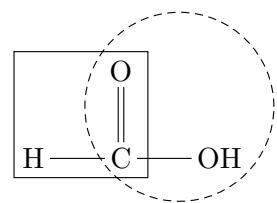
Chinese labels in figure: 羧基 = Carboxyl group; 醛基 = Aldehyde group.
Formic acid is mainly used industrially as a reducing agent, as a mordant in the dyeing industry, and as a disinfectant in medicine.
Higher Fatty Acids
Among monocarboxylic acids, some have alkyl groups containing a relatively large number of carbon atoms. Fatty acids with relatively many carbon atoms in their alkyl groups are called higher fatty acids. For example, stearic acid (\(\ce{C17H35COOH}\)), palmitic acid (\(\ce{C15H31COOH}\)), and oleic acid (\(\ce{C17H33COOH}\)) are all important higher fatty acids. Among these, the alkyl group of oleic acid contains one double bond, whereas the alkyl groups of stearic acid and palmitic acid contain no unsaturated bonds. Stearic acid and palmitic acid are saturated higher fatty acids and are solid at room temperature. Oleic acid is an unsaturated higher fatty acid and is liquid at room temperature. Higher fatty acids are insoluble in water.
Higher fatty acid molecules contain carboxyl groups, so they have the properties of carboxylic acids. For example, higher fatty acids can react with alkaline solutions to form salts:
\[\ce{C17H35COOH + NaOH -> C17H35COONa + H2O}\]
The soap we use daily consists mainly of sodium salts of higher fatty acids.
The oleic acid molecule contains one unsaturated double bond, so in addition to the above reactions, oleic acid can also undergo addition reactions with hydrogen or chlorine. For example, liquid oleic acid undergoes an addition reaction with hydrogen in the presence of a nickel catalyst, producing solid stearic acid:
\[\ce{C17H33COOH + H2 ->[\text{catalyst}][\Delta] C17H35COOH}\]
Benzoic Acid
Benzoic acid (\(\ce{C6H5COOH}\)), also known by its old name benzoin acid, is an aromatic acid. It is the simplest aromatic acid in terms of molecular composition. Benzoic acid is a white needle-shaped crystal with a melting point of \(122.4\,{}^{\circ}\text{C}\). It sublimes readily, is slightly soluble in water, and is readily soluble in ethanol and diethyl ether. The acidity of benzoic acid is slightly stronger than that of acetic acid. Benzoic acid is a raw material for organic synthesis — besides being used to make fragrances, it is also used to produce dyes and drugs. Its sodium salt can serve as a food preservative.
Oxalic Acid
Oxalic acid (\(\ce{HOOC-COOH}\)), also called ethanedioic acid, is the simplest dicarboxylic acid. Oxalic acid consists of colorless, transparent crystals. It usually contains two molecules of water of crystallization and is soluble in water and ethanol. Oxalic acid is an important chemical raw material and can be used as a reducing agent and for extracting rare metals.
Exercises for Section 6
What are carboxylic acids? What is the functional group of carboxylic acids? What chemical properties do they have?
Can an aqueous solution of formic acid react with sodium carbonate? Can it react with the silver–ammonia complex ion? Why?
The simplest unsaturated acid is acrylic acid (\(\ce{CH2=CH-COOH}\)). What reactions can acrylic acid undergo? Write the chemical equations for these reactions.
Formic acid is commonly called ant acid because the secretions of many insects such as ants and bees contain formic acid. When stung by a bee, applying a little dilute ammonia solution or dilute sodium carbonate solution can relieve the itching and pain. Why? Write the chemical equations for the reactions.
How can you use chemical methods to distinguish each group of substances?
Formaldehyde, formic acid, and acetic acid
Methanol, formic acid, and propionic acid
3.7 Section 7: Esters
We learned that acetic acid and ethanol can react in the presence of concentrated sulfuric acid to produce ethyl acetate. Similarly, other acids can also undergo analogous reactions with alcohols. For example, formic acid reacts with ethanol in the presence of concentrated sulfuric acid to produce ethyl formate:
\[\ce{HCOOH + HO-C2H5 ->[\ce{H2SO4}(\text{conc.})] HCOOC2H5 + H2O}\]
The class of compounds formed by the reaction of acids with alcohols is called esters. The general formula for esters is \(\ce{RCOO}R'\), where R and R’ may be the same or different. Ester compounds are named according to the acid and alcohol from which they are formed. For example, \(\ce{CH3COOC2H5}\) is called ethyl acetate, and \(\ce{HCOOCH3}\) is called methyl formate.
Inorganic acids such as nitric acid can also react with alcohols to form esters:
\[\ce{C2H5OH + HO-NO2 -> C2H5-O-NO2 + H2O}\]
Esters are widely found in nature. Low-molecular-weight esters are liquids with pleasant fruity aromas and are present in various fruits and flowers. For example, pears contain isoamyl acetate, while apples and bananas contain isoamyl isovalerate. Esters are generally lighter than water, poorly soluble in water, and readily soluble in ethanol, diethyl ether, and other organic solvents. Esters can be used as solvents and in the preparation of beverages and candy as fruit-flavored essences.
An important chemical property of esters is their ability to undergo hydrolysis with water.
To each of three test tubes, add 6 drops of ethyl acetate. To the first test tube, add \(5.5\ \text{mL}\) of distilled water. To the second test tube, add \(0.5\ \text{mL}\) of dilute sulfuric acid (1:5) and \(5\ \text{mL}\) of distilled water. To the third test tube, add \(0.5\ \text{mL}\) of \(30\%\) sodium hydroxide solution and \(5\ \text{mL}\) of distilled water. After shaking to mix uniformly, place all three test tubes in a \(70\)–\(80\,{}^{\circ}\text{C}\) water bath to heat. After a few minutes, the odor of ethyl acetate in the third test tube disappears completely. In the second test tube, a slight ethyl acetate odor remains. In the first test tube, the ethyl acetate odor shows little change.
The experiment shows that in the presence of acid or base, esters undergo hydrolysis with water, producing the corresponding acid and alcohol. For example, ethyl acetate hydrolyzes to produce acetic acid and ethanol:
\[\ce{CH3COOC2H5 + H2O <=>[{\text{inorganic acid or base}}] CH3COOH + C2H5OH}\]
Ester hydrolysis is the reverse reaction of esterification. When the rates of esterification and hydrolysis are equal, the reaction mixture is in a state of equilibrium:
\[\ce{RCOOH} + \ce{HO}R' \ce{<=>[\text{esterification}][\text{hydrolysis}]} \ce{RCOO}R' + \ce{H2O}\]
At equilibrium, the extent of ester hydrolysis is closely related to the reaction conditions. When a base is present, it reacts with the acid produced by hydrolysis in a neutralization reaction, increasing the extent of hydrolysis:
\[\ce{RCOOH + NaOH -> RCOONa + H2O}\]
When only an inorganic acid is present, it merely serves as a catalyst and does not remove the acid produced by hydrolysis, so the extent of hydrolysis is smaller.
In actual production, reaction conditions can be controlled as needed to direct the reaction in the desired direction — for example, adding a base to promote ester hydrolysis.
Exercises for Section 7
Write the condensed structural formulas of the following substances:
- Ethyl butyrate, (2) methyl propanoate, (3) octyl butyrate, (4) ethyl benzoate
Write the chemical equations for the reactions of formic acid with each of the following substances, and explain how to carry out each reaction:
- Methanol, (2) ethanol
What carboxylic acid or ester has the composition \(\ce{C3H6O2}\)? Write their structural formulas and names.
How can the following transformations be achieved? Write the relevant chemical equations.
\(\ce{C -> CaC2 -> C2H2 -> CH3CHO -> CH3COOH -> CH3COOC2H5}\)
\(\ce{CH3OH -> HCHO -> HCOOH -> HCOOC2H5}\)
The vapor density of a certain organic compound is 3.04 times that of air. \(2.2\ \text{g}\) of this organic compound, upon combustion, produces \(1.8\ \text{g}\) of water and \(2.24\ \text{L}\) of carbon dioxide (at STP). Find its chemical formula. If this organic compound can undergo the silver mirror reaction and can be hydrolyzed to produce an alcohol and an acid, determine its structural formula and write the relevant chemical equations.
3.8 Section 8: Fats and Oils
Fats and oils are one of the main foods for humans and are also important industrial raw materials. The lard, tallow, mutton fat, peanut oil, rapeseed oil, soybean oil, and cottonseed oil we consume daily are all fats and oils.
Under normal temperature conditions, some fats and oils are solid while others are liquid. Generally speaking, those that are solid are called fats, and those that are liquid are called oils. Since plant-derived fats and oils are usually liquid, they are called oils; animal-derived fats and oils are usually solid, and are called fats. Fats and oils are collectively referred to as lipids (fats and oils). Chemically, they are all esters formed from higher fatty acids and glycerol, so fats and oils belong to the ester class.
Composition and Structure of Fats and Oils
Fats and oils are glycerol esters (glycerides) formed from various higher fatty acids — such as stearic acid, palmitic acid, or oleic acid — with glycerol. Their structure can be represented as:
\[\begin{array}{l} \ce{R1-COO-CH2} \\ \ce{R2-COO-CH} \\ \ce{R3-COO-CH2} \end{array}\]
In the structural formula, \(\ce{R1}\), \(\ce{R2}\), and \(\ce{R3}\) represent saturated or unsaturated hydrocarbon groups. They may be the same or different. If \(\ce{R1}\), \(\ce{R2}\), and \(\ce{R3}\) are the same, such a fat or oil is called a simple glyceride. If \(\ce{R1}\), \(\ce{R2}\), and \(\ce{R3}\) are different, it is called a mixed glyceride. Most natural fats and oils are mixed glycerides.
The degree of saturation of the fatty acids that form fats and oils has an important effect on their melting points. Glycerides formed from saturated stearic acid or palmitic acid have higher melting points and are solid. Glycerides formed from unsaturated oleic acid have lower melting points and are liquid. Because different fats and oils contain different relative amounts of saturated and unsaturated hydrocarbon groups, they have different melting points.
Properties of Fats and Oils
1. Physical Properties
Fats and oils are lighter than water, with densities in the range of \(0.9\)–\(0.95\ \text{g/cm}^3\). They are insoluble in water but readily soluble in gasoline, diethyl ether, benzene, and many other organic solvents. Industrially, based on this property, organic solvents can be used to extract oil from plant seeds.
2. Chemical Properties
Since fats and oils are mixtures of glycerides of various higher fatty acids — including both saturated and unsaturated ones — fats and oils possess some chemical properties of both esters and alkenes.
(1) Hydrogenation of Fats and Oils
Liquid oils, in the presence of a catalyst (such as Ni) and under heating and pressurization, can undergo addition reactions with hydrogen, increasing the degree of saturation and producing solid fats:
Chinese labels in figure: 油酸甘油酯(油) = Glyceryl trioleate (oil); 硬脂酸甘油酯(脂肪) = Glyceryl tristearate (fat); 催化剂 = Catalyst; 加热、加压 = Heat, pressure.
This reaction is called hydrogenation of fats and oils, also known as hardening. The fats produced in this way are called artificial fats or hardened oils. Industrially, hydrogenation reactions are commonly used to convert various plant oils into hardened oils. Hardened oils are stable in properties, not easily spoiled, and convenient for transportation. They can be used as raw materials for manufacturing soap, fatty acids, glycerol, margarine, and other products.
(2) Hydrolysis of Fats and Oils
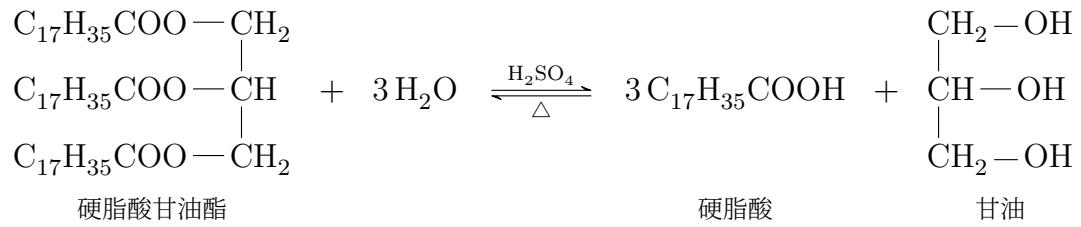
Like the hydrolysis of esters, under appropriate conditions (such as in the presence of acid, base, or high-temperature steam), fats and oils undergo hydrolysis with water, producing glycerol and the corresponding higher fatty acids. For example, the hydrolysis of glyceryl tristearate in the presence of acid can be represented as:
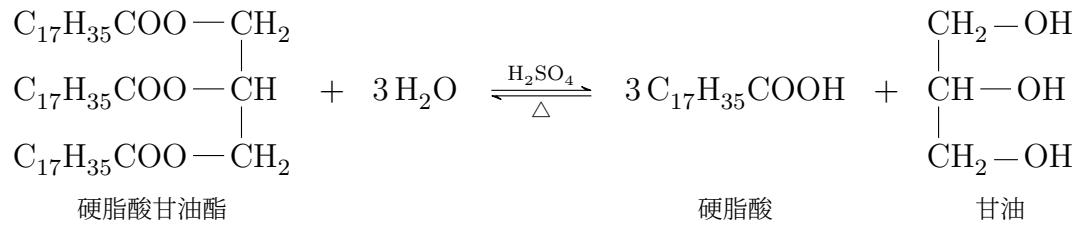
Chinese labels in figure: 硬脂酸甘油酯 = Glyceryl tristearate; 甘油 = Glycerol; 硬脂酸 = Stearic acid.
Industrially, this reaction is used to produce higher fatty acids and glycerol from fats and oils.
If the hydrolysis of fats and oils is carried out in the presence of a base, then the higher fatty acids produced react with the base to form higher fatty acid salts. For example, glyceryl tristearate undergoes hydrolysis in the presence of sodium hydroxide, producing sodium stearate and glycerol:
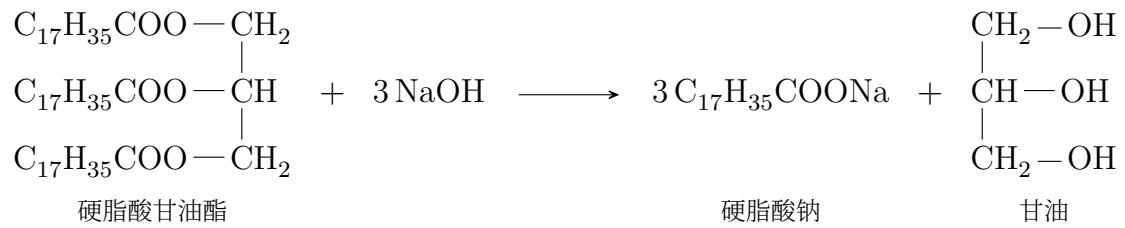
Chinese labels in figure: 硬脂酸甘油酯 = Glyceryl tristearate; 甘油 = Glycerol; 硬脂酸钠 = Sodium stearate.
The hydrolysis of fats and oils under alkaline conditions is also called a saponification reaction.
Industrially, saponification is used to manufacture soap. First, animal fats (tallow, mutton fat, etc.), plant oils (cottonseed oil, soybean oil, etc.), and sodium hydroxide solution are placed in the appropriate proportions in a saponification kettle and heated with steam while being stirred appropriately. Because excess base is present, the fats and oils undergo hydrolysis to produce sodium salts of higher fatty acids and glycerol.
After the reaction is complete, the resulting mixture of sodium salts of higher fatty acids, glycerol, and water forms a mixed liquid. The sodium salts of higher fatty acids form a colloidal solution in water. To separate the soap from the glycerol, heating and stirring continue, and fine table salt is gradually added to the kettle. Under the action of the electrolyte, the colloidal solution is destroyed, and the sodium salts of higher fatty acids precipitate out. This process of adding salt to cause the soap to precipitate is called salting out. The heating and stirring are then stopped, and the solution is allowed to stand for a time, separating into two layers. The upper layer is sodium salts of higher fatty acids, and the lower layer is a mixture of glycerol and salt solution. The upper layer material is removed, fillers (such as rosin and sodium silicate) are added, and the mixture is filtered, dried, and shaped to produce finished soap. The lower layer solution is separated and purified to obtain glycerol.
Fats and oils are important nutritional substances. When completely oxidized (to \(\ce{CO2}\) and \(\ce{H2O}\)), the heat released (about \(9.4\ \text{kCal/g}\)) is much greater than the heat released by carbohydrates (about \(4.1\ \text{kCal/g}\)).8 In the small intestine, fats and oils are hydrolyzed under the action of enzymes (proteins with catalytic function), mainly producing fatty acids and glycerol, along with some intermediate products. The intestinal wall can absorb fatty acids and glycerol. Within the cells of the intestinal wall, the hydrolysis products recombine to form fats and oils. These fats and oils enter the body’s various tissues via the lymphatic system and blood, where they undergo oxidation.
The Cleaning Action of Soap
Ordinary soap contains approximately \(70\%\) sodium salts of higher fatty acids and \(30\%\) water plus a small amount of salt. Some soaps also contain fillers, fragrances, and dyes. The cleaning action of soap is primarily due to the sodium salts of higher fatty acids. Structurally, a molecule of sodium fatty acid salt can be divided into two parts: one is the polar \(\ce{-COONa}\) (or \(\ce{-COO-}\)) group, which is soluble in water and is called the hydrophilic group; the other is the nonpolar chain-like hydrocarbon group (\(\ce{-R}\)), which has a structure very different from water and cannot dissolve in it — this is called the hydrophobic group. The hydrophobic group has an affinity for oil (it is lipophilic). During washing, when dirt containing oil and grease comes into contact with soap, the hydrocarbon chain of the fatty acid sodium molecule inserts into the oil droplet, while the water-soluble carboxylate part extends outside the oil droplet into the water. In this way, the oil droplet becomes surrounded by soap molecules (Figure 3.16). Through rubbing and agitation, the large oil droplets are dispersed into small oil beads, which eventually detach from the fabric being washed and disperse into the water as an emulsion, thereby achieving the cleaning effect.
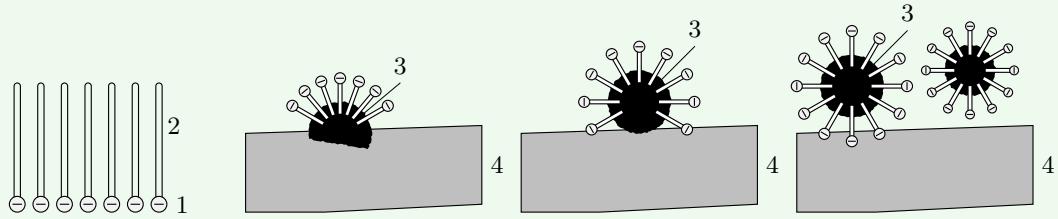
Chinese labels in figure: 1. 亲水基 = Hydrophilic group; 2. 憎水基 = Hydrophobic group; 3. 油污 = Oil/grease; 4. 纤维织品 = Textile fiber.
Synthetic Detergents
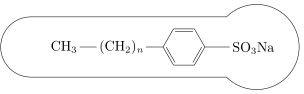
Based on research into the cleaning mechanism of soap, people realized that any substance whose molecules have a hydrophilic group at one end and a hydrophobic group at the other possesses a certain cleaning ability. Therefore, artificial synthesis can be used to create substances with this structure for use as detergents — these are the synthetic detergents people use daily. Currently, commonly used synthetic detergents have as their main component sodium alkylbenzenesulfonate or sodium alkylsulfonate. Their structural formulas are \(\ce{R-C6H4-SO3Na}\) and \(\ce{R-SO3Na}\) (Figure 3.17), respectively. The hydrophilic group in both cases is the polar group \(\ce{-SO3Na}\), and the hydrophobic groups are the nonpolar groups \(\ce{R-C6H4-}\) and \(\ce{R-}\), respectively. In these formulas, R generally represents a hydrocarbon group containing more than ten carbon atoms. If the hydrocarbon group has too few carbon atoms, the hydrophobic effect is too weak, making the hydrophobic group’s affinity for oil insufficient. Conversely, if the hydrocarbon group has too many carbon atoms, it becomes difficult to dissolve in water. Therefore, a hydrocarbon group that is either too large or too small will not serve well for cleaning.
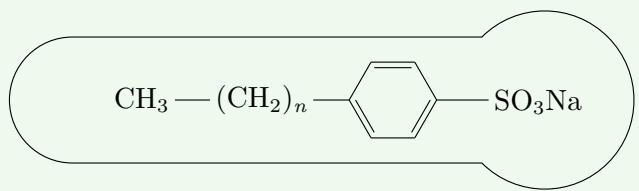
Chinese labels in figure: 亲水基 = Hydrophilic group; 憎水基 = Hydrophobic group; 合成洗涤剂分子结构示意图 = Schematic diagram of synthetic detergent molecular structure.
Synthetic detergents have very strong cleaning ability and excellent wetting and emulsifying properties. Compared to soap, they not only save large amounts of fats and oils, but their calcium and magnesium salts are also soluble in water, so they are unaffected by hard water. For these reasons, synthetic detergents have developed very rapidly.
Exercises for Section 8
What is the difference between fats and oils? How can an oil be converted into a fat? Write the chemical equation for the reaction.
Under what conditions can fats and oils be hydrolyzed? What products are obtained after hydrolysis? Write the chemical equations.
Give one example each to illustrate how each of the following reactions is applied in the organic chemical industry, and write the chemical equations:
Esterification
Saponification
If only \(85\%\) of glyceryl tristearate undergoes hydrolysis during the saponification reaction, how many tonnes of glyceryl tristearate are needed to produce \(5\ \text{t}\) of glycerol?
3.9 Section 9: Nitro Compounds
Compounds formed by replacing hydrogen atoms in hydrocarbon molecules with nitro groups (\(\ce{-NO2}\)) are called nitro compounds. Their general formula is \(\ce{R-NO2}\). In nitro compound molecules, the nitro group \(\ce{-NO2}\) is directly bonded to a carbon atom. This differs from ethyl nitrate, which we studied earlier: in ethyl nitrate (\(\ce{C2H5O-NO2}\)), the nitro group \(\ce{-NO2}\) is connected to the carbon atom through an oxygen atom. Therefore, one cannot simply call every compound whose molecule contains a \(\ce{-NO2}\) group a nitro compound.
Nitro compounds can be classified according to the type of hydrocarbon group directly bonded to the nitro group — into aliphatic nitro compounds and aromatic nitro compounds. Among these, aromatic nitro compounds are more important. Below we will study two important aromatic nitro compounds: nitrobenzene and trinitrotoluene.
Nitrobenzene
Nitrobenzene (\(\ce{C6H5NO2}\)) is an important industrial raw material. Industrially, it is produced by the nitration reaction of benzene with a mixture of concentrated nitric acid and concentrated sulfuric acid:
\[\ce{C6H6 + HONO2 ->[\ce{H2SO4}(\text{conc.})] C6H5NO2 + H2O}\]
Nitrobenzene is a colorless oily liquid. When impure, it appears pale yellow and has a bitter almond odor. It is denser than water, poorly soluble in water, and readily soluble in ethanol and diethyl ether. Nitrobenzene is toxic — skin contact with it or inhalation of its vapors can cause poisoning.
Nitrobenzene can be reduced to aniline. Aniline is an important raw material for the dye industry, and the most important use of nitrobenzene is for manufacturing aniline:
\[\ce{C6H5NO2 + 3Fe + 6HCl -> C6H5NH2 + 3FeCl2 + 2H2O}\]
Trinitrotoluene
2,4,6-Trinitrotoluene, commonly abbreviated as TNT, has the chemical formula \(\ce{C6H2CH3(NO2)3}\).
TNT is a pale yellow needle-shaped crystal that is insoluble in water. Under normal conditions, it is relatively stable — even when heated or subjected to impact, it does not easily explode. However, when detonated by a sensitive initiator such as mercury fulminate (\(\ce{Hg(ONC)2}\)), it undergoes a violent explosion. Therefore, TNT is a high explosive with wide-ranging applications in national defense, mining, road construction, and water conservancy projects.
TNT is produced by the nitration reaction of toluene with a mixture of nitric acid and sulfuric acid:
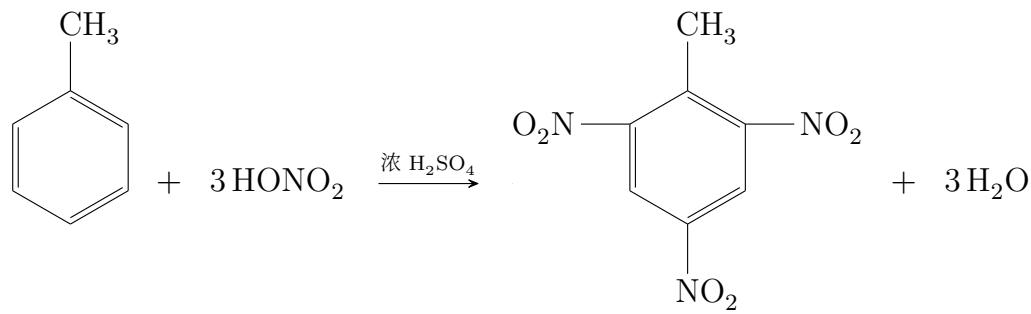
Chinese labels in figure: 甲苯 = Toluene; 三硝基甲苯 = Trinitrotoluene (TNT).
Exercises for Section 9
What is the difference in molecular structure between a nitro compound and a nitrate ester? Write the structural formulas of nitroethane and ethyl nitrate.
Based on the structural formulas of the following substances, identify which class of compounds each belongs to, explain why, and state what type of reaction can be used to prepare each:
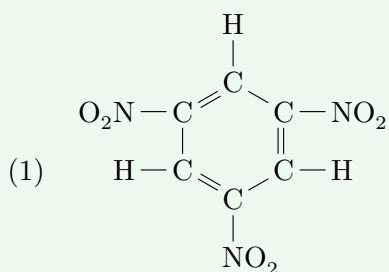
Structural formulas for classification 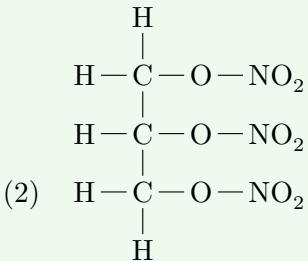
Structural formulas for classification In the laboratory, \(39\ \text{g}\) of benzene is subjected to nitration and \(55\ \text{g}\) of nitrobenzene is obtained. Calculate the yield of nitrobenzene.
3.10 Section 10: Amines and Amides
Amines
Compounds formed by replacing hydrogen atoms in hydrocarbon molecules with amino groups (\(\ce{-NH2}\)) are called amines. For example, replacing one hydrogen atom in a methane molecule with an amino group gives methylamine (\(\ce{CH3NH2}\)). Replacing two hydrogen atoms in an ethane molecule with two amino groups gives ethylenediamine (\(\ce{H2NCH2CH2NH2}\)). Replacing one hydrogen atom in a benzene molecule with an amino group gives aniline (\(\ce{C6H5NH2}\)). Methylamine, ethylenediamine, and aniline all belong to the amine class of compounds. Amine compounds generally have basic properties. Below we introduce aniline.
Aniline is an important amine compound and an intermediate for synthesizing dyes (aniline dyes), drugs (sulfonamide drugs), and other products.
1. Physical Properties
Aniline is a colorless oily liquid with a distinctive odor. It oxidizes readily in air, turning reddish-brown. Aniline is slightly soluble in water and readily soluble in alcohol, ether, benzene, and other organic solvents. Aniline is toxic.
2. Chemical Properties
(1) Weak Basicity
Aniline has a structure similar to that of ammonia — it can be viewed as derived from an ammonia molecule by replacing one hydrogen atom with a phenyl group. Therefore, aniline and ammonia have similar properties — both possess weak basicity (though aniline is even weaker than ammonia). This is because in the aniline molecule, the nitrogen atom of the amino group has a lone pair of electrons. In aqueous solution, it can form a coordinate bond with a \(\ce{H+}\) ion, thereby increasing the concentration of \(\ce{OH-}\) ions and exhibiting weak basicity:
\[\ce{C6H5NH2 + H2O <=> C6H5NH3+ + OH-}\]
To a test tube containing \(3\ \text{mL}\) of water, add about \(0.5\ \text{mL}\) of aniline and shake — the aniline does not dissolve. Then add concentrated hydrochloric acid dropwise, and you can see the aniline gradually dissolving. Once the aniline has completely dissolved, add concentrated sodium hydroxide solution dropwise, and you can see the aniline separating out again.
From this experiment, we can see that aniline is basic and can react with hydrochloric acid to form a salt — aniline hydrochloride. This reaction is very similar to the reaction of ammonia with acid:
\[\ce{C6H5NH2 + HCl -> C6H5NH3Cl}\]
\[\ce{NH3 + HCl -> NH4Cl}\]
Aniline hydrochloride is a white, flaky crystalline solid that is readily soluble in water. When it reacts with an alkaline solution, aniline is regenerated — much like an ammonium salt reacting with a base:
\[\ce{C6H5NH3Cl + NaOH -> C6H5NH2 + NaCl + H2O}\]
\[\ce{NH4Cl + NaOH -> NH3 + NaCl + H2O}\]
(2) When aniline is exposed to air, it can be oxidized by atmospheric oxygen, causing its color to darken. When oxidized with an oxidizing agent, a rather complex mixture of products forms. The main products depend on the oxidizing agent and the experimental conditions. For example, when potassium dichromate is used as the oxidizing agent, as the degree of oxidation progressively increases, the color changes from green to blue, and finally to black. This black product is called aniline black — it is an excellent dye for cotton fabrics and leather.
Aniline can also react with other substances to produce a variety of dyes. Therefore, aniline is an intermediate for synthesizing dyes.
Amides
Compounds formed by replacing the hydroxyl group in a carboxylic acid molecule with an amino group are called amides.9 Their general formula is \(\ce{R-CO-NH2}\), where \(\ce{R-CO-}\) (or \(\ce{RCO-}\)) is called an acyl group. Amides can also be viewed as derived from ammonia by replacing a hydrogen atom with an acyl group (\(\ce{R-CO-}\)). Common amides include formamide (\(\ce{H-CO-NH2}\)), acetamide (\(\ce{CH3-CO-NH2}\)), urea (carbamide, \(\ce{CO(NH2)2}\)), and benzamide (\(\ce{C6H5-CO-NH2}\)).
Among amide compounds, at room temperature, all except formamide (which is a liquid) are crystalline solids. Lower amides are readily soluble in water.
Amides are neutral substances. When heated with water in the presence of an acid or base, amides undergo hydrolysis, producing a carboxylic acid and ammonia:
\[\ce{RCONH2 + H2O ->[\Delta] RCOOH + NH3 -> RCOONH4}\]
In practice, hydrolysis is usually carried out with the addition of base or acid to facilitate the reaction. If a base is added during hydrolysis, the acid produced is converted into its salt, and ammonia is released:
\[\ce{RCONH2 + NaOH ->[\Delta] RCOONa + NH3 ^}\]
Exercises for Section 10
Write the structural formulas of the following substances:
Formamide
Acetamide
Carbamide (urea)
Benzamide
In what respects are the properties of aniline similar to those of ammonia? Illustrate with examples and write the relevant chemical equations.
Starting from benzene, write the chemical equations for preparing each of the following substances. Note the conditions required for each reaction.
Benzenesulfonic acid
Nitrobenzene
Aniline
A barrel of aniline weighs \(200\ \text{kg}\) and has a purity of \(99\%\). How many kilograms of nitrobenzene are needed to produce this barrel of aniline (the conversion rate of nitrobenzene is \(70\%\))?
3.11 Chapter Summary
The following table summarizes the classification, functional groups, representative substances, structural features, and main chemical properties of the hydrocarbon derivatives studied in this chapter.
| Class | General formula | Functional group | Representative substance | Structural features | Main chemical properties |
|---|---|---|---|---|---|
| Haloalkanes | \(\ce{R-X}\) | \(\ce{-X}\) | \(\ce{C2H5X}\) | The \(\ce{C-X}\) bond is polar | 1. Substitution with aqueous \(\ce{NaOH}\), forming an alcohol. 2. Elimination: heated with strong base in alcohol solvent, losing \(\ce{HX}\) to form an alkene. |
| Alcohols | \(\ce{R-OH}\) | \(\ce{-OH}\) | \(\ce{C2H5OH}\) | Contains \(\ce{O-H}\) and \(\ce{C-O}\) bonds (polar); \(\ce{-OH}\) is bonded to an alkyl group | 1. Reacts with \(\ce{Na}\), forming alkoxide + \(\ce{H2}\). 2. Reacts with \(\ce{HX}\), forming haloalkane. 3. Dehydration: at \(140\,{}^{\circ}\text{C}\) (intermolecular) → ether; at \(170\,{}^{\circ}\text{C}\) (intramolecular) → alkene. 4. Oxidation to aldehyde. 5. Esterification with acids. |
| Phenols | — | \(\ce{-OH}\) | \(\ce{C6H5OH}\) | \(\ce{-OH}\) is directly bonded to the benzene ring | 1. Weak acidity: reacts with \(\ce{NaOH}\), forming sodium phenoxide. 2. Substitution: reacts with conc. bromine water, forming tribromophenol (white precipitate). 3. Color reaction: reacts with \(\ce{FeCl3}\), turning purple — used to detect phenol. |
| Aldehydes | \(\ce{RCHO}\) | \(\ce{-CHO}\) | \(\ce{CH3CHO}\) | Contains the \(\ce{C=O}\) double bond with an H on the carbonyl C | 1. Addition: \(\ce{H2}\) addition (with Ni catalyst) → alcohol. 2. Reducing properties: silver mirror reaction; reduces \(\ce{Cu(OH)2}\) to red \(\ce{Cu2O}\). |
| Ketones | \(\ce{RCOR'}\) | \(\ce{C=O}\) | \(\ce{CH3COCH3}\) | Contains \(\ce{C=O}\) double bond (similar to aldehydes), but no H bonded to the carbonyl C | 1. Addition reactions. 2. Difficult to oxidize; no reducing properties. |
| Carboxylic acids | \(\ce{RCOOH}\) | \(\ce{-COOH}\) | \(\ce{CH3COOH}\) | Under the influence of the \(\ce{C=O}\) group, the \(\ce{O-H}\) bond ionizes more readily, releasing \(\ce{H+}\) | 1. Has general acid properties. 2. Esterification reactions. |
| Esters | \(\ce{RCOOR'}\) | — | \(\ce{CH3COOC2H5}\) | The bond between the acyl group and \(\ce{-OR'}\) is easily broken | Hydrolysis to produce carboxylic acid + alcohol. |
| Nitro compounds | \(\ce{R-NO2}\) | \(\ce{-NO2}\) | \(\ce{C6H5NO2}\) | \(\ce{-NO2}\) is directly bonded to C of the hydrocarbon group | Easily reduced to amines. |
| Amines | \(\ce{R-NH2}\) | \(\ce{-NH2}\) | \(\ce{C6H5NH2}\) | \(\ce{-NH2}\) is directly bonded to C of the hydrocarbon group | 1. Weak basicity. 2. Easily oxidized, causing color change. |

Chinese labels in figure: This diagram shows the interconversion pathways among hydrocarbon derivatives: 烃 = Hydrocarbons; 卤代烃 = Haloalkanes; 醇 = Alcohols; 醛 = Aldehydes; 羧酸 = Carboxylic acids; 酯 = Esters; 酚 = Phenols; 硝基化合物 = Nitro compounds; 胺 = Amines.
Review Problems
Use a single reagent to distinguish each pair of substances:
Ethanol and diethyl ether
Acetaldehyde and butanone
Formaldehyde and formic acid
Sodium acetate and sodium phenoxide
Aniline and phenol
Nitrobenzene and aniline
Two organic compounds both have the percent composition: \(40\%\) carbon, \(6.67\%\) hydrogen, and \(53.33\%\) oxygen. The formula mass of the first is 30, and the formula mass of the second is twice that of the first. Both can undergo the silver mirror reaction. Find their structural formulas and names.
Among the substances we have studied, find three that can undergo the silver mirror reaction (they must be organic compounds of different classes). Write their names and structural formulas, and explain from a structural standpoint why they undergo the silver mirror reaction.
There are two test tubes containing cloudy aqueous solutions. It is known that one contains phenol solution and the other contains aniline solution. When \(\ce{NaOH}\) is added to one test tube, the solution clears up; when \(\ce{HCl}\) is added, it becomes cloudy again. When \(\ce{HCl}\) is added to the other test tube, the solution clears up; when \(\ce{NaOH}\) is added, it becomes cloudy again. Which test tube contains phenol and which contains aniline? Why? Write the relevant chemical equations.
A certain organic compound is composed of carbon, hydrogen, and oxygen in the mass ratio \(12:3:16\). \(3.1\ \text{g}\) of this compound’s vapor, converted to the equivalent at \(27\,{}^{\circ}\text{C}\) and \(720\ \text{mmHg}\) pressure, occupies a volume of \(1.3\ \text{L}\). Find its chemical formula. If this organic compound can undergo esterification with an acid, determine its structural formula.
The Chinese term 胺 is pronounced àn.↩︎
\(\delta+\) and \(\delta-\) denote partial charges less than one full unit. \(\delta\) is the Greek letter delta.↩︎
Translator’s note: The original uses \(\ell\) as an abbreviation for the Chinese unit 毫升 (milliliters).↩︎
The Chinese character 羟 is composed of the radical for oxygen (氧) and the radical for hydrogen (氢).↩︎
Translator’s note: The original gives \(326.88\ \text{kCal}\). Converting: \(326.88 \times 4.184 \approx 1368\ \text{kJ}\), which rounds to \(1367\ \text{kJ}\).↩︎
This reaction involves phenol forming a colored complex with the \(\ce{Fe^{3+}}\) ion.↩︎
The Chinese character 羰 is a specialized chemistry term composed of the radical for carbon (碳) and the radical for oxygen (氧).↩︎
Translator’s note: In SI units, these values are approximately \(39.3\ \text{kJ/g}\) and \(17.2\ \text{kJ/g}\), respectively.↩︎
The Chinese character 酰 (xiān) refers to the acyl group.↩︎