5 Synthetic Macromolecules
After studying this chapter, you should be able to:
- Explain the concepts of formula weight, degree of polymerization, structural units (chain links), and monomers for macromolecular compounds
- Distinguish between linear and cross-linked (network) macromolecular structures, and relate structure to properties
- Describe how linear macromolecules dissolve in solvents, and explain why cross-linked macromolecules do not dissolve
- Explain the thermoplastic behavior of linear polymers and the thermosetting behavior of cross-linked polymers
- Distinguish between addition polymerization and condensation polymerization reactions, and write equations for each type
- Describe the production, properties, and applications of major plastics, synthetic fibers, and synthetic rubbers
- Explain the vulcanization of rubber and its effect on structure and properties
We have already studied natural macromolecular compounds such as starch, cellulose, and proteins, as well as synthetic macromolecular compounds such as polyethylene, poly(vinyl chloride), and phenol-formaldehyde resin. In this chapter, we mainly discuss the structure, properties, synthesis, and applications of synthetic macromolecular compounds, though we also touch upon certain natural macromolecular compounds such as natural rubber.
5.1 Section 1: Overview
Formula Weight of Macromolecules
We know that the formula weights of hydrocarbons, alcohols, aldehydes, carboxylic acids, esters, monosaccharides, and oligosaccharides are all relatively low. For example, the formula weight of sucrose is \(342\) and that of glyceryl tristearate is \(890\). Their formula weights seldom exceed one thousand, so they can be called low-formula-weight compounds, or simply small molecules. In contrast, the formula weight of starch ranges from tens of thousands to hundreds of thousands; cellulose also reaches hundreds of thousands; and proteins range from tens of thousands to millions or even higher. Nucleoproteins have the highest known formula weights — some reaching tens of millions. Polyethylene, synthesized from ethylene, and poly(vinyl chloride), synthesized from vinyl chloride, typically have formula weights in the range of tens of thousands to hundreds of thousands. Starch, cellulose, proteins, poly(vinyl chloride), polyethylene, and phenol-formaldehyde resins are all macromolecular compounds (also called high polymers or simply macromolecules).
Although macromolecules have very large formula weights, their structures are often relatively simple — they are built from repeating structural units. What are these structural units? We know that cellulose molecules \((\ce{C6H10O5})_n\) are composed of thousands of \(\ce{C6H10O5}\) units linked together. Polyethylene molecules \((\ce{C2H4})_n\) are composed of thousands or tens of thousands of \(\ce{C2H4}\) units linked together. The structural unit of cellulose is \(\ce{C6H10O5}\); the structural unit of polyethylene is \(\ce{C2H4}\). The repeating structural unit in a macromolecule is called a chain link (or repeat unit). The value \(n\) represents the number of times the chain link repeats in each macromolecule, and is called the degree of polymerization. Polyethylene is formed by the polymerization of ethylene — ethylene is the monomer of polyethylene. The chain links in a macromolecule are formed from the monomers during the reaction.
For a single macromolecule, it has a definite degree of polymerization — that is, \(n\) is a specific integer — and therefore its formula weight is definite. However, a piece of macromolecular material is an aggregate of many macromolecules with the same or different degrees of polymerization. Therefore, the formula weight we measure experimentally for a given macromolecular substance can only be an average formula weight. This property of macromolecules differs from that of small molecules.
Structure of Macromolecules
Macromolecules also differ from small molecules in their structural characteristics. An individual macromolecule is composed of chain links connected one after another, often forming a long chain of thousands or tens of thousands of links. The most common and important structure of macromolecules is the long-chain, or linear structure (Figure 5.1 a). Within a macromolecular chain, atoms and chain links are joined by covalent bonds. For example, the long chains of polyethylene and poly(vinyl chloride) are connected by \(\ce{C-C}\) bonds. The long chains of starch and cellulose are connected by \(\ce{C-C}\) and \(\ce{C-O}\) bonds. The long chains of proteins are connected by \(\ce{C-C}\) and \(\ce{C-N}\) bonds. These are all single bonds, and single bonds can rotate freely, so the \(\ce{C-C}\) bonds in macromolecular chains can rotate. The rotation of single bonds in a macromolecular chain often causes chain links — or more commonly, multiple chain links (i.e., chain segments) — to rotate. One can imagine that a long chain capable of rotation, with no external force stretching it, would never assume a straight-line shape — macromolecular chains are indeed coiled long chains.
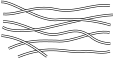
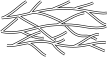
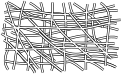
When many macromolecules aggregate together, what happens?
We know that intermolecular forces exist between molecules. The energy of intermolecular forces is much smaller than chemical bond energies. But for macromolecules, the situation is quite different. Macromolecules are long chains with thousands or tens of thousands of chain links, and the molecules are entangled with one another, with an extremely large number of contact points between them — that is, intermolecular forces act at very many locations. Therefore, the strength of macromolecular materials arises from both the chemical bonds within the chains and the intermolecular forces between chains — and sometimes the intermolecular forces are more important. If the formula weight of a macromolecule is large and the chain is long, the intermolecular forces between macromolecules increase accordingly. Thus, the formula weight of a substance must reach a certain level before the material exhibits the properties characteristic of macromolecular materials.
Some linear macromolecules are branched (Figure 5.1 b) — for example, branched-chain starch (amylopectin) is branched. Branched macromolecules are still individual, separate macromolecules.
If the macromolecular chains still contain reactive functional groups, when they react with other monomers or substances, chemical bonds form between the chains, creating cross-links (Figure 5.1 c) and producing a network structure (also called a three-dimensional or cross-linked structure). Vulcanized rubber, which we will study below, is an example of this.
As discussed above, macromolecules can be classified by structure into two types: linear (including branched) and network (cross-linked, with varying degrees of cross-linking).
Properties of Macromolecules
Because of their large formula weights and specific structures, macromolecular compounds possess properties that differ from those of small-molecule substances. People exploit these properties in practical applications.
From the standpoint of practical use, macromolecular materials are generally classified into plastics, fibers, and rubbers. Each class has its own characteristic properties. With the development of polymer science and technology, it has become possible to synthesize these materials with specific properties in mind. The properties of macromolecular materials are multifaceted; here we introduce only those that are clearly related to structure and closely connected to production and use — namely, the dissolution behavior of macromolecular materials in solvents, their performance at different temperatures, and other important properties.
1. Dissolution of Macromolecular Materials in Solvents
The dissolution process of macromolecular materials in solvents (usually organic solvents) differs from that of small molecules. For a linear macromolecule, the first step of dissolution involves solvent molecules penetrating between the entangled linear macromolecules, causing the material to swell. The second step involves solvent molecules surrounding individual macromolecules, separating them so they can move freely. Linear macromolecules dissolve in organic solvents to form macromolecular solutions. In solution, the macromolecules are large enough to be colloidal in size, forming a sol — yet the dispersed entities are individual macromolecules.
Scrape polystyrene resin into a powder. Take \(0.5\ \text{g}\) of the powder, place it in a test tube, add \(10\ \text{mL}\) of benzene, and observe the dissolution process.
Place \(2\ \text{g}\) of phenol in a test tube, add \(1.5\ \text{mL}\) of trichloromethane (chloroform), and heat the test tube in a water bath until the phenol completely dissolves. Add \(1\ \text{g}\) of polyamide 6 (nylon) fiber and observe the dissolution process.
Take \(0.5\ \text{g}\) of poly(methyl methacrylate) (i.e., Plexiglas) powder, place it in a test tube, and add \(9\ \text{mL}\) of trichloromethane. Observe the dissolution process.
From the experiments above, it can be observed that these linear macromolecules are able to dissolve in appropriate solvents. However, the dissolution process of macromolecules is much slower than that of small molecules.
Macromolecular solutions are very important for studying the formula weight, structure, properties, and processing of macromolecules.
Scrape some rubber powder from a waste tire. Take \(0.5\ \text{g}\) of the powder, place it in a test tube, and add \(5\ \text{mL}\) of gasoline (or benzene). Observe what happens — can it dissolve?
From the experiment above, it can be seen that cross-linked, network-type macromolecules are difficult to dissolve, but they can swell to some extent.
2. Performance of Macromolecular Materials at Different Temperatures
Place about \(3\ \text{g}\) each of poly(vinyl chloride), polyethylene, and polypropylene plastic pieces in three separate test tubes. Heat slowly with an alcohol lamp. Observe the softening and melting behavior. Stop heating once the material melts to prevent decomposition. After cooling, the material solidifies again. Heating again causes it to melt once more.
It can be observed that these linear macromolecules soften upon heating to a certain temperature range, eventually melting into a flowing liquid. However, unlike crystalline small-molecule substances, they do not have a definite melting point. After cooling and solidifying, they can be melted again by heating. Therefore, linear macromolecules exhibit thermoplasticity — they can be softened by heating and then processed into various shapes.
When a solid linear macromolecule is heated and melted, the chain links and chain segments within the molecules can move and rotate. Under an external force, entire molecular chains slide past one another, causing a change in shape that persists even after the force is removed.
As the temperature decreases, the kinetic energy of the molecules decreases. The entire molecular chains can no longer slide past each other, but chain segments can still move and rotate. Under an external force, part of the macromolecular chain can be stretched from a coiled to an extended state; upon removing the force, the chain returns to its coiled state.
When the temperature decreases further, the kinetic energy continues to decrease. Both molecular motion and chain segment rotation become frozen, and the molecules can only vibrate in place.
Network-type macromolecules do not melt upon heating because the cross-linked chemical bonds between chains restrict the movement of the molecular chains. At even higher temperatures, the chemical bonds in network-type macromolecules break and the macromolecular structure is destroyed. Therefore, network-type macromolecules exhibit thermosetting behavior — once processed into shape, they cannot be re-melted by heating.
However, the difference in properties between network and linear macromolecular materials is relative. Highly branched linear macromolecules have properties approaching those of lightly cross-linked network macromolecules.
3. Strength, Plasticity, Electrical Insulation, and Other Properties
Many macromolecular materials have considerable strength. For example, if \(10\ \text{kg}\) of macromolecular material or metal were made into a \(100\ \text{m}\) rope and used to hoist loads from a tall building: nylon could support \(15{,}500\ \text{kg}\), polyester fiber could support \(12{,}000\ \text{kg}\), titanium could support \(7{,}700\ \text{kg}\), and carbon steel could support \(6{,}500\ \text{kg}\). Macromolecular materials have lower densities than metals, typically \(0.9\)–\(1.5\ \text{g/cm}^3\). If ropes of the same cross-sectional area are compared for tensile strength, carbon steel reaches \(14{,}500\ \text{kgf/cm}^2\) and nylon reaches \(10{,}500\ \text{kgf/cm}^2\). Therefore, for equal mass, macromolecular materials generally exhibit greater strength.
Under suitable conditions, macromolecular materials have good plasticity and are easy to process — they can be drawn into fibers, blown into films, or pressed into various shapes using molds. For example, macromolecular films are used in agriculture, industry, and daily life; various fibers are woven into cloth or made into fishing nets; and so on.
The atoms in macromolecular chains are joined by covalent bonds and generally lack free electrons, making them poor conductors of electricity. Macromolecular materials are commonly excellent electrical insulators, used for coating cables and wires, and for manufacturing components of electrical equipment.
Some macromolecules consist of saturated hydrocarbon chains and possess the stability of saturated hydrocarbons, making them resistant to chemical corrosion. Some contain benzene rings in the chain, giving them better heat resistance and higher melting temperatures. Macromolecular materials also tend to be wear-resistant, waterproof, or oil-resistant.
Although macromolecular materials have many excellent properties, they also have some drawbacks. Generally speaking, they are not resistant to high temperatures, are flammable, and are prone to aging. Aging refers to the gradual loss of the material’s original excellent properties during processing or use, due to the combined effects of light, heat, air, moisture, and corrosive gases, ultimately rendering the material unusable. By improving the structure of macromolecular compounds, refining polymerization and processing techniques, and paying attention to the environment and conditions of use, one can improve macromolecular performance and reduce or delay aging — these are all important research topics in the field of macromolecular materials.
- Formula weight: Macromolecules have very large formula weights (tens of thousands to millions); experimentally measured values are average formula weights
- Chain links and degree of polymerization: The repeating structural unit is the chain link; the number of repeats (\(n\)) is the degree of polymerization; the small molecule from which the chain link is derived is the monomer
- Structure: Linear macromolecules (with or without branches) are individual chains; cross-linked (network) macromolecules have chains joined by chemical bonds
- Dissolution: Linear macromolecules can dissolve in appropriate solvents (first swelling, then dissolving); network macromolecules cannot dissolve but can swell
- Temperature behavior: Linear macromolecules are thermoplastic (soften and melt upon heating); network macromolecules are thermosetting (do not melt)
- Other properties: High strength relative to mass, good plasticity, electrical insulation, chemical resistance; drawbacks include poor heat resistance, flammability, and aging
Exercises for Section 1
What are the differences in structure and properties between linear macromolecules and network macromolecules?
A certain poly(vinyl chloride) has a degree of polymerization of 2000. Calculate its average formula weight. (Hint: Formula weight of polymer = degree of polymerization \(\times\) formula weight of one chain link.)
What principle is used when sealing the opening of a plastic bag?
The macromolecular solution prepared in Experiment 5.2 can be used to repair slightly damaged nylon fabrics. The macromolecular solution prepared in Experiment 5.3 can be used to repair damaged Plexiglas articles. These can be tried under the guidance of a teacher.
5.2 Section 2: Addition Polymerization and Condensation Polymerization
A few varieties of synthetic macromolecules were prepared as early as the 19th century. Only small quantities were produced in the early 20th century. Because of their good properties and practical usefulness, they gradually attracted attention. But without theoretical guidance, effective production methods had not been found. By the 1930s, the structural theory of macromolecules was initially established, reaction principles were progressively clarified, and many varieties of synthetic macromolecules developed rapidly. The raw materials for synthesizing macromolecules are extremely rich and diverse — they can come from coal, natural gas, petroleum, and agricultural by-products. The rapid development of petrochemistry has provided an even greater variety and quantity of monomers, such as ethylene, propylene, butadiene, benzene, toluene, xylene, acetylene, phenol, formaldehyde, ethylene glycol, and many more.
Synthetic macromolecules are formed by the polymerization of monomers, which is why macromolecules are also called high polymers. The two fundamental reactions for synthesizing high polymers are addition polymerization (abbreviated as addition polymerization) and condensation polymerization (abbreviated as condensation polymerization). These were introduced previously; here we elaborate with practical examples.
Addition Polymerization
Unsaturated hydrocarbons (including their derivatives) as monomers typically undergo addition polymerization to form macromolecules. Here we only introduce the polymerization of ethylene and propylene.
1. Polymerization of Ethylene
Under different temperature, pressure, and catalyst conditions, ethylene molecules as monomers can undergo addition polymerization to produce polyethylene with different properties.
This reaction can be represented as follows:
\[n\ce{CH2=CH2} \xrightarrow{\text{catalyst}} \ce{-[-CH2-CH2-]_{$n$}-}\]
Under conditions of about \(700\ \text{atm}\) and \(150\,{}^{\circ}\text{C}\) with oxygen as the catalyst, the resulting polyethylene has more branches on the molecular chain, less ordered molecular packing, lower density (\(0.91\)–\(0.93\ \text{g/cm}^3\)), and lower strength. Under conditions of atmospheric pressure and below \(100\,{}^{\circ}\text{C}\) using a coordination catalyst made from \(\ce{TiCl4}\) and similar compounds, the resulting polyethylene has very few branches, more ordered molecular packing, higher density (\(0.94\)–\(0.97\ \text{g/cm}^3\)), and greater strength. This shows that by improving the catalyst, one can lower the temperature and pressure and synthesize materials with better properties.
2. Polymerization of Propylene
In the 1950s, it was discovered that using a coordination catalyst made from titanium chlorides (such as \(\ce{TiCl3}\)) could cause the linear polypropylene chains formed during polymerization to arrange in a regular pattern — with all methyl groups aligned on the same side (Figure 5.2). The addition polymerization of propylene can be simply represented as follows:
\[n\ce{CH3CH=CH2} \xrightarrow{\text{catalyst}} \ce{-[-CH(CH3)-CH2-]_{$n$}-}\]
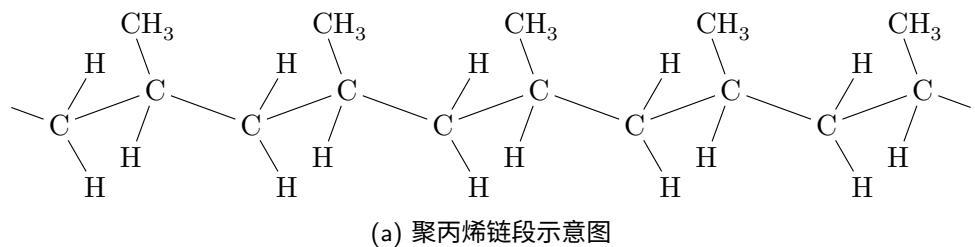
Chinese labels in figure: 聚丙烯结构示意图 = Schematic diagram of polypropylene structure. The figure shows \(\ce{CH3}\) groups aligned on one side of the chain.
Polypropylene synthesized in this way has very orderly chain arrangement, readily achieving a high degree of crystallization. It can be spun into very fine yet tough fibers for textile use, or made into films for packaging materials or very strong tapes.
Condensation Polymerization
The polymerization of amino acids into proteins is an example of condensation polymerization. Here, we discuss only the condensation polymerization reactions for polyester fibers and phenol-formaldehyde resin.
1. Condensation Polymerization for Polyester Fiber Synthesis
Polyester fiber is typically produced by the condensation polymerization of terephthalic acid and ethylene glycol. The reaction of terephthalic acid with ethylene glycol is also an esterification reaction. For example:
\[\ce{HOOC-C6H4-COOH + HOCH2CH2OH -> HOOC-C6H4-COOCH2CH2OH + H2O}\]
Since the product still has one carboxyl group and one hydroxyl group — two reactive functional groups — it can continue to react with additional terephthalic acid and ethylene glycol molecules, eventually forming a macromolecular compound. This reaction can be summarized as:
\[n\ce{HOOC-C6H4-COOH} + n\ce{HOCH2CH2OH} \ce{->} \ce{-[-OC-C6H4-CO-O-CH2CH2-O-]_{$n$}-} + 2n\ce{H2O}\]
In addition to the macromolecular compound, small molecules of water are simultaneously produced. This is the characteristic feature of condensation polymerization, which is also called step-growth polymerization. In the condensation reaction above, the product is a linear polymer.
2. Phenol-Formaldehyde Resin
Phenol-formaldehyde resin is typically produced by the reaction of phenol with formaldehyde. Since phenol can react at the ortho and para positions, it can form either linear or network polymers with formaldehyde. Under acidic conditions with excess phenol, the phenol reacts mainly at the two ortho positions to produce linear phenol-formaldehyde resin:
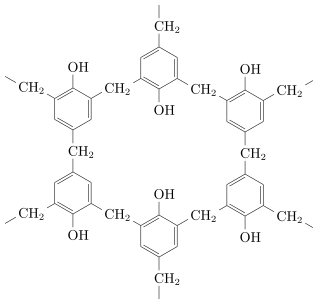
This reaction can also be represented as:
\[n\ce{C6H5OH} + n\ce{HCHO} \xrightarrow{\text{catalyst}} \ce{[-C6H3(OH)CH2-]_{$n$}} + n\ce{H2O}\]
Under alkaline conditions with excess formaldehyde, the phenol reacts not only at the ortho positions but also at the para position, yielding network-type phenol-formaldehyde resin (Figure 5.4).
Place \(2.5\ \text{g}\) of phenol and \(2.5\ \text{mL}\) of \(40\%\) formaldehyde solution in a test tube, then add \(1\ \text{mL}\) of concentrated hydrochloric acid. Heat in a boiling water bath. Caution: the reaction is rather vigorous. When the solution becomes turbid, remove the test tube from the water bath. In another test tube, add \(2.5\ \text{g}\) of phenol and \(3\)–\(4\ \text{mL}\) of \(40\%\) formaldehyde solution. Heat in a boiling water bath. Then add \(1\ \text{mL}\) of concentrated ammonia solution. Observe the color and other properties of the resin that forms.
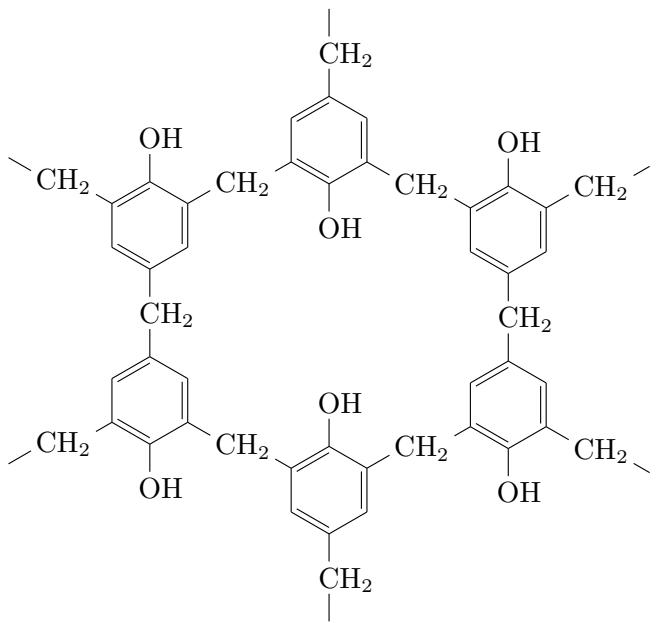
Chinese labels in figure: 体型酚醛树脂结构示意图 = Schematic diagram of network phenol-formaldehyde resin structure. The structure shows extensive cross-linking through \(\ce{-CH2-}\) bridges at both ortho and para positions of the phenol rings.
Phenol-formaldehyde resins are a class of synthetic resins. The phenol component can be phenol, cresol, resorcinol, or others; the aldehyde component can be formaldehyde, furfural, or others. Industrially, the most important phenol-formaldehyde resin is made from phenol and formaldehyde.
- Addition polymerization: Unsaturated monomers join through addition reactions without loss of atoms; the polymer has the same empirical formula as the monomer (e.g., polyethylene, polypropylene)
- Condensation polymerization: Monomers with two or more functional groups react to form a polymer while releasing small molecules such as water (e.g., polyester fiber, phenol-formaldehyde resin); also called step-growth polymerization
- Improved catalysts (e.g., Ziegler–Natta coordination catalysts) enable polymerization at lower temperatures and pressures, and produce polymers with more ordered chain structures
- Condensation polymerization with bifunctional monomers yields linear polymers; with trifunctional or higher monomers, it can yield network polymers
Exercises for Section 2
Write the chemical equation for the polymerization of styrene (\(\ce{C6H5CH=CH2}\)) to form polystyrene. Do you think this reaction is addition polymerization or condensation polymerization? Why?
Based on what you have learned, what are the main differences between addition polymerization and condensation polymerization?
Must condensation polymerization necessarily involve two different monomers?
5.3 Section 3: Synthetic Materials
The synthetic macromolecular materials we commonly use — known as synthetic materials — mainly include plastics, synthetic fibers, and synthetic rubbers. Polymers formed by condensation polymerization are mainly used as plastics and synthetic fibers, while those formed by addition polymerization are mainly used as rubbers, plastics, and synthetic fibers. The following provides a brief introduction to each.
Plastics
Plastics are a class of materials with plasticity, whose main component is synthetic resin. Polyethylene, polypropylene, and poly(vinyl chloride), which we have already studied, are all synthetic resins used in plastics production. Many synthetic resins have a linear structure and exhibit thermoplasticity; the plastics made from them are thermoplastic plastics. Conversely, network-type phenol-formaldehyde resins exhibit thermosetting behavior; the plastics made from them are thermosetting plastics.
The raw materials for producing plastic products, besides synthetic resins, generally include reinforcing materials and fillers that improve mechanical properties, plasticizers that enhance plasticity, anti-aging agents1 that prevent aging, and other additives. These are processed through compression molding, extrusion, or other methods to produce finished plastic products.
There are many varieties of synthetic resins used in plastics production. Besides those already mentioned, others include polytetrafluoroethylene (PTFE), poly(methyl methacrylate) (Plexiglas), and epoxy resins.
The following briefly introduces the production, properties, and applications of poly(vinyl chloride). Poly(vinyl chloride) is synthesized by the addition polymerization of the monomer vinyl chloride (\(\ce{CH2=CHCl}\)). The reaction can be simply represented as:
\[n\ce{CH2=CHCl} \ce{->} \ce{-[-CH2-CHCl-]_{$n$}-}\]
Poly(vinyl chloride) is a linear polymer. The polar chlorine atoms appearing at alternating positions along the long chain make the backbone more rigid and also increase the attractive forces between chains. Therefore, poly(vinyl chloride) is fairly tough, resistant to dilute acids, and thermoplastic, but not heat-resistant. Plasticizers must be added to produce soft, flexible soft PVC products, which are widely used for agricultural films, wire and cable sheathing, flexible tubing, and everyday items. With little or no plasticizer added, rigid PVC is produced, characterized by being hard yet lightweight with good strength, and is used as building materials, insulating materials, and corrosion-resistant materials.
Poly(vinyl chloride) readily undergoes elimination reactions upon heating, releasing hydrogen chloride. This tendency to decompose when heated makes processing more difficult. To prevent the release of \(\ce{HCl}\), alkaline substances that can absorb it must be added as stabilizers.
PVC plastics are prone to aging during use if environmental factors are not controlled — including UV exposure from sunlight, effects of air, water, and corrosive gases, radiation, heat, and evaporation of plasticizers. Over time, the material becomes hard, brittle, cracked, and may grow mold.
The many varieties of plastics encounter different storage and usage conditions, leading to various aging characteristics. For example, agricultural films become discolored, brittle, and less transparent after sun and rain exposure. Outdoor cable and wire sheathing hardens and cracks over long use. The face of a Plexiglas watch crystal becomes less transparent with prolonged use.
Additionally, with the modernization of production and rapid advances in science and technology, many special-purpose plastics have been developed, such as engineering plastics, reinforced plastics, and functional polymers.
Engineering plastics. Polyamide 1010
\[\ce{-[-NH-(CH2)10-NH-CO-(CH2)8-CO-]_{$n$}-}\]
is an engineering plastic produced by the condensation polymerization of sebacamide (\(\ce{H2N(CH2)10NH2}\), sebacamine) with sebacic acid (\(\ce{HOOC(CH2)8COOH}\)). Mechanical parts made from it — such as gears and bearings — have low friction, self-lubricating properties, long service life, and save energy. Polyamide 6 and other polyamides can also serve as engineering plastics. ABS engineering plastic, made by copolymerization of acrylonitrile, butadiene, and styrene, is a rapidly developing variety.
Reinforced plastics. Phenol-formaldehyde plastics reinforced with carbon fiber, boron fiber, or glass fiber can be used to manufacture components for spacecraft, satellites, and intercontinental missiles. Epoxy resin alone has poor strength, but when combined with glass fiber, it produces a reinforced plastic — fiberglass-reinforced plastic (FRP) — with strength comparable to steel. Epoxy resin reinforced with carbon fiber exceeds the strength of the strongest steel.
Functional polymers. By chemically introducing appropriate functional groups into polymers, one can produce functional polymers with ion-exchange, photosensitive, and other capabilities. For example, the ion-exchange resins used in water softening are polymers with acidic or basic functional groups introduced, enabling ion exchange. Photosensitive polymers contain functional groups that undergo rapid reactions upon light exposure, and are used in the fabrication of printed circuits.
Synthetic Fibers
Cotton, wool, and wood or grass fibers are all natural fibers. Viscose rayon is an artificial fiber made by processing natural fibers. Synthetic fibers are produced by forming monomers from petroleum, natural gas, coal, and agricultural by-products as raw materials, then polymerizing these monomers. Synthetic fibers and artificial fibers are collectively called chemical fibers.
Synthetic fibers began to be produced in the 1930s, providing people with various durable and attractive clothing materials. Synthetic fibers are processed from linear macromolecules. The intermolecular forces between macromolecular chains — and in some cases hydrogen bonds — give them good strength, elasticity, and wear and corrosion resistance. There are many varieties of synthetic fibers, including polyester fiber, polyamide fiber, polyacrylonitrile fiber, and polyolefin fiber. The following provides a brief introduction to polyamide and other fibers.
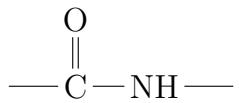
Polyamide fiber. Polyamide macromolecular chains contain amide groups (\(\ce{-CO-NH-}\)).
There are many types of polyamide fibers. The engineering plastic polyamide 1010 discussed above is one example. Others include polyamide 6 (nylon 6) and polyamide 66 (nylon 66). Here we only introduce the production of polyamide 6. The raw materials for producing polyamide 6 can include benzene, cyclohexane, or phenol as starting materials. After several reaction steps, the monomer caprolactam (\(\ce{HN(CH2)5CO}\), a cyclic amide containing 6 carbon atoms) is produced. Pure caprolactam does not polymerize spontaneously. At high temperature and in the presence of an initiator (usually water), caprolactam is hydrolyzed and the ring is opened:
\[\ce{HN(CH2)5CO + H2O -> H2N(CH2)5COOH}\]
The resulting aminocaproic acid has two functional groups. The amino group of one molecule can react with the carboxyl group of another:
\[\ce{H2N(CH2)5COOH + H2N(CH2)5COOH -> H2N(CH2)5CO-NH(CH2)5COOH + H2O}\]
The product undergoes further condensation polymerization to form polyamide 6. The overall chemical equation can be represented as:
\[n\ce{H2N(CH2)5COOH} \ce{->} \ce{-[-NH(CH2)5CO-]_{$n$}-} + n\ce{H2O}\]
Polyamide fiber is currently the strongest synthetic fiber. It is used to make parachutes, tire cord, and fishing nets. Why does polyamide fiber have such excellent properties? Because between its molecular chains, in addition to intermolecular forces, there are also hydrogen bonds (Figure 5.6), which strengthen the intermolecular attractions and promote the formation of relatively ordered crystalline regions (Figure 5.7). After stretching, the crystalline regions become even more ordered, and the intermolecular forces and hydrogen bonds contribute even more effectively. Since crystalline regions and non-crystalline regions coexist, polyamide fiber has excellent overall properties.
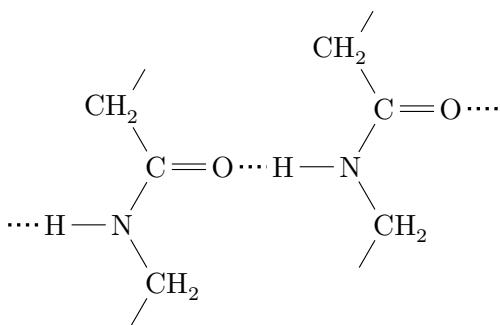
Chinese labels in figure: 聚酰胺链间的氢键示意图 = Schematic diagram of hydrogen bonds between polyamide chains. Dashed lines represent hydrogen bonds between \(\ce{C=O}\) and \(\ce{N-H}\) groups on adjacent chains.
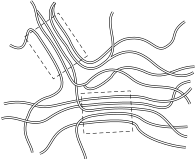
Polyester fiber. Polyester macromolecular chains contain the ester group \(\ce{-CO-O-}\). The ester group is also a polar group, providing strong intermolecular forces between chains and increasing the possibility of achieving high crystallinity upon stretching. Polyester fiber is therefore a synthetic fiber with relatively excellent properties — particularly good wrinkle resistance, elasticity, and wear resistance. Polyester fiber is produced by condensation polymerization of terephthalic acid (\(\ce{HOOC-C6H4-COOH}\)) with ethylene glycol (\(\ce{HOCH2CH2OH}\)):
\[\ce{-[-OCH2CH2-OCO-C6H4-CO-]_{$n$}-}\]
In Chinese, this fiber is commonly known as 涤纶 (dílún), or colloquially as 的确良 (díquèliáng, “indeed fine”).
Polyacrylonitrile fiber. Polyacrylonitrile \(\ce{-[-CH(CN)-CH2-]_{\)n\(}-}\) has cyano groups (\(\ce{-CN}\)) along the molecular chain. Although the molecular chains are not very orderly, the polar cyano groups provide considerable intermolecular forces, enabling it to be made into fibers. Polyacrylonitrile fiber has insufficient strength but good elasticity, and is commonly called “artificial wool.”
Polyolefin fiber. Polyolefin fibers are mainly polyethylene fiber and polypropylene fiber:
\[\ce{-[-CH2-CH2-]_{$n$}-} \qquad \ce{-[-CH(CH3)-CH2-]_{$n$}-}\]
When olefins undergo addition polymerization using coordination catalysts, the resulting polymers have orderly arrangements and can be used as synthetic fibers. For example, the polyethylene chain has only hydrogen atoms and no other substituent groups, so the molecules pack easily in an orderly fashion. Upon stretching, the degree of crystallinity is high, making it suitable for fiber applications.
Synthetic fibers undergo aging after prolonged use, mainly manifested as decreased strength, fading, and fracture. The primary cause is that active groups such as carbonyl groups in the fiber structure are affected by external factors — sunlight, oxygen, ozone, heat, water, high-energy radiation, industrial gases (such as \(\ce{CO2}\), \(\ce{NH3}\), \(\ce{HCl}\)), and mold. Attention to avoiding these external factors during use will delay the aging of synthetic fiber products.
Rubber
Rubber includes natural rubber and synthetic rubber. In the late 18th century, people began using natural rubber to make erasers and other stationery. Not until the mid-19th century did natural rubber truly enter the stage of practical use. Synthetic rubber began to be synthesized in the early 20th century and developed rapidly from the 1940s onward. Natural rubber has relatively comprehensive properties — good elasticity, electrical insulation, and processability. Synthetic rubbers excel in certain specific properties: some are heat-resistant or cold-resistant, some are oil-resistant, and others have excellent gas impermeability. Rubber is an essential material for manufacturing aircraft, warships, tractors, harvesters, automobiles, hydraulic irrigation machinery, medical equipment, and more. The production of many everyday items also depends on rubber.
1. Natural Rubber
Natural rubber comes mainly from the latex of rubber trees and rubber-producing plants. The main component of latex is polyisoprene. Rubber produced from the latex of rubber trees (specifically, the Hevea rubber tree) and rubber-producing plants has excellent elasticity. Natural rubber is polyisoprene, with the following structural formula:
\[\ce{-[-CH2-C(CH3)=CH-CH2-]_{$n$}-}\]
The latex used to make natural rubber is a milky white colloid that flows from the latex vessels within the bark of rubber trees. Concentrated latex can be used directly for producing rubber products such as medical gloves. Latex is coagulated by adding acetic acid, then pressed into sheets and dried to produce raw rubber sheets, or coagulated, pelletized, and dried to produce granular rubber. This unprocessed raw rubber softens when heated, becomes hard and brittle when cooled, is difficult to shape, wears easily, dissolves readily in gasoline, carbon tetrachloride, and other organic solvents, and — because of the double bonds in the molecule — is susceptible to addition reactions and prone to aging. In production, a series of processing steps including vulcanization must be performed to improve the properties of rubber products. Vulcanization converts the linear macromolecule into a cross-linked, network-type macromolecule through cross-linking (Figure 5.8).
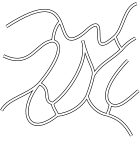
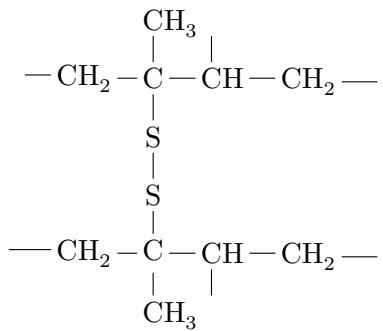
Chinese labels in figure: (a) 交联 = Cross-linking; (b) 交联的结构 = Structure of cross-links. The diagrams show sulfur bridges (\(\ce{-S-S-}\)) connecting adjacent polyisoprene chains.
The linear molecular chains of raw rubber are flexible, and chain segments can move. Under an external force, the chains extend from a coiled to a stretched state; when the force is removed, they return to their original coiled state — this is the essential condition for elasticity. However, the chains slide easily past one another, resulting in poor strength and toughness. Cross-linking is necessary to create chemical bonds between molecular chains, increasing strength and toughness. The usual method of cross-linking is vulcanization. The vulcanization process is quite complex, often involving the formation of disulfide bridges (\(\ce{-S-S-}\)) that serve as cross-links. When the amount of sulfur added is typically about \(3\%\) of the total, the degree of cross-linking is relatively low, and the resulting rubber product has excellent elasticity and toughness. If the sulfur content reaches about \(30\%\), nearly all the \(\pi\) bonds in the chains are cross-linked, producing a highly cross-linked network macromolecule — this is hard rubber (ebonite).
2. Synthetic Rubber
Through long-term production and scientific experimentation, people came to understand the structure of natural rubber, and — inspired by this knowledge — successfully synthesized many varieties of synthetic rubber. Synthetic rubber is produced using dienes and olefins derived from petroleum and natural gas as monomers. The most important monomers include butadiene, isoprene, chloroprene, styrene, isobutylene, and acrylonitrile — of which butadiene is the most important. Commonly used synthetic rubbers include styrene-butadiene rubber (SBR), cis-polybutadiene rubber, and chloroprene rubber, all of which are general-purpose rubbers.
Styrene-butadiene rubber (SBR). SBR is produced by the addition copolymerization of two monomers — butadiene and styrene — in the presence of an initiator2 or catalyst. The reaction process is very complex; the following chemical equation is only a simplified representation:
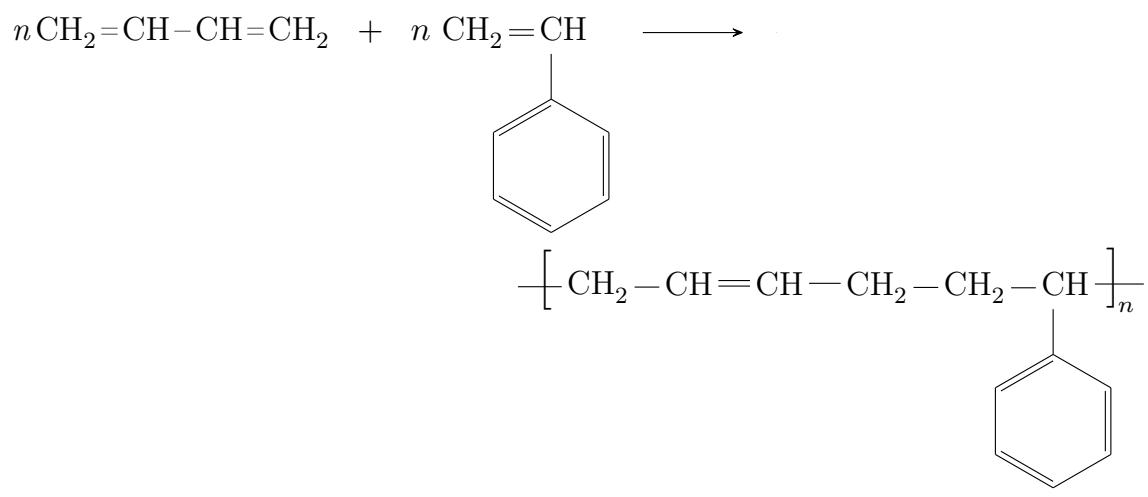
Chinese labels in figure: 丁二烯 = Butadiene; 苯乙烯 = Styrene; 引发剂 = Initiator; 丁苯橡胶 = Styrene-butadiene rubber (SBR).
SBR has relatively good resistance to sunlight, weather, and aging. The presence of the chemically stable benzene ring in the chain link improves its thermal stability. However, SBR has slow vulcanization speed and poor cold resistance.
cis-Polybutadiene rubber. cis-Polybutadiene rubber is one of the most rapidly developing synthetic rubber varieties. Ordinary polybutadiene does not have good properties, but when 1,3-butadiene is polymerized using a titanium coordination catalyst, the resulting cis-polybutadiene rubber has \(\ce{CH2}\) groups arranged on the same side — like natural rubber — giving it a relatively regular structure and thus excellent properties.
\[n\ce{CH2=CH-CH=CH2} \xrightarrow{\text{coordination catalyst}} \ce{-[-CH2-CH=CH-CH2-]_{$n$}-}\]
China has abundant rare earth metal resources, and the rare earth metal coordination catalysts developed in China can produce cis-polybutadiene rubber of relatively high purity. cis-Polybutadiene rubber has high wear resistance and good elasticity, and is widely used in tire manufacturing.
Chloroprene rubber is produced by the polymerization of chloroprene (2-chloro-1,3-butadiene) as the monomer. Its condensed structural formula is:
\[\ce{-[-CH2-CCl=CH-CH2-]_{$n$}-}\]
Specialty rubbers include polysulfide rubber, which has excellent oil resistance, and silicone rubber, which withstands both extreme cold and high temperatures.
\[\ce{-[-CH2CH2-S4-]_{$n$}-} \qquad \ce{-[-Si(CH3)2-O-]_{$n$}-}\]
The first is polysulfide rubber; the second is silicone rubber.
Rubber products in general use have only light cross-linking, and the macromolecular chains still contain double bonds. Under the action of oxygen and ozone, sunlight, and especially high-energy radiation, they are still prone to aging. Automobile tires and bicycle tires stored or used for long periods develop cracks. Latex gloves become sticky or become hard and brittle. Other rubber products may show decreased elasticity, hardening and cracking, or softening and sticking.
Based on what you have already learned, discuss what polyvinyl chloride, cis-polybutadiene rubber, and polyamide 6 have in common and how they differ with regard to the following: the class of monomer, the type of polymerization reaction, and the structure of the resulting polymer (linear or network).
- Plastics: Thermoplastic plastics are made from linear macromolecules and can be reshaped by heating; thermosetting plastics are made from network macromolecules and cannot be re-melted. Additives include plasticizers, stabilizers, fillers, and anti-aging agents
- Poly(vinyl chloride): Linear thermoplastic polymer from addition polymerization of \(\ce{CH2=CHCl}\); flexible PVC (with plasticizer) and rigid PVC (without) have different applications
- Synthetic fibers: Made from linear macromolecules; hydrogen bonds between chains (as in polyamide fibers) enhance strength and promote the formation of crystalline regions
- Natural rubber: Polyisoprene with cis configuration; vulcanization introduces sulfur cross-links to improve strength and elasticity while preserving the flexibility of chain segments
- Synthetic rubbers: SBR (from butadiene + styrene), cis-polybutadiene, and chloroprene rubber are common general-purpose rubbers; specialty rubbers (polysulfide, silicone) have unique properties
- All macromolecular materials are subject to aging from light, heat, oxygen, and other environmental factors
Exercises for Section 3
What is a thermoplastic plastic, and what is a thermosetting plastic? How do these two types of plastics differ structurally?
Why must plasticizers be added to some plastics during manufacturing? What is the function of a plasticizer?
What is the difference between artificial (regenerated) fiber and synthetic fiber?
Why must both natural rubber and synthetic rubber undergo vulcanization?
Compare the structures of the three classes of macromolecular materials: plastics, synthetic fibers, and rubbers.
For each of the three categories — plastics, synthetic fibers, and rubbers — give two examples, and state their monomers, chain links, and the chemical equations for their polymerization reactions.
5.4 Chapter Summary
I. Formula Weight, Structure, and Properties of Macromolecules
Macromolecules have very large formula weights. The formula weight of a macromolecule is an average formula weight.
The structures of macromolecules can be broadly divided into two main types: linear structure and network (cross-linked) structure. A macromolecular chain is composed of chain links joined at a certain degree of polymerization. The properties of macromolecular materials are directly related to the bond energies of the chemical bonds within the chains and the magnitude of intermolecular forces between chains. The greater the formula weight and the longer the chain, the greater the intermolecular forces. When hydrogen bonds form between chains, the attractive forces are even greater.
Linear macromolecules can dissolve in appropriate solvents; network macromolecules cannot dissolve. Linear macromolecules melt upon heating; network macromolecules do not melt upon heating. Macromolecular materials also have excellent properties such as high strength, plasticity, electrical insulation, corrosion resistance, and low density. Different macromolecular materials each have their own distinctive properties.
II. Synthetic Materials
Plastics. Plastics made from linear macromolecules are thermoplastic plastics; those made from network macromolecules are thermosetting plastics.
Synthetic fibers. Synthetic fibers are processed from linear macromolecules and have excellent strength.
Rubber. Linear rubber macromolecular chains typically undergo vulcanization to become network macromolecular materials. Vulcanized rubber generally has a low degree of cross-linking and is highly elastic. Depending on the application, rubbers are classified into general-purpose rubbers and specialty rubbers.
Review Problems
Determine whether the following statements are correct and explain your reasoning:
The monomers of all synthetic rubbers are dienes.
A macromolecular solution is both a true solution with individual molecules dispersed in the solvent and a colloidal solution exhibiting the Tyndall effect and other colloidal properties.
All synthetic fibers are produced by condensation polymerization of monomers.
How does the formula weight of macromolecules differ from that of small molecules? Why must a macromolecule have a sufficiently large formula weight before it exhibits the properties characteristic of macromolecular substances?
Deduce the monomers for the following polymers and write simplified chemical equations for their polymerization:
\(\ce{-[-CH2-CHF-]_{\)n\(}-}\)
\(\ce{-[-CH2-CH(CH3)-]_{\)n\(}-}\)
\(\ce{-[-CF2-CF2-]_{\)n\(}-}\)
Describe the major breakthrough stages in the progression from the discovery of Hevea rubber tree latex to the synthesis of cis-polybutadiene rubber with ordered molecular chain arrangements.
General Review Problems
Using iron as an example, describe some features of transition elements — in terms of atomic structure and properties — that distinguish them from main-group elements.
How can you use chemical methods to remove:
iron powder mixed in with copper powder,
\(\ce{CuCl2}\) mixed in with \(\ce{FeCl2}\),
\(\ce{FeCl3}\) mixed in with \(\ce{FeCl2}\),
aluminum powder mixed in with iron powder?
Given a small piece of copper–silver alloy, design an experimental procedure to separate and identify the two metals. Write the chemical equations for the reactions involved.
How would you prepare \(\ce{FeCl3}\) from \(\ce{FeSO4}\) in the laboratory? Write the chemical equations for each step.
Substance A is a black solid. When it reacts with hydrochloric acid, a colorless gas B is produced that turns litmus paper red, and the resulting solution is pale green. When \(\ce{NaOH}\) solution is added to this solution, a white precipitate C forms. In air, C rapidly turns grayish-green and eventually becomes a reddish-brown precipitate D. Determine the identities of A, B, C, and D.
Write the ionic equations for the following reactions:
\(\ce{AgNO3}\) solution with ammonia solution,
\(\ce{FeCl3}\) solution with \(\ce{KSCN}\) solution,
\(\ce{FeCl3}\) solution with \(\ce{C6H5OH}\) solution,
\(\ce{CuSO4}\) solution with ammonia solution,
Au with \(\ce{KCN}\) solution.
Given \(200\ \text{mL}\) of \(0.1\ \text{mol/L}\)3 \(\ce{CoCl2 . 5NH3}\) solution, upon adding excess \(\ce{AgNO3}\) solution, \(5.74\ \text{g}\) of \(\ce{AgCl}\) precipitate forms. Determine the complex ion, the central ion, the ligands, and the coordination number of this coordination compound.
Determine the molecular formulas of several hydrocarbons based on the following conditions:
Complete combustion of \(0.1\ \text{mol}\) of a certain hydrocarbon produces \(0.3\ \text{mol}\) of \(\ce{CO2}\) and \(0.3\ \text{mol}\) of \(\ce{H2O}\).
At standard conditions, complete combustion of \(20\ \text{mL}\) of a gaseous hydrocarbon produces \(40\ \text{mL}\) of \(\ce{CO2}\) and \(60\ \text{mL}\) of \(\ce{H2O}\) (gaseous).
When a gaseous alkene undergoes complete combustion, the volume of oxygen consumed is 6 times its own volume.
Write the structural formulas and names of alkynes with the following carbon skeletons:
C—C—C—C≡C—C—C—C
C—C—C≡C—C—C (with a branch C on C-4)
C—C—C≡C—C—C—C (with a branch C on C-3)
Name the following substances according to systematic nomenclature:
\(\ce{CH3-CCl(CH3)-CH=CH2}\)
\(\ce{CH3-CH(CH3)-CH(CH3)-CH2OH}\)
\(\ce{CH3-CH=CH-C(CH3)=CH2}\)
(compound with an aldehyde group — see original text for structural formula)
(compound with an aldehyde group — see original text for structural formula)
\(\ce{-[-CH(CH3)-CH2-]_{\)n\(}-}\)
Describe three methods for preparing bromoethane.
Among the following substances, identify which are structural isomers and which are homologs:
A. \(\ce{C2H4}\) B. \(\ce{C2H2}\) C. \(\ce{HCHO}\) D. \(\ce{C6H6}\)
E. \(\ce{CH3COOC2H5}\) F. \(\ce{C2H5CHO}\) G. \(\ce{C6H5C2H5}\) H. \(\ce{C2H5COOCH3}\)
How can you use chemical methods to remove:
aniline mixed in with benzene,
phenol mixed in with benzene,
ethylene mixed in with ethane,
acetic acid mixed in with ethyl acetate?
Fill in the blanks:
A student attempted to prepare diethyl ether by heating ethanol with concentrated sulfuric acid, but the main product obtained was ethylene. This was primarily because ____________.
A student attempted to prepare propanol by reacting 1-bromopropane with sodium hydroxide in ethanol solution, but the main product obtained was propylene. This was primarily because ____________.
A certain organic compound has the molecular formula \(\ce{C3H4O2}\). Its aqueous solution is acidic and can react with \(\ce{Na2CO3}\) solution. It can also decolorize bromine water. Write the structural formula of this organic compound.
A certain hydrocarbon contains \(92.3\%\) C and \(7.7\%\) H by mass. At standard conditions, \(1\ \text{L}\) of this gas has a mass of \(3.49\ \text{g}\). Determine the molecular formula of this hydrocarbon.
In a gaseous compound, the mass ratio of the elements is \(\text{C} : \text{H} : \text{O} = 6 : 1 : 8\). At the same temperature and pressure, the mass of this gas is \(0.94\) times the mass of an equal volume of oxygen. Determine the molecular formula of this compound.
There are two chain-type hydrocarbon derivatives A and B, both containing carbon, hydrogen, and oxygen, with the same percentage composition. A has a formula weight of 44 and B has a formula weight of 88.
A can undergo the silver mirror reaction but B cannot. When A is added to freshly prepared \(\ce{Cu(OH)2}\) and heated to boiling, a red precipitate forms along with an organic compound C. B undergoes hydrolysis under inorganic acid catalysis to produce C and D. D can be oxidized by air in the presence of a catalyst (\(\ce{Cu}\) or \(\ce{Ag}\)) upon heating to produce A. When the sodium salt of C (anhydrous) is mixed with soda-lime and heated, a gaseous alkane with a formula weight of 16 is obtained.
Write the names and condensed structural formulas of A, B, C, and D, and write the chemical equations for each reaction described above.
Fats, starch, and proteins are three important nutritional components. Among them, ______ is not a macromolecular compound. The hydrolysis products of fats are ______ and ______; the hydrolysis product of starch is ______; the hydrolysis products of proteins are ______.
Fill in the brackets with the correct answer (A, B, C, or D):
The reaction of phenol with formaldehyde to form phenol-formaldehyde resin is ( )
A. an addition reaction B. a condensation polymerization reaction
C. an esterification reaction D. an addition polymerization reaction
Starch and cellulose are ( )
A. structural isomers
B. homologs
C. both addition polymers of glucose
D. natural macromolecular compounds with the same composition but different formula weights
Translator’s note: Anti-aging agents are now more commonly called antioxidants or stabilizers in modern polymer science.↩︎
Translator’s note: In modern polymer chemistry, the term “initiator” (引发剂) refers to the species that starts free-radical polymerization, distinct from a “catalyst” which is not consumed in the reaction.↩︎
Translator’s note: The original text uses the notation “\(0.1 M\)” (molar). In modern chemistry, “\(0.1\ \text{mol/L}\)” is preferred.↩︎