2 Hydrocarbons
After studying this chapter, you should be able to:
- Define organic compounds and describe their general properties compared to inorganic compounds
- Describe the structure, preparation, and chemical properties of methane, including substitution reactions
- Write structural formulas, condensed structural formulas, and name alkanes using systematic nomenclature
- Explain the concepts of homologous series, structural isomerism, and hydrocarbon radicals
- Describe the structure and chemical properties of ethylene, including addition, oxidation, and polymerization reactions
- Name alkenes and explain the concept of dienes
- Describe the structure and chemical properties of acetylene, including its preparation from calcium carbide
- Explain the structure and chemical properties of benzene and aromatic hydrocarbons
- Describe the composition of petroleum, the principles of fractional distillation, catalytic cracking, and catalytic reforming
- Explain coal distillation and its products
2.1 Section 1: Organic Compounds
In daily life and in agricultural and industrial production, people have a very long history of obtaining various compounds — such as sugars, starch, proteins, fats, cellulose, and dyes — from animals, plants, and other living organisms for use as necessities in food, clothing, and other aspects of life. Because such compounds could originally only be obtained from living organisms, they were called organic compounds.
Beginning in the 1820s, scientists successively synthesized many organic compounds — such as urea — from substances obtained from non-living sources. This broke the limitation of obtaining organic compounds only from living organisms. Today, not only can we synthesize many organic compounds that already exist in nature, but we can also synthesize a great variety of organic compounds with excellent properties that do not occur naturally — such as synthetic resins, synthetic rubber, synthetic fibers, and many pharmaceuticals and dyes. Thus the name “organic compound” has lost its original historical meaning, but it continues to be used because of convention.
Today, organic compounds, or simply organic substances, refer to compounds containing the element carbon. The chemistry that studies organic substances is called organic chemistry. Besides the principal element carbon, organic compounds usually also contain hydrogen, oxygen, nitrogen, sulfur, halogens, phosphorus, and other elements. Inorganic compounds, or simply inorganic substances,1 generally refer to substances whose composition does not contain carbon. Many compounds we have previously studied — such as water, sodium chloride, ammonia, and sulfuric acid — are all inorganic substances. A small number of carbon-containing substances, such as carbon monoxide, carbon dioxide, and carbonates, are traditionally classified as inorganic because their composition and properties closely resemble those of inorganic substances.
Organic compounds are extremely numerous in variety. Currently, the number of organic compounds discovered in nature and synthesized artificially has reached several million, while inorganic compounds number only about one hundred thousand. This is because carbon atoms have four valence electrons in their outer shell, which can form four covalent bonds with other atoms. More remarkably, carbon atoms can bond to each other through relatively stable covalent bonds, forming long carbon chains.
Generally speaking, organic compounds have the following main characteristics:
Solubility: Most organic compounds are poorly soluble in water but readily soluble in organic solvents such as gasoline, ethanol, and benzene. By contrast, many inorganic compounds are readily soluble in water.
Thermal stability and combustibility: The vast majority of organic compounds decompose easily when heated and burn readily, whereas most inorganic compounds are not easily combustible.
Electrical properties: The vast majority of organic compounds are nonelectrolytes, do not conduct electricity easily, and have low melting points.
Reaction characteristics: Chemical reactions of organic compounds are generally more complex and slower than those of inorganic compounds — some require hours, days, or even longer to complete — and are often accompanied by side reactions. Therefore, many organic reactions require heating or the use of catalysts. This is clearly different from many inorganic reactions that occur almost instantaneously.
The physical and chemical properties described above are closely related to the structure of organic compounds. In most organic molecules, carbon atoms are bonded to other atoms through covalent bonds, and these molecules aggregate as molecular crystals. Many inorganic compounds we have studied are bonded by ionic bonds and form ionic crystals. These structural differences are reflected in the physical and chemical properties. Of course, strictly speaking, the distinction between organic and inorganic compounds is not absolute.
Because organic compounds are of great importance for developing the national economy and improving people’s standard of living, industries producing organic compounds have developed rapidly in modern times.
Organic chemistry has long since evolved from studying and utilizing natural organic compounds to mass-producing (synthesizing) new organic compounds by artificial methods.
Organic chemistry occupies an extremely important position in fields such as agriculture, energy, materials, and other areas of science and technology. Organic chemistry is also one of the foundations for studying biochemistry and molecular biology, which deal with life processes.
Exercises for Section 1
What are organic compounds? What are the main elements that compose organic compounds?
Briefly describe the characteristics of organic compounds.
2.2 Section 2: Methane
Among organic compounds, there is a large class of substances composed of only carbon and hydrogen. The general name for this class is hydrocarbons.2 Methane is the simplest hydrocarbon in terms of molecular composition.
Occurrence of Methane in Nature
Methane is a colorless, odorless gas. Its density (at STP) is \(0.717\ \text{g/L}\), approximately half the density of air. It is extremely poorly soluble in water and burns very easily.
Methane is also called marsh gas or pit gas, because the gas produced at the bottoms of marshes and in coal mine tunnels consists mainly of methane. This methane is generated by the fermentation of plant remains by certain microorganisms under conditions isolated from air. In addition, large quantities of combustible gas called natural gas are stored deep underground in some locations. Its main component is also methane (by volume, natural gas generally contains about \(80\%\)–\(90\%\) methane, sometimes as high as \(98\%\)).
Biogas (marsh gas) is of great importance for solving energy problems in rural areas, improving rural sanitation, and enhancing fertilizer quality. In recent years, biogas development in rural China has progressed rapidly.
Composition and Structure of the Methane Molecule
Methane is composed of carbon and hydrogen. From the measured density of methane gas at STP, we can calculate the molar mass of methane:
\[0.717\ \text{g/L} \times 22.4\ \text{L/mol} = 16\ \text{g/mol}\]
Through quantitative analysis of methane gas, we find that the mass percentage of carbon is \(75\%\) and that of hydrogen is \(25\%\). We can determine:
The mass of carbon in \(1\ \text{mol}\) of methane molecules is approximately \(1\ \text{mol} \times 16\ \text{g/mol} \times 75\% = 12\ \text{g}\). Since the mass of \(1\ \text{mol}\) of carbon atoms is \(12\ \text{g}\), \(1\ \text{mol}\) of methane molecules contains \(1\ \text{mol}\) of carbon atoms.
The mass of hydrogen in \(1\ \text{mol}\) of methane molecules is approximately \(1\ \text{mol} \times 16\ \text{g/mol} \times 25\% = 4\ \text{g}\). Since the mass of \(1\ \text{mol}\) of hydrogen atoms is \(1\ \text{g}\), \(1\ \text{mol}\) of methane molecules contains \(4\ \text{mol}\) of hydrogen atoms.
Therefore, the chemical formula of methane is: \(\ce{CH4}\).
How are the 1 carbon atom and 4 hydrogen atoms bonded in a methane molecule? To answer this, let us recall the electron configuration of the carbon atom. The electron configuration of carbon is \(1s^2 2s^2 2p^2\), and its orbital diagram is:
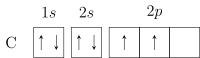
This shows that among the 4 valence electrons of the carbon atom, there are two \(2s\) electrons and two \(2p\) electrons. When the carbon atom participates in chemical reactions, one \(2s\) electron absorbs a certain amount of energy during the reaction and is promoted to a \(2p\) orbital. This can be represented as:
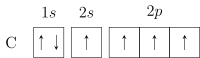
Now the carbon atom has 4 unpaired electrons: one \(2s\) electron and three \(2p\) electrons. Therefore, carbon exhibits a valence of 4 and can form 4 covalent bonds with 4 hydrogen atoms. Using \(\cdot\) to represent valence electrons of the carbon atom and \({\scriptscriptstyle\times}\) to represent valence electrons of hydrogen atoms, the electron-dot formula of methane can be written with hydrogen atoms at all four positions around carbon, each sharing one electron pair with carbon.
In chemistry, a short line is commonly used to represent a shared electron pair. Thus, the structural formula of methane can be represented as:
\[\begin{array}{c} \text{H} \\ | \\ \text{H} - \text{C} - \text{H} \\ | \\ \text{H} \end{array}\]
This type of diagram, using short lines to represent shared electron pairs, is called a structural formula.
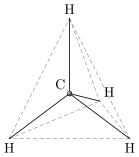
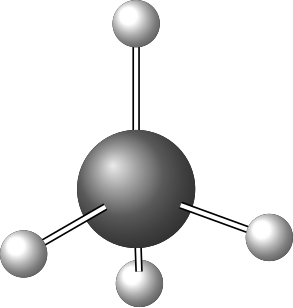
Although the structural formula of methane can preliminarily illustrate how the carbon and hydrogen atoms are bonded, it cannot show the actual spatial distribution of atoms in the molecule. Extensive scientific experiments have proven that the one carbon atom and four hydrogen atoms in a methane molecule are not in the same plane but form a regular tetrahedral three-dimensional structure. The carbon atom is located at the center of the regular tetrahedron, and the four hydrogen atoms are located at the four vertices. The angles between any two of the carbon atom’s four bonds (bond angles) are all equal, each being \(109^{\circ}28'\). All four C–H bonds have a bond length of \(1.09 \times 10^{-10}\ \text{m}\). The C–H bond energy has been measured as \(98.8\ \text{kCal/mol}\).3 Figure 2.1 is a schematic diagram of the methane molecular structure, showing the relative positions of the atoms. Figure 2.2 (a) is a ball-and-stick model of the methane molecule, where the black ball represents the carbon atom, white balls represent hydrogen atoms, and the short rods represent bonds. Figure 2.2 (b) is a space-filling model (scale model), which uses the volume ratio of the black and white balls to approximately represent the volume ratio of the carbon and hydrogen atoms.
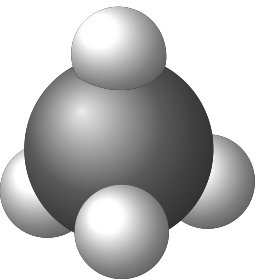
Structural formulas of compounds are very important for understanding their structure, preparation methods, and properties — especially for organic compounds. Molecular models can help us further understand the three-dimensional shape of molecules and the relative positions of atoms within them. We will discuss this further later.
The three-dimensional structures of organic compounds are rather cumbersome to draw. For convenience, planar structural formulas are generally used.
We know that when the carbon atom in a methane molecule participates in a chemical reaction, one \(2s\) electron is promoted to the \(2p\) orbital, giving 4 unpaired outermost electrons, so carbon displays a valence of 4.
However, we also know that \(2s\) and \(2p\) electrons are different, which would suggest that the four bonds in a methane molecule cannot all be identical — one bond should differ from the other three. Yet experimental evidence proves that all four bonds are equivalent. How can this be explained? To resolve this contradiction, scientists proposed the theory of hybridized orbitals.
This theory holds that in a methane molecule, the four bonding electrons of the carbon atom do not separately occupy the \(2s\), \(2p_x\), \(2p_y\), and \(2p_z\) orbitals. Instead, these four orbitals “mix” and recombine into four new orbitals of equal energy. This process of forming new orbitals is called hybridization. The four new orbitals formed by hybridizing one \(s\) orbital and three \(p\) orbitals are called \(sp^3\) hybridized orbitals.

A single \(sp^3\) hybridized orbital of the carbon atom is shown in Figure 2.3 (a). The four \(sp^3\) hybridized orbitals point toward the four vertices of a regular tetrahedron. The angle between the symmetry axes of the \(sp^3\) hybridized orbitals is \(109^{\circ}28'\). The carbon atom sits at the center of the tetrahedron (Figure 2.3 (b)).

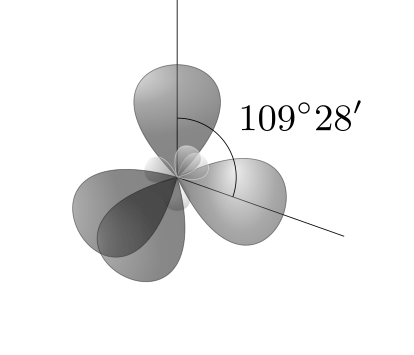
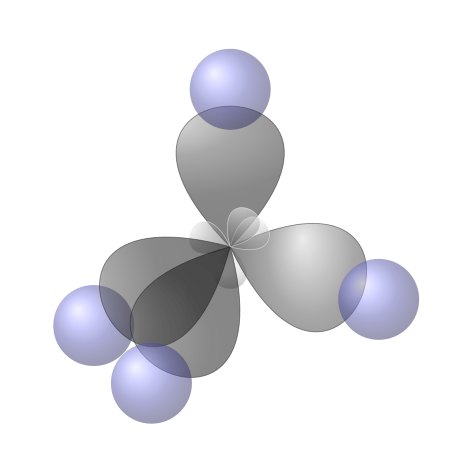
According to hybridized orbital theory, in a methane molecule, each of the four \(sp^3\) hybridized orbitals overlaps with the \(1s\) orbital of a hydrogen atom to form four C–H covalent bonds. Because the \(sp^3\) hybridized orbitals are asymmetric — larger at one end and smaller at the other — the larger end can overlap more effectively with the orbital of another atom, resulting in greater bonding capability (Figure 2.4).
A bond formed by two identical or different atoms whose valence electrons overlap along the orbital symmetry axis (here, the line connecting the two nuclei) is called a \(\sigma\) (sigma) bond. A characteristic of \(\sigma\) bonds is that they can rotate freely about the symmetry axis without affecting bond strength or the angles between bonds. For example, the H–H bond in a hydrogen molecule, the H–Cl bond in a hydrogen chloride molecule, and the C–H bonds in a methane molecule are all \(\sigma\) bonds.
Preparation and Properties of Methane
1. Preparation of Methane
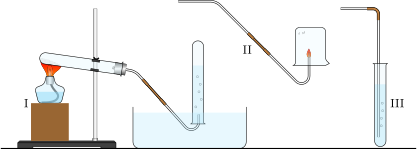
In the laboratory, methane is prepared by heating a mixture of anhydrous sodium acetate (\(\ce{CH3COONa}\)) and soda lime (see Figure 2.5, I). Soda lime is a mixture of sodium hydroxide and lime. The chemical equation4 for the reaction of sodium hydroxide with sodium acetate is:
\[\ce{CH3COONa + NaOH ->[\Delta] Na2CO3 + CH4 ^}\]
Take one spatula of finely ground anhydrous sodium acetate and three spatulas of finely ground soda lime.5 Mix them thoroughly on paper and quickly transfer into a test tube. Set up the apparatus as shown in Figure 2.5, I. Heat the mixture. Collect the methane by water displacement into a test tube. Observe its color and smell its odor.
2. Chemical Properties and Uses of Methane
Under normal conditions, methane is relatively stable and generally does not react with strong acids, strong bases, or strong oxidizing agents.
Pass methane through a test tube containing acidified potassium permanganate solution (Figure 2.5, III). Observe whether the purple solution changes color.
We can see from the experiment that the solution color does not change, indicating that methane does not react with the strong oxidizing agent potassium permanganate. However, the stability of methane is relative — under specific conditions, it can undergo certain reactions.
(1) Substitution reactions
Prepare a gas collection bottle containing a mixture of pure methane and chlorine gas. Cover the bottle mouth with a glass plate and place it in a well-lit area (caution: do not place it in direct sunlight, as this could cause an explosion). Wait a moment and observe the change in gas color inside the bottle.
At room temperature, a mixture of methane and chlorine gas can be stored in the dark indefinitely without any reaction. But when the mixed gases are exposed to light, a reaction occurs and the yellow-green color of chlorine gradually fades. The chemical equation for this reaction can be expressed as follows (using structural formulas instead of molecular formulas for clarity):
\[\ce{CH4 + Cl2 ->[\text{light}] CH3Cl + HCl}\]
The product \(\ce{CH3Cl}\) is chloromethane (methyl chloride).
But the reaction does not stop there. The chloromethane produced continues to react with chlorine, successively forming dichloromethane, trichloromethane (also called chloroform), and tetrachloromethane (also called carbon tetrachloride):
\[\ce{CH3Cl + Cl2 ->[\text{light}] CH2Cl2 + HCl}\]
\[\ce{CH2Cl2 + Cl2 ->[\text{light}] CHCl3 + HCl}\]
\[\ce{CHCl3 + Cl2 ->[\text{light}] CCl4 + HCl}\]
In these reactions, hydrogen atoms in the methane molecule are progressively replaced by chlorine atoms, producing four substitution products. A reaction in which certain atoms or groups of atoms in an organic molecule are replaced by other atoms or groups of atoms is called a substitution reaction.
Chloromethane and the other three substitution products are all chlorinated derivatives of methane. They are all insoluble in water. At room temperature, chloromethane is a gas, while the other three are liquids. Chloroform and carbon tetrachloride are both important industrial solvents. Carbon tetrachloride is also a relatively effective fire extinguishing agent.
(2) Oxidation reaction
Ignite pure methane (caution: before igniting, test the purity of the methane just as you would test hydrogen gas for purity). Observe the flame. Then hold a dry beaker inverted over the flame (Figure 2.5, II). Very quickly, the inner wall of the beaker will become clouded with condensed water vapor. Turn the beaker upright, add a small amount of clear limewater, and shake. Observe the limewater becoming turbid.
Pure methane burns quietly in air, producing carbon dioxide and water while releasing a large amount of heat:
\[\ce{CH4 + 2O2 ->[\text{ignite}] CO2 + 2H2O}(\text{l}) + 212.8\ \text{kCal}\]
Methane is an excellent gaseous fuel. However, it is essential to note that igniting a mixture of methane with oxygen or air6 will immediately cause an explosion. Therefore, in coal mine tunnels, safety measures such as ventilation and strict prohibition of open flames must be taken to prevent explosions of methane–air mixtures.
(3) Thermal decomposition
When heated to nearly \(1000\,{}^{\circ}\text{C}\) in the absence of air, methane begins to decompose. With prolonged heating at about \(1500\,{}^{\circ}\text{C}\), decomposition becomes fairly complete, producing carbon black and hydrogen gas:
\[\ce{CH4 ->[\text{high temp.}] C + 2H2 ^}\]
The carbon black produced from methane decomposition is an important raw material for the rubber industry and can also be used to manufacture pigments, inks, paints, etc. The hydrogen produced can serve as raw material for ammonia synthesis.
- Methane (\(\ce{CH4}\)) has a regular tetrahedral structure with bond angles of \(109^{\circ}28'\)
- Methane is relatively stable but undergoes substitution reactions with halogens (e.g., \(\ce{Cl2}\)) under light
- Substitution reactions replace H atoms with halogen atoms one at a time, producing up to four substitution products
- Methane burns in air (oxidation) and decomposes at high temperatures
Exercises for Section 2
A gas contains \(82.7\%\) carbon and \(17.3\%\) hydrogen. At STP, its density is \(2.59\ \text{g/L}\). Determine the chemical formula of this gas.
A certain hydrocarbon contains \(92.3\%\) carbon and \(7.7\%\) hydrogen. At \(1\ \text{atm}\) and \(117\,{}^{\circ}\text{C}\), \(0.5\ \text{g}\) of the compound (vapor) occupies a volume of \(205\ \text{mL}\). Find the formula mass and chemical formula of this hydrocarbon.
How can you experimentally distinguish methane, hydrogen, and carbon monoxide?
The substitution reaction and products of bromine with methane are similar to those of chlorine with methane. Write the chemical equations for each step of the reaction of bromine with methane.
At \(27\,{}^{\circ}\text{C}\) and \(750\ \text{mmHg}\), how many liters of carbon dioxide are produced when \(5\ \text{mol}\) of methane undergo complete combustion?
2.3 Section 3: Alkanes and Homologous Series
Alkanes
Besides methane, there is a series of hydrocarbons with very similar properties, such as ethane (\(\ce{C2H6}\)), propane (\(\ce{C3H8}\)), butane (\(\ce{C4H10}\)), and so on. Their structural formulas show that in each molecule, carbon atoms are bonded to each other by single bonds in a chain. As with methane, the remaining bonds of the carbon atoms are all bonded to hydrogen atoms. This type of bonding makes every carbon atom’s valence fully utilized, reaching “saturation.” Chain hydrocarbons with this type of bonding are called saturated chain hydrocarbons, or alkanes.
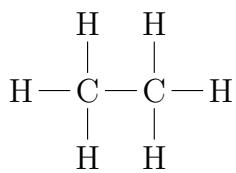
Chinese labels in figure: 乙烷 = Ethane; 丙烷 = Propane; 丁烷 = Butane.
These alkanes are named according to the number of carbon atoms in the molecule. For carbon numbers up to ten, the Chinese naming system uses specific characters (methane through decane). For carbon numbers above ten, numerical prefixes are used.7 For example, \(\ce{C7H16}\) is called heptane, and \(\ce{C17H36}\) is called heptadecane.
For convenience, organic compounds can be represented not only by structural formulas but also by condensed structural formulas. For example, the condensed structural formula of ethane is \(\ce{CH3CH3}\), that of propane is \(\ce{CH3CH2CH3}\), and that of pentane is \(\ce{CH3(CH2)3CH3}\).
Alkanes are very numerous. Table 2.1 lists the physical properties of some of them.
| Name | Condensed formula | State at RT | MP (\(\,{}^{\circ}\text{C}\)) | BP (\(\,{}^{\circ}\text{C}\)) | Density, liquid (g/cm³) |
|---|---|---|---|---|---|
| Methane | \(\ce{CH4}\) | Gas | \(-182.5\) | \(-164\) | \(0.466\)* |
| Ethane | \(\ce{CH3CH3}\) | Gas | \(-183.3\) | \(-88.63\) | \(0.572\)** |
| Propane | \(\ce{CH3CH2CH3}\) | Gas | \(-189.7\) | \(-42.07\) | \(0.5005\) |
| Butane | \(\ce{CH3(CH2)2CH3}\) | Gas | \(-138.4\) | \(-0.5\) | \(0.5788\) |
| Pentane | \(\ce{CH3(CH2)3CH3}\) | Liquid | \(-129.7\) | \(36.07\) | \(0.6262\) |
| Heptane | \(\ce{CH3(CH2)5CH3}\) | Liquid | \(-90.61\) | \(98.42\) | \(0.6838\) |
| Octane | \(\ce{CH3(CH2)6CH3}\) | Liquid | \(-56.79\) | \(125.7\) | \(0.7025\) |
| Decane | \(\ce{CH3(CH2)8CH3}\) | Liquid | \(-29.7\) | \(174.1\) | \(0.7300\) |
| Heptadecane | \(\ce{CH3(CH2)15CH3}\) | Solid | \(22\) | \(301.8\) | \(0.7780\) (solid) |
| Tetracosane | \(\ce{CH3(CH2)22CH3}\) | Solid | \(54\) | \(391.3\) | \(0.7991\) (solid) |
Homologous Series
From Table 2.1 we can also see that the physical properties of alkanes generally change in a regular pattern as the number of carbon atoms in the molecule increases (and correspondingly, the formula mass increases). For example, at room temperature, their states progress from gas to liquid to solid, and their boiling points gradually increase.
The chemical properties of these hydrocarbons are similar to those of methane. Under normal conditions, they are very stable and do not react with acids, bases, or oxidizing agents, nor do they readily combine with other substances. These hydrocarbons can all be ignited in air. Under light, they can all undergo substitution reactions with chlorine gas.
From the chemical formulas of the alkanes in Table 2.1, we can see that each adjacent pair of alkanes differs in composition by one “\(\ce{CH2}\)” group. If we denote the number of carbon atoms as \(n\), the number of hydrogen atoms is \(2n + 2\). Therefore, the general formula for alkanes can be expressed as \(\ce{C_nH_{2n+2}}\).
Substances that have similar structures and differ in molecular composition by one or more \(\ce{CH2}\) groups are called homologs of each other.
Methane, ethane, propane, etc. are all homologs in the alkane series.
Hydrocarbon Radicals
The portion remaining after a hydrocarbon molecule loses one or more hydrogen atoms is called a hydrocarbon radical (or simply a radical). Hydrocarbon radicals are generally represented as “R–.” If the hydrocarbon is an alkane, the group remaining after an alkane loses hydrogen atoms is called an alkyl group. \(\ce{-CH3}\) is called a methyl group, \(\ce{-CH2CH3}\) is called an ethyl group, and so on.
Structural Isomers and Alkane Nomenclature
1. Structural Isomerism
When studying the molecular composition and properties of substances, many cases have been found where substances have the same molecular composition but different properties. For example, in studying butane (\(\ce{C4H10}\)), another substance was found with the same composition and formula mass as butane but with different properties. To distinguish them, one is called n-butane and the other isobutane. Some of their property differences are shown below:
| n-Butane | Isobutane | |
|---|---|---|
| Melting point (\(\,{}^{\circ}\text{C}\)) | \(-138.4\) | \(-159.6\) |
| Boiling point (\(\,{}^{\circ}\text{C}\)) | \(-0.5\) | \(-11.7\) |
| Density (g/cm³) | \(0.5788\) | \(0.557\) |
Why do these two butanes have the same composition and formula mass but different properties? Scientific experiments have proven that they have different structures. In n-butane, the carbon atoms form a straight chain, while in isobutane, the carbon chain has a branch:
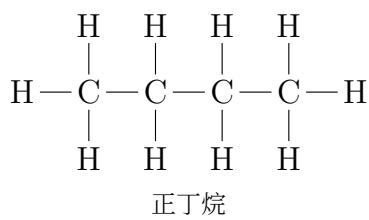
Chinese labels in figure: Shows structural formulas and condensed structural formulas of n-butane (正丁烷) and isobutane (异丁烷).
Thus, carbon atoms in hydrocarbon molecules can form both straight-chain carbon chains (as in n-butane) and branched carbon chains. Although the two butanes have the same composition — that is, the same chemical formula — the atoms are bonded in a different order, meaning the molecular structures are different, and therefore their properties differ.
The phenomenon in which compounds have the same chemical formula but different structures is called structural isomerism (or constitutional isomerism). Compounds that exhibit structural isomerism are called structural isomers of each other. For example, n-butane and isobutane are two structural isomers of butane. Pentane has three structural isomers, with boiling points of \(36.07\,{}^{\circ}\text{C}\) (n-pentane), \(27.9\,{}^{\circ}\text{C}\) (isopentane), and \(9.5\,{}^{\circ}\text{C}\) (neopentane).
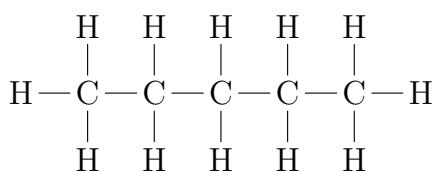
Chinese labels in figure: 正戊烷 = n-Pentane; 异戊烷 = Isopentane; 新戊烷 = Neopentane.
Figure 2.6 shows ball-and-stick models of the three structural isomers of pentane.
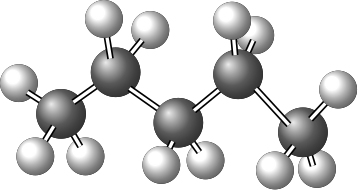
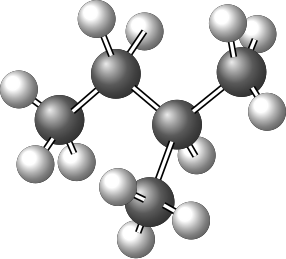
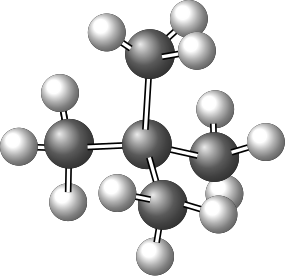
From Figure 2.6 we can see that even for an unbranched chain hydrocarbon, its carbon chain is not linear but zigzag-shaped. Similarly, the carbon chain in an isopentane molecule is also zigzag-shaped.
In the alkane homologous series, as the number of carbon atoms increases, the ways carbon atoms can bond become increasingly complex, and the number of structural isomers increases as well. For example, hexane (\(\ce{C6H14}\)) has 5 structural isomers, heptane (\(\ce{C7H16}\)) has 9, and decane (\(\ce{C10H22}\)) has as many as 75.
2. Systematic Nomenclature of Alkanes
Organic compounds are extremely numerous and their molecular compositions and structures are relatively complex, so naming them is very important. The three structural isomers of pentane mentioned above can only be distinguished by the prefixes n-, iso-, and neo-. If the number of carbon atoms is a bit larger, such a simple naming method clearly cannot meet the needs. Let us now use a branched alkane as an example to introduce a commonly used systematic nomenclature. The steps of this naming method are:
Select the longest carbon chain in the molecule as the main chain, and name it as “___ane” according to the number of carbon atoms in the main chain.
Number the carbon atoms in the main chain starting from the end nearest to a branch, using \(1, 2, 3, \ldots\) to determine the position of each branch.
Treat each branch as a substituent. Write the name of the substituent group before the alkane name, and use Arabic numerals before the substituent name to indicate its position on the main chain, separated by a hyphen.
For example: \(\ce{CH3-CH(CH3)-CH2-CH3}\) is named 2-methylbutane (i.e., isopentane).
If there are identical substituent groups, they can be combined using the prefixes di-, tri-, etc., but the Arabic numerals indicating the positions of identical substituent groups are separated by commas. If there are different substituent groups, the simpler one is written first and the more complex one afterward.
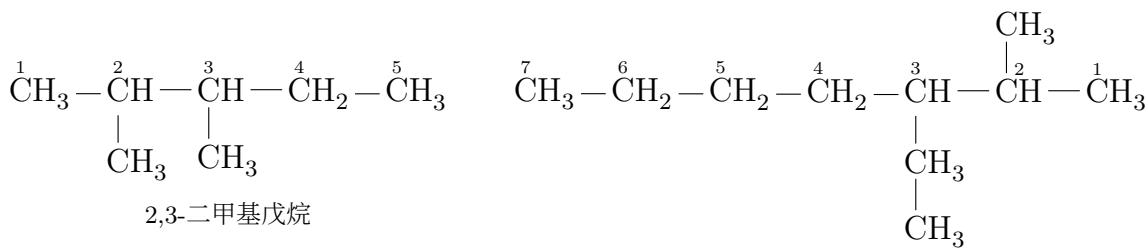
Chinese labels in figure: 2-甲基-3-乙基庚烷 = 2-Methyl-3-ethylheptane.
This compound is named 2-methyl-3-ethylheptane.
Cycloalkanes
Hydrocarbons in which the carbon atoms are connected to each other in a ring are called cyclic hydrocarbons.
Among cyclic hydrocarbons, those in which the carbon atoms are bonded to each other by single bonds are called cycloalkanes. The properties of cycloalkanes are similar to those of saturated chain hydrocarbons. Below are the condensed structural formulas of four cycloalkanes:
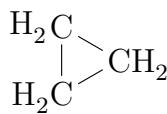
Chinese labels in figure: 环丙烷 = Cyclopropane; 环丁烷 = Cyclobutane; 环戊烷 = Cyclopentane; 环己烷 = Cyclohexane.
We can see that cycloalkanes have two fewer hydrogen atoms than the corresponding alkanes, so the general formula for cycloalkanes is \(\ce{C_nH_{2n}}\).
Among the cycloalkanes, cyclohexane has relatively wide industrial applications. Cyclohexane is a colorless liquid that is volatile and flammable. It is an important raw material for producing the synthetic fiber nylon, and is also used as an organic solvent.
- Alkanes are saturated chain hydrocarbons with the general formula \(\ce{C_nH_{2n+2}}\)
- Homologs have similar structures and differ by one or more \(\ce{CH2}\) groups
- Structural isomers have the same molecular formula but different structural arrangements
- The systematic nomenclature names alkanes based on the longest chain (main chain) and substituent positions
- Cycloalkanes have the general formula \(\ce{C_nH_{2n}}\) and properties similar to alkanes
Exercises for Section 3
What are homologs? Write the chemical formula and condensed structural formula for each of the following straight-chain alkanes:
- octane, (2) octadecane, (3) tricosane, (4) nonatriacontane, (5) the alkane containing 30 hydrogen atoms.
Which alkane has a density approximately equal to that of air?
Write the name of the following hydrocarbon:
\[\ce{CH3-CH(CH3)-CH2-CH(CH2CH2CH3)-CH2-CH(CH3)-CH2-CH2-CH3}\]
Write the electron-dot formula of pentane.
Write the condensed structural formulas of all structural isomers of hexane, and name each using systematic nomenclature.
Burning \(8.8\ \text{g}\) of a gaseous hydrocarbon produces \(26.4\ \text{g}\) of carbon dioxide. The density of this hydrocarbon at STP is \(1.96\ \text{g/L}\). Determine the chemical formula of this hydrocarbon.
At STP, how many liters of air are needed to completely burn a mixture of \(2\ \text{mol}\) methane and \(10\ \text{L}\) ethane?
Write the chemical equation for the complete combustion of octane.
How do the meanings of the following four terms differ: homologs, structural isomers, allotropes, and isotopes? Give examples.
Among the following alkane molecules, which are structural isomers of each other?
A. \(\ce{CH3CH2CH2CH2CH3}\)
B. \(\ce{CH3CH(CH3)CH2CH3}\)
C. \(\ce{(CH3)2CHCH2CH3}\)
D. \(\ce{(CH3)2CHCH3}\)
E. \(\ce{CH3CH2CH2CH2CH(CH3)2}\)
Write the structural formulas of the following compounds:
- 2,5-dimethylheptane, (2) 2,3-dimethyl-5-ethyloctane.
A certain hydrocarbon contains \(85.7\%\) carbon and \(14.3\%\) hydrogen. Its density at STP is \(1.25\ \text{g/L}\). Find the formula mass and chemical formula of this hydrocarbon.
2.4 Section 4: Ethylene
Among chain hydrocarbons, besides saturated chain hydrocarbons, there are many hydrocarbons whose molecules contain fewer hydrogen atoms bonded to carbon than in saturated chain hydrocarbons. If these compounds react with certain substances, the carbon atoms in their molecules can still bond additional atoms or groups. Such hydrocarbons are generally called unsaturated hydrocarbons.8
Ethylene is one such unsaturated hydrocarbon. The chemical formula of ethylene is \(\ce{C2H4}\). Its structural formula shows a carbon–carbon double bond (\(\ce{C=C}\)). Chain hydrocarbons whose molecules contain a carbon–carbon double bond are called alkenes. Ethylene is the simplest alkene.
To more simply and vividly describe the structure of the ethylene molecule, we often use molecular models (Figure 2.7). In the ball-and-stick model (a), the two carbon atoms are connected by two bendable elastic rods representing the double bond. (b) shows the space-filling model of the ethylene molecule.
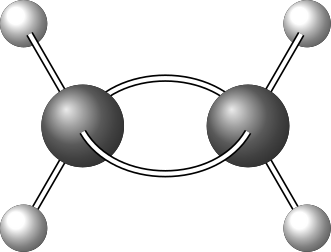
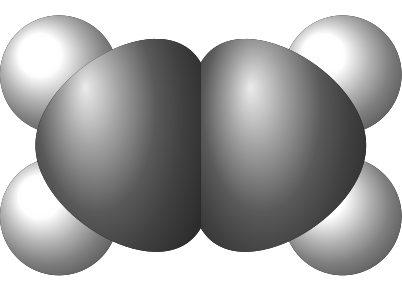
Experiments show that the \(\ce{C=C}\) double bond in ethylene has a bond length of \(1.33 \times 10^{-10}\ \text{m}\). All atoms in the ethylene molecule — two carbon atoms and four hydrogen atoms — lie in the same plane. The bond angles between them are approximately \(120^{\circ}\). The bond energy of the ethylene double bond is \(147\ \text{kCal/mol}\).9 The experimentally measured C–C single bond in ethane has a bond length of \(1.54 \times 10^{-10}\ \text{m}\) and a bond energy of \(83.1\ \text{kCal/mol}\).10 This shows that the \(\ce{C=C}\) double bond energy is not twice the C–C single bond energy but somewhat less. Therefore, only a relatively small amount of energy is needed to break one of the bonds in the double bond. This is confirmed by the chemical properties of ethylene described below.
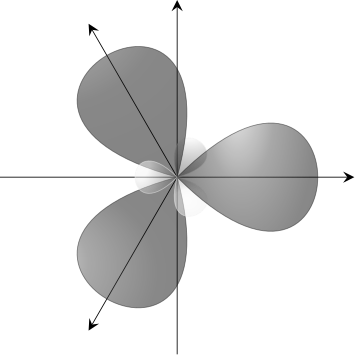
To explain the planar structure of the \(\ce{CH2=CH2}\) molecule, hybridized orbital theory proposes that each carbon atom undergoes \(sp^2\) hybridization: one \(2s\) orbital and two \(2p\) orbitals form three \(sp^2\) hybridized orbitals (Figure 2.8 (a)), while the remaining one \(p\) orbital stays unchanged and does not participate in hybridization.
In forming the ethylene molecule, each carbon atom uses 2 of its \(sp^2\) hybridized orbitals to overlap with the \(1s\) orbitals of two hydrogen atoms, forming 4 C–H \(\sigma\) bonds. The two carbon atoms each use one \(sp^2\) hybridized orbital to overlap with each other, forming one C–C \(\sigma\) bond. All 5 \(\sigma\) bonds in the molecule lie in the same plane, with bond angles of approximately \(120^{\circ}\) (Figure 2.8 (b)). Additionally, each carbon atom has one unhybridized \(p\) orbital. These two \(p\) orbitals are perpendicular to the plane containing the 5 \(\sigma\) bonds and are parallel to each other. Therefore, they can overlap laterally to form a bond (Figure 2.9). This type of bond is called a \(\pi\) (pi) bond. It is perpendicular to the plane of the five \(\sigma\) bonds.
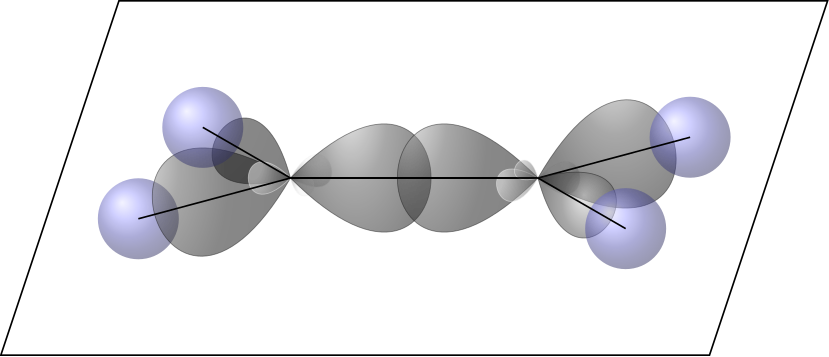
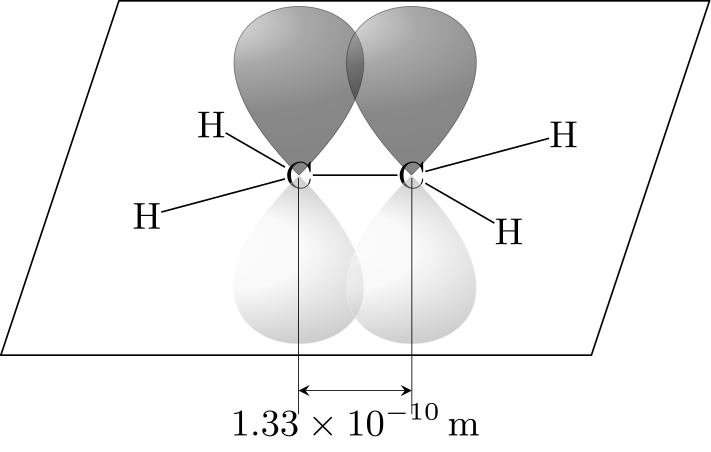
Thus, the \(\ce{C=C}\) double bond in ethylene consists of one \(\sigma\) bond and one \(\pi\) bond. The degree of orbital overlap differs between these two types of bonds. The \(\pi\) bond is formed by lateral overlap of \(p\) orbitals, which is less extensive than the head-on overlap of a \(\sigma\) bond. Therefore, the \(\pi\) bond is less stable than the \(\sigma\) bond, breaks more easily, and requires less energy to break. Furthermore, unlike the electron cloud of a \(\sigma\) bond, which is concentrated along the symmetry axis connecting the two nuclei, the \(\pi\) bond electron cloud is distributed above and below the molecular plane.
Because the carbon nuclei attract the \(\pi\) bond electron cloud relatively weakly, the \(\pi\) electron cloud is easily deformed under the influence of external conditions. This explains why alkenes are relatively reactive and readily undergo addition and other reactions.
Since the formation of the \(\pi\) bond depends on parallel overlap of two \(p\) orbitals from the side, destroying this parallel overlap would lead to breaking the \(\pi\) bond. Therefore, unlike single bonds, carbon atoms connected by a double bond cannot rotate freely about the bond axis.
Physical Properties of Ethylene
Ethylene is a colorless gas with a slight odor. Its density is \(1.25\ \text{g/L}\), slightly lighter than air, and it is poorly soluble in water.
Chemical Properties and Uses of Ethylene
Industrially, ethylene is separated from gases produced by petroleum refining and petrochemical plants. In the laboratory, it is prepared by heating a mixture of ethanol and concentrated sulfuric acid, which causes the ethanol to dehydrate. The concentrated sulfuric acid acts as both a catalyst and a dehydrating agent.
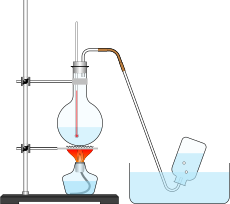
Set up the flask and delivery tube as shown in Figure 2.10. Pour approximately \(20\ \text{mL}\) of a mixture of ethanol and concentrated sulfuric acid (volume ratio \(1:3\)) into the flask, and add a few pieces of broken porcelain to prevent the mixture from bumping during boiling. Heat the liquid rapidly to \(170\,{}^{\circ}\text{C}\), at which point ethylene is produced.
1. Addition Reactions
Pass ethylene into a test tube containing bromine water. Observe that the red-brown color of the bromine water quickly disappears.
Ethylene reacts with bromine in bromine water to form the colorless liquid 1,2-dibromoethane (\(\ce{CH2Br-CH2Br}\)):
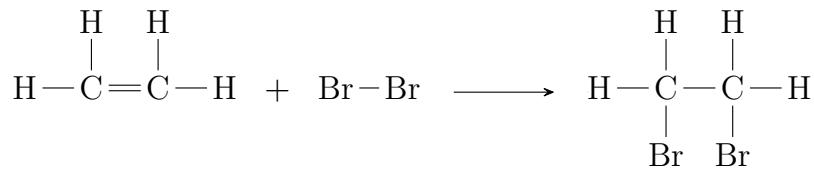
Chinese labels in figure: 1,2-二溴乙烷 = 1,2-Dibromoethane.
The essence of this reaction is that one of the bonds in the double bond of the ethylene molecule breaks easily, and two bromine atoms add to the two carbon atoms that are no longer saturated, forming dibromoethane. A reaction in which atoms or groups directly combine with unsaturated carbon atoms in an organic molecule to form a new substance is called an addition reaction.
Ethylene can also undergo addition reactions with hydrogen gas, chlorine gas, hydrogen halides, and water under suitable conditions:
\[\ce{CH2=CH2 + H2 ->[\text{catalyst}] CH3-CH3}\]
\[\ce{CH2=CH2 + HCl -> CH3-CH2Cl}\]
2. Oxidation Reactions
Ignite pure ethylene. It burns in air with a bright flame, producing black smoke at the same time.
Like other hydrocarbons, ethylene also produces carbon dioxide and water when it burns in air. However, because the ethylene molecule has a relatively high carbon content and the carbon does not burn completely, black smoke is produced. The chemical equation for the complete combustion of ethylene is:
\[\ce{CH2=CH2 + 3O2 ->[\text{ignite}] 2CO2 + 2H2O}(\text{l}) + 337.2\ \text{kCal}\]
Ethylene can not only undergo direct oxidation with oxygen but can also be oxidized by oxidizing agents.
Pass ethylene into a test tube containing potassium permanganate solution (with a few drops of dilute sulfuric acid added). Observe that the purple color of the solution quickly fades.
Ethylene can be oxidized by the oxidizing agent potassium permanganate (\(\ce{KMnO4}\)), causing the potassium permanganate solution to lose its color. This method can be used to distinguish methane from ethylene.
3. Polymerization Reactions
Under appropriate temperature, pressure, and in the presence of a catalyst, the double bond in ethylene molecules can break one of its bonds, allowing an addition reaction to occur in which ethylene molecules join together, linking the carbon atoms into very long chains:
\[n\ce{CH2=CH2} \xrightarrow{\text{catalyst}} \ce{[-CH2-CH2-]_n}\]
The product of this reaction is polyethylene. It is a compound with a very large formula mass (tens of thousands to hundreds of thousands). Its chemical formula can be simply written as \((\ce{C2H4})_n\). The formation of polyethylene is an example of a polymerization reaction. In this polymerization reaction, molecules of a compound with small formula mass combine to form molecules of a compound with very large formula mass. Since this polymerization is also an addition reaction, it is called an addition polymerization reaction, or simply an addition polymerization.
Since the 1960s, world ethylene production has developed rapidly. Ethylene is the most important basic raw material in the petrochemical industry, used to manufacture plastics, synthetic fibers, organic solvents, and more. The development of ethylene has driven the development of other petrochemical feedstocks and products.
Ethylene is also a plant growth regulator — for example, it can be used as a fruit ripening agent.
- Ethylene (\(\ce{CH2=CH2}\)) contains a \(\ce{C=C}\) double bond and has a planar structure with bond angles of about \(120^{\circ}\)
- The double bond consists of one \(\sigma\) bond and one \(\pi\) bond; the \(\pi\) bond breaks more easily
- Ethylene readily undergoes addition reactions (with \(\ce{Br2}\), \(\ce{H2}\), \(\ce{HCl}\), \(\ce{H2O}\))
- Ethylene can be oxidized by \(\ce{KMnO4}\) (decolorizes the purple solution) — used to distinguish it from methane
- Polymerization of ethylene produces polyethylene (an addition polymerization)
Exercises for Section 4
How can you identify methane and ethylene stored in different containers?
In the laboratory, how can you purify methane that is contaminated with ethylene?
When ethylene passes through a reagent bottle containing bromine, the mass of the bottle increases by \(16\ \text{g}\). How many liters of ethylene (at STP) were absorbed? How many grams of 1,2-dibromoethane were produced?
Ethylene undergoes addition with hydrogen chloride to form chloroethane (\(\ce{C2H5Cl}\)). Write the chemical equation. Calculate theoretically how many tonnes of chloroethane can be produced from one tonne of ethylene.
2.5 Section 5: Alkenes
Alkenes and Their Nomenclature
Alkenes are the general name for unsaturated chain hydrocarbons whose molecules contain a carbon–carbon double bond (\(\ce{C=C}\)). Besides ethylene, the alkene family includes propylene (\(\ce{CH3CH=CH2}\)), butylene (\(\ce{CH3CH2CH=CH2}\)), and others. Table 2.2 lists the physical properties of several ethylene homologs.
| Name | Condensed formula | State at RT | MP (\(\,{}^{\circ}\text{C}\)) | BP (\(\,{}^{\circ}\text{C}\)) | Density, liquid (g/cm³) |
|---|---|---|---|---|---|
| Ethylene | \(\ce{CH2=CH2}\) | Gas | \(-169.2\) | \(-103.7\) | \(0.384\)* |
| Propylene | \(\ce{CH3CH=CH2}\) | Gas | \(-185.3\) | \(-47.4\) | \(0.5193\) |
| 1-Butene | \(\ce{CH3CH2CH=CH2}\) | Gas | \(-185.4\) | \(-6.3\) | \(0.5951\) |
| 1-Pentene | \(\ce{CH3(CH2)2CH=CH2}\) | Liquid | \(-138\) | \(29.97\) | \(0.6405\) |
| 1-Hexene | \(\ce{CH3(CH2)3CH=CH2}\) | Liquid | \(-139.8\) | \(63.35\) | \(0.6731\) |
| 1-Heptene | \(\ce{CH3(CH2)4CH=CH2}\) | Liquid | \(-119\) | \(93.64\) | \(0.6970\) |
From Table 2.2 we can see that, like alkanes, ethylene homologs also differ successively by one \(\ce{CH2}\) group. The general formula for alkenes is \(\ce{C_nH_{2n}}\). Their physical properties also generally change regularly with increasing number of carbon atoms. The chemical properties of alkenes are similar to those of ethylene — for example, they readily undergo addition reactions.
Propylene is an important petroleum industry product and an important chemical feedstock. For example, polymerization of propylene produces polypropylene.
The nomenclature of alkenes is similar to that of alkanes, but the position of the double bond must be indicated:
Determine the longest carbon chain that includes the double bond as the main chain.
Number the carbon atoms in the main chain starting from the end nearer to the double bond.
The position of the double bond is indicated by an Arabic numeral placed before the “___ene” suffix.
For example:

Chinese labels in figure: 4-甲基-2-丁烯 = 4-Methyl-2-butene.
This is named 4-methyl-2-butene. 1-Butene and 2-butene are structural isomers.
Dienes
Chain hydrocarbons whose molecules contain two double bonds are called dienes. 1,3-Butadiene (\(\ce{CH2=CH-CH=CH2}\)) is the most important member of the diene family. 1,3-Butadiene is an important organic chemical feedstock.
Dienes have double bonds and, like alkenes, can undergo addition reactions. However, 1,3-butadiene has two double bonds and exhibits its own special characteristics. In addition reactions, the more reactive bonds in both double bonds can break simultaneously, while a new double bond forms. For example, the addition reaction of 1,3-butadiene with \(\ce{Br2}\):
\[\ce{CH2=CH-CH=CH2 + Br2 -> Br-CH2-CH=CH-CH2-Br}\]
This type of addition reaction is called 1,4-addition.
In addition to the 1,4-addition product, a 1,2-addition product is also formed:
\[\ce{Br-CH2-CHBr-CH=CH2}\]
In the addition reactions of 1,3-butadiene, the 1,4-addition product is usually the major product. The 1,4-addition reaction is of great importance in industrial production.
Dienes have one more double bond and two fewer hydrogen atoms than alkenes, so the general formula for dienes is \(\ce{C_nH_{2n-2}}\).
- Alkenes have the general formula \(\ce{C_nH_{2n}}\) and are named by indicating the double bond position
- Dienes contain two double bonds, with the general formula \(\ce{C_nH_{2n-2}}\)
- 1,3-Butadiene undergoes both 1,4-addition (major product) and 1,2-addition
Exercises for Section 5
Write the structural formulas and names of all isomers of the chain hydrocarbon with a formula mass of 56.
Write the electron-dot formulas of (1) propylene and (2) isobutylene.
Write the number of structural isomers and their structural formulas for each of the following alkenes:
\[\begin{array}{c} \ce{CH2=C(CH3)-CH3} \qquad \ce{CH3-CH=CH-CH2-CH3}\end{array}\]
Write the condensed structural formulas of the following substances:
- propylene, (2) 1-butene, (3) 1,3-butadiene, (4) isoprene (i.e., 2-methyl-1,3-butadiene).
A certain hydrocarbon has the chemical formula \(\ce{C5H10}\). Can we say it is definitely a homolog of ethylene? Why or why not?
From the chemical formula of cycloalkanes, which class of chain hydrocarbons are they structural isomers of?
After complete combustion of \(0.1\ \text{mol}\) of a hydrocarbon, \(0.3\ \text{mol}\) of \(\ce{CO2}\) and \(0.3\ \text{mol}\) of \(\ce{H2O}\) are produced. What is the chemical formula of this hydrocarbon?
2.6 Section 6: Acetylene and Alkynes
Physical Properties and Structural Formula of Acetylene
Acetylene, commonly known as calcium carbide gas, is a colorless, odorless gas in its pure form. Acetylene prepared from calcium carbide often has a peculiar unpleasant odor due to impurities such as phosphine (\(\ce{PH3}\)) and hydrogen sulfide (\(\ce{H2S}\)). The density of acetylene is \(1.16\ \text{g/L}\), slightly lighter than air. It is slightly soluble in water and readily soluble in organic solvents.11
The chemical formula of acetylene is \(\ce{C2H2}\). Compared to ethylene, the acetylene molecule has two fewer hydrogen atoms. The carbon atoms in an acetylene molecule share three electron pairs, forming what is usually called a triple bond:
\[\ce{H-C#C-H}\]
Figure 2.11 shows two models of the acetylene molecule.
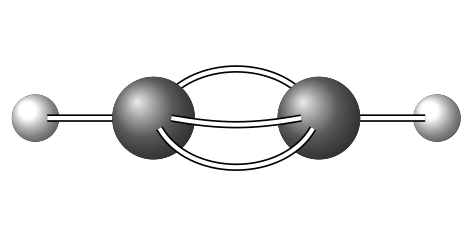
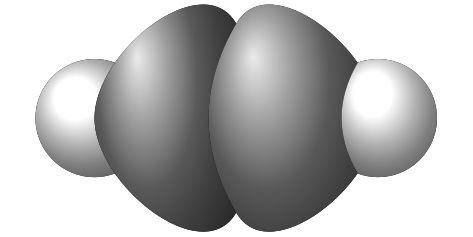
Experiments show that the triple bond in acetylene has a bond energy of \(194\ \text{kCal/mol}\),12 which is not equal to the sum of three single bond energies — it is much less (and also less than the sum of one single bond and one double bond energy). The triple bond length is \(1.20 \times 10^{-10}\ \text{m}\), shorter than both single and double bonds. It has been established that the angle between the \(\ce{C#C}\) bond and the C–H bond is \(180^{\circ}\) — that is, the two carbon atoms and two hydrogen atoms in the acetylene molecule lie on a straight line.
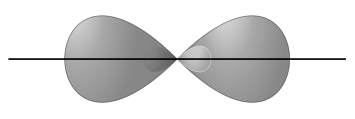

According to hybridized orbital theory, in the acetylene molecule, each carbon atom hybridizes one \(2s\) orbital and one \(2p\) orbital to form two orbitals of equal energy called \(sp\) hybridized orbitals (Figure 2.12 (a)). The symmetry axes of these two \(sp\) hybridized orbitals lie along the same straight line. Each carbon atom uses one \(sp\) hybridized orbital to overlap with the \(1s\) orbital of a hydrogen atom, forming a C–H \(\sigma\) bond. The two carbon atoms each use their remaining \(sp\) hybridized orbital to overlap with each other, forming a C–C \(\sigma\) bond (Figure 2.12 (b)). Each carbon atom still has two unhybridized \(p\) orbitals. Their electron clouds are mutually perpendicular and also perpendicular to the symmetry axis of the C–C \(\sigma\) bond. This results in the formation of two \(\pi\) bonds between the 4 \(p\) electrons, and these two \(\pi\) bonds are perpendicular to each other (Figure 2.13).
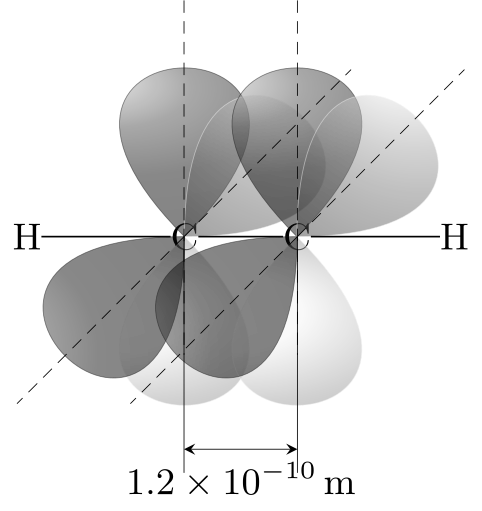
The \(\ce{C#C}\) triple bond in acetylene consists of one \(\sigma\) bond and two mutually perpendicular \(\pi\) bonds. Since the \(\pi\) bond energy is less than the \(\sigma\) bond energy, the \(\pi\) bonds break relatively easily under certain conditions. Therefore, compounds with triple bonds are also very reactive — they readily undergo oxidation, addition reactions, and more. At the same time, the triple bond length is shorter than the double bond length.
Preparation, Chemical Properties, and Uses of Acetylene
1. Laboratory Preparation
In the laboratory, acetylene is prepared by reacting calcium carbide (calcium dicarbide) with water:
\[\ce{CaC2 + 2H2O -> C2H2 ^ + Ca(OH)2} + 30.33\ \text{kCal}\]
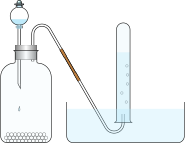
Set up the apparatus as shown in Figure 2.14. Place several small pieces of calcium carbide in the wide-mouth bottle. Gently open the stopcock of the separating funnel to allow water13 to drip slowly. Collect the acetylene by water displacement. Observe the color and state of the acetylene.
2. Chemical Properties of Acetylene
(1) Oxidation reaction
Ignite the acetylene produced in Experiment 2.9 and observe the flame.
The complete combustion of acetylene can be expressed as:
\[\ce{2C2H2 + 5O2 ->[\text{ignite}] 4CO2 + 2H2O}(\text{l}) + 621.2\ \text{kCal}\]
Acetylene releases a large amount of heat when it burns. Because of the very high carbon content in acetylene, incomplete combustion produces a bright flame with dense black smoke. A mixture of acetylene and air is explosive14 when exposed to a flame. When acetylene burns in oxygen, the resulting oxyacetylene flame reaches very high temperatures (above \(3000\,{}^{\circ}\text{C}\)) and can be used for cutting and welding metals.
Pass pure acetylene into a test tube containing potassium permanganate solution (with a small amount of sulfuric acid added). Observe the change in the purple solution.
Acetylene is also easily oxidized by oxidizing agents and can decolorize potassium permanganate solution.
(2) Addition reactions
Pass pure acetylene into a test tube containing bromine water. Observe the change in color of the solution.
Acetylene can also decolorize bromine water. The reaction proceeds in two steps:
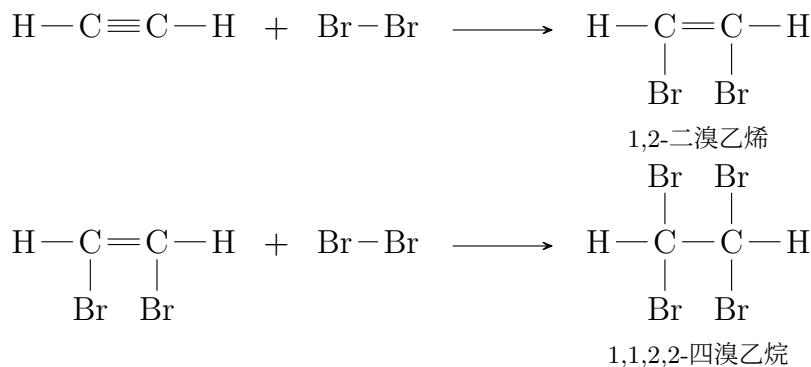
Chinese labels in figure: Shows step-by-step addition of \(\ce{Br2}\) to acetylene.
Using nickel powder as a catalyst with heating, acetylene can undergo addition reactions with hydrogen gas, first forming ethylene, then ethane:
\[\ce{CH#CH + H2 ->[\text{catalyst}][\Delta] CH2=CH2}\]
\[\ce{CH2=CH2 + H2 ->[\text{catalyst}][\Delta] CH3-CH3}\]
The addition reactions of acetylene with bromine and hydrogen powerfully confirm the correctness of the structural formula of acetylene.
At \(150\)–\(160\,{}^{\circ}\text{C}\) with mercuric chloride as catalyst, acetylene undergoes an addition reaction with hydrogen chloride to form vinyl chloride. Vinyl chloride is an important chemical feedstock:
\[\ce{HC#CH + HCl ->[\text{catalyst}][\Delta] CH2=CHCl}\]
3. Uses of Acetylene
From the properties of acetylene, we can see that starting from acetylene, many important organic chemical industrial feedstocks — such as vinyl chloride — can be produced. Therefore, acetylene is an important basic organic raw material. However, producing acetylene from calcium carbide consumes large amounts of electricity, so the trend is toward using natural gas and petroleum as starting materials for acetylene production.
Alkynes
Unsaturated chain hydrocarbons whose molecules contain a carbon–carbon triple bond are called alkynes. Besides acetylene, there are also propyne, butyne, and others. Table 2.3 lists the names, condensed structural formulas, and physical properties of several acetylene homologs.
| Name | Condensed formula | State at RT | MP (\(\,{}^{\circ}\text{C}\)) | BP (\(\,{}^{\circ}\text{C}\)) | Density, liquid (g/cm³) |
|---|---|---|---|---|---|
| Acetylene | \(\ce{HC#CH}\) | Gas | \(-80.8\) | \(-84.0\) | \(0.6181\)* |
| Propyne | \(\ce{CH3-C#CH}\) | Gas | \(-101.5\) | \(-23.2\) | \(0.66\)** |
| 1-Butyne | \(\ce{CH3CH2-C#CH}\) | Gas | \(-125.7\) | \(8.1\) | \(0.6784\)*** |
| 1-Pentyne | \(\ce{CH3(CH2)2-C#CH}\) | Liquid | \(-90\) | \(40.18\) | \(0.6901\) |
From Table 2.3 we can see that acetylene homologs also differ successively by one \(\ce{CH2}\) group, but they have two fewer hydrogen atoms than the corresponding alkenes. Therefore, the general formula for alkynes is \(\ce{C_nH_{2n-2}}\). The physical properties of alkynes also generally change regularly with increasing carbon atom number.
- Acetylene (\(\ce{C2H2}\)) contains a \(\ce{C#C}\) triple bond; all four atoms lie on a straight line
- The triple bond consists of one \(\sigma\) bond and two perpendicular \(\pi\) bonds
- Acetylene is prepared from calcium carbide (\(\ce{CaC2}\)) and water
- Like ethylene, acetylene undergoes addition reactions (with \(\ce{Br2}\), \(\ce{H2}\), \(\ce{HCl}\)) and is oxidized by \(\ce{KMnO4}\)
- Alkynes have the general formula \(\ce{C_nH_{2n-2}}\)
- The oxyacetylene flame (above \(3000\,{}^{\circ}\text{C}\)) is used for metal cutting and welding
Exercises for Section 6
How many liters of air (at \(1\ \text{atm}\) and \(27\,{}^{\circ}\text{C}\)) are needed for the complete combustion of \(13\ \text{g}\) of acetylene?
Compare the chemical properties of ethane, ethylene, and acetylene.
Are the amounts of carbon dioxide and water produced by complete combustion of equal moles of ethane, ethylene, and acetylene the same? Are the amounts of heat produced the same? Explain using thermochemical equations.
Identify which class of straight-chain hydrocarbons each of the following chemical formulas represents:
- \(\ce{C8H16}\), (2) \(\ce{C9H16}\), (3) \(\ce{C15H32}\), (4) \(\ce{C17H34}\), (5) \(\ce{C7H12}\).
Which class of hydrocarbons is called unsaturated chain hydrocarbons? What classes of unsaturated chain hydrocarbons do you know? What are the characteristic properties of unsaturated chain hydrocarbons?
At STP, \(11.2\ \text{L}\) of acetylene undergoes addition reaction with bromine. What is the maximum mass of bromine required (in grams)?
How many liters of acetylene can be produced at \(25\,{}^{\circ}\text{C}\) and \(770\ \text{mmHg}\) from \(100\ \text{g}\) of calcium carbide containing \(10\%\) impurities?
An alkyne with the general formula \(\ce{C_nH_{2n-2}}\) produces \(\ce{CO2}\) and \(\ce{H2O}\) in a molar ratio of \(2:1\) after complete combustion. Write the chemical formula of this alkyne.
2.7 Section 7: Benzene and Aromatic Hydrocarbons
Structure of the Benzene Molecule
Benzene is a colorless liquid with a distinctive odor. It is lighter than water and insoluble in water. Its boiling point is \(80.1\,{}^{\circ}\text{C}\) and its melting point is \(5.5\,{}^{\circ}\text{C}\). If cooled with ice, benzene can solidify into colorless crystals.
The chemical formula of benzene is \(\ce{C6H6}\). From this formula, benzene is far from saturated — the molecule would need 8 more hydrogen atoms to match the saturated chain hydrocarbon general formula \(\ce{C_nH_{2n+2}}\). Based on extensive research, the structural formula of benzene can be represented as:
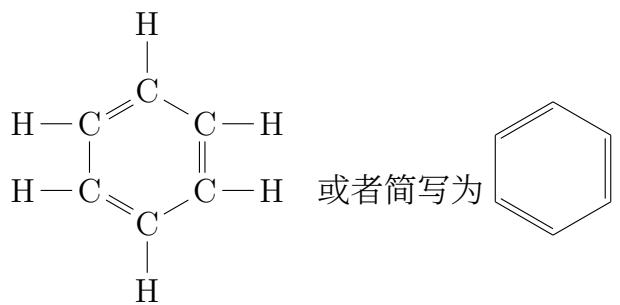
Chinese labels in figure: Shows the Kekulé structure of benzene with alternating single and double bonds.
From this structural formula (also called the Kekulé formula), one might predict that benzene should exhibit the properties of an unsaturated hydrocarbon. Is this actually the case? Let us carefully observe the following experiment.
Add acidified potassium permanganate solution and bromine water separately to two test tubes each containing benzene. In both cases, the solution colors remain unchanged. This shows that benzene does not react with either potassium permanganate solution or bromine water.
Thus, benzene has very different properties from typical alkenes.
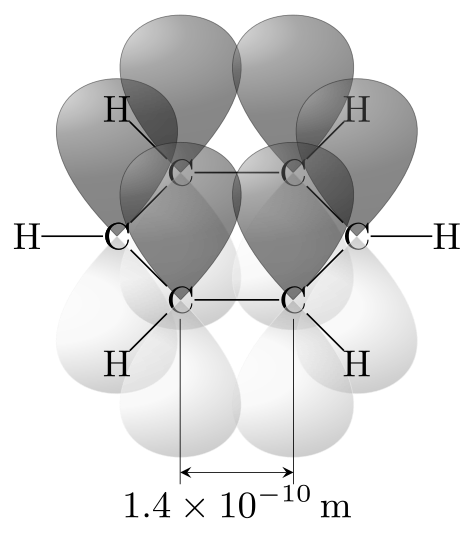
Further investigation of benzene’s structure reveals that the benzene molecule has a planar regular hexagonal structure. All bond angles are \(120^{\circ}\). The carbon–carbon bond lengths in the hexagonal ring are all \(1.40 \times 10^{-10}\ \text{m}\), different from both a typical single bond (C–C bond length \(1.54 \times 10^{-10}\ \text{m}\)) and a typical double bond (\(\ce{C=C}\) bond length \(1.33 \times 10^{-10}\ \text{m}\)).
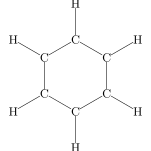
The fact that benzene does not react with potassium permanganate solution or bromine water, combined with the measured carbon–carbon bond lengths, fully demonstrates that the bonds between carbon atoms in the benzene ring are a unique type of bond intermediate between single bonds and double bonds. To represent this structural feature of the benzene molecule, the simplified structural formula of benzene is often written as a hexagon with a circle inside.
The Kekulé formula is still in use today, but when using it, one must never consider benzene as having a ring structure with alternating single and double bonds.
Among organic compounds, there is a large class called aromatic compounds.15 Compounds whose molecules contain one or more benzene rings belong to the aromatic compound family. Thus, the benzene ring is the parent structure of aromatic compounds. Benzene is the simplest and most fundamental aromatic hydrocarbon (arene).
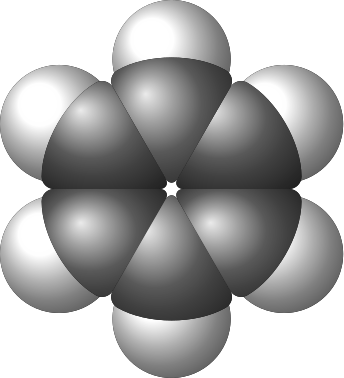
According to hybridized orbital theory, all six carbon atoms in the benzene molecule undergo \(sp^2\) hybridization. They overlap with each other to form six C–C \(\sigma\) bonds and each overlaps with one hydrogen atom’s \(1s\) orbital to form six C–H \(\sigma\) bonds. Because of \(sp^2\) hybridization, the bond angles are \(120^{\circ}\), and all 6 carbon atoms and 6 hydrogen atoms are connected in the same plane (Figure 2.16).
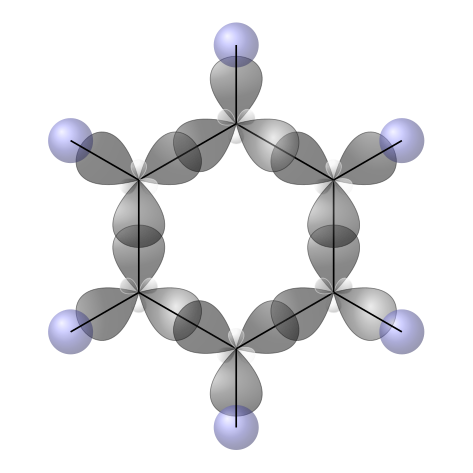
Each of the six carbon atoms on the benzene ring has one unhybridized \(2p\) orbital perpendicular to the ring plane. These overlap laterally to form a closed \(\pi\) bond (Figure 2.17), which is symmetrically distributed above and below the ring plane. This type of bonding is usually called a delocalized \(\pi\) bond (or a “large \(\pi\) bond”).
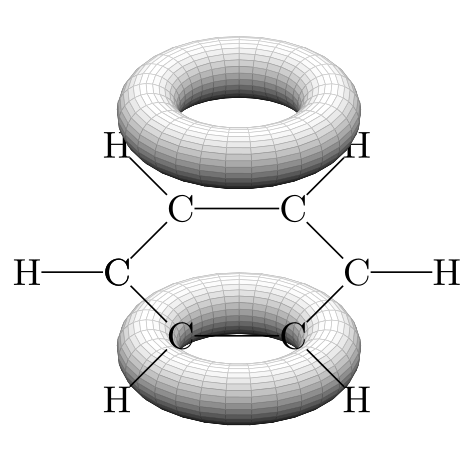
The formation of the delocalized \(\pi\) bond means that the \(\pi\) electrons are not shared by just two carbon atoms but are shared by all six carbon atoms. They are attracted by all six carbon nuclei simultaneously, making the bonds relatively strong. This is why benzene is more stable than typical unsaturated hydrocarbons — it does not readily undergo the addition reactions that typical unsaturated hydrocarbons easily undergo. Furthermore, because the delocalized \(\pi\) bond is evenly distributed among all six carbon atoms, all C–C bond lengths and bond energies in benzene are equal.
Chemical Properties and Uses of Benzene
1. Substitution Reactions
Hydrogen atoms in the benzene molecule can be replaced by other atoms or groups.
(1) Substitution reaction of benzene with halogens
Place benzene and a small amount of liquid bromine in a flask, along with a small amount of iron filings as catalyst.16 Seal the flask with a stopper fitted with a delivery tube (Figure 2.18). The vertical section of the delivery tube near the flask also serves as a condenser. At room temperature, white fumes (formed when \(\ce{HBr}\) encounters water vapor) quickly appear near the end of the delivery tube. After the reaction is complete, add \(\ce{AgNO3}\) solution to the liquid in the conical flask — a pale yellow silver bromide precipitate forms. Pour the liquid from the round-bottom flask into a beaker of cold water; a brown liquid insoluble in water settles to the bottom.
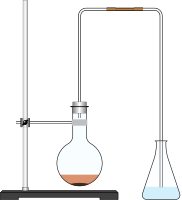
The water-insoluble liquid is bromobenzene, a colorless liquid heavier than water that appears brown because of dissolved bromine. The chemical equation for benzene reacting with bromine is:
\[\ce{C6H6 + Br2 ->[\ce{FeBr3}] C6H5Br + HBr}\]
With a catalyst, benzene can also undergo substitution reactions with other halogens.
(2) Nitration of benzene
In a large test tube, first add \(1.5\ \text{mL}\) of concentrated nitric acid and \(2\ \text{mL}\) of concentrated sulfuric acid. Shake well and cool to below \(50\)–\(60\,{}^{\circ}\text{C}\). Then slowly add \(1\ \text{mL}\) of benzene dropwise, shaking continuously to ensure thorough mixing. Place the test tube in a \(60\,{}^{\circ}\text{C}\) water bath for \(10\ \text{min}\). Pour the mixture into another test tube containing water. An oily substance clearly forms.
This oily liquid is nitrobenzene (\(\ce{C6H5NO2}\)). The chemical equation is:
\[\ce{C6H6 + HO-NO2 ->[\ce{H2SO4}][\Delta] C6H5NO2 + H2O}\]
The reaction in which a hydrogen atom of benzene is replaced by the \(\ce{-NO2}\) group is called a nitration reaction. The \(\ce{-NO2}\) group from the nitric acid molecule is called a nitro group.
Nitrobenzene is a colorless oily liquid (impure samples appear pale yellow). It has a bitter almond odor, is heavier than water, is toxic, and is an important raw material for manufacturing dyes.
(3) Sulfonation of benzene
When heated together to \(70\)–\(80\,{}^{\circ}\text{C}\), benzene reacts with concentrated sulfuric acid. In this reaction, a hydrogen atom of benzene is replaced by a sulfonic acid group (\(\ce{-SO3H}\)) from the sulfuric acid molecule, producing benzenesulfonic acid (\(\ce{C6H5-SO3H}\)). This type of reaction is called a sulfonation reaction.
\[\ce{C6H6 + HO-SO3H ->[\Delta] C6H5SO3H + H2O}\]
The nitration and sulfonation reactions of benzene are both substitution reactions.
2. Addition Reactions
Benzene does not exhibit the typical addition reaction behavior expected of double bonds. However, under special conditions, it can still undergo addition reactions. For example, in the presence of a nickel catalyst at \(180\)–\(250\,{}^{\circ}\text{C}\), benzene can add hydrogen to form a saturated cyclic hydrocarbon:
\[\ce{C6H6 + 3H2 ->[\text{Ni}][\Delta] C6H12}\]
The product is cyclohexane.
Under light, benzene undergoes addition with chlorine gas to form hexachlorocyclohexane (\(\ce{C6H6Cl6}\)), once a widely used pesticide known as BHC (benzene hexachloride). However, because its chemical properties are stable and it can accumulate in animals, plants, and the environment, contaminating both the environment and food, restrictions on its use have been imposed, and it is being replaced by more effective, less toxic, and less persistent new pesticides.
3. Combustion of Benzene in Air
Benzene can burn in air to produce carbon dioxide and water. It burns with a bright, smoky flame due to the high carbon content of the benzene molecule.
Benzene is a very important organic chemical feedstock, widely used to produce synthetic fibers, synthetic rubber, plastics, pesticides, pharmaceuticals, dyes, fragrances, and more. Benzene is also commonly used as an organic solvent.
In the past, benzene was extracted from coal tar obtained by coking coal, which limited its production. Since the rapid development of the petroleum industry, large quantities of benzene can be obtained from petroleum refining.
Compare the chemical properties of benzene with those of methane and ethylene. How do you understand the fact that benzene’s properties are both similar to and different from those of alkanes and alkenes?
Homologs of Benzene
Toluene (\(\ce{C7H8}\)), xylene (\(\ce{C8H10}\)), and other compounds whose molecules contain a benzene ring are all homologs of benzene. The general formula for benzene homologs is \(\ce{C_nH_{2n-6}}\) (\(n \geq 6\)). They are all aromatic hydrocarbons. Replacing one hydrogen atom in the benzene molecule with a methyl group (\(\ce{CH3}\)) produces toluene. Replacing two hydrogen atoms with two methyl groups produces xylene. Because the substitution positions differ, xylene has three isomers:
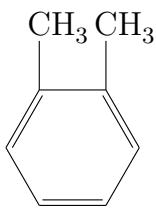
Chinese labels in figure: 邻-二甲苯 = ortho-Xylene (bp \(144.4\,{}^{\circ}\text{C}\)); 间-二甲苯 = meta-Xylene (bp \(139.1\,{}^{\circ}\text{C}\)); 对-二甲苯 = para-Xylene (bp \(138.4\,{}^{\circ}\text{C}\)).
Benzene homologs have many properties similar to benzene — for example, they all burn with a smoky flame and can undergo substitution reactions.
However, due to the mutual influence of the benzene ring and the side chain, benzene homologs also have some chemical properties that differ from benzene.
Add 3 drops of acidified potassium permanganate solution to each of two test tubes containing \(2\ \text{mL}\) of toluene and \(2\ \text{mL}\) of xylene respectively. Shake vigorously — the purple color fades in both cases.
This experiment shows that toluene and xylene can be oxidized by potassium permanganate, but what is oxidized is the side chain on the benzene ring — that is, the methyl group.
We have now studied chain hydrocarbons, cyclic hydrocarbons, and aromatic hydrocarbons. To distinguish them from the ring-forming cycloalkanes and aromatic hydrocarbons, chain hydrocarbons are also called aliphatic hydrocarbons. Aliphatic hydrocarbons are so named because they have a structure similar to that of fats and related substances.
Naphthalene and Anthracene
In addition to benzene and its homologs, coal tar also contains other aromatic hydrocarbons such as naphthalene and anthracene.
1. Naphthalene (\(\ce{C10H8}\))
Naphthalene is an important chemical feedstock. Its structure consists of two fused benzene rings sharing two adjacent carbon atoms.
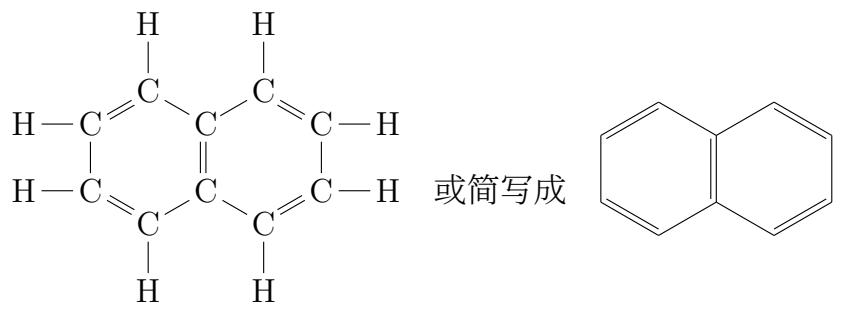
Chinese labels in figure: Shows the structural formula of naphthalene (萘).
Naphthalene is a colorless crystalline solid with a melting point of \(80.55\,{}^{\circ}\text{C}\) and a distinctive odor. It is insoluble in water and readily sublimes. Naphthalene can be used as a germicide, moth repellent, and insect repellent. Mothballs are primarily composed of naphthalene.
2. Anthracene (\(\ce{C14H10}\))
Anthracene is also an important chemical feedstock. Its structure consists of three linearly fused benzene rings.
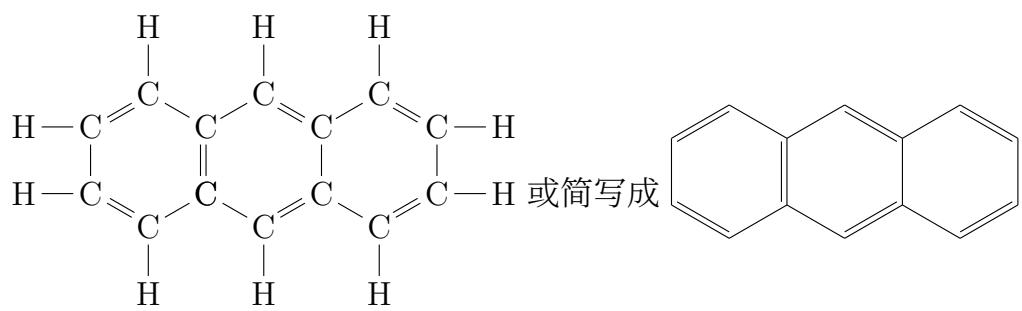
Chinese labels in figure: Shows the structural formula of anthracene (蒽).
Anthracene is a colorless crystalline solid with a melting point of \(216.2\,{}^{\circ}\text{C}\). It readily sublimes. Anthracene is an important raw material for dye production.
Both naphthalene and anthracene are aromatic hydrocarbons formed by two or more benzene rings sharing adjacent carbon atoms. Such aromatic hydrocarbons are specifically called polycyclic aromatic hydrocarbons (or fused-ring aromatic hydrocarbons).
- Benzene (\(\ce{C6H6}\)) has a planar regular hexagonal structure with equal C–C bond lengths (\(1.40 \times 10^{-10}\ \text{m}\))
- The bonds in the benzene ring are intermediate between single and double bonds (delocalized \(\pi\) bond)
- Benzene primarily undergoes substitution reactions: halogenation, nitration, sulfonation
- Benzene can also undergo addition reactions under forcing conditions (e.g., \(\ce{+ 3H2 -> C6H12}\))
- Benzene homologs have the general formula \(\ce{C_nH_{2n-6}}\); their side chains can be oxidized by \(\ce{KMnO4}\)
- Naphthalene (\(\ce{C10H8}\)) and anthracene (\(\ce{C14H10}\)) are polycyclic aromatic hydrocarbons
Exercises for Section 7
How can you experimentally distinguish benzene, hexane, and hexene?
A certain hydrocarbon has the chemical formula \(\ce{C8H10}\). It cannot decolorize bromine water but can decolorize acidified potassium permanganate solution. It can undergo addition with hydrogen to form ethylcyclohexane. Write the structural formula of this hydrocarbon.
Identify the class of hydrocarbon for each of the following compounds, and write their names and structural formulas:
- \(\ce{C6H5-C3H7}\), (2) \(\ce{C6H14}\), (3) \(\ce{C6H6}\), (4) \(\ce{C3H6}\), (5) \(\ce{C2H2}\), (6) \(\ce{CH3-CH2-CH=CH2}\), (7) \(\ce{C3H4}\), (8) \(\ce{C10H8}\).
2.8 Section 8: Petroleum and Petroleum Products
The natural sources of hydrocarbons are primarily petroleum and natural gas. The main component of natural gas is methane, which can constitute \(80\%\)–\(98\%\) (by volume). Some natural gases also contain ethane, propane, as well as \(\ce{CO2}\), \(\ce{N2}\), etc. The composition varies depending on the source. Natural gas is an excellent gaseous fuel.
Petroleum is an extremely important resource, vital to national economic development and national defense. Through petroleum refining, fuels such as gasoline, kerosene, and diesel can be obtained, along with lubricating oils for various machinery and many gaseous hydrocarbons (called refinery gas). The industry that uses petroleum products and petroleum gas (refinery gas, oilfield gas, natural gas) as feedstocks to produce chemical products is called the petrochemical industry. Using petroleum products as feedstocks, a wide variety of products can be manufactured through chemical processes — synthetic fibers, synthetic rubber, plastics, pesticides, chemical fertilizers, explosives, pharmaceuticals, dyes, paints, synthetic detergents, and more. Petroleum products have been widely applied in every sector of the national economy. This is why petroleum is called the “lifeblood of industry.”
Composition of Petroleum
Petroleum was formed from the remains of ancient animals and plants through extremely complex transformations over geological time. Petroleum is usually black or dark brown, often with green or blue fluorescence, has a distinctive odor, is insoluble in water, and is slightly lighter than water. It has no fixed melting point or boiling point.
The basic elements in petroleum are carbon and hydrogen, with a combined average content of \(97\%\)–\(98\%\) (sometimes up to \(99\%\)). Small amounts of sulfur, oxygen, and nitrogen are also present. The chemical composition of petroleum varies with its source. Petroleum is mainly a mixture of various alkanes, cycloalkanes, and aromatic hydrocarbons. Most of the petroleum consists of liquid hydrocarbons, with gaseous and solid hydrocarbons dissolved in the liquid.
Refining of Petroleum
Petroleum extracted from oil fields that has not undergone processing is called crude oil. Crude oil has a complex composition and still contains water and salts such as calcium chloride and magnesium chloride. High water content wastes fuel during refining; high salt content corrodes equipment. Therefore, crude oil must first undergo dewatering and desalting before it can be refined.
1. Fractional Distillation of Petroleum
After dewatering and desalting, petroleum is mainly a mixture of hydrocarbons and therefore has no fixed boiling point. Among hydrocarbon molecules, those with fewer carbon atoms generally have lower boiling points, while those with more carbon atoms have higher boiling points. Therefore, when petroleum is heated, the hydrocarbons with the lowest boiling points vaporize first and are separated by condensation. As the temperature rises, hydrocarbons with progressively higher boiling points vaporize and are similarly separated. This method is called fractional distillation (or fractionation) of petroleum. The products separated at different boiling point ranges are called fractions (each fraction is still a mixture of multiple hydrocarbons).
Set up the apparatus as shown in Figure 2.19. After carefully checking the apparatus for gas-tightness, pour \(100\ \text{mL}\) of crude oil into the distillation flask and add a few porcelain chips (to prevent bumping). Heat the flask and collect the fractions boiling at \(60\)–\(150\,{}^{\circ}\text{C}\) and \(150\)–\(300\,{}^{\circ}\text{C}\) separately. This yields gasoline and kerosene.
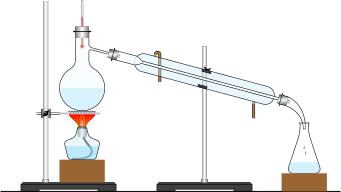
In oil refineries, the principle of fractional distillation is the same as in the above experiment, but the equipment is larger, more precise, and capable of continuous production. The main equipment used industrially includes: a heating furnace for heating the crude oil, and a fractionating tower that separates various products based on their different boiling points.
The main process of fractional distillation (Figure 2.20) involves pumping the treated crude oil into the heating furnace and heating it to about \(360\,{}^{\circ}\text{C}\), turning the crude oil into a mixture of liquid and vapor. This mixture enters the fractionating tower through a pipe. Inside the tower, different hydrocarbon fractions — heavy oil, diesel, kerosene, and others — are separated on different tray levels according to their boiling points (i.e., their volatility). The hydrocarbons with the lowest boiling points exit as vapor from the top of the tower and are then condensed to produce gasoline (including solvent naphtha).
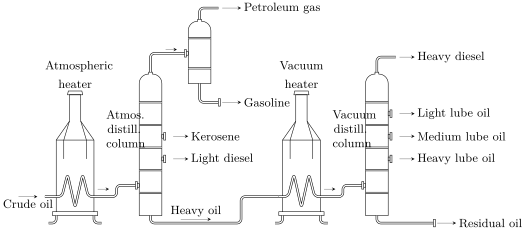
Heavy oil flowing from the bottom of the fractionating tower can be further separated. To separate components from heavy oil at atmospheric pressure would require even higher temperatures. However, at high temperatures, high-boiling hydrocarbons decompose, and more seriously, charring and coking can occur, damaging equipment and disrupting production. To resolve this contradiction, the petroleum refining industry commonly uses vacuum distillation. The principle is that reducing the external pressure lowers the boiling point. By reducing the pressure inside the fractionating tower, heavy oil boils at temperatures lower than it would under normal pressure. To distinguish it from normal distillation, the latter is called atmospheric distillation, while the two are commonly combined in what is called atmospheric-vacuum distillation.
In the vacuum fractionating tower, heavy diesel and various grades of lubricating oil fractions are separated from different levels based on their boiling ranges. The residue at the bottom is called residual oil.
Lubricating oil fractions require further processing — removal of petroleum jelly, paraffin wax, etc. — and refining before various grades of lubricating oil can be obtained. Residual oil can be processed to produce asphalt or coked to produce petroleum coke.
The products of petroleum fractional distillation and their uses are shown in Table 2.4.
| Fraction | Carbon atoms per molecule | Boiling range | Uses |
|---|---|---|---|
| Solvent naphtha | \(\ce{C5}\)–\(\ce{C6}\) | \(30\)–\(150\,{}^{\circ}\text{C}\) | Solvents in fats, rubber, and paint production |
| Gasoline | \(\ce{C5}\)–\(\ce{C11}\) | Below \(220\,{}^{\circ}\text{C}\) | Fuel for airplanes, automobiles, and various gasoline engines |
| Aviation kerosene | \(\ce{C10}\)–\(\ce{C15}\) | \(150\)–\(250\,{}^{\circ}\text{C}\) | Fuel for jet aircraft |
| Kerosene | \(\ce{C11}\)–\(\ce{C16}\) | \(180\)–\(310\,{}^{\circ}\text{C}\) | Tractor fuel, industrial cleaner |
| Diesel | \(\ce{C15}\)–\(\ce{C18}\) | \(200\)–\(360\,{}^{\circ}\text{C}\) | Fuel for heavy vehicles, warships, ships, tanks, tractors, diesel engines |
| Lubricating oils | \(\ce{C18}\)–\(\ce{C20}\) | Above \(360\,{}^{\circ}\text{C}\) | Lubricants for machinery, anti-rust |
| Petroleum jelly | Liquid + solid HC mixture | Above \(360\,{}^{\circ}\text{C}\) | Lubricant, anti-rust agent, pharmaceutical ointments |
| Paraffin wax | \(\ce{C20}\)–\(\ce{C30}\) | Above \(360\,{}^{\circ}\text{C}\) | Wax paper, insulating materials |
| Asphalt | \(\ce{C30}\)–\(\ce{C40}\) | Above \(360\,{}^{\circ}\text{C}\) | Road paving, building materials, anticorrosive coatings |
| Petroleum coke | Mainly C | Above \(360\,{}^{\circ}\text{C}\) | Electrodes, production of \(\ce{SiC}\), etc. |
Gasoline is an important fuel widely used in transportation and national defense. The quality of gasoline is very important for its use. So what standard is used to measure gasoline quality?
Gasoline obtained directly from fractional distillation (usually called straight-run gasoline) has strong knocking properties, producing loud noise, reducing engine efficiency, and wasting energy — making it unfavorable as a fuel. This creates a need to produce gasoline with less knocking.
Anti-knock performance is used as one standard for measuring gasoline quality. The octane rating (or octane number) is commonly used to quantify gasoline’s anti-knock performance. The higher the octane rating, the better the anti-knock performance. Why is it called “octane rating”?
There is a compound called isooctane (2,2,4-trimethylpentane, \(\ce{CH3CH(CH3)CH2C(CH3)3}\)), which has the weakest knocking tendency. Its anti-knock performance is defined as 100. Another compound, n-heptane (\(\ce{C7H16}\)), which has extremely strong knocking tendency, is defined as 0. By comparing a gasoline sample’s anti-knock performance with mixtures of these two hydrocarbons in various proportions, the octane rating of the gasoline can be determined.
For example, if a gasoline sample has anti-knock performance equal to that of a mixture containing \(66\%\) isooctane and \(34\%\) n-heptane, then the octane rating of that gasoline is 66.
To improve gasoline’s anti-knock performance, small amounts of anti-knock additives can also be added to the gasoline, thereby raising its octane rating.
2. Cracking
The light liquid fuels obtained from petroleum by fractional distillation — gasoline, kerosene, and diesel — account for only about \(25\%\) of the total petroleum. To increase the yield of light liquid fuels, especially gasoline, the petroleum industry uses cracking. Cracking is the process of breaking large, high-boiling-point hydrocarbon molecules into smaller, lower-boiling-point hydrocarbons under certain conditions. There are two types: thermal cracking and catalytic cracking.
Heavy oil, paraffin wax, and other large hydrocarbon molecules can be cracked at about \(500\,{}^{\circ}\text{C}\) under a certain pressure, transforming them into hydrocarbons with smaller molecular masses. For example:17
\[\ce{C16H34 ->[\Delta] C8H18 + C8H16}\]
This produces a liquid mixture of relatively small, low-boiling saturated and unsaturated hydrocarbons similar to gasoline.
Some cracking products may further decompose into gaseous saturated and unsaturated hydrocarbons:
\[\ce{C8H18 ->[\Delta] C4H10 + C4H8}\]
\[\ce{C4H10 ->[\Delta] CH4 + C3H6}\]
\[\ce{C4H10 ->[\Delta] C2H6 + C2H4}\]
In practice, the quality of gasoline from thermal cracking is still not high enough, and at excessively high temperatures, coking can occur, damaging equipment and disrupting production. To overcome these drawbacks, catalysts are used. Cracking carried out under catalytic conditions is called catalytic cracking, which produces higher-quality gasoline. Therefore, thermal cracking has been largely replaced by catalytic cracking.
Set up the apparatus as shown in Figure 2.21. Place \(4\ \text{g}\) of paraffin wax (candle wax may be substituted) and \(3\ \text{g}\) of powdered alumina (\(\ce{Al2O3}\), or anhydrous aluminum chloride) in test tube I. Heat the test tube. After the paraffin melts, observe the progress of the reaction. Continue heating for \(5\)–\(10\ \text{min}\), then observe the color change of the acidified potassium permanganate solution (or bromine water) in test tube III. A small amount of liquid will condense in test tube II. Smell whether this liquid has the odor of gasoline. Then add small amounts of this liquid separately to test tubes containing acidified potassium permanganate solution and bromine water. Observe whether the colors change.
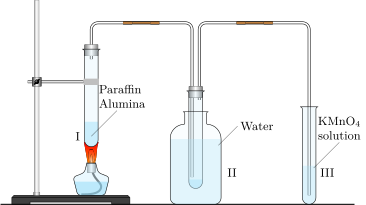
The above experiment helps us understand catalytic cracking and its products. Industrially, commonly used catalysts include synthetic silica-alumina and molecular sieves (primarily aluminosilicates). The catalytic cracking process is very complex, and when larger hydrocarbon molecules are broken down, alkenes are produced among the products.
3. Catalytic Reforming of Petroleum
Benzene, toluene, and other aromatic hydrocarbons were formerly produced entirely from coal tar (a product of coal distillation). Now they are produced industrially in large quantities through catalytic reforming of petroleum products.
“Reforming” means “rearranging” the molecular structures of straight-chain hydrocarbons in gasoline, converting them to aromatic hydrocarbons or branched alkane isomers (isoparaffins). Reforming is carried out by heating in the presence of a catalyst. The catalysts widely used in industry include platinum (Pt), rhenium (Re), or both platinum and rhenium together. Depending on the catalyst used, the process is called platinum reforming, rhenium reforming, or platinum-rhenium reforming.
Straight-run gasoline, after reforming, can not only yield aromatic hydrocarbons but also effectively improve gasoline quality.
Petrochemical Industry
In the petrochemical production process, petroleum fractionation products (including petroleum gas) containing straight-chain alkanes are used as feedstocks. Using temperatures higher than those in cracking (\(700\)–\(800\,{}^{\circ}\text{C}\), sometimes even \(1000\,{}^{\circ}\text{C}\) or higher), long-chain hydrocarbons are broken into various short-chain gaseous hydrocarbons and small amounts of liquid hydrocarbons to provide organic chemical feedstocks. In industry, this method is called steam cracking (or pyrolysis) of petroleum. Thus, steam cracking is essentially deep cracking, aimed at obtaining short-chain unsaturated hydrocarbons as the primary products. The chemical process of steam cracking is quite complex. The resulting cracking gas is a complex mixture containing mainly unsaturated hydrocarbons such as ethylene, propylene, and butadiene, along with methane, ethane, hydrogen, hydrogen sulfide, and others. The alkene content in the cracking gas is relatively high. Therefore, ethylene production is commonly used as a benchmark for measuring the level of petrochemical development. After rapid cooling and separation, the desired basic organic feedstocks can be obtained. These feedstocks are widely used in the synthetic fiber, plastics, and rubber industries.
China was one of the earliest countries in the world to discover and utilize petroleum and natural gas. According to historical records, 1,800 years ago, China’s industrious and wise working people discovered natural gas and petroleum. In the long course of production, they accumulated rich experience in extracting and utilizing petroleum and natural gas.
In the process of vigorously developing the petroleum industry, close attention must also be paid to pollution of the atmosphere, land, and rivers, lakes, and seas from “waste water,” “waste gas,” and “waste residue” produced by petroleum refining and petrochemical industries, as well as from offshore oil extraction and oil tanker transportation. Automobiles, tractors, and other vehicles using petroleum fuels also emit polluting exhaust gases. Protecting the environment and preventing pollution are of great importance for safeguarding public health and improving people’s lives.
- Petroleum is a complex mixture of alkanes, cycloalkanes, and aromatic hydrocarbons
- Fractional distillation separates petroleum into fractions by boiling point range (gasoline, kerosene, diesel, heavy oil, etc.)
- Catalytic cracking breaks large hydrocarbon molecules into smaller ones, increasing gasoline yield
- Catalytic reforming converts straight-chain alkanes to aromatic hydrocarbons or branched alkane isomers
- Steam cracking (pyrolysis) produces short-chain unsaturated hydrocarbons (ethylene, propylene, butadiene) — the basic feedstocks of petrochemistry
- Octane rating measures gasoline’s anti-knock performance
Exercises for Section 8
What elements compose petroleum? What are the main components of petroleum?
How can you determine that petroleum is a mixture rather than a pure substance?
Briefly explain what is meant by:
- fractional distillation, (2) catalytic cracking, (3) catalytic reforming.
How do steam cracking and cracking differ?
Why can common gasoline decolorize bromine water or acidified potassium permanganate solution?
2.9 Section 9: Coal and Its Comprehensive Utilization
Coal is an important source of aromatic hydrocarbons in industry. Coal can be classified into anthracite, bituminous coal, lignite, and others, with carbon contents of approximately: anthracite \(\sim 95\%\), bituminous coal \(70\%\)–\(80\%\), lignite \(50\%\)–\(70\%\), and peat \(50\%\)–\(60\%\). Besides primarily containing carbon, coal also contains small amounts of sulfur, phosphorus, hydrogen, nitrogen, and oxygen, as well as inorganic minerals (primarily containing silicon, aluminum, calcium, and iron). Coal is a complex mixture composed of organic and inorganic substances.
Place bituminous coal powder in an iron tube (or porcelain tube) and heat strongly in the absence of air (Figure 2.22). After a while, gaseous substances will be released. When these gases pass through a cooling system, water and a dark brown viscous oily substance — coal tar — condense in the U-tube. Gas that continues to escape through the U-tube can be collected by water displacement.
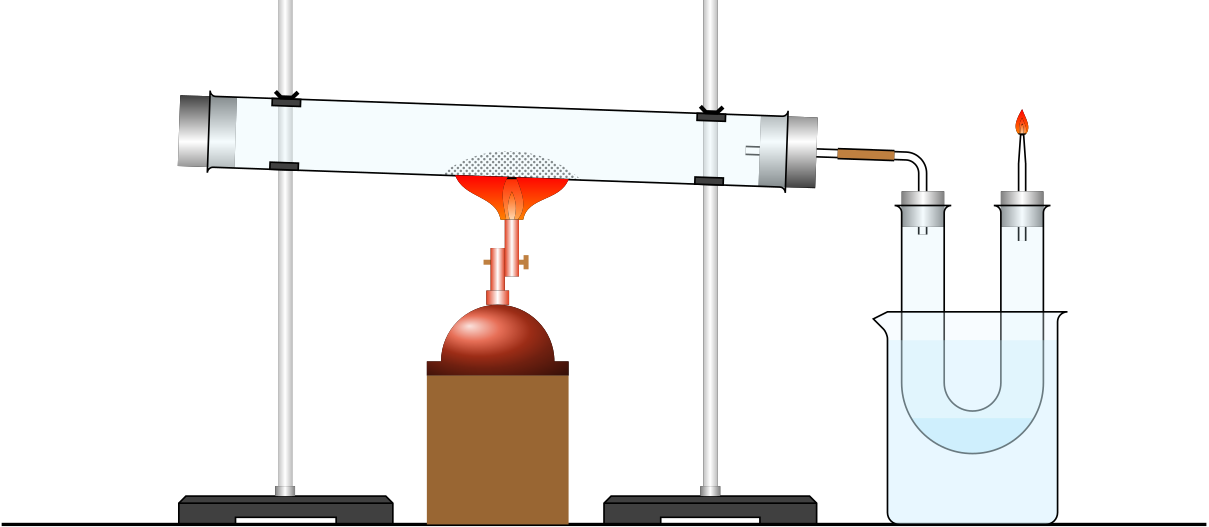
The coal tar produced contains many aromatic compounds. The water that condenses contains dissolved ammonia, which can be detected with an indicator. In production, this water is called crude ammonia water. The collected gas burns easily and is called coke oven gas (or coal gas). After the reaction is complete, the gray-black solid remaining in the iron tube is coke.
The process of heating coal strongly in the absence of air to cause its decomposition is called destructive distillation (or dry distillation) of coal.
Through destructive distillation, coal can produce coke, coal tar, crude ammonia water, and coke oven gas.
Industrial coking follows the same principle as the above experiment. In coking ovens, coal powder is heated to above \(1000\,{}^{\circ}\text{C}\) in the absence of air, causing complex chemical changes — this is called high-temperature destructive distillation. The main product is coke for the metallurgical industry, along with coke oven gas, crude ammonia water, and coal tar.
The main components of coke oven gas are hydrogen and methane, with small amounts of carbon monoxide, carbon dioxide, ethylene, nitrogen, and other gases.
Coal tar from high-temperature distillation is a complex mixture containing many aromatic compounds (hundreds of different substances). Coal tar can be separated by fractional distillation. Fractions distilling below \(170\,{}^{\circ}\text{C}\) mainly contain benzene, toluene, xylene, and other benzene homologs. Fractions from \(170\)–\(230\,{}^{\circ}\text{C}\) mainly contain phenols and naphthalene. Heating above \(230\,{}^{\circ}\text{C}\) yields many more complex aromatic compounds. The thick black residue remaining after distillation of coal tar is pitch (coal tar pitch).
The main coking products and their uses can be summarized as follows:
- Coke oven gas — hydrogen, methane, ethylene, carbon monoxide → gaseous fuel, chemical feedstock
- Crude ammonia water — ammonia and ammonium salts → nitrogen fertilizers
- Crude benzene — benzene, toluene, xylene → explosives, dyes, pharmaceuticals, pesticides, synthetic materials
- Coal tar — benzene, toluene, xylene, phenols, naphthalene → dyes, pesticides, pharmaceuticals, synthetic materials; pitch → road paving, electrodes
- Coke — metallurgy, calcium carbide production, ammonia synthesis feedstock gas, fuel
The wide variety of products that can be obtained from coking demonstrates the extremely broad range of uses for coal.
The coal tar from high-temperature distillation accounts for approximately \(3\%\) of the raw coal. To obtain more coal tar, the distillation temperature can be lowered to \(500\)–\(600\,{}^{\circ}\text{C}\) — this is called low-temperature destructive distillation. Coal tar from low-temperature distillation can amount to \(10\%\) of the raw coal. The coal tar from low-temperature distillation mainly contains alkanes, alkenes, and larger amounts of cycloalkanes. Further refining can yield gasoline, kerosene, diesel, and other products. Low-temperature destructive distillation is more suitable for lignite.
Coal occupies a very important position in the national economy. Besides serving as fuel and an important raw material for the metallurgical industry, coal can be processed by various methods to better utilize this resource — converting it into gaseous and liquid fuels, and into feedstocks for producing chemical fertilizers, plastics, synthetic rubber, synthetic fibers, explosives, dyes, pharmaceuticals, and many other important chemical products. The comprehensive utilization of coal is therefore of great significance.
In processing coal and using it as fuel, the coal ash, slag, waste gas, and waste liquid produced must all be properly treated and utilized. Pollution must be eliminated and the environment protected — this is a very important issue in the development of the coal industry.
- Coal is a complex mixture of organic and inorganic substances; types include anthracite (\(\sim 95\%\) C), bituminous (\(70\)–\(80\%\) C), lignite (\(50\)–\(70\%\) C), and peat (\(50\)–\(60\%\) C)
- Destructive distillation (carbonization) heats coal in the absence of air, producing coke, coal tar, crude ammonia water, and coke-oven gas
- High-temperature carbonization (\(>1000\,{}^{\circ}\text{C}\)): primarily produces metallurgical coke
- Low-temperature carbonization (\(500\)–\(600\,{}^{\circ}\text{C}\)): produces more coal tar (\(\sim 10\%\) vs. \(\sim 3\%\)), which can be refined into liquid fuels
- Coal tar is separated by fractional distillation into benzene, toluene, xylenes, phenols, naphthalene, and pitch
- Destructive distillation (chemical decomposition) differs fundamentally from petroleum fractionation (physical separation)
Exercises for Section 9
What is destructive distillation of coal? What are the main products obtained through coal distillation? What are the uses of these products? How does the destructive distillation of coal differ fundamentally from the fractional distillation of petroleum?
Briefly describe the composition and uses of the following gases:
- natural gas, (2) coke oven gas, (3) cracking gas (pyrolysis gas).
Why is coal an important industrial source of aromatic hydrocarbons? What is the other important source for obtaining aromatic hydrocarbons industrially today? How are the aromatic hydrocarbons obtained?
2.10 Chapter Summary
I. Organic Compounds
Organic compounds are compounds containing the element carbon, abbreviated as organic substances. The chemistry that studies organic substances is called organic chemistry.
Organic compounds are extremely numerous, reaching several million species. Most organic substances are poorly soluble in water but readily soluble in organic solvents, are nonelectrolytes, conduct electricity poorly, and have low melting points. The chemical reaction rates of organic substances are generally slow, and reactions are often accompanied by side reactions.
II. Hydrocarbons Are the Parent Substances of Organic Compounds
Alkanes are saturated chain hydrocarbons; the representative compound is methane. Alkanes are generally quite stable, but under specific conditions they can undergo substitution reactions, oxidation, and thermal decomposition.
Alkenes are chain hydrocarbons containing a \(\ce{C=C}\) double bond; the representative compound is ethylene. Alkenes are unsaturated hydrocarbons that readily undergo addition reactions, oxidation reactions, and polymerization.
Alkynes are chain hydrocarbons containing a \(\ce{C#C}\) triple bond; the representative compound is acetylene. Acetylene releases a large amount of heat upon combustion and is used in the oxyacetylene flame. As an unsaturated hydrocarbon, it can undergo addition reactions, oxidation reactions, etc.
Aromatic hydrocarbons are hydrocarbons whose molecules contain one or more benzene rings. Benzene is the “parent” of aromatic organic compounds. Benzene’s chemical properties are relatively stable, but under specific conditions it can undergo substitution, addition, and combustion reactions.
III. Petroleum
Petroleum is mainly a mixture of various alkanes, cycloalkanes, and aromatic hydrocarbons.
Petroleum refining:
- Atmospheric and vacuum distillation — separates a series of products based on differences in boiling points.
- Cracking — breaks longer carbon chains into shorter ones.
- Catalytic reforming — converts straight-chain hydrocarbons into aromatic hydrocarbons or branched alkane isomers. Both catalytic cracking and catalytic reforming can improve gasoline quality.
Petrochemical industry — uses petroleum products as feedstocks, processes them through steam cracking (pyrolysis) to obtain basic organic feedstocks, and then produces large quantities of diverse chemical products.
IV. Destructive Distillation of Coal
The main products are coke, coal tar, coke oven gas, and crude ammonia water. Coal tar is one of the important raw materials for producing aromatic compounds.
Review Problems
For each of the following pairs of organic compounds, identify the class of hydrocarbon to which each belongs, state the relationship between the two, and give their names.
\(\ce{CH3CH2CH=CH2}\) and \(\ce{CH3CH=CHCH3}\) — these belong to ______ hydrocarbons, and are ______. Their names are ______ and ______.
\(\ce{C6H6}\) and \(\ce{C6H4(CH3)2}\) — these belong to ______ hydrocarbons, and are ______. Their names are ______ and ______.
\(\ce{CH3CH(CH3)CH2CH3}\) and \(\ce{CH3CH2CH(CH3)CH2CH3}\) — these belong to ______ hydrocarbons, and are ______. Their names are ______ and ______.
\(\ce{C5H10}\) and \(\ce{C6H12}\) — both do not react with bromine water. They belong to ______ hydrocarbons, and are ______. Their names are ______ and ______.
Compare the reaction of ethylene with bromine and the reaction of benzene with bromine. What are the differences in the following respects?
Reactant Reagent conditions Catalyst Temperature Reaction type Products Ethylene Benzene The natural gas produced in a certain area contains \(90\%\) methane, \(5\%\) ethane, \(3\%\) carbon dioxide, and \(2\%\) nitrogen (by volume). At STP, how many liters of air are needed to burn \(1\ \text{m}^3\) of this gas? Given the heats of combustion (methane \(212.8\ \text{kCal/mol}\), ethane \(372.8\ \text{kCal/mol}\)), calculate the heat released by burning \(1\ \text{m}^3\) of this natural gas.
You have three bottles of gas: hydrogen, ethane, and ethylene. What methods can you use to distinguish them?
You have three bottles of liquid: benzene, 1-hexene, and toluene. What methods can you use to distinguish them?
The chemical formula of benzene is \(\ce{C6H6}\). Based on what properties can you deduce that the following formula cannot represent benzene?
\[\ce{CH2=CH-C#C-CH=CH2}\]
Write the chemical equations for the 1,4-addition and 1,2-addition reactions of 1,3-butadiene with hydrogen gas in the presence of a catalyst. What are the names of the products? Are they structural isomers?
After complete combustion of a certain hydrocarbon in air, approximately \(134.4\ \text{L}\) (at STP) of \(\ce{CO2}\) and \(90\ \text{g}\) of water are produced. One mole of this hydrocarbon can undergo addition with one mole of hydrogen gas to form a saturated hydrocarbon. This hydrocarbon is ( ).
A. \(\ce{CH3(CH2)3C#CH}\)
B. \(\ce{H2C=CH(CH2)2CH=CH2}\)
C. Cyclohexene
D. \(\ce{CH3(CH2)2CH=CH2}\)
E. Methylcyclopentane
Given the heats of combustion (propane \(530.6\ \text{kCal/mol}\), butane \(688\ \text{kCal/mol}\)), compare the alkane homologous series methane, ethane, propane, and butane. Approximately how much does the heat of combustion increase for each additional \(\ce{CH2}\) group?
The Chinese term 无机物 literally means “non-organic substance.”↩︎
Translator’s note: The Chinese character 烃 (tīng) is a portmanteau combining the radicals for carbon (碳) and hydrogen (氢). In English, these compounds are called “hydrocarbons” — from “hydrogen” and “carbon.”↩︎
Translator’s note: \(98.8\ \text{kCal/mol} \approx 413\ \text{kJ/mol}\) in modern SI units.↩︎
Translator’s note: In this equation, \(\ce{CH3COONa}\) is written beneath with its Chinese name 醋酸钠 (sodium acetate). In organic chemistry, structural formulas or condensed formulas are often used instead of molecular formulas to show the arrangement of atoms.↩︎
Soda lime may be replaced by a suitable mixture of calcium hydroxide and calcium oxide.↩︎
A mixture of methane and air containing \(5\%\)–\(15\%\) methane by volume is explosive.↩︎
Translator’s note: The Chinese naming system uses the characters 甲(1), 乙(2), 丙(3), 丁(4), 戊(5), 己(6), 庚(7), 辛(8), 壬(9), 癸(10) for alkanes with 1–10 carbons. In English, Greek/Latin prefixes are used: meth-, eth-, prop-, but-, pent-, hex-, hept-, oct-, non-, dec-.↩︎
Translator’s note: The Chinese characters 烯 (xī, alkene) and 炔 (quē, alkyne) are derived from 烃 (tīng, hydrocarbon) with radicals suggesting “rare” and “missing” hydrogen atoms, respectively.↩︎
Translator’s note: \(147\ \text{kCal/mol} \approx 615\ \text{kJ/mol}\).↩︎
Translator’s note: \(83.1\ \text{kCal/mol} \approx 348\ \text{kJ/mol}\).↩︎
Translator’s note: The Chinese character 炔 (quē, alkyne) is a portmanteau combining the radical for 火 (fire/hydrocarbon) with 缺 (lacking), indicating that alkynes are deficient in hydrogen compared to alkanes.↩︎
Translator’s note: \(194\ \text{kCal/mol} \approx 812\ \text{kJ/mol}\).↩︎
The reaction between calcium carbide and water is quite vigorous. To obtain a steady stream of acetylene, saturated sodium chloride solution can be used instead of water. Sodium chloride does not react with calcium carbide.↩︎
Therefore, safety precautions must be taken during the production and use of acetylene.↩︎
Translator’s note: The term “aromatic” originally referred to the pleasant odors of many of these compounds, but it now refers specifically to compounds containing a benzene ring or having similar electronic structure (aromaticity).↩︎
The actual catalyst is \(\ce{FeBr3}\), which forms when iron reacts with bromine.↩︎
These equations are simplified representations. Actual cracking reactions are much more complex.↩︎