Laboratory Experiments
Experiment 1: Preparation and Properties of Ammonia; Testing for Ammonium Ion
Objective
- Learn the laboratory method for preparing ammonia.
- Understand the physical and chemical properties of ammonia.
- Learn the methods for testing for ammonia and ammonium ion.
Materials
Test tubes, iron stand, alcohol lamp, glass rod, spatula, glass plate, mortar, stopper with delivery tube, rubber-bulb dropper, water trough, cotton.
Ammonium chloride, ammonium sulfate, ammonium nitrate, calcium hydroxide, sodium hydroxide solution, concentrated hydrochloric acid, concentrated sulfuric acid, concentrated nitric acid, moist red litmus paper, phenolphthalein indicator solution.
Procedure
1. Preparation of ammonia
Take one spatula-full each of ammonium chloride and calcium hydroxide and place them in a mortar. Thoroughly mix them with a glass rod. What odor is produced? What reaction has occurred? Write the chemical equation.
Transfer the mixture into a test tube. Stopper the test tube with a delivery tube assembly and clamp it to the iron stand. Insert the other end of the delivery tube upward into another dry, inverted test tube (see Figure 1).
Heat the test tube with a small flame — ammonia gas is produced.
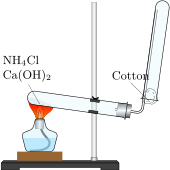
2. Properties of ammonia
Place a strip of moist red litmus paper at the mouth of the collection test tube. When the red litmus paper turns blue, the test tube is full of ammonia — stop heating at this point. Carefully remove the inverted test tube and cover the mouth with your thumb. Observe the color, odor, and state of ammonia.
While keeping the ammonia-filled test tube inverted and covered with your thumb, plunge it mouth-down into the water in the water trough (Figure 2). Release your thumb. What phenomenon do you observe? Why?
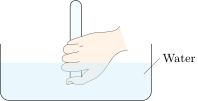
Figure 2: Dissolution of ammonia in water After water enters the test tube, cover the mouth of the test tube with your thumb under water, remove the test tube from the water, turn it mouth-up, and shake it. Add a few drops of phenolphthalein indicator to the solution. What phenomenon do you observe?
Set up the ammonia preparation apparatus from step 1 as shown in Figure 3. Dip a glass rod into concentrated sulfuric acid, concentrated nitric acid, and concentrated hydrochloric acid in turn, placing one drop of each at different spots on a glass plate (rinse the glass rod with water after each acid before taking the next one). Then heat the ammonium chloride–calcium hydroxide mixture. When ammonia is released, move the glass plate so that the delivery tube outlet faces each of the three acid drops in turn. What phenomena occur?
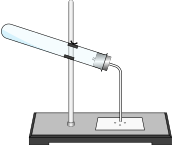
Why does white smoke appear over some of the acid drops? What are the three white substances formed on the glass plate? Write the chemical equations for all three reactions.
3. Testing for ammonium ion
Take small amounts of ammonium chloride, ammonium nitrate, and ammonium sulfate crystals and place them in three separate test tubes. Using a rubber-bulb dropper, add a small amount of sodium hydroxide solution to each test tube. Heat the test tubes, then hold a strip of moist red litmus paper at the mouth of each test tube. Observe any color change of the litmus paper. Write the chemical equations. What conclusion can you draw from this experiment?
Discussion
What precautions should be taken when preparing and collecting ammonia?
Experiment 2: Properties of Nitric Acid and Nitrates
Objective
To understand the characteristic properties of nitric acid and nitrates.
Materials
Test tubes, alcohol lamp, test tube holder, rubber-bulb dropper, flask, iron stand, delivery tube, water trough, wooden splint, rubber stopper.
Concentrated nitric acid, dilute nitric acid (\(1:2\)), concentrated sulfuric acid, copper(II) nitrate, sodium nitrate, ammonium nitrate, copper pieces, litmus indicator solution, blue litmus paper.
Procedure
1. Properties of nitric acid
Effect of concentrated and dilute nitric acid on litmus. Pour \(1\)–\(2\ \text{mL}\) of concentrated nitric acid and dilute nitric acid into two separate test tubes. Add a few drops of litmus indicator solution to each. Heat gently and observe: the litmus turns red in dilute nitric acid but is decolorized in concentrated nitric acid. Why?
Reaction of concentrated nitric acid with copper. Place a piece of copper in a test tube and add a few drops of concentrated nitric acid. Observe the color of the gas released.
Add \(5\ \text{mL}\) of water to this test tube and observe the color of the solution.
What substances do these phenomena indicate have been produced? Write the chemical equation for the reaction of concentrated nitric acid with copper.
Reaction of dilute nitric acid with copper. Assemble the apparatus as shown in Figure 4 and check it for gas-tightness.
Place \(3\)–\(4\) pieces of copper in the flask. Pour in dilute nitric acid until the copper is just submerged. Heat the flask and collect one test tube of nitric oxide by water displacement.
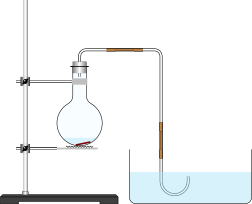
Figure 4: Apparatus for the generation of NO Carefully observe the color of nitric oxide.
Cover the mouth of the test tube with your thumb under water, remove the test tube from the water, and turn it mouth-up. Release your thumb and observe how the color of the gas changes. After the gas has completely changed color, add \(2\ \text{mL}\) of water to the test tube and stopper it. Shake to dissolve the gas in the water. Using a glass rod, transfer a drop of the solution to blue litmus paper and observe any change. Write the chemical equation for the reaction of copper with dilute nitric acid.
2. Properties of nitrates
Place a small amount of pre-dried copper(II) nitrate powder in a dry test tube. Heat and observe the changes that occur and the color of the gas released. Insert a glowing wooden splint into the test tube — what happens? Write the chemical equation for the reaction.
Place small amounts of solid sodium nitrate, copper(II) nitrate, and ammonium nitrate into three separate test tubes. Add a small amount of concentrated sulfuric acid to each, then add a small piece of copper to each test tube. Heat and observe the phenomena. Write the relevant chemical equations.
Discussion
How do the phenomena of the reaction of nitric acid with metals differ from those of hydrochloric acid with metals? What is the essential difference?
Experiment 3: Chemical Reaction Rate; Chemical Equilibrium
Objective
- Consolidate knowledge of the effects of concentration, temperature, and catalysts on reaction rate.
- Consolidate knowledge of the effects of concentration and temperature on chemical equilibrium.
Materials
Test tubes, beaker, rubber-bulb dropper, rubber stopper, timer (or stopwatch), alcohol lamp, thermometer, iron stand, spatula, wooden splint.
\(3\%\) sodium thiosulfate (\(\ce{Na2S2O3}\)) solution, sulfuric acid (\(1:5\)), \(3\%\) hydrogen peroxide (\(\ce{H2O2}\)) solution, iron(III) chloride (\(\ce{FeCl3}\)) solution, ammonium thiocyanate (\(\ce{NH4SCN}\)) solution, two large test tubes filled with nitrogen dioxide1, manganese dioxide (\(\ce{MnO2}\)).
Procedure
1. Effect of concentration, temperature, and catalysts on chemical reaction rate
(1) Effect of concentration on reaction rate
Take three test tubes, label them 1, 2, and 3, and add the quantities of sodium thiosulfate solution and distilled water specified in the table below. After shaking well, place each test tube in front of a sheet of paper with writing on it — the writing should be clearly visible through the solution. Then add the sulfuric acid. Starting from the moment the first drop of sulfuric acid is added, record the time until the turbidity that appears in the solution makes the writing behind the test tube no longer visible. Enter the recorded times in the table.
| No. | \(3\%\) \(\ce{Na2S2O3}\) (mL) | \(\ce{H2O}\) (mL) | \(\ce{H2SO4}\) (\(1:5\)) (drops) | Time for turbidity to appear (s) |
|---|---|---|---|---|
| 1 | 5 | 5 | 10 | |
| 2 | 7 | 3 | 10 | |
| 3 | 10 | 0 | 10 |
(2) Effect of temperature on reaction rate
Take three test tubes and add \(5\ \text{mL}\) of sodium thiosulfate solution to each. At room temperature, add 5 drops of sulfuric acid to one test tube and record the time for turbidity to appear. Place the other two test tubes in a water bath and heat them to temperatures \(10\,{}^{\circ}\text{C}\) and \(20\,{}^{\circ}\text{C}\) above room temperature, respectively. Then add 5 drops of sulfuric acid to each and record the time for turbidity to appear using the same method as in step 1(1).
| No. | \(3\%\) \(\ce{Na2S2O3}\) (mL) | \(\ce{H2SO4}\) (\(1:5\)) (drops) | Temperature (\({}^{\circ}\text{C}\)) | Time (s) |
|---|---|---|---|---|
| 1 | 5 | 5 | Room temp. | |
| 2 | 5 | 5 | Room temp. \(+ 10\) | |
| 3 | 5 | 5 | Room temp. \(+ 20\) |
(3) Effect of catalyst on reaction rate
Add about \(2\ \text{mL}\) of \(3\%\) \(\ce{H2O2}\) solution to a test tube. Observe whether any bubbles form. Then add a small amount of manganese dioxide (\(\ce{MnO2}\)) powder. Observe again whether bubbles form, and test the gas produced with a glowing wooden splint.
2. Effect of concentration and temperature on chemical equilibrium
(1) Effect of concentration on chemical equilibrium
In a small beaker, add \(10\ \text{mL}\) each of iron(III) chloride solution and ammonium thiocyanate solution. After mixing, a red solution is obtained. Divide this solution equally among three test tubes.
To the first test tube, add iron(III) chloride solution. To the second test tube, add ammonium thiocyanate solution. Compare the color of each of these two test tubes with the third (untreated) test tube.
Based on the color changes, explain the effect of concentration on chemical equilibrium.
(2) Effect of temperature on chemical equilibrium
Take two large stoppered test tubes containing an equilibrium mixture of \(\ce{NO2}\) and \(\ce{N2O4}\) gases:
\[\ce{2NO2 <=> N2O4} + 13.6\ \text{kcal}\]
(\(\ce{NO2}\): reddish-brown; \(\ce{N2O4}\): colorless)
Immerse one test tube in a beaker of hot water and the other in a beaker of cold water. Compare the colors of the gases in the two test tubes and explain the effect of temperature on chemical equilibrium.
Discussion
Summarize the conditions that affect chemical reaction rate and chemical equilibrium.
Experiment 4: Laboratory Exercise
Objective
To consolidate previously learned knowledge and develop experimental skills.
Problems
Devise experimental methods to distinguish:
Concentrated nitric acid and dilute nitric acid.
Concentrated sulfuric acid and dilute sulfuric acid.
Hydrochloric acid and nitric acid.
Four white powders are ammonium sulfate, sodium nitrate, ammonium chloride, and sodium chloride. Devise experiments to identify each one.
How would you demonstrate through simple experiments what the decomposition products of ammonium bicarbonate (\(\ce{NH4HCO3}\)) upon heating are?
What simple method can be used to remove a small amount of ammonium chloride mixed in with sodium chloride crystals? How would you verify that it has been completely removed?
Using only one reagent, identify the following solutions:
\[\ce{Na2CO3},\quad \ce{AgNO3},\quad \ce{NH4Cl}\]
Using solutions of \(0.02\ \text{mol/L}\) \(\ce{Ca(OH)2}\) and \(0.02\ \text{mol/L}\) \(\ce{H3PO4}\), prepare \(\ce{Ca3(PO4)2}\), \(\ce{CaHPO4}\), and \(\ce{Ca(H2PO4)2}\) in sequence. If the volume of \(\ce{Ca(OH)2}\) used is \(1.5\ \text{mL}\), calculate the volume of \(\ce{H3PO4}\) needed. Based on your calculations, starting with a test tube containing \(1.5\ \text{mL}\) of \(\ce{Ca(OH)2}\) solution, first add a calculated amount of \(\ce{H3PO4}\) and observe the \(\ce{Ca3(PO4)2}\) precipitate formed. Then add more \(\ce{H3PO4}\) to produce \(\ce{CaHPO4}\), and continue adding \(\ce{H3PO4}\) to obtain a \(\ce{Ca(H2PO4)2}\) solution. Observe the experimental phenomena.
Experiment 5: Properties of Colloids
Objective
To understand the methods for preparing colloids and their properties.
Materials
Beaker, iron stand, asbestos gauze, test tubes, test tube holder, alcohol lamp, rubber-bulb dropper, graduated cylinder, thick cardboard tube, focusing flashlight.
Saturated iron(III) chloride (\(\ce{FeCl3}\)) solution, \(1\ \text{mol/L}\) hydrochloric acid, water glass (sodium silicate solution), sodium chloride (\(\ce{NaCl}\)) solution, magnesium sulfate (\(\ce{MgSO4}\)) solution.
Procedure
1. Preparation of colloids
Preparation of iron(III) hydroxide sol. Pour \(30\ \text{mL}\) of distilled water into a beaker and heat to boiling. Then add the saturated \(\ce{FeCl3}\) solution dropwise while shaking, continuing until the solution turns reddish-brown. The resulting liquid is the \(\ce{Fe(OH)3}\) sol.
Preparation of silicic acid sol. Pour \(5\)–\(10\ \text{mL}\) of hydrochloric acid into a large test tube, add \(1\ \text{mL}\) of water glass, and shake vigorously. The resulting liquid is the silicic acid sol.
2. Properties of colloids
Tyndall effect. Slip a thick cardboard tube (with a small hole in it, and with a diameter slightly larger than the test tube) over a test tube containing the \(\ce{Fe(OH)3}\) sol (or silicic acid sol). Allow sunlight to enter the solution through the small hole (or illuminate the hole with a focusing flashlight). Looking down into the tube from above, you can see a bright “pathway” of light through the sol. Perform the same experiment with a test tube containing sodium chloride solution — does the Tyndall effect occur?
Coagulation of colloids
Add \(3\ \text{mL}\) of \(\ce{Fe(OH)3}\) sol to a test tube, then add magnesium sulfate solution and shake. What phenomenon do you observe?
Add \(3\ \text{mL}\) of \(\ce{Fe(OH)3}\) sol to a test tube, then add \(3\ \text{mL}\) of silicic acid sol and shake. What phenomenon do you observe?
Add \(3\ \text{mL}\) of silicic acid sol to a test tube. Using a test tube holder, heat the test tube over an alcohol lamp. What phenomenon do you observe?
Discussion
What method can be used to determine whether a liquid is a true solution or a colloidal sol?
Experiment 6: Electrolyte Solutions
Objective
To consolidate knowledge of electrolyte solutions and practice using pH paper.
Materials
Test tubes, test tube holder, glass rod, alcohol lamp, pH paper.
Three solutions of unknown pH, \(0.1\ \text{mol/L}\) hydrochloric acid, \(0.1\ \text{mol/L}\) acetic acid, ammonium sulfate solution, sodium chloride solution, ammonium acetate solution, sodium carbonate solution, sodium acetate solution, saturated aluminum sulfate solution and sodium bicarbonate solution, phenolphthalein indicator solution, zinc granules.
Procedure
1. Using pH paper
Dip a clean glass rod into a small amount of each unknown solution and place a drop on a small piece of pH paper. Observe the color change and compare with the standard color chart to determine the pH value of each of the three unknown solutions. Be sure to rinse the glass rod with water after each solution before testing the next one. Compare which solution has the highest hydrogen ion concentration.
2. Strong and weak electrolytes
Pour \(2\ \text{mL}\) of \(0.1\ \text{mol/L}\) hydrochloric acid and \(0.1\ \text{mol/L}\) acetic acid into two separate test tubes. Using a glass rod, place a drop from each on pH paper and determine their pH values. Then add a small zinc granule to each test tube and heat. Compare the rates of reaction in the two test tubes. Write the ionic equations for the reactions.
3. Hydrolysis of salts
Pour \(1\ \text{mL}\) each of sodium carbonate, ammonium sulfate, sodium chloride, and ammonium acetate solutions into four separate test tubes. Use pH paper to determine the pH of each. From the results, what simple rule can you derive about salt hydrolysis? Write the ionic equations for the hydrolysis reactions.
Add \(3\ \text{mL}\) of sodium acetate solution to a test tube and add a few drops of phenolphthalein indicator. Observe the color of the solution. Pour half of the solution into another test tube and heat it over an alcohol lamp. Compare the colors in the two test tubes and consider how temperature affects hydrolysis.
Principle of the foam fire extinguisher. Pour \(2\ \text{mL}\) of saturated aluminum sulfate solution and saturated sodium bicarbonate solution into two separate test tubes. Then pour the contents of one test tube into the other. Observe the phenomenon. Write the ionic equation for the reaction.
Discussion
Someone claims that since both sodium chloride solution and ammonium acetate solution have pH values close to 7, neither undergoes hydrolysis. Is this statement correct? Explain your reasoning.
Arrange the following solutions of equal concentration in order of increasing pH:
\[\ce{Na2S},\quad \ce{CH3COONH4},\quad \ce{HCl},\quad \ce{NaOH},\quad \ce{Al2(SO4)3}\]
Experiment 7: Neutralization Titration
Objective
- Learn the basic technique of neutralization titration.
- Apply and consolidate computational skills related to neutralization titration.
Materials
Acid burette, base burette, pipette, burette clamp, Erlenmeyer flask, iron stand, beaker.
Standard \(0.2\ \text{mol/L}\) \(\ce{HCl}\) solution2, unknown \(\ce{NaOH}\) solution and \(\ce{HCl}\) solution, phenolphthalein indicator solution, methyl orange indicator solution, distilled water.
Procedure
1. Preparation before titration
Wash the burettes thoroughly.
Check whether the burettes leak. Verify that the stopcock of the acid burette turns smoothly. Clamp the burettes on either side of the burette clamp and practice the technique of dispensing liquid drop by drop from the burette.
Remove the acid burette and rinse it \(2\)–\(3\) times with the standard \(\ce{HCl}\) solution, using \(3\)–\(5\ \text{mL}\) of acid each time. Then fill the acid burette with standard \(\ce{HCl}\) solution to \(2\)–\(3\ \text{cm}\) above the “0” mark. Secure the burette. Place a beaker underneath and adjust the stopcock until the tip of the burette is completely filled with solution, ensuring there are no air bubbles inside, and the liquid level is at or below the “0” mark. Record the meniscus reading in the table below.
Using the same method as in (3), rinse the base burette with the unknown \(\ce{NaOH}\) solution, fill it, adjust, and record the reading.
2. Titration
Using a pipette, transfer \(25\ \text{mL}\) of the unknown \(\ce{NaOH}\) solution into an Erlenmeyer flask (if no pipette is available, use the base burette to dispense the \(\ce{NaOH}\) solution). Add \(2\)–\(3\) drops of methyl orange indicator. Swirl the flask to mix the solution thoroughly — the solution should be yellow.
Place the Erlenmeyer flask beneath the burette on a sheet of white paper. Carefully add the acid solution drop by drop while swirling the flask. Continue until the addition of one drop of acid causes the solution color to change from yellow to orange and the color does not fade immediately. This is the endpoint of the titration. Record the burette reading and enter it in the table below.
Discard the solution in the Erlenmeyer flask, wash the flask thoroughly with distilled water, and repeat the titration. Record the burette readings before and after titration in the table.
Volume of unknown base solution Standard acid solution volume Titration Before titration After titration Volume First (mL) (mL) Second (mL) (mL) Calculate the concentration of the unknown \(\ce{NaOH}\) solution using the average of the two titration values.
3. Titration of an unknown \(\ce{HCl}\) solution
Using the \(\ce{NaOH}\) solution whose concentration has now been determined, titrate another \(\ce{HCl}\) solution of unknown concentration.
Transfer \(25\ \text{mL}\) of the unknown \(\ce{HCl}\) solution into an Erlenmeyer flask. Add a few drops of phenolphthalein indicator. Titrate with the \(\ce{NaOH}\) solution of known concentration from the base burette. Continue until the solution changes from colorless to pink and the pink color persists for at least half a minute. Repeat the titration once more and record the data. Finally, calculate the concentration of this \(\ce{HCl}\) solution.
Discussion
Does the Erlenmeyer flask need to be rinsed with the solution being titrated? Why or why not?
What should you pay attention to when reading the liquid level in a burette?
Experiment 8: Measurement of Heat of Neutralization
Objective
- Demonstrate that neutralization reactions are exothermic.
- Measure the heat of neutralization for the reaction of a strong acid with a strong base.
Materials
Large beaker (\(500\ \text{mL}\)), small beaker (\(100\ \text{mL}\)), thermometer, graduated cylinders (\(50\ \text{mL}\), two), shredded paper, cardboard lid (with a small hole in the center), glass stirring rod.
\(1\ \text{mol/L}\) hydrochloric acid, \(1.1\ \text{mol/L}\) sodium hydroxide solution3.
Procedure
Place some shredded paper in the large beaker. Set the small beaker on top of the shredded paper, then fill the space between the two beakers with more shredded paper (Figure 5). Cover the large beaker with a cardboard lid. This arrangement provides insulation and minimizes heat loss during the experiment.
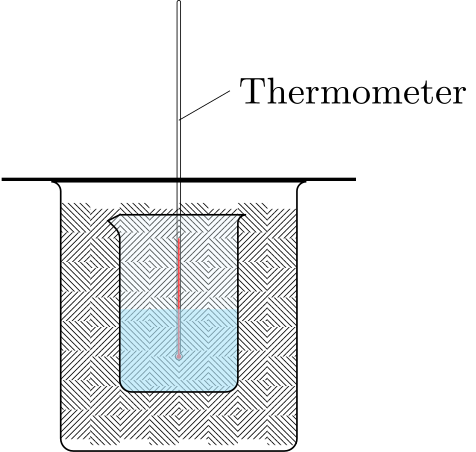
Figure 5: Apparatus for measuring heat of neutralization Using one graduated cylinder, measure out \(50\ \text{mL}\) of \(1\ \text{mol/L}\) hydrochloric acid and pour it into the small beaker. Measure the temperature of the hydrochloric acid with the thermometer and record it in the table below. Rinse the acid from the thermometer with water.
Initial temperature (\({}^{\circ}\text{C}\)) Final temp. (\({}^{\circ}\text{C}\)) Temp. difference (\({}^{\circ}\text{C}\)) Trial \(\ce{HCl}\) \(\ce{NaOH}\) Average \(t_1\) \(t_2\) 1 2 3 Using the other graduated cylinder, measure out \(50\ \text{mL}\) of \(1.1\ \text{mol/L}\) sodium hydroxide solution. Measure the temperature of the \(\ce{NaOH}\) solution with the thermometer and record it in the table.
Place the thermometer in the hydrochloric acid in the small beaker. Pour the sodium hydroxide solution from the graduated cylinder into the small beaker all at once (be careful not to spill any). Gently stir the solution with the glass rod, and accurately read the maximum temperature reached by the mixed solution. Record this as the final temperature in the table.
Calculation of heat of neutralization
To simplify the calculation, we make the following approximations:
The density of both \(1\ \text{mol/L}\) \(\ce{HCl}\) and \(1.1\ \text{mol/L}\) \(\ce{NaOH}\) solution is \(1\ \text{g/mL}\). Therefore, the mass of \(50\ \text{mL}\) of \(1\ \text{mol/L}\) \(\ce{HCl}\) is \(m_1 = 50\ \text{g}\), and the mass of \(50\ \text{mL}\) of \(1.1\ \text{mol/L}\) \(\ce{NaOH}\) is \(m_2 = 50\ \text{g}\).
The specific heat capacity of the resulting solution is \(C = 1\ \text{cal} \cdot \text{g}^{-1} \cdot \text{K}^{-1}\).
From these, the heat released \(Q\) when \(50\ \text{mL}\) of \(1\ \text{mol/L}\) \(\ce{HCl}\) reacts with \(50\ \text{mL}\) of \(1.1\ \text{mol/L}\) \(\ce{NaOH}\) is:
\[Q = (m_1 + m_2) \cdot C \cdot (t_2 - t_1) = 100(t_2 - t_1)\ \text{cal}\]
Since \(50\ \text{mL}\) of \(1\ \text{mol/L}\) \(\ce{HCl}\) contains \(\dfrac{50}{1000} = 0.05\ \text{mol}\) of \(\ce{HCl}\), and \(0.05\ \text{mol}\) of \(\ce{HCl}\) reacts with \(0.05\ \text{mol}\) of \(\ce{NaOH}\) to produce \(0.05\ \text{mol}\) of water, the heat released for the formation of \(0.05\ \text{mol}\) of water is \(Q\). Therefore, the heat released per mole of water formed — that is, the heat of neutralization — is:
\[\text{Heat of neutralization} = \frac{Q}{0.05} = \frac{100(t_2 - t_1)}{0.05}\ \text{cal}\]
Discussion
To improve the accuracy of the measurement, what precautions should be taken during the experiment?
Experiment 9: Primary Cells; Electrochemical Corrosion of Metals
Objective
- Understand the principle of primary cells.
- Recognize the causes of electrochemical corrosion of metals.
Materials
Beaker, test tubes, dropper, connecting wires, galvanometer, small knife.
Dilute sulfuric acid, dilute hydrochloric acid, copper(II) sulfate (\(\ce{CuSO4}\)) solution, sodium chloride (\(\ce{NaCl}\)) solution, potassium ferricyanide (\(\ce{K3[Fe(CN)6]}\)) solution4, galvanized iron sheet, tinned iron sheet (tin plate), zinc sheet, copper sheet, zinc granules, impure zinc5.
Procedure
1. Principle of primary cells
Insert a piece of pure zinc sheet into a beaker containing dilute sulfuric acid. Observe the phenomena. Then insert a piece of copper sheet into the same beaker. Observe whether any gas is released on the copper sheet. Connect the zinc and copper sheets with a wire and observe whether gas is now released on the copper sheet. Insert a galvanometer into the circuit and observe whether the needle deflects. Explain the observations and write the reactions occurring at the positive and negative electrodes.
2. Electrochemical corrosion of metals
Using a sharp knife, scratch the surface of a small piece of galvanized iron (white iron) and a small piece of tinned iron (tin plate) to expose the iron underneath. Place one drop of sodium chloride solution on each scratch, then add one drop of potassium ferricyanide solution. Allow to stand for \(5\ \text{min}\) and observe the phenomena. If the results are not obvious, allow to stand for an additional \(10\ \text{min}\). (While waiting, proceed with the experiments below.)
Place a small piece of pure zinc in one test tube and a small piece of impure zinc in another. Add \(2\ \text{mL}\) of dilute sulfuric acid to each. Observe the phenomena — in which test tube is the reaction more vigorous? Why?
To the test tube from experiment (2) that contains pure zinc and dilute sulfuric acid, add a small amount of copper(II) sulfate solution. Observe what changes occur. Why?
Discussion
When preparing hydrogen in the laboratory, is it better to use pure zinc or zinc containing small amounts of impurities?
Based on your experiments, summarize the conditions that must be met to construct a primary cell.
Experiment 10: Electrolysis; Electroplating
Objective
- Consolidate understanding of the principles of electrolysis and electroplating.
- Learn the basic procedure for cyanide-free zinc electroplating.
Materials
Iron workpiece (item to be plated), sandpaper, beaker, U-tube, glass rod, connecting wires, DC power source, graphite electrodes, potassium iodide–starch paper.
\(1\ \text{mol/L}\) sodium hydroxide solution, zinc sheet, electroplating solution, passivation solution6, \(20\%\) hydrochloric acid, copper(II) chloride (\(\ce{CuCl2}\)) solution.
Procedure
1. Electrolysis
Pour copper(II) chloride solution into a U-tube. Insert two graphite electrodes. Connect to the power source. Place a strip of moist potassium iodide–starch paper near the anode carbon rod to test the gas released, and observe the phenomena occurring in the U-tube.
2. Zinc electroplating
(1) Degreasing and rust removal of the workpiece
Polish the workpiece with sandpaper. Place it in \(1\ \text{mol/L}\) \(\ce{NaOH}\) solution to remove grease, then rinse with clean water. Next, immerse it in \(20\%\) hydrochloric acid to remove rust. After a few minutes, remove and rinse with clean water.
(2) Electroplating
Connect the workpiece to the negative terminal of a DC power source set to \(2\)–\(3\ \text{V}\). Connect the zinc sheet to the positive terminal. Immerse both electrodes parallel to each other in the electroplating solution, with approximately \(5\ \text{cm}\) between them. After \(5\)–\(10\ \text{min}\), remove the workpiece — its surface is now coated with a layer of zinc.
(3) Passivation
Remove the plated workpiece, rinse with clean water, and immerse it in the passivation solution. After \(5\)–\(10\ \text{s}\), remove and rinse with clean water. The surface of the plated workpiece should now display a colorful iridescent pattern.
Discussion
In the electrolysis of water, why is sodium hydroxide solution or sulfuric acid often added?
Given a beaker containing copper(II) chloride solution, two wires, and two graphite electrodes, can you design a simple experiment to determine the positive and negative terminals of a battery? Explain your reasoning.
Experiment 11: Chemical Properties of Aluminum and Aluminum Hydroxide
Objective
To understand the main chemical properties of aluminum and the amphoteric nature of aluminum hydroxide.
Materials
Test tubes, test tube holder, alcohol lamp, filter paper.
Dilute hydrochloric acid, dilute sulfuric acid, concentrated nitric acid, ammonia solution, \(\ce{NaOH}\) solution, \(\ce{KOH}\) solution, mercury(II) nitrate (\(\ce{Hg(NO3)2}\)) solution, aluminum sulfate (\(\ce{Al2(SO4)3}\)) solution, aluminum chloride (\(\ce{AlCl3}\)) solution, aluminum strips (or aluminum foil), distilled water.
Procedure
1. Chemical properties of aluminum
Reaction of aluminum with acids. Place pieces of aluminum strip of similar size into three test tubes. Add \(2\)–\(3\ \text{mL}\) of dilute hydrochloric acid, dilute sulfuric acid, and concentrated nitric acid to the three test tubes, respectively (the test tube for concentrated nitric acid must be dry). Observe carefully which test tubes show a reaction and which show no change. Write the chemical equations and ionic equations.
Reaction of aluminum with bases. Place pieces of aluminum strip of similar size into two test tubes. Add \(2\)–\(3\ \text{mL}\) of \(\ce{NaOH}\) solution and \(\ce{KOH}\) solution, respectively. Heat gently and observe the phenomena. Write the chemical equations and ionic equations for both reactions.
Protective role of the aluminum oxide film. Place an aluminum strip in a test tube containing \(2\)–\(3\ \text{mL}\) of \(\ce{NaOH}\) solution. Heat gently to allow the aluminum to react with the \(\ce{NaOH}\) solution. After \(2\)–\(3\ \text{min}\), remove the aluminum strip and rinse it thoroughly with distilled water. Then immerse the aluminum strip in \(\ce{Hg(NO3)2}\) solution. Aluminum undergoes a displacement reaction with \(\ce{Hg(NO3)2}\). When a small amount of mercury is observed deposited on the aluminum strip, remove it. Gently blot the surface dry with small pieces of filter paper. Place the aluminum strip on dry filter paper. Observe the phenomena occurring on the surface of the aluminum strip. Write the relevant chemical equations.
2. Amphoteric nature of aluminum hydroxide
Formation of aluminum hydroxide. Take \(3\ \text{mL}\) of \(\ce{Al2(SO4)3}\) solution in each of three test tubes. Add \(\ce{NaOH}\) solution, \(\ce{KOH}\) solution, and ammonia solution dropwise to each of the three test tubes, respectively, until a large amount of precipitate forms. Write the relevant chemical equations and ionic equations.
Repeat the experiment using \(\ce{AlCl3}\) solution in place of \(\ce{Al2(SO4)3}\) solution. Write the relevant chemical equations and ionic equations.
Reaction of aluminum hydroxide with acids and bases. Take two test tubes containing \(\ce{Al(OH)3}\) precipitate. Add dilute hydrochloric acid to one and strong base solution (\(\ce{NaOH}\) or \(\ce{KOH}\) solution) to the other. Shake and observe the phenomena. Write the relevant chemical equations and ionic equations.
Take another test tube containing \(\ce{Al(OH)3}\) precipitate. Add ammonia solution to it and shake. Observe the phenomena.
Discussion
How does the reaction of aluminum with dilute hydrochloric acid differ from its reaction with concentrated nitric acid? Why?
Compare the results of adding strong base solution versus ammonia solution to \(\ce{Al(OH)3}\) precipitate. What is different? Why?
Is the result the same if you gradually add excess \(\ce{NaOH}\) solution to \(\ce{AlCl3}\) solution, compared to gradually adding excess \(\ce{AlCl3}\) solution to \(\ce{NaOH}\) solution?
Experiment 12: Determination of Molecular Mass
Objective
To learn one method for determining molecular mass — the vapor density method.
Materials
Platform balance, round-bottom flask (\(250\ \text{mL}\)), beaker (\(500\ \text{mL}\)), graduated cylinders (\(10\ \text{mL}\) and \(100\ \text{mL}\), one each), aluminum foil, cotton thread, needle, alcohol lamp, iron stand, iron ring, asbestos gauze.
Carbon tetrachloride (\(\ce{CCl4}\)).
Procedure
Preparing the boiling water. Add approximately \(200\ \text{mL}\) of hot water to a \(500\ \text{mL}\) beaker. Place it on the asbestos gauze on the iron stand and heat with an alcohol lamp until boiling (\(100\,{}^{\circ}\text{C}\)). This water will be used in the steps below.
Weighing the flask. Take a dry, clean \(250\ \text{mL}\) round-bottom flask. Weigh it together with the aluminum foil and cotton thread for sealing on the platform balance. Record this mass as \(W_1\) (accurate to \(0.1\ \text{g}\)).
Vaporization of carbon tetrachloride. Add approximately \(2\ \text{mL}\) of carbon tetrachloride to the weighed flask. Seal the mouth with aluminum foil and cotton thread. Pierce a small hole in the aluminum foil with a needle. Then immerse the flask in the boiling water in the beaker (Figure 6), keeping the flask submerged (continue heating to maintain the water at a rolling boil). The carbon tetrachloride in the flask is heated and vaporizes, displacing the air from the flask.
Weighing the carbon tetrachloride. After the carbon tetrachloride has completely vaporized, remove the flask from the boiling water. The carbon tetrachloride vapor is cooled by the air and condenses entirely into a liquid. After the flask has cooled to room temperature, dry its exterior and weigh it. Record this mass as \(W_2\).
Measuring the flask volume. Pour out the liquid carbon tetrachloride from the weighed flask. Using a \(100\ \text{mL}\) graduated cylinder, add water to the flask until it is completely full. The volume of water equals the volume of the flask, \(V\). (Alternatively, fill the flask with water first, then pour the water into the graduated cylinder to measure its volume.)
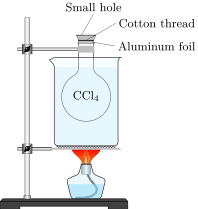
Figure 6: Apparatus for the vaporization of carbon tetrachloride Calculation of the molecular mass of carbon tetrachloride
Using the ideal gas law:
\[PV = nRT\]
where:
- \(P \approx 1\ \text{atm}\) (approximately)
- \(T = 273 + 100 = 373\ \text{K}\)
- \(R = 0.082\ \text{L} \cdot \text{atm} \cdot \text{K}^{-1} \cdot \text{mol}^{-1}\)
- \(n = \dfrac{W_2 - W_1}{M}\) (where \(M\) is the molar mass of carbon tetrachloride)
Solving for \(M\):
\[M = \frac{RT(W_2 - W_1)}{PV} = \frac{0.082 \times 373 \times (W_2 - W_1)}{V}\]
The numerical value of the molar mass is the same as the molecular mass (in atomic mass units).
Discussion
Can the vapor density method be used to determine the molecular mass of substances that do not volatilize upon heating, or that decompose upon heating?
Discuss how each of the following conditions would affect the experimental result:
The pressure is lower than \(1\ \text{atm}\).
The water has not reached boiling.
The carbon tetrachloride has not completely vaporized.
Experiment 13: Laboratory Exercise
Objective
To consolidate previously learned knowledge and develop experimental skills.
Problems
How would you demonstrate that sucrose is a nonelectrolyte, acetic acid is a weak electrolyte, and sodium chloride is a strong electrolyte?
When electrolyzing sodium sulfate (\(\ce{Na2SO4}\)) solution, what reactions occur at the cathode and anode? (In this system, \(\ce{OH-}\) loses electrons more easily than \(\ce{SO4^{2-}}\).)
Test the following aqueous solutions for acidity or basicity, and explain the reasons:
\(\ce{NaNO3}\)
\(\ce{K2CO3}\)
\(\ce{NH4Cl}\)
\(\ce{CH3COONH4}\)
Place a small amount of alum (\(\ce{KAl(SO4)2 . 12H2O}\)) in a test tube, add water to dissolve it, test its acidity or basicity, and determine whether the resulting solution is a colloid.
Determine whether each of the following is a colloid:
Sodium chloride solution
Sucrose solution
Starch solution
Diluted blue ink
An unknown liquid
Three bottles of water are distilled water, permanently hard water, and temporarily hard water. Devise experiments to identify which bottle contains which type of water.
Four bottles contain solutions of \(\ce{MgSO4}\), \(\ce{BaCl2}\), \(\ce{Al2(SO4)3}\), and \(\ce{FeCl3}\). Devise experiments to identify each one.
Five bottles contain solutions of \(\ce{KCl}\), \(\ce{Ba(NO3)2}\), \(\ce{Na2CO3}\), \(\ce{Na2SO4}\), and \(\ce{FeCl3}\). Without using any other reagent or indicator paper, identify which bottle contains which solution through observation and experimentation.
Using only one reagent, identify the following solutions.
Using hydrochloric acid of known concentration, titrate an unknown potassium hydroxide solution to determine its concentration.
To prepare these, introduce \(\ce{NO2}\) gas into dry test tubes and seal with rubber stoppers.↩︎
The exact concentration must be determined accurately in advance.↩︎
A slight excess of \(\ce{NaOH}\) is used to ensure complete neutralization of the \(\ce{HCl}\).↩︎
Potassium ferricyanide is also known as potassium hexacyanoferrate(III), or “red prussiate of potash.”↩︎
Commercially available zinc often contains small amounts of impurities such as carbon, iron, etc.↩︎
A passivation solution produces a thin protective chromate film on the zinc coating, giving it an iridescent appearance and improving corrosion resistance.↩︎