1 Chemical Bonds and Molecular Structure
After studying this chapter, you should be able to:
- Define chemical bonds and explain their role in holding atoms together
- Describe ionic bonds, including the formation of ions, their structural characteristics, and the properties of ionic crystals
- Explain covalent bonds, including bond length, bond energy, saturation, and directionality
- Define coordinate bonds and illustrate their formation using the ammonium ion as an example
- Compare and contrast atomic crystals and ionic crystals
- Distinguish between nonpolar and polar covalent bonds, and use electronegativity to predict bond type
- Determine whether a molecule is polar or nonpolar based on its geometry and bond polarity
- Describe intermolecular forces (van der Waals forces) and the properties of molecular crystals
- Explain the formation and properties of hydrogen bonds and their effect on physical properties
We have already studied the basics of atomic structure and how atomic structure relates to periodic trends in the properties of elements. Beginning with this chapter, we will study how atoms combine with one another, and the relationship between molecular structure and the properties of substances.
1.1 Section 1: Ionic Bonds
What Are Chemical Bonds?
Scientists have discovered and synthesized millions of substances. Why can atoms of only slightly more than a hundred elements form such a vast variety of substances? How do atoms combine with one another? Why can two hydrogen atoms spontaneously combine to form a hydrogen molecule, while two helium atoms cannot bind together? Why do atoms combine in fixed ratios? Why do the properties of molecules differ so greatly from those of their constituent atoms? To answer these many questions, we must begin by studying the interactions between atoms as they form molecules, building on our knowledge of atomic structure.
Since atoms can combine to form molecules, there must be interactions between them. Such interactions exist not only between directly adjacent atoms, but also between non-adjacent atoms within a molecule. The former type of interaction is much stronger and is the primary factor that binds atoms together into molecules; breaking it requires a considerable amount of energy. This strong interaction between two or more adjacent atoms is generally called a chemical bond.
The main types of chemical bonds include ionic bonds, covalent bonds, and metallic bonds. In this chapter, we will first study ionic bonds and covalent bonds.
Ionic Bonds
1. Formation of Ionic Bonds
We already know that metallic sodium reacts with chlorine gas to form sodium chloride:
\[ \ce{2Na + Cl2 = 2NaCl} \]
Because the ionization energy of sodium atoms is very small, they easily lose electrons, while chlorine atoms readily gain electrons. When sodium reacts with chlorine gas, the \(3s\) electron of each sodium atom is transferred to the \(3p\) orbital of a chlorine atom:
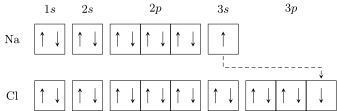
Each sodium atom loses one \(3s\) electron, forming a stable electron configuration similar to that of neon, and acquires one unit of positive charge to become a sodium ion (\(\ce{Na+}\)). Each chlorine atom gains one electron, forming a stable electron configuration similar to that of argon, and acquires one unit of negative charge to become a chloride ion (\(\ce{Cl-}\)).
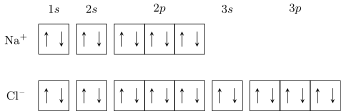
Between the sodium ion and the chloride ion, in addition to electrostatic attraction, there are also repulsive interactions between the electrons and between the nuclei. When the two ions approach a certain distance, the attractive and repulsive forces reach equilibrium, and a stable chemical bond forms between the anion and cation.
The formation of sodium chloride can also be represented using electron-dot formulas:
\[ \ce{Na}^{{\scriptscriptstyle\times}} + \cdot\overset{\cdot\cdot}{\underset{\cdot\cdot}{\ce{Cl}}}{:} \longrightarrow \ce{Na+}\!\left[\,{}_{{\scriptscriptstyle\times}}^{\cdot}\overset{\cdot\cdot}{\underset{\cdot\cdot}{\ce{Cl}}}{:}\,\right]^{-} \]
A chemical bond formed between anions and cations through electrostatic interactions, as in sodium chloride, is called an ionic bond.
When active metals (such as potassium, sodium, and calcium) combine with active nonmetals (such as chlorine and bromine), ionic bonds are formed. For example, calcium bromide is formed through ionic bonding.
\[ \ce{Ca}^{{\scriptscriptstyle\times}}_{{\scriptscriptstyle\times}} + 2\cdot\overset{\cdot\cdot}{\underset{\cdot\cdot}{\ce{Br}}}{:} \longrightarrow \left[{:}\overset{\cdot\cdot}{\underset{\cdot\cdot}{\ce{Br}}}{}_{{\scriptscriptstyle\times}}^{\cdot}\right]^{-} \ce{Ca^{2+}} \left[{}_{{\scriptscriptstyle\times}}^{\cdot}\overset{\cdot\cdot}{\underset{\cdot\cdot}{\ce{Br}}}{:}\right]^{-} \]
2. Characteristics of Ions
Ionic charge
Ions are atoms or groups of atoms that carry electric charges. The sign and magnitude of an ion’s charge are related to the number of electrons gained or lost during bond formation. For example, when magnesium reacts with chlorine to form magnesium chloride, each magnesium atom loses 2 electrons to form \(\ce{Mg^{2+}}\), and each chlorine atom gains 1 electron to form \(\ce{Cl-}\).
Electron-shell structure of ions
The electron shells of ions formed by main-group elements are generally fully occupied. For example, the outermost shells of \(\ce{Li+}\) and \(\ce{Be^{2+}}\) contain 2 electrons. The outermost shells of \(\ce{Na+}\), \(\ce{K+}\), \(\ce{Ca^{2+}}\), \(\ce{Mg^{2+}}\), \(\ce{Al^{3+}}\), \(\ce{O^{2-}}\), \(\ce{S^{2-}}\), \(\ce{F-}\), and \(\ce{Cl-}\) each contain 8 electrons. In contrast, ions formed by transition-group and Group VIII elements often have incompletely filled electron shells. For example, the outermost shell of \(\ce{Fe^{3+}}\) has 13 electrons, and that of \(\ce{Co^{3+}}\) has 14 electrons.
Ionic radii
Because cations are formed when atoms lose outer electrons, the radius of a cation is smaller than that of the corresponding atom. For example:
| Li | Na | K | Rb | Cs | |
|---|---|---|---|---|---|
| Atomic radius (\(\times 10^{-10}\ \text{m}\)) | 1.52 | 1.86 | 2.27 | 2.48 | 2.65 |
| Ionic radius (\(\times 10^{-10}\ \text{m}\)) | 0.68 | 0.97 | 1.33 | 1.47 | 1.67 |
Because anions have more outer electrons than the corresponding atoms, yet the nuclear charge remains the same, the radius of an anion is larger than that of the corresponding atom. For example:
| F | Cl | Br | I | |
|---|---|---|---|---|
| Atomic radius (\(\times 10^{-10}\ \text{m}\)) | 0.71 | 0.99 | 1.14 | 1.33 |
| Ionic radius (\(\times 10^{-10}\ \text{m}\)) | 1.33 | 1.81 | 1.96 | 2.20 |
For ions with the same electron-shell configuration — such as \(\ce{F-}\), \(\ce{Na+}\), \(\ce{Mg^{2+}}\), and \(\ce{Al^{3+}}\) (all of which have the same electron configuration as neon) — the ionic radius decreases as the nuclear charge increases. Their radii (\(\times 10^{-10}\ \text{m}\)) are listed below:
| \(\ce{F-}\) | \(\ce{Na+}\) | \(\ce{Mg^{2+}}\) | \(\ce{Al^{3+}}\) |
|---|---|---|---|
| 1.33 | 0.97 | 0.65 | 0.50 |
Ionic Crystals
Compounds held together by ionic bonds are ionic compounds. At room temperature, ionic compounds exist as crystals. A crystal in which ions are bonded together through ionic bonds is called an ionic crystal.
In an ionic crystal, the anions and cations are arranged in a regular spatial pattern. Figure 1.3 shows the crystal structure of \(\ce{NaCl}\), and Figure 1.4 shows the crystal structure of \(\ce{CsCl}\).
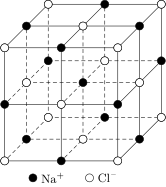
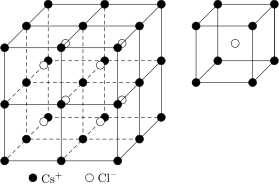
In the \(\ce{NaCl}\) crystal, each \(\ce{Na+}\) ion simultaneously attracts 6 \(\ce{Cl-}\) ions, and each \(\ce{Cl-}\) ion simultaneously attracts 6 \(\ce{Na+}\) ions. In the \(\ce{CsCl}\) crystal, each \(\ce{Cs+}\) ion simultaneously attracts 8 \(\ce{Cl-}\) ions, and each \(\ce{Cl-}\) ion simultaneously attracts 8 \(\ce{Cs+}\) ions. Therefore, in neither \(\ce{NaCl}\) nor \(\ce{CsCl}\) crystals do individual \(\ce{NaCl}\) or \(\ce{CsCl}\) molecules exist. However, in both crystals, the ratio of anions to cations is \(1 : 1\). Strictly speaking, \(\ce{NaCl}\) and \(\ce{CsCl}\) represent the ratio of ions in the ionic crystal. They are chemical formulas that express the composition of a substance using element symbols, not molecular formulas that describe the composition of individual molecules.1
In ionic compounds, relatively strong ionic bonds exist between the ions. Therefore, ionic compounds generally have high hardness, high density, are difficult to compress, difficult to volatilize, and have high melting points and boiling points.
- A chemical bond is a strong interaction between two or more adjacent atoms in a molecule
- The main types of chemical bonds are ionic bonds, covalent bonds, and metallic bonds
- An ionic bond is formed between anions and cations through electrostatic attraction
- Active metals and active nonmetals typically form ionic bonds
- Cations are smaller than the parent atom; anions are larger than the parent atom
- Isoelectronic ions decrease in radius as nuclear charge increases
- Ionic crystals have no individual molecules; formulas represent ion ratios
- Ionic compounds have high melting points, high boiling points, and high hardness
Exercises for Section 1
Draw orbital diagrams showing the electron shell and subshell structure of \(\ce{Mg}\) and \(\ce{F}\) atoms, and use electron-dot formulas to represent the formation of the ionic bond in \(\ce{MgF2}\).
Draw orbital diagrams showing the electron shell and subshell structure of \(\ce{Na}\) and \(\ce{S}\) atoms, and use electron-dot formulas to represent the formation of the ionic bond in \(\ce{Na2S}\).
Draw orbital diagrams showing the electron shell and subshell structure of the following ions: \(\ce{Ba^{2+}}\), \(\ce{Ag+}\), \(\ce{Al^{3+}}\), \(\ce{Fe^{2+}}\), \(\ce{Fe^{3+}}\).
Why are there no individual molecules in an ionic crystal?
1.2 Section 2: Covalent Bonds
Covalent Bonds
The covalent bond is an important type of chemical bond. We will now use several elements and compounds as examples to illustrate how covalent bonds form and their properties.
1. Formation of the Hydrogen Molecule
First, let us study how hydrogen atoms combine to form hydrogen molecules. Under ordinary conditions, when one hydrogen atom approaches another hydrogen atom, they interact and form a hydrogen molecule:
\[ \ce{H + H = H2} \]
During the formation of a hydrogen molecule, the electrons are not transferred from one hydrogen atom to the other; instead, they are shared between the two hydrogen atoms. These two shared electrons fill the \(1s\) orbitals of both hydrogen atoms and move around both nuclei. In this way, the \(1s\) orbital of each hydrogen atom is fully occupied, and each hydrogen atom achieves the stable electron configuration of helium.
The shared electron pair in a hydrogen molecule can be represented as follows:
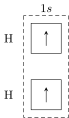
The electron-dot formula of the hydrogen molecule is: H : H.
In chemistry, a short line is commonly used to represent a shared electron pair. Therefore, the hydrogen molecule can also be written as: H–H.
From the perspective of electron cloud distribution in the hydrogen molecule: when two hydrogen atoms with electrons spinning in the same direction approach each other, the electron cloud between the two nuclei is sparse, and a stable hydrogen molecule cannot form. When two hydrogen atoms with electrons spinning in opposite directions approach each other, the electron cloud between the two nuclei becomes dense, generating an attractive force on both nuclei, and a stable \(\ce{H2}\) molecule can form (Figure 1.6).
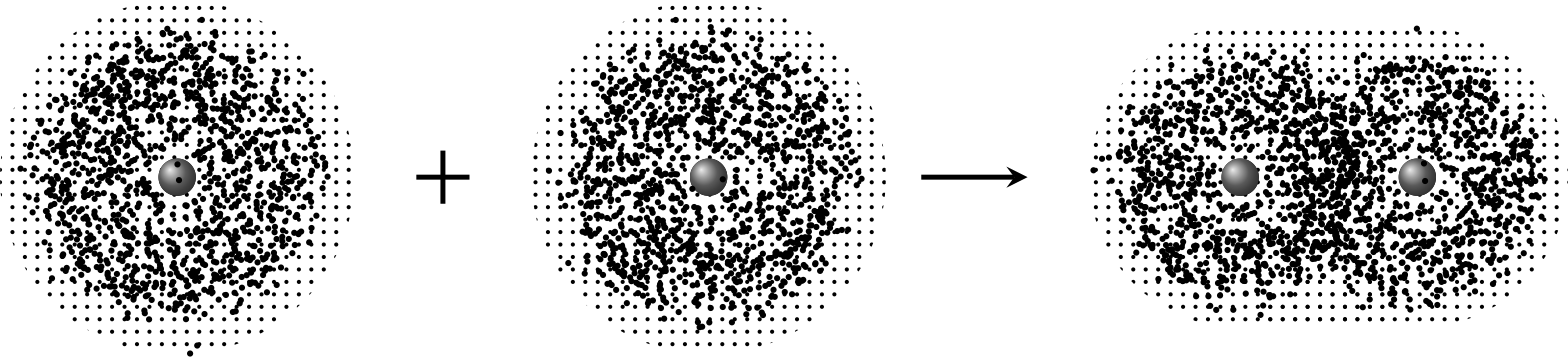
The formation of the hydrogen molecule can also be explained using electron cloud overlap. When the electron clouds of two atoms partially overlap, the electron cloud between the nuclei becomes dense, forming a stable molecule. The greater the electron cloud overlap, the more stable the molecule.
A chemical bond formed between atoms through shared electron pairs (electron cloud overlap), as in the hydrogen molecule, is called a covalent bond.
2. Bond Length and Bond Energy
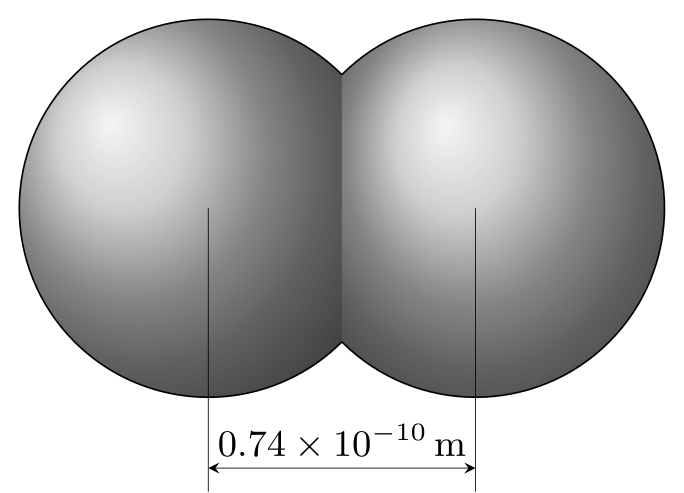
In a molecule, the average distance between the nuclei of two bonded atoms is called the bond length. For example, the H–H bond length is \(0.74 \times 10^{-10}\ \text{m}\) (Figure 1.7), the C–C bond length is \(1.54 \times 10^{-10}\ \text{m}\), and the Cl–Cl bond length is \(1.98 \times 10^{-10}\ \text{m}\). Generally speaking, the shorter the bond between two atoms, the stronger and more stable the bond.
During the formation of \(\ce{H2}\) from hydrogen atoms, heat is released:
\[ \ce{H + H -> H2} + 104.2\ \text{kCal} \]
From this equation we know that when 1 mol of H atoms combines with 1 mol of H atoms to form 1 mol of \(\ce{H2}\) molecules, \(104.2\ \text{kCal}\) of heat is released.2 This also indicates that \(\ce{H2}\) molecules have lower energy than H atoms, and \(\ce{H2}\) molecules are more stable than H atoms.
If we want to split 1 mol of \(\ce{H2}\) molecules into 2 mol of H atoms, the same amount of energy — \(104.2\ \text{kCal}\) — must be absorbed:
\[ \ce{H2} + 104.2\ \text{kCal} \longrightarrow \ce{H + H} \]
This tells us that breaking 1 mol of H–H bonds requires absorbing \(104.2\ \text{kCal}\) of energy. This energy is the bond energy of the H–H bond. The greater the bond energy, the stronger the chemical bond, and the more stable the molecule containing that bond.
Table 1.4 lists the bond energies of some covalent bonds.
| Bond | Bond energy | Bond | Bond energy | Bond | Bond energy | Bond | Bond energy | Bond | Bond energy |
|---|---|---|---|---|---|---|---|---|---|
| H–H | 104.2 | Cl–Cl | 58.0 | Br–Br | 46.3 | I–I | 36.5 | C–C | 83.1 |
| C–H | 98.8 | O–H | 110.6 | N–H | 93.4 | H–Cl | 103.2 | H–I | 71.4 |
Given the reaction:
\[ \ce{H2 + Cl2 = 2HCl} + 44.2\ \text{kCal} \]
Discuss the relationship between the bond energies of the reactants (H–H, Cl–Cl) and the product (H–Cl) and the heat of this reaction.
3. Other Examples of Covalent Bond Formation
The formation of the diatomic \(\ce{Cl2}\) molecule is similar to that of the \(\ce{H2}\) molecule. Two chlorine atoms share one pair of electrons, and this shared pair fills the incompletely occupied \(3p\) orbitals of each chlorine atom, so that each chlorine atom achieves the electron configuration of argon.
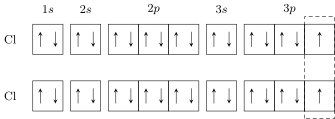
The chlorine molecule can be represented as:
\[ \genfrac{}{}{0pt}{2}{\scriptscriptstyle\times}{\scriptscriptstyle\times}\overset{{\scriptscriptstyle\times}{\scriptscriptstyle\times}}{\underset{{\scriptscriptstyle\times}{\scriptscriptstyle\times}}{\ce{Cl}}}\genfrac{}{}{0pt}{2}{\scriptscriptstyle\times}{\cdot}\overset{\cdot\cdot}{\underset{\cdot\cdot}{\ce{Cl}}}{:} \qquad \ce{Cl-Cl} \]
The formation of the nitrogen molecule is similar to that of the chlorine molecule, except that three pairs of \(p\) electrons are shared to form a triple bond.
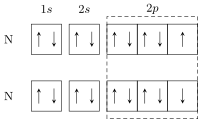
The nitrogen molecule can be represented as:
\[ \ce{N} \equiv \ce{N} \]
Now let us consider two examples in which different atoms are joined by covalent bonds. In the \(\ce{HCl}\) molecule:
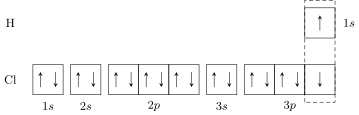
The \(\ce{HCl}\) molecule can be represented as:
\[ \ce{H} - \ce{Cl} \]
Similarly, in the \(\ce{H2O}\) molecule:
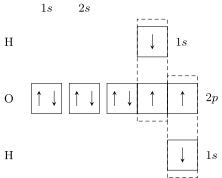
The \(\ce{H2O}\) molecule can be represented as:
\[ \ce{H} - \ce{O} - \ce{H} \]
Saturation and Directionality of Covalent Bonds
From the formation of covalent bonds in the elements and compounds studied above, we can identify two common properties of covalent bonds.
1. Saturation
Because once an unpaired electron of one atom pairs with an electron of opposite spin from another atom, it cannot pair with a third electron. Therefore, the number of covalent bonds an atom can form equals the number of its unpaired electrons. This is the saturation of covalent bonds. For example, a sulfur atom can combine with hydrogen atoms to form hydrogen sulfide: each sulfur atom has two unpaired \(3p\) electrons and each hydrogen atom has one unpaired \(1s\) electron, so one sulfur atom can bond with two hydrogen atoms to form an \(\ce{H2S}\) molecule, but not \(\ce{H3S}\) or \(\ce{H4S}\).
2. Directionality
We know that except for \(s\) orbitals, whose electron clouds are spherically symmetric, the electron clouds of other orbitals (\(p\) orbitals, \(d\) orbitals, etc.) extend in specific directions. When forming covalent bonds, the greater the electron cloud overlap, the greater the electron density between the nuclei, and the stronger the covalent bond. Therefore, covalent bonds tend to form along the directions of maximum electron cloud density. For example, when a sulfur atom bonds with hydrogen atoms to form \(\ce{H2S}\), the two unpaired \(3p\) electrons of the sulfur atom have electron clouds oriented at right angles to each other, and the \(1s\) electron clouds of the hydrogen atoms overlap with the \(3p\) electron clouds along the perpendicular directions. Thus the angle between the two covalent bonds in \(\ce{H2S}\) should be close to \(90^{\circ}\) (Figure 1.12).
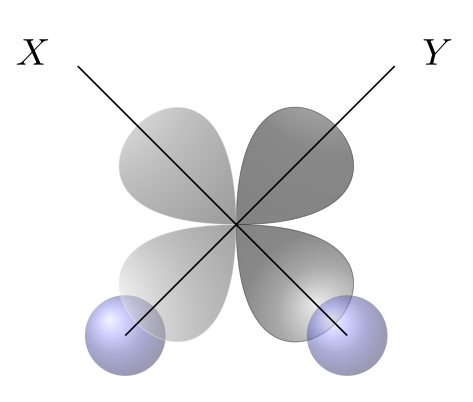
The angle between bonds in a molecule is called the bond angle. For example, the angle between the two O–H bonds in a water molecule is \(104.5^{\circ}\). In a carbon dioxide molecule, the two \(\ce{C=O}\) bonds are arranged in a straight line, so the bond angle is \(180^{\circ}\). In an ammonia molecule, the angle between two N–H bonds is \(107^{\circ}18'\). In a methane molecule, the angle between two C–H bonds is \(109^{\circ}28'\).
Coordinate Bonds
In the covalent bonds introduced above, the shared electron pairs are each contributed by both bonding atoms, each providing one unpaired electron. There is also a special type of covalent bond in which the electron pair is provided entirely by one atom and shared with another atom. Such a covalent bond is called a coordinate bond (also known as a dative bond).
Let us use the ammonium ion \(\ce{NH4+}\) as an example to illustrate the formation of a coordinate bond. We already know that ammonia reacts with acids to form ammonium salts. For example:
\[ \ce{NH3 + HCl = NH4Cl} \]
This reaction can be expressed as an ionic equation:
\[ \ce{NH3 + H+ = NH4+} \]
This equation shows that ammonia reacts with substances that can produce hydrogen ions (acids) to form the ammonium ion.
The electron-dot formula of the ammonia molecule is:
\[ \ce{H} {:} \overset{\cdot\cdot}{\ce{N}} {:} \ce{H} \] \[ \phantom{00}\ce{H} \]
The nitrogen atom has one pair of electrons that are not shared with any other atom — a lone pair of electrons. The hydrogen ion (\(\ce{H+}\)) is formed when a hydrogen atom loses its \(1s\) electron, leaving behind an empty \(1s\) orbital. When an ammonia molecule interacts with a hydrogen ion, the lone pair on nitrogen enters the empty orbital of the hydrogen ion, and this electron pair is shared between the nitrogen and hydrogen atoms, forming a coordinate bond. A coordinate bond can be represented as \(\ce{A -> B}\), where A is the atom that provides the lone pair and B is the atom that has the empty orbital to accept the electrons.
In the ammonium ion, although one of the N–H bonds is formed differently from the other three, the bond length, bond energy, and bond angle of all four N–H bonds are identical, and all four bonds exhibit the same chemical properties. Therefore, the ammonium ion is usually represented as:
\[ \left[\begin{array}{c} \ce{H} \\ | \\ \ce{H-N-H} \\ | \\ \ce{H} \end{array}\right]^{+} \]
Atomic Crystals
We already know that diamond and graphite are both pure forms of carbon, yet their properties are very different. This is because their crystal structures are different.
1. Diamond
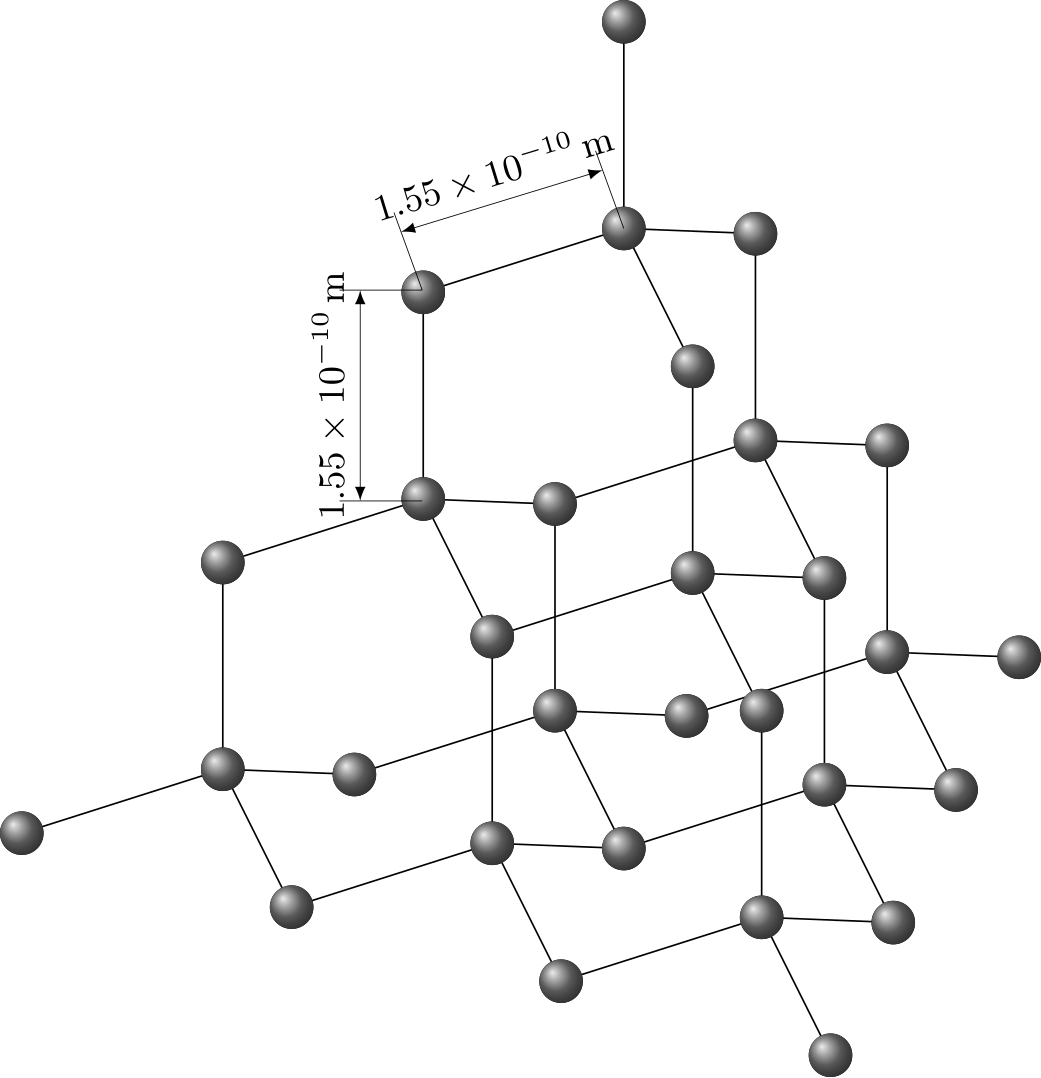
In the diamond crystal, each carbon atom is surrounded by 4 neighboring carbon atoms, situated at the center of a regular tetrahedron, bonded to these 4 carbon atoms by covalent bonds. These tetrahedral units extend through space to form a strong, interconnected three-dimensional network crystal (Figure 1.13). The bond length between adjacent carbon atoms is \(1.55 \times 10^{-10}\ \text{m}\), and the bond angle is \(109^{\circ}28'\). A crystal in which adjacent atoms are bonded together by covalent bonds to form a three-dimensional network structure is called an atomic crystal.
2. Graphite
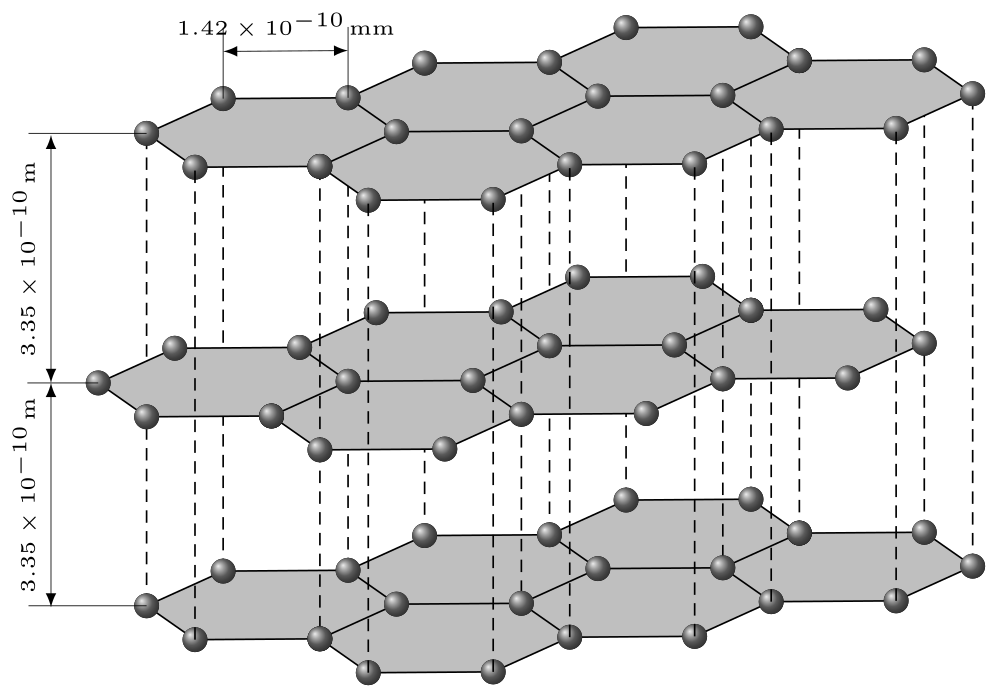
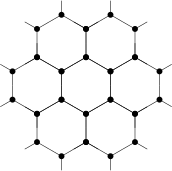
The graphite crystal (Figure 1.14) has a layered structure. Within each layer, the carbon atoms are arranged in hexagons, forming a planar network structure (Figure 1.15), with each carbon atom bonded to three others. Within the same layer, adjacent carbon atoms are connected by covalent bonds with a bond length of \(1.42 \times 10^{-10}\ \text{m}\). The distance between adjacent layers is \(3.55 \times 10^{-10}\ \text{m}\). Of the 4 outermost electrons of each carbon atom in graphite, 3 form single bonds. The fourth electron forms a more complex type of bond and can move within the layer.3
3. Properties of Atomic Crystals
In atomic crystals, atoms are bonded together by strong covalent bonds. Therefore, atomic crystals have high melting points and boiling points. For example, the melting point of diamond is above \(3550\,{}^{\circ}\text{C}\) and its boiling point is \(4827\,{}^{\circ}\text{C}\). The melting point of graphite is \(3652\)–\(3697\,{}^{\circ}\text{C}\) (sublimation) and its boiling point is \(4827\,{}^{\circ}\text{C}\). Both are insoluble in ordinary solvents.
- A covalent bond is formed between atoms through shared electron pairs (electron cloud overlap)
- Bond length is the average distance between bonded nuclei; shorter bonds are generally stronger
- Bond energy is the energy required to break 1 mol of bonds; greater bond energy means a more stable molecule
- Covalent bonds have saturation: an atom can form as many bonds as it has unpaired electrons
- Covalent bonds have directionality: bonds form along directions of maximum electron cloud overlap
- A coordinate bond is a covalent bond in which one atom provides the lone pair and the other provides an empty orbital
- An atomic crystal is a three-dimensional network of atoms connected by covalent bonds; it has very high melting and boiling points
Exercises for Section 2
Draw orbital diagrams showing the electron shell and subshell structure of \(\ce{F}\) and \(\ce{Br}\) atoms, and show the formation process of \(\ce{F2}\) and \(\ce{Br2}\) molecules.
Draw orbital diagrams showing the electron shell and subshell structure of \(\ce{N}\) and \(\ce{H}\) atoms, and show the formation process of the \(\ce{NH3}\) molecule.
What are the saturation and directionality of covalent bonds?
Why can noble gases not form diatomic molecules?
Based on the bond energies of \(\ce{H2}\), \(\ce{Cl2}\), \(\ce{Br2}\), and \(\ce{I2}\), which molecule is the most stable and which is the least stable?
In acidic aqueous solutions, the \(\ce{H+}\) ion often combines with an \(\ce{H2O}\) molecule to form the \(\ce{H3O+}\) ion. Explain the formation of \(\ce{H3O+}\) in terms of coordinate bonds.
1.3 Section 3: Nonpolar and Polar Molecules
Nonpolar and Polar Bonds
In molecules of elements (homonuclear diatomic molecules), atoms of the same kind form covalent bonds. Since both atoms attract electrons equally, the shared electron pair is not shifted toward either atom. The two electrons appear most frequently at the midpoint of the bond, and neither bonding atom carries a net charge. Such a covalent bond is called a nonpolar covalent bond, or simply a nonpolar bond. For example, the H–H bond and the Cl–Cl bond are both nonpolar bonds.
In compound molecules, different kinds of atoms form covalent bonds. Because different atoms attract electrons with different strengths, the shared electron pair is necessarily shifted toward the atom with the greater electron-attracting ability — that is, the electron cloud is denser near the more electronegative atom. Consequently, the atom with the stronger electron-attracting ability acquires a partial negative charge, and the atom with the weaker electron-attracting ability acquires a partial positive charge. Such a covalent bond is called a polar covalent bond, or simply a polar bond. For example, in the \(\ce{HCl}\) molecule, the chlorine atom attracts electrons more strongly than the hydrogen atom. The bonding electron cloud shifts toward the chlorine atom, giving the chlorine atom a partial negative charge and the hydrogen atom a partial positive charge.
Electronegativity
The relative ability of two bonded atoms in a molecule to attract electrons is expressed by the element’s electronegativity. Electronegativity values range from \(0.7\) to \(4\). The larger the electronegativity value, the greater the atom’s ability to attract bonding electrons. Table 1.5 lists the electronegativity values of common elements.
| Element | Electronegativity | Element | Electronegativity | Element | Electronegativity | Element | Electronegativity |
|---|---|---|---|---|---|---|---|
| H | 2.1 | Ba | 0.9 | Pb | 1.9 | F | 4.0 |
| Li | 1.0 | B | 2.0 | N | 3.0 | Cl | 3.0 |
| Na | 0.9 | Al | 1.5 | P | 2.1 | Br | 2.8 |
| K | 0.8 | Ga | 1.6 | As | 2.0 | I | 2.5 |
| Rb | 0.8 | In | 1.7 | Sb | 1.9 | Cu | 1.9 |
| Cs | 0.7 | Tl | 1.8 | Bi | 1.9 | Ag | 1.9 |
| Be | 1.5 | C | 2.5 | O | 3.5 | Au | 2.4 |
| Mg | 1.2 | Si | 1.8 | S | 2.5 | Zn | 1.6 |
| Ca | 1.0 | Ge | 1.8 | Se | 2.4 | Cd | 1.7 |
| Sr | 1.0 | Sn | 1.8 | Te | 2.1 | Hg | 1.9 |
From Table 1.5, we can observe that metals have smaller electronegativity values — the smaller the electronegativity, the more reactive the metal. Nonmetals have larger electronegativity values — the larger the electronegativity, the more reactive the nonmetal.
Based on the electronegativity values of two elements, we can roughly predict the type of bond they will form and the degree of polarity of a covalent bond.
Active metal atoms and active nonmetal atoms form ionic bonds through the transfer of outer-shell electrons. Active metals have small electronegativity values while active nonmetals have large electronegativity values, so the difference in electronegativity between the two atoms forming an ionic bond is relatively large. In elemental molecules, atoms of the same kind are bonded, and the difference in electronegativity is zero — meaning that nonpolar bonds are formed when the electronegativity difference is zero. The electronegativity difference for polar bonds lies between that for ionic bonds and zero. From this, we can conclude that the greater the electronegativity difference between two bonded atoms, the greater the polarity of the bond.
Nonpolar and Polar Molecules
If all the bonds in a molecule are nonpolar, the shared electron pairs are not shifted toward any atom, and the overall charge distribution of the molecule is uniform and symmetric. Such a molecule is called a nonpolar molecule. Molecules formed entirely by nonpolar bonds are nonpolar molecules, such as \(\ce{H2}\), \(\ce{O2}\), \(\ce{Cl2}\), and \(\ce{N2}\).
In a diatomic molecule with a polar bond, such as \(\ce{HCl}\), the shared electron pair is displaced toward the chlorine atom. The chlorine end carries a partial negative charge, and the hydrogen end carries a partial positive charge. The overall charge distribution of the molecule is non-uniform and asymmetric. Such a molecule is called a polar molecule. All diatomic molecules formed by polar bonds are polar molecules.
For polyatomic molecules formed by polar bonds, the molecule may be polar or nonpolar, depending on the spatial arrangement of the bonds within the molecule.
For example, carbon dioxide is a linear molecule, with the two oxygen atoms symmetrically positioned on either side of the carbon atom:
\[ \ce{O=C=O} \]
In the \(\ce{CO2}\) molecule, the \(\ce{C=O}\) bonds are polar bonds because the electronegativity of oxygen is greater than that of carbon, and the shared electron pairs are shifted toward the oxygen atoms, giving them partial negative charges. However, looking at the \(\ce{CO2}\) molecule as a whole, the two \(\ce{C=O}\) bonds are symmetrically arranged, and the polarities of the two bonds cancel each other out. The molecule as a whole has no net polarity. Therefore, carbon dioxide is a nonpolar molecule.
The water molecule is not linear — the angle between the two O–H bonds is approximately \(104.5^{\circ}\).
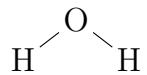
Chinese labels in figure: The figure shows the water molecule with bond angle \(104.5^{\circ}\) and partial charges (\(\delta +\) on H, \(\delta -\) on O).
The O–H bonds are polar bonds. The electronegativity of oxygen is greater than that of hydrogen, so the shared electron pairs shift toward the oxygen atom, giving the oxygen atom a partial negative charge and the hydrogen atoms partial positive charges. Since the hydrogen atoms are located on one side of the molecule, the hydrogen end is positively charged and the oxygen end is negatively charged. Water is a polar molecule.
The trigonal pyramidal ammonia molecule (bond angle between N–H bonds is \(107^{\circ}18'\)) is also a polar molecule.
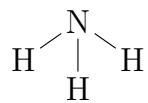
Chinese labels in figure: The figure shows the ammonia molecule with N at the apex and three H atoms at the base of a triangular pyramid.
In the carbon tetrachloride molecule, the carbon atom is located at the center of a regular tetrahedron, and the 4 chlorine atoms are positioned at the 4 vertices of the tetrahedron (with C–Cl bond angles of \(109^{\circ}28'\)), symmetrically arranged around the carbon atom. \(\ce{CCl4}\) is a nonpolar molecule.
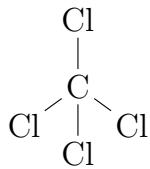
Chinese labels in figure: The figure shows the \(\ce{CCl4}\) molecule with C at the center and 4 Cl atoms at the vertices of a regular tetrahedron.
Fill an acid burette with \(30\ \text{mL}\) of distilled water and clamp it to a burette stand, with a large beaker placed below. Open the stopcock and let the water flow slowly in a thin stream. Bring an electrostatically charged glass rod or plastic rod close to the stream of water and observe whether the direction of the water stream changes.
Repeat the experiment using \(\ce{CCl4}\) in place of water. What phenomenon occurs?
Based on practical experience, solutes composed of polar molecules dissolve readily in solvents composed of polar molecules, and solutes composed of nonpolar molecules dissolve readily in solvents composed of nonpolar molecules. Use this principle to explain the following phenomena:
Hydrogen chloride dissolves readily in water but not readily in gasoline (nonpolar).
Iodine dissolves readily in \(\ce{CCl4}\) but not readily in water.
Paraffin wax (nonpolar) dissolves readily in gasoline but not readily in water.
Can you think of other examples from daily life illustrating the relationship between solubility and polarity?
- A nonpolar bond forms between identical atoms; the shared electron pair is equally shared
- A polar bond forms between different atoms; the shared electron pair shifts toward the more electronegative atom
- Electronegativity measures an atom’s ability to attract bonding electrons; the greater the electronegativity difference, the more polar the bond
- A large electronegativity difference indicates an ionic bond; zero difference indicates a nonpolar bond; intermediate difference indicates a polar bond
- A nonpolar molecule has a symmetric charge distribution (e.g., \(\ce{H2}\), \(\ce{CO2}\), \(\ce{CCl4}\))
- A polar molecule has an asymmetric charge distribution (e.g., \(\ce{HCl}\), \(\ce{H2O}\), \(\ce{NH3}\))
- Polyatomic molecules with polar bonds can be nonpolar if bonds are symmetrically arranged
- “Like dissolves like” — polar solutes dissolve in polar solvents; nonpolar solutes in nonpolar solvents
Exercises for Section 3
What is a nonpolar bond? What is a polar bond? Give examples.
Using electronegativity values, determine the type of chemical bond in each of the following substances:
\(\ce{KBr}\)
\(\ce{CCl4}\)
\(\ce{N2}\)
\(\ce{CaO}\)
\(\ce{H2S}\)
Must a compound containing polar bonds necessarily be a polar molecule? Explain with examples.
Which of the following molecules are nonpolar and which are polar?
\(\ce{NO}\)
\(\ce{H2S}\)
\(\ce{CS2}\) (a linear molecule, with the two S atoms on either side of the C atom)
\(\ce{SO2}\) (bond angle \(120^{\circ}\))
1.4 Section 4: Intermolecular Forces
Van der Waals Forces
Substances such as hydrogen, chlorine, and carbon dioxide are gases at room temperature. When the temperature is lowered and the pressure increased, they can condense into liquids and further solidify into solids. The fact that gaseous substances can be converted to liquids and solids — that is, the molecules can reduce the distances between them and transition from random motion to regular arrangement — demonstrates that intermolecular forces exist. These intermolecular forces are also called van der Waals forces.4
We have learned that chemical bonds are the strong interactions between adjacent atoms as they combine to form molecules. Typical bond energies range from \(30\) to \(200\ \text{kCal/mol}\). In contrast, intermolecular forces are much weaker than chemical bonds, typically only a few kCal per mole. For example, the H–Cl bond energy is \(103.2\ \text{kCal/mol}\), while the intermolecular force between \(\ce{HCl}\) molecules is only \(5.05\ \text{kCal/mol}\).
In essence, intermolecular forces are also electrical attractive forces. For example, polar molecules attract each other through the ends carrying opposite charges. Although nonpolar molecules have a uniform charge distribution overall, at any given instant, the relative motion of the nucleus and the electron cloud can give the molecule an instantaneous polarity, which in turn produces intermolecular attraction.
The magnitude of intermolecular forces affects the melting point, boiling point, solubility, and other properties of a substance. For example, the greater the intermolecular force, the more energy is required to overcome intermolecular attraction in order to melt or vaporize the substance.
Among substances with similar composition and structure, as the molecular mass increases, the intermolecular forces also increase, which is reflected in higher melting and boiling points (see Table 1.6 and Table 1.7).
The magnitude of intermolecular forces depends not only on molecular mass but also on molecular polarity, molecular shape, and other factors.
| Substance | Melting point (\({}^{\circ}\text{C}\)) | Boiling point (\({}^{\circ}\text{C}\)) |
|---|---|---|
| \(\ce{F2}\) | \(-219.6\) | \(-188.1\) |
| \(\ce{Cl2}\) | \(-101.0\) | \(-34.6\) |
| \(\ce{Br2}\) | \(-7.2\) | \(58.78\) |
| \(\ce{I2}\) | \(113.5\) | \(184.4\) |
| Substance | Melting point (\({}^{\circ}\text{C}\)) | Boiling point (\({}^{\circ}\text{C}\)) |
|---|---|---|
| \(\ce{CF4}\) | \(-128\) | \(-128\) |
| \(\ce{CCl4}\) | \(-22.9\) | \(76.5\) |
| \(\ce{CBr4}\) | \(90.1\) | \(189.5\) |
| \(\ce{CI4}\) | \(171\) (decomposes) | — |
Molecular Crystals
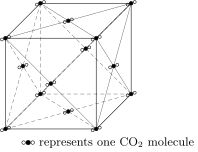
A crystal in which molecules are held together by intermolecular forces is called a molecular crystal. Both nonpolar and polar molecules can form molecular crystals. For example, the halogens, noble gases, oxygen, carbon dioxide, ammonia, and hydrogen halides can all form molecular crystals. Figure 1.19 shows the crystal structure of solid carbon dioxide (dry ice).
Because intermolecular forces are very weak, molecular crystals have relatively low melting points, low boiling points, and low hardness.
The four types of crystals we have studied — ionic crystals, atomic crystals, molecular crystals, and metallic crystals (to be studied in Chapter 6) — and their main properties are summarized in Figure 1.20.

Chinese labels in figure: 晶体类型 = crystal type; 构成微粒 = constituent particles; 微粒间相互作用 = interactions between particles; 物理性质特点 = physical property characteristics; 举例 = examples; 离子晶体 = ionic crystal; 原子晶体 = atomic crystal; 分子晶体 = molecular crystal; 金属晶体 = metallic crystal; 阴、阳离子 = anions and cations; 原子 = atoms; 分子 = molecules; 金属阳离子和自由电子 = metal cations and free electrons; 离子键 = ionic bond; 共价键 = covalent bond; 分子间力 = intermolecular forces; 金属键 = metallic bond; 硬度较大 = relatively high hardness; 熔沸点较高 = relatively high melting/boiling points; 硬度大 = high hardness; 熔沸点高 = high melting/boiling points; 硬度小 = low hardness; 熔沸点低 = low melting/boiling points.
- Intermolecular forces (van der Waals forces) are weak forces between molecules, typically a few kCal/mol — much weaker than chemical bonds (\(30\)–\(200\ \text{kCal/mol}\))
- Intermolecular forces are electrical in nature: polar molecules attract via opposite charges; nonpolar molecules interact through instantaneous dipoles
- For substances of similar composition and structure, intermolecular forces increase with molecular mass, leading to higher melting and boiling points
- A molecular crystal is held together by intermolecular forces; it has low melting points, low boiling points, and low hardness
- Four crystal types: ionic, atomic, molecular, and metallic (to be studied later)
Exercises for Section 4
Why are the melting and boiling points of chlorine very low, while those of sodium chloride are very high?
Why do the melting and boiling points of the noble gases increase with increasing atomic number?
When dry ice melts and vaporizes, do the \(\ce{C=O}\) bonds within the \(\ce{CO2}\) molecules change?
Given that the melting point of \(\ce{BBr3}\) is \(-46\,{}^{\circ}\text{C}\) and the melting point of \(\ce{KBr}\) is \(734\,{}^{\circ}\text{C}\), predict which type of crystal each substance belongs to.
1.5 Section 5: Hydrogen Bonding
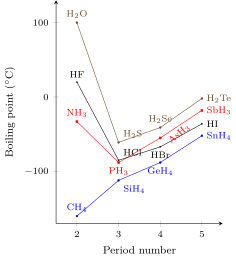
In Section 4, we introduced the fact that for certain similar substances, intermolecular forces increase with molecular mass, and their melting and boiling points rise accordingly. However, the boiling point trends of some hydrides do not entirely conform to this rule. Let us examine Table 1.8 and Figure 1.21.
| Carbon group | Nitrogen group | Oxygen group | Halogen group | ||||
|---|---|---|---|---|---|---|---|
| \(\ce{CH4}\) | \(-160\) | \(\ce{NH3}\) | \(-33\) | \(\ce{H2O}\) | \(100\) | \(\ce{HF}\) | \(20\) |
| \(\ce{SiH4}\) | \(-112\) | \(\ce{PH3}\) | \(-88\) | \(\ce{H2S}\) | \(-61\) | \(\ce{HCl}\) | \(-85\) |
| \(\ce{GeH4}\) | \(-88\) | \(\ce{AsH3}\) | \(-55\) | \(\ce{H2Se}\) | \(-41\) | \(\ce{HBr}\) | \(-67\) |
| \(\ce{SnH4}\) | \(-52\) | \(\ce{SbH3}\) | \(-18\) | \(\ce{H2Te}\) | \(-2\) | \(\ce{HI}\) | \(-36\) |
From Table 1.8 and Figure 1.21, we can see that the boiling points of the carbon-group hydrides increase steadily with increasing molecular mass, conforming to the rule described in the previous section. However, among the hydrides of the nitrogen group, oxygen group, and halogen group, \(\ce{NH3}\), \(\ce{H2O}\), and \(\ce{HF}\) exhibit anomalously high boiling points. For example, based on the downward trend of the boiling point curve, the boiling point of \(\ce{HF}\) should be below \(-90\,{}^{\circ}\text{C}\), but it is actually \(+20\,{}^{\circ}\text{C}\). The boiling point of \(\ce{H2O}\) should be below \(-70\,{}^{\circ}\text{C}\) based on the trend, yet it is actually \(+100\,{}^{\circ}\text{C}\).
Why do \(\ce{HF}\), \(\ce{H2O}\), and \(\ce{NH3}\) exhibit anomalous boiling points? This is because their molecules form a type of interaction called hydrogen bonds, which strengthens the intermolecular attractions. These hydrogen bonds cause \(\ce{HF}\), \(\ce{H2O}\), and \(\ce{NH3}\) to require higher temperatures for vaporization.
Formation of Hydrogen Bonds
How are hydrogen bonds formed? Let us use \(\ce{HF}\) as an example. In the \(\ce{HF}\) molecule, because fluorine has a very high electronegativity, the H–F bond is strongly polar, and the shared electron pair is strongly displaced toward the F atom. In other words, the electron cloud of the H atom is attracted by the F atom, leaving the H atom nearly as a “bare” proton. This very small, partially positive hydrogen nucleus allows a partially negative fluorine atom from a neighboring molecule to approach it closely, generating electrostatic attraction. This forms a hydrogen bond. The distance between the two fluorine nuclei is the hydrogen bond length.
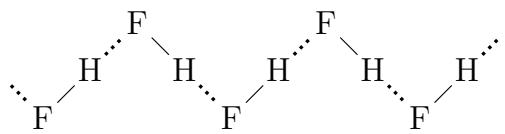
Chinese labels in figure: The diagram shows the hydrogen bond \(\ce{F-H\cdots F}\) between two HF molecules, with the hydrogen bond length indicated between the two F nuclei.
A hydrogen bond is generally represented as \(\ce{X-H\cdots Y}\), where X and Y represent nonmetal atoms with high electronegativity and small atomic radii, such as F, O, and N. The distance between the X and Y nuclei is the hydrogen bond length. In \(\ce{X-H\cdots Y}\), the H atom can bond with only one Y atom, so hydrogen bonds exhibit saturation. Because the X–H bond axis tends to align with the direction of the lone pair on the Y atom, hydrogen bonds are strongest when the three atoms X, H, and Y lie along a straight line. Thus, hydrogen bonds also exhibit directionality.
The bond energy of hydrogen bonds is below \(10\ \text{kCal/mol}\), which is much smaller than covalent bond energies but somewhat larger than van der Waals forces. The formation of intermolecular hydrogen bonds raises the melting and boiling points of a substance, because melting solids or vaporizing liquids requires breaking intermolecular hydrogen bonds, which consumes additional energy.
The strength of a hydrogen bond is related to the electronegativity of X and Y — the greater their electronegativity, the stronger the hydrogen bond. It is also related to the atomic radius of Y — the smaller the radius of Y, the more easily it can approach X–H, making the hydrogen bond stronger. For example, since the F atom has the highest electronegativity and a very small radius, \(\ce{F-H\cdots F}\) is the strongest hydrogen bond. Although the Cl atom has a high electronegativity, its large atomic radius means that \(\ce{Cl-H\cdots Cl}\) hydrogen bonds are very weak. The C atom has a relatively low electronegativity and generally does not form hydrogen bonds. This explains why \(\ce{HF}\), \(\ce{H2O}\), and \(\ce{NH3}\) have anomalous boiling points, while the boiling points of \(\ce{HCl}\) and \(\ce{CH4}\) follow the trend predicted by van der Waals forces.
In water molecules, the O atom also has a high electronegativity and a relatively small radius, so strong hydrogen bonds form between water molecules.
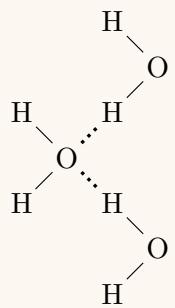
Chinese labels in figure: The figure shows hydrogen bonding between water molecules, with covalent bonds (solid lines) and hydrogen bonds (dotted lines) forming a network.
From the diagram above, we can see that each water molecule has the oxygen atom bonded to hydrogen atoms by two covalent bonds and two hydrogen bonds.
In water vapor, water exists as individual \(\ce{H2O}\) molecules. In liquid water, several water molecules are frequently linked together through hydrogen bonds to form \((\ce{H2O})_n\). In solid water (ice), water molecules are all connected by hydrogen bonds. It is evident that as the temperature decreases, the number of hydrogen bonds formed increases.
- Hydrogen bonds form when a partially positive H atom (bonded to a highly electronegative atom X) attracts a nearby highly electronegative atom Y with lone pairs
- Represented as \(\ce{X-H\cdots Y}\), where X and Y are typically F, O, or N
- Hydrogen bonds have both saturation and directionality
- Hydrogen bond energy is below \(10\ \text{kCal/mol}\) — weaker than covalent bonds but stronger than van der Waals forces
- Hydrogen bonds explain the anomalously high boiling points of \(\ce{HF}\), \(\ce{H2O}\), and \(\ce{NH3}\)
- In water: vapor contains single \(\ce{H2O}\) molecules; liquid water contains hydrogen-bonded clusters \((\ce{H2O})_n\); ice is a complete hydrogen-bonded network
Exercises for Section 5
Why is the boiling point of \(\ce{HF}\) much higher than those of \(\ce{HCl}\) and \(\ce{HBr}\)?
Why is the boiling point of \(\ce{H2O}\) much higher than those of \(\ce{H2S}\) and \(\ce{H2Se}\)?
Why is the chemical formula of liquid hydrogen fluoride sometimes written as \((\ce{HF})_n\)?
Why is ammonia easily liquefied? Why does ammonia dissolve readily in water? (Hint: ammonia forms hydrogen bonds when dissolved in water.)
Compare the similarities and differences between hydrogen bonds and covalent bonds.
Content Summary
Chemical bond: When atoms combine to form molecules, the strong interaction between two or more adjacent atoms is called a chemical bond.
Main types of chemical bonds:
- Ionic bond
- Covalent bond
- Nonpolar bond
- Polar bond
- Metallic bond (to be studied in Chapter 6)
Ionic bond: A chemical bond formed between anions and cations through electrostatic interactions is called an ionic bond.
Covalent bond: A chemical bond formed between atoms through shared electron pairs (electron cloud overlap) is called a covalent bond. Covalent bonds possess saturation and directionality.
Nonpolar bond: When the same kinds of atoms form a covalent bond, the shared electron pair is not displaced toward either atom. Such a covalent bond is called a nonpolar bond.
Polar bond: When different kinds of atoms form a covalent bond, the shared electron pair is displaced toward the atom with greater electron-attracting ability (which is measured by electronegativity). Such a covalent bond is called a polar bond.
A covalent bond in which the electron pair is provided entirely by one atom and shared with another atom is called a coordinate bond.
Nonpolar and polar molecules:
Molecules composed of nonpolar bonds are nonpolar molecules.
For molecules composed of polar bonds: if the charge distribution in space is symmetric, the molecule is nonpolar; if the charge distribution in space is asymmetric, the molecule is polar.
Intermolecular forces:
Intermolecular forces, also called van der Waals forces, are essentially electrical attractive forces. They are much weaker than chemical bonds, typically only a few kCal per mole. The magnitude of intermolecular forces affects the melting point, boiling point, solubility, and other properties of a substance.
Hydrogen bonds:
Hydrogen bonds are generally represented as \(\ce{X-H\cdots Y}\), where X and Y represent nonmetal atoms with high electronegativity and small atomic radii, such as F, O, and N. The bond energy of hydrogen bonds is below \(10\ \text{kCal/mol}\), much smaller than covalent bond energies but somewhat larger than van der Waals forces.
Review Exercises
Give an example of a compound that contains ionic bonds, covalent bonds, and coordinate bonds.
Using bond energy data, determine whether the energy change in each of the following reactions is exothermic or endothermic, and calculate the magnitude of the energy change.
\(\ce{H + I = HI}\)
\(\ce{Cl + Cl = Cl2}\)
Using electronegativity data, identify which bond has the smallest polarity and which has the greatest polarity in each of the following groups of compounds:
\(\ce{NaCl}\), \(\ce{MgCl2}\), \(\ce{AlCl3}\), \(\ce{SiCl4}\), \(\ce{PCl5}\)
\(\ce{LiF}\), \(\ce{NaF}\), \(\ce{KF}\), \(\ce{RbF}\), \(\ce{CsF}\)
\(\ce{HF}\), \(\ce{HCl}\), \(\ce{HBr}\), \(\ce{HI}\)
Based on the following properties, predict which type of crystal each substance forms in the solid state:
Crystalline silicon is a hard, brittle solid with a melting point of \(1410\,{}^{\circ}\text{C}\), a boiling point of \(2355\,{}^{\circ}\text{C}\), and is insoluble in ordinary solvents.
Sulfur is typically a pale yellow crystal with a melting point of \(112.8\,{}^{\circ}\text{C}\), a boiling point of \(444.6\,{}^{\circ}\text{C}\), and is readily soluble in carbon disulfide.
Calcium chloride is a colorless crystal with a melting point of \(782\,{}^{\circ}\text{C}\), a boiling point of \(1600\,{}^{\circ}\text{C}\). It dissolves readily in water, and its aqueous solution conducts electricity.
Methane is a colorless gas with a melting point of \(-182.5\,{}^{\circ}\text{C}\) and a boiling point of \(-164\,{}^{\circ}\text{C}\). It dissolves readily in gasoline and other organic solvents.
Do hydrogen bonds form between \(\ce{HCl}\) molecules or between \(\ce{CH4}\) molecules? Why? What properties of these substances support your conclusion?
Describe the types of chemical bonds in the \(\ce{H2O}\) molecule and the \(\ce{H3O+}\) ion.
For each of the following substances, identify the type of chemical bond between the atoms:
Hydrogen bromide
Barium chloride
Ammonium chloride
Diamond
Ammonia
If we imagine that no hydrogen bonds existed between water molecules, in what temperature range would the boiling point of water fall? Imagine what the surface of the Earth would look like under those conditions.
Translator’s note: In modern chemistry, \(\ce{NaCl}\) is called a formula unit rather than a molecule. The text’s distinction between “chemical formula” and “molecular formula” is consistent with current usage.↩︎
Translator’s note: Modern chemistry uses kilojoules (kJ) rather than kilocalories (kCal). \(1\ \text{kCal} = 4.184\ \text{kJ}\). Thus, \(104.2\ \text{kCal/mol} \approx 436\ \text{kJ/mol}\).↩︎
Translator’s note: The fourth electron participates in delocalized \(\pi\) bonding across the layer. This delocalized electron gives graphite its electrical conductivity along the layers and its dark, lustrous appearance.↩︎
Translator’s note: Named after the Dutch physicist Johannes Diderik van der Waals (1837–1923), who first proposed these forces to explain the behavior of real gases.↩︎