5 Electrolyte Solutions
After studying this chapter, you should be able to:
- Distinguish between strong and weak electrolytes and explain why they differ in conductivity
- Define ionization degree and ionization constant, and use them to compare the relative strength of weak electrolytes
- Explain the ionization of water and the concept of the ion product constant \(K_w\)
- Define pH and calculate the pH of solutions of strong acids, strong bases, and weak electrolytes
- Explain why certain salts undergo hydrolysis and predict whether a salt solution is acidic, basic, or neutral
- Define the gram-equivalent and equivalent concentration of acids and bases, and apply the formula \(N_1 V_1 = N_2 V_2\)
- Describe the procedure of acid-base neutralization titration and the concept of heat of neutralization
- Explain the working principle of galvanic (primary) cells and the electrochemical corrosion and protection of metals
- Describe the principles of electrolysis and electroplating, and distinguish anodic from cathodic reactions
We have already learned some introductory knowledge about electrolyte solutions and ionic reactions. Now, applying what we have learned about the structure of matter and chemical equilibrium, we will further study the properties of electrolyte solutions, gain a deeper understanding of the reactions that acids, bases, and salts undergo in aqueous solutions, and learn the chemical principles behind galvanic cells, electrolysis, electroplating, and related processes.
5.1 Section 1: Strong and Weak Electrolytes
Acids, bases, and salts are all electrolytes, and their aqueous solutions can all conduct electricity. Let us now investigate the following question: under identical conditions, do aqueous solutions of different acids, bases, and salts with the same volume and same concentration all have the same ability to conduct electricity?
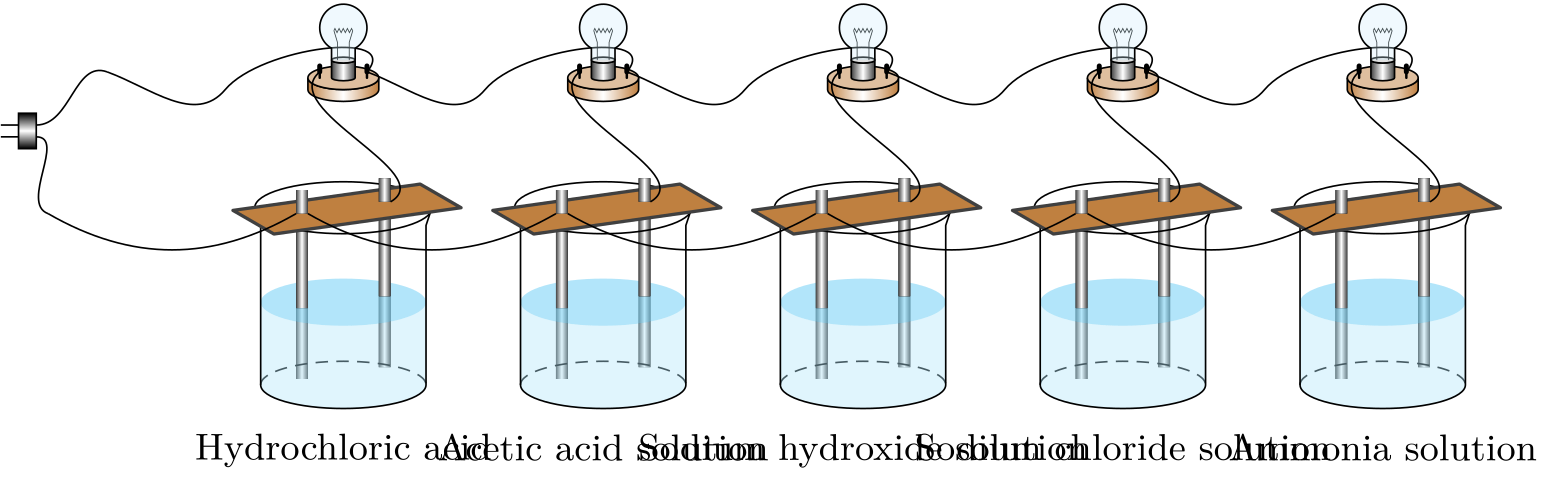
Set up the apparatus as shown in Figure 5.1, then pour equal volumes of \(0.5\ M\) hydrochloric acid, ammonia solution, \(0.5\ M\) acetic acid, \(0.5\ M\) sodium hydroxide solution, and \(0.5\ M\) sodium chloride solution into five separate beakers and connect the circuit. Observe the brightness of the light bulbs carefully.
The experimental results show that the light bulbs connected to the electrodes immersed in acetic acid solution and ammonia solution are dimmer than the other three. Clearly, aqueous solutions of different types of acids, bases, and salts at the same volume and concentration do not have equal conductivity under the same conditions. The solutions of hydrochloric acid, sodium hydroxide, and sodium chloride conduct electricity more strongly than those of ammonia and acetic acid.
Why is this? Because electrolyte solutions conduct electricity due to the presence of freely moving ions. The conductivity of a solution depends on the number of freely moving ions per unit volume. In other words, among solutions of equal volume and concentration, a solution with stronger conductivity must contain more freely moving ions than one with weaker conductivity. This tells us that different electrolytes ionize to different extents in solution.
We know that ionic compounds are composed of anions and cations. When we place crystals of the ionic compound sodium chloride into water, under the action of water molecules, the anions \(\ce{Cl^-}\) and cations \(\ce{Na^+}\) gradually detach from the crystal surface and enter the solution, becoming freely moving hydrated chloride ions and hydrated sodium ions. In the aqueous solution of any ionic compound, the anions and cations are similarly acted upon by water molecules, becoming hydrated anions and hydrated cations.
For simplicity, we customarily use the ordinary ion symbols to represent hydrated ions. For example:
\[ \ce{NaCl} = \ce{Na^+} + \ce{Cl^-} \]
\[ \ce{NaOH} = \ce{Na^+} + \ce{OH^-} \]
Experiments have shown that most salts and strong bases are ionic compounds. In their aqueous solutions, only hydrated ions are present; no molecules exist.
Covalent compounds with polar bonds exist as molecules. For example, in liquid hydrogen chloride, only hydrogen chloride molecules are present and no ions exist. In the hydrogen chloride molecule, because the electronegativity of the chlorine atom is greater than that of the hydrogen atom, the covalent bond between hydrogen and chlorine is a polar bond. When hydrogen chloride molecules dissolve in water, under the action of water molecules, they can be completely ionized into hydrated hydrogen ions and hydrated chloride ions, so that no hydrogen chloride molecules remain in solution. Other strong acids such as sulfuric acid and nitric acid behave like hydrogen chloride: in their aqueous solutions, only hydrated hydrogen ions and hydrated acid-radical ions are present.
Because the hydrogen ion is a “bare” proton (what remains of a hydrogen atom after it loses its electron is a nucleus consisting of a single proton), it has a very small radius and is easily attracted by water molecules to form the hydronium ion, commonly written as \(\ce{H3O^+}\). For simplicity, we also often write \(\ce{H3O^+}\) as \(\ce{H^+}\).
However, certain covalent compounds with polar bonds, when dissolved in water, undergo the same interaction with water molecules but only partially ionize into ions. When ions collide with each other, they can attract one another and recombine into molecules. Therefore, the ionization of such polar covalent compounds in water is a reversible process. Like a reversible chemical reaction, this reversible ionization process eventually reaches equilibrium. During ionization, the rate at which molecules ionize into ions decreases as the concentration of ions in solution gradually increases, while the rate at which ions recombine into molecules steadily increases. At a given set of conditions (such as temperature and concentration), when these two rates become equal, the ionization process reaches a state of equilibrium called ionization equilibrium. Like chemical equilibrium, ionization equilibrium is a dynamic equilibrium. At equilibrium, the number of molecules that ionize per unit time equals the number of molecules regenerated from ion recombination; that is, both the ion concentrations and the molecular concentration in solution remain constant. Therefore, the ionization of such polar covalent compounds in water is commonly represented by reversible ionization equations. For example, the ionization of acetic acid and ammonia solution can be written as follows:
\[ \ce{CH3COOH} \rightleftharpoons \ce{H^+} + \ce{CH3COO^-} \]
\[ \ce{NH3 * H2O} \rightleftharpoons \ce{NH4^+} + \ce{OH^-} \]
It is evident that in solutions of this type of electrolyte, both ions and electrolyte molecules coexist.
From the three situations described above, we can conclude: ionic compounds and certain covalent compounds with polar bonds ionize completely into ions in aqueous solution, with no molecules remaining. Therefore, no equilibrium between molecules and ions exists, and such electrolytes are classified as strong electrolytes. Strong electrolytes are fully ionized into ions in aqueous solution. Strong acids, strong bases, and most salts are strong electrolytes. Certain covalent compounds with polar bonds only partially ionize into ions in aqueous solution, with un-ionized electrolyte molecules still present, and an ionization equilibrium exists between molecules and ions. Such electrolytes are classified as weak electrolytes. Weak electrolytes are only partially ionized into ions in aqueous solution. Weak acids and weak bases are weak electrolytes.
- Electrolyte solutions conduct electricity because of freely moving ions; conductivity depends on the number of ions per unit volume
- Strong electrolytes (strong acids, strong bases, most salts) ionize completely in aqueous solution — no un-ionized molecules remain
- Weak electrolytes (weak acids, weak bases) only partially ionize in aqueous solution — an ionization equilibrium exists between molecules and ions
- Ionic compounds and certain strongly polar covalent compounds are strong electrolytes; weakly polar covalent compounds that only partially ionize are weak electrolytes
Exercises for Section 1
Are there ions in a sodium chloride crystal? Why must sodium chloride be in aqueous solution or in the molten state in order to conduct electricity?
Are there ions in a hydrogen chloride molecule? Why can an aqueous solution of hydrogen chloride conduct electricity, while pure liquid hydrogen chloride cannot?
Among the following substances, which can conduct electricity? Why? Write ionization equations for those that can. Which cannot conduct electricity? Why?
Aqueous solution of potassium hydroxide
Potassium chloride crystals
Aqueous solution of acetic acid
Pure (glacial) acetic acid
Chlorine water
Liquid chlorine
In a conductivity apparatus, when concentrated acetic acid solution is used, the light is very dim; the same result is obtained with concentrated ammonia solution. However, when these two solutions are mixed together and tested, the light becomes very bright. Why?
5.2 Section 2: Ionization Degree and Ionization Constant
I. Ionization Degree
Different weak electrolytes ionize to different extents in aqueous solution. Some ionize to a greater extent, others to a lesser extent. The magnitude of this ionization can be expressed using the ionization degree. The ionization degree of an electrolyte is the percentage of electrolyte molecules that have ionized at equilibrium, relative to the original total number of molecules (including both ionized and un-ionized). The ionization degree is commonly denoted by the symbol \(\alpha\):
\[ \alpha = \frac{\text{number of ionized electrolyte molecules}}{\text{total number of electrolyte molecules originally in solution}} \times 100\% \]
For example, at \(25\,{}^{\circ}\text{C}\), in a \(0.1\ M\) acetic acid solution, out of every 10,000 acetic acid molecules, 132 have ionized into ions. The ionization degree is:
\[ \alpha = \frac{132}{10000} \times 100\% = 1.32\% \]
Table 5.1 lists the ionization degrees of several common weak electrolytes.
| Electrolyte | Formula | Ionization degree (%) | Electrolyte | Formula | Ionization degree (%) |
|---|---|---|---|---|---|
| Hydrofluoric acid | \(\ce{HF}\) | 8.0 | Acetic acid | \(\ce{CH3COOH}\) | 1.32 |
| Nitrous acid | \(\ce{HNO2}\) | 7.16 | Hydrocyanic acid | \(\ce{HCN}\) | 0.01 |
| Formic acid | \(\ce{HCOOH}\) | 4.24 | Ammonia solution | \(\ce{NH3 * H2O}\) | 1.33 |
From Table 5.1, we can see that under the same conditions, different weak electrolytes have different ionization degrees, which are determined by the relative strength of the weak electrolyte. Generally speaking, the weaker the electrolyte, the smaller its ionization degree. Therefore, the ionization degree can indicate the relative strength of weak electrolytes.
The ionization degree depends not only on the nature of the electrolyte but also on the concentration and temperature of the solution. For the same weak electrolyte, the more dilute the solution, the fewer opportunities ions have to collide and recombine into molecules, so the ionization degree increases. For example, at \(25\,{}^{\circ}\text{C}\), the ionization degree of \(0.2\ M\) \(\ce{CH3COOH}\) is \(0.948\%\); that of \(0.1\ M\) \(\ce{CH3COOH}\) is \(1.32\%\); and that of \(0.001\ M\) \(\ce{CH3COOH}\) is \(13.2\%\). Temperature also affects the ionization degree of electrolytes. Since ionization of electrolyte molecules into ions generally requires absorption of heat, raising the temperature generally shifts the equilibrium toward ionization, thereby increasing the ionization degree. Therefore, when stating the ionization degree of a weak electrolyte, one should specify the concentration and temperature of the solution. If no temperature is stated, it is usually understood to be \(25\,{}^{\circ}\text{C}\).
II. Ionization Constant
When a weak electrolyte reaches ionization equilibrium under given conditions, the relationship among the concentrations of the various species in solution follows the same pattern as chemical equilibrium. For a monoprotic weak acid or a monobasic weak base, the product of the molar concentrations of the ions produced by ionization, divided by the molar concentration of un-ionized molecules, is a constant. This constant is called the ionization equilibrium constant, or simply the ionization constant. Taking acetic acid as an example, the ionization equation of acetic acid in aqueous solution is:
\[ \ce{CH3COOH} \rightleftharpoons \ce{H^+} + \ce{CH3COO^-} \]
At equilibrium, the relationship between the ion concentrations and the un-ionized molecular concentration can be expressed as:
\[ \frac{[\ce{CH3COO^-}][\ce{H^+}]}{[\ce{CH3COOH}]} = K_\text{ionization} \]
where \([\ce{CH3COO^-}]\) and \([\ce{H^+}]\) represent the molar concentrations of acetate ions and hydrogen ions in solution, \([\ce{CH3COOH}]\) represents the molar concentration of un-ionized acetic acid molecules, and \(K_\text{ionization}\) represents the ionization constant of acetic acid.
From the expression for acetic acid’s ionization constant, we can see that a larger \(K_\text{ionization}\) necessarily means a larger ion concentration, indicating that the electrolyte ionizes more readily. Therefore, the magnitude of \(K_\text{ionization}\) also reveals the relative strength of weak electrolytes. For example, both acetic acid and hydrocyanic acid are weak acids. At \(25\,{}^{\circ}\text{C}\), the \(K_\text{ionization}\) of \(0.1\ M\) acetic acid is \(1.75 \times 10^{-5}\), while the \(K_\text{ionization}\) of \(0.1\ M\) hydrocyanic acid is \(4.93 \times 10^{-10}\). Therefore, hydrocyanic acid is a weaker acid than acetic acid.
For dilute solutions of the same weak electrolyte, the ionization constant, like the chemical equilibrium constant, does not change with concentration but only with temperature. For example, at \(25\,{}^{\circ}\text{C}\) the \(K_\text{ionization}\) of acetic acid is \(1.75 \times 10^{-5}\), while at \(0\,{}^{\circ}\text{C}\) it is \(1.65 \times 10^{-5}\). Since the ionization constant changes only slightly with temperature, at room temperature one can generally neglect the effect of temperature on the ionization constant.
Let us now briefly discuss the ionization of polyprotic weak acids and weak bases.
The ionization of polyprotic weak acids proceeds stepwise. For example:
\[ \ce{H3PO4} \rightleftharpoons \ce{H^+} + \ce{H2PO4^-} \]
\[ \ce{H2PO4^-} \rightleftharpoons \ce{H^+} + \ce{HPO4^{2-}} \]
\[ \ce{HPO4^{2-}} \rightleftharpoons \ce{H^+} + \ce{PO4^{3-}} \]
Each step of ionization has its own ionization constant, and these constants differ from one another. They are usually distinguished as \(K_1\), \(K_2\), \(K_3\), etc. Different electrolytes have different ionization constants. Table 5.2 lists the ionization constants of several common weak electrolytes.
| Electrolyte | Ionization constant | Electrolyte | Ionization constant |
|---|---|---|---|
| Acetic acid \(\ce{CH3COOH}\) | \(1.75 \times 10^{-5}\) | Phosphoric acid \(\ce{H3PO4}\) | \(K_1 = 7.52 \times 10^{-3}\), \(K_2 = 6.23 \times 10^{-8}\), \(K_3 = 2.2 \times 10^{-13}\) |
| Carbonic acid \(\ce{H2CO3}\) | \(K_1 = 4.3 \times 10^{-7}\), \(K_2 = 5.6 \times 10^{-11}\) | Sulfurous acid \(\ce{H2SO3}\) | \(K_1 = 1.54 \times 10^{-2}\) (\(18\,{}^{\circ}\text{C}\)), \(K_2 = 1.02 \times 10^{-7}\) (\(18\,{}^{\circ}\text{C}\)) |
| Hydrocyanic acid \(\ce{HCN}\) | \(K = 4.93 \times 10^{-10}\) | Hydrosulfuric acid \(\ce{H2S}\) | \(K_1 = 9.1 \times 10^{-8}\) (\(18\,{}^{\circ}\text{C}\)), \(K_2 = 1.1 \times 10^{-12}\) (\(18\,{}^{\circ}\text{C}\)) |
| Hydrofluoric acid \(\ce{HF}\) | \(K = 7.2 \times 10^{-4}\) | Ammonia solution \(\ce{NH3 * H2O}\) | \(1.77 \times 10^{-5}\) |
Comparing the ionization constants for the successive ionization steps of polyprotic weak acids, we can see that \(K_1 > K_2 > K_3\). Taking phosphoric acid as an example, \(K_1\) is about \(10^5\) times greater than \(K_2\), and \(K_2\) is about \(10^5\) times greater than \(K_3\). This shows that the acidity of a polyprotic weak acid solution is primarily determined by the first ionization step.
The ionization of monobasic and polybasic weak bases follows a pattern similar to that of monoprotic and polyprotic weak acids.
We have already mentioned that both the ionization constant and the ionization degree can express the relative strength of weak electrolytes. What then is the relationship between them? Let us use \(\ce{CH3COOH}\) as an example to illustrate.
Let the molar concentration of acetic acid molecules in solution be \(c\) and the ionization degree of acetic acid be \(\alpha\). Then for every \(c\alpha\ \text{mol/L}\) of acetic acid that ionizes, \(c\alpha\ \text{mol/L}\) of \(\ce{H^+}\) ions and \(c\alpha\ \text{mol/L}\) of \(\ce{CH3COO^-}\) ions are produced. That is:
\[ [\ce{H^+}] = [\ce{CH3COO^-}] = c\alpha \]
The ionization equation for acetic acid is:
\[ \ce{CH3COOH} \rightleftharpoons \ce{H^+} + \ce{CH3COO^-} \]
| \(\ce{CH3COOH}\) | \(\ce{H^+}\) | \(\ce{CH3COO^-}\) | |
|---|---|---|---|
| Initial concentration | \(c\) | \(0\) | \(0\) |
| Equilibrium concentration | \(c - c\alpha\) | \(c\alpha\) | \(c\alpha\) |
\[ K_\text{ionization} = \frac{[\ce{H^+}][\ce{CH3COO^-}]}{[\ce{CH3COOH}]} = \frac{c\alpha \cdot c\alpha}{c - c\alpha} = \frac{c\alpha^2}{1 - \alpha} \]
For weak electrolytes, when \(K_\text{ionization}\) is very small (\(K_\text{ionization} < 10^{-4}\)), \(\alpha\) is also very small, so we can approximate \(1 - \alpha \approx 1\). Then:
\[ K_\text{ionization} = \frac{c\alpha^2}{1 - \alpha} \approx c\alpha^2 \]
\[ \alpha = \sqrt{\frac{K_\text{ionization}}{c}} \]
This formula shows that at a given temperature, when the concentration \(c\) of the solution changes, the ionization degree \(\alpha\) changes accordingly — the higher the concentration, the smaller the ionization degree. We already know that the ionization constant \(K_\text{ionization}\) does not change with concentration.
It follows that the ionization constant is a better measure of the relative strength of weak electrolytes than the ionization degree.
Having established the relationship between ionization degree and ionization constant, let us now apply it to some simple calculations.
At \(25\,{}^{\circ}\text{C}\), what is the hydrogen ion concentration in a \(0.10\ M\) acetic acid solution?
Solution: Given \(c = 0.10\ M\), \(K_\text{ionization} = 1.75 \times 10^{-5}\).
\[ \alpha = \sqrt{\frac{K_\text{ionization}}{c}} = \sqrt{\frac{1.75 \times 10^{-5}}{0.10}} = 1.32 \times 10^{-2} \]
\[ [\ce{H^+}] = c\alpha = 0.1 \times 1.32 \times 10^{-2} = 1.32 \times 10^{-3}\ M \]
Answer: The hydrogen ion concentration in \(0.1\ M\) acetic acid solution is \(1.32 \times 10^{-3}\ M\).
At a certain temperature, the ionization degree of \(0.20\ M\) ammonia solution is \(0.934\%\). Find the ionization constant of ammonia solution.
Solution: Given \(c = 0.20\ M\), \(\alpha = 0.934\% = 0.00934\). Substituting into:
\[ K_\text{ionization} = c\alpha^2 \]
\[ K_\text{ionization} = 0.20 \times (0.00934)^2 = 1.74 \times 10^{-5} \]
Answer: At this temperature, the ionization constant of ammonia solution is \(1.74 \times 10^{-5}\).
- The ionization degree \(\alpha\) is the fraction (%) of electrolyte molecules that have ionized at equilibrium
- Ionization degree depends on the nature of the electrolyte, the concentration, and the temperature: more dilute solutions have larger ionization degrees
- The ionization constant \(K_\text{ionization}\) equals the product of ion concentrations divided by the un-ionized molecule concentration at equilibrium
- For a monoprotic weak acid: \(K_\text{ionization} \approx c\alpha^2\) (when \(\alpha\) is small) and \(\alpha = \sqrt{K_\text{ionization}/c}\)
- Polyprotic weak acids ionize stepwise, with \(K_1 > K_2 > K_3\); solution acidity is mainly determined by the first ionization
- The ionization constant is independent of concentration and is a better measure of electrolyte strength than ionization degree
Exercises for Section 2
Compare the relative strengths of acetic acid, hydrocyanic acid, and hydrofluoric acid.
Why does the ionization degree of a weak electrolyte depend on the concentration of the solution?
In \(1\ \text{L}\) of a \(2\ \text{mol}\) electrolyte solution, \(0.2\ \text{mol}\) of the electrolyte has ionized. What is the ionization degree of this electrolyte?
In a hydrofluoric acid solution, \(0.2\ \text{mol}\) of hydrogen fluoride has ionized and \(1.8\ \text{mol}\) remains un-ionized. Find the ionization degree of hydrogen fluoride in this solution.
If an electrolyte has a large ionization degree, does that necessarily mean its solution has strong conductivity?
Which of the following two solutions has the greater hydrogen ion concentration? Why?
\(1\ \text{L}\) of \(0.1\ M\) acetic acid solution
\(1\ \text{L}\) of \(0.01\ M\) acetic acid solution
At \(25\,{}^{\circ}\text{C}\), the \(K_\text{ionization}\) of hydrocyanic acid is \(4.93 \times 10^{-10}\). Calculate the ionization degree of \(0.01\ M\) hydrocyanic acid.
The ionization degree of \(0.1\ M\) acetic acid solution is \(1.32\%\). Find \(K_\text{ionization}\) of acetic acid.
Carbonic acid is a weak acid. Write its ionization equations and indicate which types of ions are present in the solution. Which ion has the highest concentration? Which has the lowest?
5.3 Section 3: Water Ionization and pH
When studying electrolyte solutions, we often need to consider the acidity or basicity of the solution. The acidity or basicity of an electrolyte solution is closely related to the ionization of water. To understand the nature of solution acidity and basicity, we must study how water ionizes.
I. Ionization of Water
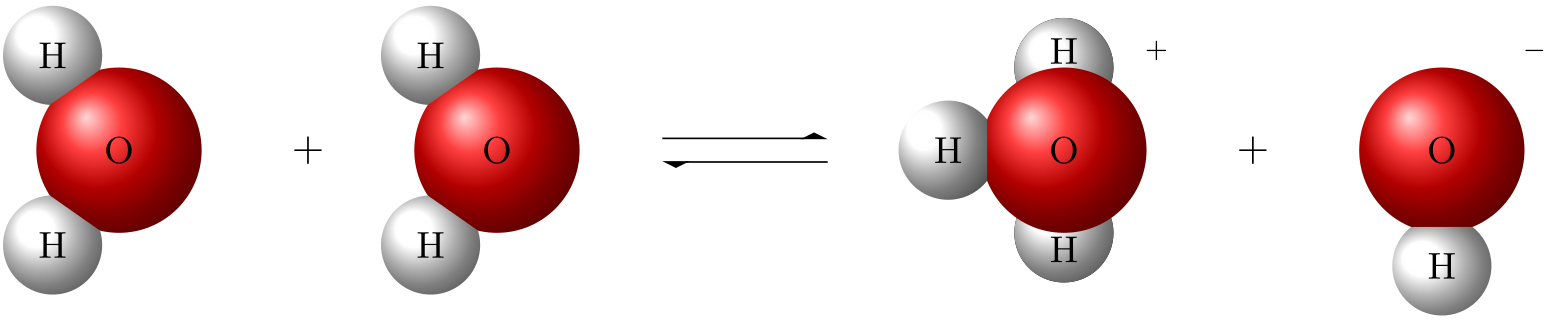
Precise experiments have shown that water is an extremely weak electrolyte that undergoes very slight ionization, producing \(\ce{H3O^+}\) and \(\ce{OH^-}\):
\[ \ce{H2O + H2O} \rightleftharpoons \ce{H3O^+ + OH^-} \]
This can be simplified to:
\[ \ce{H2O} \rightleftharpoons \ce{H^+ + OH^-} \]
From conductivity measurements of pure water, it has been determined that at \(25\,{}^{\circ}\text{C}\), the concentrations of \(\ce{H^+}\) and \(\ce{OH^-}\) in pure water are each equal to \(10^{-7}\ \text{mol/L}\). At a given temperature, like any other weak electrolyte, water has an ionization constant:
\[ K_\text{ionization} = \frac{[\ce{H^+}][\ce{OH^-}]}{[\ce{H2O}]} \]
Because the ionization degree of water is so small, out of the \(55.5\ \text{mol}\) of water molecules in one liter of water, only \(10^{-7}\ \text{mol}\) ionize. The ionized fraction is negligible, so the number of moles of water molecules remains virtually unchanged before and after ionization and can be treated as a constant. The expression above can therefore be rewritten as:
\[ [\ce{H^+}][\ce{OH^-}] = K_\text{ionization} \cdot [\ce{H2O}] \]
Since \(K_\text{ionization}\) is a constant and \([\ce{H2O}]\) can also be treated as a constant, the product of two constants is a new constant, which we write as \(K_w\):
\[ [\ce{H^+}][\ce{OH^-}] = K_w \]
\(K_w\) is the product of \([\ce{H^+}]\) and \([\ce{OH^-}]\) in water. We call \(K_w\) the ion product constant of water, or simply the ion product of water. What is the value of \(K_w\)? We know that at \(25\,{}^{\circ}\text{C}\), both \([\ce{H^+}]\) and \([\ce{OH^-}]\) in water are \(1 \times 10^{-7}\ \text{mol/L}\). Therefore:
\[ K_w = [\ce{H^+}][\ce{OH^-}] = 1 \times 10^{-7} \times 1 \times 10^{-7} = 1 \times 10^{-14} \]
Since the ionization of water is an endothermic process, when the temperature rises, the degree of ionization of water increases and the ion product also increases. At \(100\,{}^{\circ}\text{C}\), \(K_w = 1 \times 10^{-12}\), which is about 100 times larger than \(1 \times 10^{-14}\). However, at room temperature, \(K_w\) can generally be taken as \(1 \times 10^{-14}\).
II. Solution Acidity/Basicity and pH
The product of \([\ce{H^+}]\) and \([\ce{OH^-}]\) is a constant equal to \(1 \times 10^{-14}\). Because of the ionization equilibrium of water, this is true not only in pure water but also in dilute acidic or basic solutions. At room temperature, in a neutral solution the hydrogen ion concentration equals the hydroxide ion concentration, both being \(1 \times 10^{-7}\ \text{mol/L}\). In an acidic solution, it is not that \(\ce{OH^-}\) is absent, but simply that \(\ce{H^+}\) is more abundant. In a basic solution, it is not that \(\ce{H^+}\) is absent, but simply that \(\ce{OH^-}\) is more abundant. In short, regardless of whether a dilute solution is acidic, basic, or neutral, at room temperature the product of \([\ce{H^+}]\) and \([\ce{OH^-}]\) is always \(1 \times 10^{-14}\). Thus, knowing the \(\ce{H^+}\) concentration of a solution allows us to determine the \(\ce{OH^-}\) concentration. For instance, if at room temperature a solution has \([\ce{H^+}] = 1 \times 10^{-1}\ \text{mol/L}\), then the \(\ce{OH^-}\) concentration is:
\[ [\ce{OH^-}] = \frac{K_w}{[\ce{H^+}]} = \frac{1 \times 10^{-14}}{1 \times 10^{-1}} = 10^{-13}\ \text{mol/L} \]
At room temperature, the relationship between the acidity/basicity of a solution and the concentrations of \(\ce{H^+}\) and \(\ce{OH^-}\) can be summarized as follows:
- Neutral solution: \([\ce{H^+}] = [\ce{OH^-}] = 1 \times 10^{-7}\ M\)
- Acidic solution: \([\ce{H^+}] > [\ce{OH^-}]\), \([\ce{H^+}] > 1 \times 10^{-7}\ M\)
- Basic solution: \([\ce{H^+}] < [\ce{OH^-}]\), \([\ce{H^+}] < 1 \times 10^{-7}\ M\)
The greater \([\ce{H^+}]\) is, the more acidic the solution; the smaller \([\ce{H^+}]\) is, the less acidic the solution. We frequently work with solutions having very small \(\ce{H^+}\) concentrations, such as \([\ce{H^+}] = 10^{-7}\ M\) or \(1.34 \times 10^{-3}\ M\). Using such numbers to express the acidity or basicity of a solution is very inconvenient. For this reason, chemistry commonly uses the negative logarithm (base 10) of the \(\ce{H^+}\) concentration to express the strength of acidity or basicity, called the pH of the solution:
\[ \text{pH} = -\lg[\ce{H^+}] \]
For example, pure water has \([\ce{H^+}] = 1 \times 10^{-7}\ M\), so its pH is:
\[ \text{pH} = -\lg 10^{-7} = -(-7) = 7 \]
For an acidic solution with \([\ce{H^+}] = 10^{-5}\ M\):
\[ \text{pH} = -\lg 10^{-5} = 5 \]
For a basic solution with \([\ce{H^+}] = 10^{-9}\ M\):
\[ \text{pH} = -\lg 10^{-9} = 9 \]
For a solution with \([\ce{H^+}] = 1\ M\):
\[ \text{pH} = -\lg[\ce{H^+}] = -\lg 1 = 0 \]
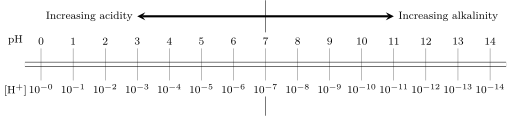
Therefore, in a neutral solution the pH equals 7; in an acidic solution the pH is less than 7; in a basic solution the pH is greater than 7. The stronger the acidity, the smaller the pH. The stronger the basicity, the larger the pH. Thus, pH can be used to express both the strength of acidity and the strength of basicity of a solution, as shown in Figure 5.4.
When the \(\ce{H^+}\) or \(\ce{OH^-}\) concentration of a solution is greater than \(1\ M\), using pH to express acidity or basicity is not convenient, as shown in Table 5.3.
| \([\ce{H^+}]\) | \(2\ M\) | \(4\ M\) | \(6\ M\) |
|---|---|---|---|
| pH | \(-0.3\) | \(-0.6\) | \(-0.78\) |
Therefore, when the \(\ce{H^+}\) concentration of a solution is greater than \(1\ M\), pH is generally not used; instead, the \(\ce{H^+}\) concentration is stated directly.
III. Acid-Base Indicators
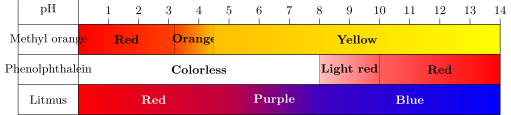
There are many methods for measuring the pH of a solution. Commonly used methods include acid-base indicators, pH test paper, and pH meters (instruments that measure pH). Acid-base indicators are generally weak organic acids or weak organic bases. Their color changes occur within a certain range of pH values. The pH range over which an indicator changes color is called the color-change range (or transition range) of the indicator. The color-change ranges of various indicators are determined experimentally. From Figure 5.5, we can see that the color-change ranges of litmus, phenolphthalein, and methyl orange are each different.
The measurement and control of pH is very important in industrial and agricultural production, scientific research, and medical and health care. A relatively simple method for measuring pH is to use pH test paper. This paper is prepared by soaking in a mixed solution of multiple indicators. A drop of the test solution is placed on the pH paper, and the resulting color is compared with a standard color chart to determine the pH of the solution. The most precise method for measuring pH is to use a pH meter.
Why can double-displacement reactions that produce weak electrolytes proceed? Try to explain using the concept of ionization equilibrium.
- Water is an extremely weak electrolyte: \(\ce{H2O} \rightleftharpoons \ce{H^+ + OH^-}\)
- The ion product of water: \(K_w = [\ce{H^+}][\ce{OH^-}] = 1 \times 10^{-14}\) (at \(25\,{}^{\circ}\text{C}\))
- \(K_w\) applies to all dilute aqueous solutions — neutral, acidic, or basic
- pH \(= -\lg[\ce{H^+}]\): neutral solutions have pH \(= 7\); acidic solutions have pH \(< 7\); basic solutions have pH \(> 7\)
- When \([\ce{H^+}] > 1\ M\), it is more practical to state \([\ce{H^+}]\) directly rather than use pH
- Acid-base indicators change color within characteristic pH ranges
Exercises for Section 3
Calculate the ionization constant of water at \(25\,{}^{\circ}\text{C}\).
What is \([\ce{H^+}]\) in \(0.2\ M\) \(\ce{HCl}\) and in \(0.2\ M\) \(\ce{CH3COOH}\) solution, respectively?
Calculate \([\ce{H^+}]\) and \([\ce{OH^-}]\) in each of the following solutions:
\(0.1\ M\) \(\ce{NaOH}\)
\(1 \times 10^{-3}\ M\) \(\ce{HCl}\)
\(0.1\ M\) \(\ce{CH3COOH}\)
\(0.1\ M\) \(\ce{NH3 * H2O}\)
Are \(\ce{OH^-}\) ions present in an acidic aqueous solution? Are \(\ce{H^+}\) ions present in a basic aqueous solution? Why?
What is pH? How is pH related to the acidity or basicity of an aqueous solution?
Calculate the pH of each of the following solutions:
\(0.01\ M\) \(\ce{HCl}\)
\(0.001\ M\) \(\ce{KOH}\)
\(0.01\ M\) \(\ce{NH3 * H2O}\)
\(0.1\ M\) \(\ce{CH3COOH}\)
\([\ce{H^+}] = 10^{-6}\ M\)
\([\ce{OH^-}] = 10^{-9}\ M\)
Given that \([\ce{H^+}]\) of a certain solution is \(10^{-4}\ M\), calculate the \([\ce{OH^-}]\) and pH of the solution.
Three solutions A, B, and C are given. Solution A has pH \(= 5\); solution B has \([\ce{H^+}] = 10^{-4}\ M\); solution C has \([\ce{OH^-}] = 10^{-11}\ M\). Which is the most acidic?
A \(1\ \text{L}\) solution contains \(4\ \text{g}\) of \(\ce{NaOH}\). Find the pH of this solution.
When the pH of a dilute solution increases by 2 units, how do \([\ce{H^+}]\) and \([\ce{OH^-}]\) change? When the pH decreases by 3 units, how do \([\ce{H^+}]\) and \([\ce{OH^-}]\) change?
The pH of a healthy person’s blood is \(7.35\)–\(7.45\). A person with a certain illness may temporarily have blood pH as low as \(5.9\). How many times greater is the hydrogen ion concentration in the blood at pH \(5.9\) compared to the normal state?
What is the color-change range of an indicator? If a solution has pH \(= 6\), what color appears when you add (1) methyl orange, (2) litmus, or (3) phenolphthalein?
5.4 Section 4: Hydrolysis of Salts
I. Hydrolysis of Salts
Certain salts, when dissolved in water, produce aqueous solutions that exhibit a definite acidity or basicity.
Add small amounts of \(\ce{CH3COONa}\), \(\ce{NH4Cl}\), and \(\ce{NaCl}\) crystals separately to three test tubes containing distilled water. Shake the test tubes to dissolve the crystals. Then test each solution with pH paper.
The experimental results show that the aqueous solution of \(\ce{CH3COONa}\) is basic, the aqueous solution of \(\ce{NH4Cl}\) is acidic, and the aqueous solution of \(\ce{NaCl}\) is neutral. Why is this?
We have learned that water ionizes weakly to produce \(\ce{H^+}\) and \(\ce{OH^-}\), whose concentrations are equal, and that the system is in a state of dynamic equilibrium.
The \(\ce{CH3COONa}\) used in Experiment 5.2 is a salt formed by a strong base (sodium hydroxide) and a weak acid (acetic acid). In its aqueous solution, the following ionizations coexist:
\[ \ce{CH3COONa} = \ce{CH3COO^-} + \ce{Na^+} \]
\[ \ce{H2O} \rightleftharpoons \ce{H^+} + \ce{OH^-} \]
We can clearly see that because \(\ce{CH3COO^-}\) combines with \(\ce{H^+}\) from water to form the weakly ionizing \(\ce{CH3COOH}\), it consumes \(\ce{H^+}\) in the solution, thereby disrupting the ionization equilibrium of water. As the \(\ce{H^+}\) concentration in solution decreases, the ionization equilibrium of water shifts to the right, and the \(\ce{OH^-}\) concentration increases until a new equilibrium is established. As a result, \([\ce{OH^-}] > [\ce{H^+}]\) in the solution, making it basic. This reaction can be represented by the following ionic equation:
\[ \ce{CH3COO^- + H2O} \rightleftharpoons \ce{CH3COOH + OH^-} \]
The reaction in which ions of a salt combine with \(\ce{H^+}\) or \(\ce{OH^-}\) produced by the ionization of water to form weak electrolytes is called the hydrolysis of salts.
From the equation above, we can see that salt hydrolysis produces an acid and a base; that is, salt hydrolysis can be viewed as the reverse of an acid-base neutralization reaction:
\[ \text{acid} + \text{base} \underset{\text{hydrolysis}}{\stackrel{\text{neutralization}}{\rightleftharpoons}} \text{salt} + \text{water} \]
The hydrolysis of salts is closely related to the strength of the acid and base from which the salt is formed. This is explained separately below.
(1) Hydrolysis of salts formed from strong bases and weak acids
The sodium acetate discussed above is a salt formed from a strong base (sodium hydroxide) and a weak acid (acetic acid). Hydrolysis of this salt makes the solution basic.
Sodium carbonate is also a salt formed from a strong base (sodium hydroxide) and a weak acid (carbonic acid). After hydrolysis, its solution is also basic. Because carbonic acid is a diprotic acid, the hydrolysis of sodium carbonate is more complex and proceeds in two steps.
The first step is the hydrolysis of \(\ce{CO3^{2-}}\) ionized from sodium carbonate in solution:
\[ \ce{CO3^{2-} + H2O} \rightleftharpoons \ce{HCO3^- + OH^-} \]
The second step is the further hydrolysis of the \(\ce{HCO3^-}\) produced:
\[ \ce{HCO3^- + H2O} \rightleftharpoons \ce{H2CO3 + OH^-} \]
Thus, \(\ce{CO3^{2-}}\) in solution combines with \(\ce{H^+}\) ionized from water molecules to form \(\ce{HCO3^-}\), and \(\ce{HCO3^-}\) further combines with \(\ce{H^+}\) to form \(\ce{H2CO3}\), promoting the continued ionization of water. The \(\ce{OH^-}\) concentration in solution increases, so the solution is basic.
However, the second-step hydrolysis of \(\ce{Na2CO3}\) proceeds to only a very small extent; the concentration of \(\ce{H2CO3}\) molecules at equilibrium is very small and \(\ce{CO2}\) gas is not released.
Other salts such as potassium carbonate, sodium sulfide, and sodium phosphate also undergo this type of hydrolysis.
(2) Hydrolysis of salts formed from strong acids and weak bases
The \(\ce{NH4Cl}\) used in Experiment 5.2 is a salt formed by a strong acid (hydrochloric acid) and a weak base (ammonia solution). Its hydrolysis process in aqueous solution can be represented as follows:
\[ \ce{NH4Cl} = \ce{NH4^+ + Cl^-} \]
\[ \ce{H2O} \rightleftharpoons \ce{OH^- + H^+} \]
Here, because \(\ce{NH4^+}\) combines with \(\ce{OH^-}\) from water to form the weakly ionizing \(\ce{NH3 * H2O}\), it disrupts the ionization equilibrium of water. As the \(\ce{OH^-}\) concentration decreases, the ionization equilibrium of water shifts to the right, and the \(\ce{H^+}\) concentration increases until a new equilibrium is established. As a result, \([\ce{H^+}] > [\ce{OH^-}]\) in the solution, making it acidic. This reaction can also be expressed as an ionic equation:
\[ \ce{NH4^+ + H2O} \rightleftharpoons \ce{NH3 * H2O + H^+} \]
Other salts such as copper nitrate, copper sulfate, and ammonium sulfate also undergo this type of hydrolysis.
(3) Hydrolysis of salts formed from weak acids and weak bases
Salts formed from weak acids and weak bases also undergo hydrolysis in aqueous solution. For example, \(\ce{CH3COONH4}\) is a salt formed from a weak acid (acetic acid) and a weak base (ammonia solution). Its hydrolysis process in water can be represented as follows:
\[ \ce{CH3COONH4} = \ce{CH3COO^- + NH4^+} \]
\[ \ce{H2O} \rightleftharpoons \ce{H^+ + OH^-} \]
The above reaction can be expressed as an ionic equation:
\[ \ce{CH3COO^- + NH4^+ + H2O} \rightleftharpoons \ce{CH3COOH + NH3 * H2O} \]
Clearly, because the weak acid anion and the weak base cation of this salt can combine with \(\ce{OH^-}\) and \(\ce{H^+}\) from water, respectively, to form the weakly ionizing \(\ce{CH3COOH}\) and \(\ce{NH3 * H2O}\), the ionization equilibrium of water is disrupted and shifts to the right. Whether the solution of such a salt is acidic or basic depends on the relative magnitudes of the ionization constants of the acid and base formed. If the ionization constant of the weak acid is larger, the solution is acidic; if the ionization constant of the weak base is larger, the solution is basic; if the two ionization constants are equal, the solution is neutral. For example, the ionization constants of \(\ce{CH3COOH}\) and \(\ce{NH3 * H2O}\) are \(1.75 \times 10^{-5}\) and \(1.77 \times 10^{-5}\), respectively, which are essentially equal, so the aqueous solution of \(\ce{CH3COONH4}\) is approximately neutral.
Another example is \(\ce{NH4CN}\), a salt formed from a weak base (ammonia solution) and a weak acid (hydrocyanic acid). Because the ionization constant of ammonia solution (at \(25\,{}^{\circ}\text{C}\): \(1.75 \times 10^{-5}\)) is much larger than that of hydrocyanic acid (at \(25\,{}^{\circ}\text{C}\): \(4.93 \times 10^{-10}\)), when \(\ce{NH4CN}\) hydrolyzes, the solution is basic.
The fundamental reason these three types of salts undergo hydrolysis is that the ions composing the salt can combine with \(\ce{H^+}\) or \(\ce{OH^-}\) from the ionization of water to form weak electrolytes.
Salts formed from strong acids and strong bases, such as \(\ce{NaCl}\), do not undergo hydrolysis because the anions and cations produced by their ionization do not combine with \(\ce{H^+}\) or \(\ce{OH^-}\) in solution to form weak electrolytes. Therefore, the amounts of \(\ce{H^+}\) and \(\ce{OH^-}\) in water remain unchanged, and the ionization equilibrium of water is not disrupted. The solution remains neutral. The \(\ce{NaCl}\) used in Experiment 5.2 is an example of such a salt. Other salts such as potassium chloride, sodium sulfate, and sodium nitrate also do not hydrolyze for this same reason.
II. Applications of Salt Hydrolysis
The extent of salt hydrolysis is mainly determined by the nature of the salt. At the same time, when hydrolysis reaches equilibrium, it is also affected by temperature, concentration, and other factors, just like any other equilibrium.
Salt hydrolysis is the reverse of a neutralization reaction. Neutralization is exothermic, so hydrolysis must be endothermic. Therefore, raising the temperature promotes salt hydrolysis. For example, when using a soda ash (\(\ce{Na2CO3}\)) solution to wash greasy items, hot soda water works better than cold. This is because heating promotes the hydrolysis of soda ash, increasing \([\ce{OH^-}]\), and thereby enhancing the degreasing ability.
When \([\ce{H^+}]\) or \([\ce{OH^-}]\) is increased or decreased, the equilibrium shifts left or right, which can suppress or promote the hydrolysis reaction. For example, when preparing \(\ce{FeCl3}\) solution in the laboratory, since \(\ce{FeCl3}\) is a salt formed from a strong acid and a weak base, it readily hydrolyzes to form the water-insoluble \(\ce{Fe(OH)3}\):
\[ \ce{FeCl3 + 3H2O} \rightleftharpoons \ce{Fe(OH)3 + 3HCl} \]
This causes the solution to become turbid, making it impossible to obtain a clear \(\ce{FeCl3}\) solution. Therefore, when preparing \(\ce{FeCl3}\) solution, a certain amount of hydrochloric acid is usually added to prevent hydrolysis.
A salt is the product of a neutralization reaction. Why then do certain salts undergo hydrolysis (the reverse of neutralization)? Explain using the concept of ionization equilibrium.
- Hydrolysis is the reaction of a salt’s ions with \(\ce{H^+}\) or \(\ce{OH^-}\) from water to form weak electrolytes — it is the reverse of neutralization
- Salts of strong bases and weak acids hydrolyze to give basic solutions (e.g., \(\ce{CH3COONa}\), \(\ce{Na2CO3}\))
- Salts of strong acids and weak bases hydrolyze to give acidic solutions (e.g., \(\ce{NH4Cl}\), \(\ce{FeCl3}\))
- Salts of weak acids and weak bases hydrolyze; the solution’s acidity/basicity depends on the relative ionization constants of the acid and base
- Salts of strong acids and strong bases do not hydrolyze; their solutions are neutral
- Raising temperature promotes hydrolysis; adding acid or base can suppress or promote it
Exercises for Section 4
For each of the following salts, determine whether it hydrolyzes and whether its solution is acidic, basic, or neutral. Write the ionic equation for the hydrolysis reaction where applicable.
- \(\ce{NH4NO3}\); (2) \(\ce{CH3COOK}\); (3) \(\ce{NaNO3}\); (4) \(\ce{FeSO4}\)
What is the simplest method to distinguish the following three solutions: \(\ce{NaCl}\) solution, \(\ce{NH4Cl}\) solution, and \(\ce{Na2CO3}\) solution?
If you want the hydrolysis of \(\ce{FeCl3}\) to proceed more completely, what measures can you take?
Wood ash is a common potassium fertilizer used in rural areas, and its main component is potassium carbonate. Explain why wood ash should not be mixed with ammonium salts used as nitrogen fertilizers.
A foam fire extinguisher contains solutions of \(\ce{Al2(SO4)3}\) and \(\ce{NaHCO3}\). Why does mixing these two solutions produce a fire-extinguishing effect? What chemical reactions occur?
Both sodium chloride solution and ammonium acetate solution are neutral, but the reasons for their neutrality are fundamentally different. Explain this difference.
5.5 Section 5: Equivalent Concentration of Acids and Bases
I. Gram-Equivalent of Acids and Bases
In introductory chemistry, we learned that solutions of acids and bases can react with each other in neutralization reactions. Let us now examine more closely the quantitative relationships in these reactions. The following reactions are all neutralization reactions:
\[ \ce{NaOH + HCl} = \ce{NaCl + H2O} \]
\[ \ce{2NaOH + H2SO4} = \ce{Na2SO4 + 2H2O} \]
or
\[ \ce{NaOH + \frac{1}{2}H2SO4} = \ce{\frac{1}{2}Na2SO4 + H2O} \]
\[ \ce{3NaOH + H3PO4} = \ce{Na3PO4 + 3H2O} \]
or
\[ \ce{NaOH + \frac{1}{3}H3PO4} = \ce{\frac{1}{3}Na3PO4 + H2O} \]
From these chemical equations, we can see that monoprotic, diprotic, and triprotic acids require different numbers of moles to completely neutralize \(1\ \text{mol}\) of \(\ce{NaOH}\). A monoprotic acid (such as \(\ce{HCl}\)) requires \(1\ \text{mol}\); a diprotic acid (such as \(\ce{H2SO4}\)) requires only \(\frac{1}{2}\ \text{mol}\); a triprotic acid (such as \(\ce{H3PO4}\)) requires only \(\frac{1}{3}\ \text{mol}\). This is because the essence of an acid-base neutralization reaction is:
\[ \ce{H^+ + OH^-} \rightleftharpoons \ce{H2O} \]
That is, \(1\ \text{mol}\) of \(\ce{H^+}\) neutralizes exactly \(1\ \text{mol}\) of \(\ce{OH^-}\) to form water. However, equal moles of monoprotic, diprotic, and triprotic acids provide different numbers of moles of \(\ce{H^+}\) in a neutralization reaction. For example, \(1\ \text{mol}\) of \(\ce{HCl}\) provides \(1\ \text{mol}\) of \(\ce{H^+}\); \(1\ \text{mol}\) of \(\ce{H2SO4}\) provides \(2\ \text{mol}\) of \(\ce{H^+}\); \(1\ \text{mol}\) of \(\ce{H3PO4}\) provides \(3\ \text{mol}\) of \(\ce{H^+}\). Therefore, to completely neutralize \(1\ \text{mol}\) of \(\ce{OH^-}\), one needs \(1\ \text{mol}\) of a monoprotic acid, \(\frac{1}{2}\ \text{mol}\) of a diprotic acid, or \(\frac{1}{3}\ \text{mol}\) of a triprotic acid. In terms of actual mass, \(1\ \text{mol}\) of \(\ce{HCl}\) has a mass of \(36.5\ \text{g}\); \(\frac{1}{2}\ \text{mol}\) of \(\ce{H2SO4}\) has a mass of \(49\ \text{g}\); \(\frac{1}{3}\ \text{mol}\) of \(\ce{H3PO4}\) has a mass of \(32.7\ \text{g}\). Although their masses are not equal, they all have the same neutralizing capacity — each can completely neutralize \(40\ \text{g}\) of \(\ce{NaOH}\). In chemistry, the masses (in grams) of acids and bases that are equivalent to one another in a reaction are called the gram-equivalents of the acid and base. The gram-equivalents of \(\ce{HCl}\), \(\ce{H2SO4}\), \(\ce{H3PO4}\), and \(\ce{NaOH}\) mentioned above are \(36.5\ \text{g}\), \(49\ \text{g}\), \(32.7\ \text{g}\), and \(40\ \text{g}\), respectively.1
The gram-equivalents of acids and bases can be expressed by the following formulas:
\[ \text{Gram-equivalent of an acid} = \frac{\text{mass of 1 mol of the acid (g)}}{\text{number of moles of}\ \ce{H^+}\ \text{provided by 1 mol of the acid}} \]
\[ \text{Gram-equivalent of a base} = \frac{\text{mass of 1 mol of the base (g)}}{\text{number of moles of}\ \ce{OH^-}\ \text{provided by 1 mol of the base}} \]
For example, \(1\ \text{mol}\) of \(\ce{HNO3}\) has a mass of \(63\ \text{g}\) and provides \(1\ \text{mol}\) of \(\ce{H^+}\).
\[ \text{Gram-equivalent of}\ \ce{HNO3} = \frac{63}{1} = 63\ \text{g} \]
For another example, \(1\ \text{mol}\) of \(\ce{H2SO4}\) has a mass of \(98\ \text{g}\) and provides \(2\ \text{mol}\) of \(\ce{H^+}\).
\[ \text{Gram-equivalent of}\ \ce{H2SO4} = \frac{98}{2} = 49\ \text{g} \]
Similarly, \(1\ \text{mol}\) of \(\ce{Ca(OH)2}\) has a mass of \(74\ \text{g}\) and provides \(2\ \text{mol}\) of \(\ce{OH^-}\).
\[ \text{Gram-equivalent of}\ \ce{Ca(OH)2} = \frac{74}{2} = 37\ \text{g} \]
Note that in different chemical reactions, an acid or base may have different gram-equivalents. For example:
\[ \ce{H2SO4 + NaCl} \xrightarrow{\text{gentle heat}} \ce{NaHSO4 + HCl ^} \]
\[ \ce{H2SO4 + 2NaCl} \xrightarrow{\text{strong heat}} \ce{Na2SO4 + 2HCl ^} \]
In the first reaction, \(1\ \text{mol}\) of \(\ce{H2SO4}\) provides only \(1\ \text{mol}\) of \(\ce{H^+}\), so the gram-equivalent of \(\ce{H2SO4}\) is \(98\ \text{g}\). In the second reaction, \(1\ \text{mol}\) of \(\ce{H2SO4}\) provides \(2\ \text{mol}\) of \(\ce{H^+}\), so the gram-equivalent of \(\ce{H2SO4}\) is \(98/2 = 49\ \text{g}\). Therefore, the gram-equivalent of a polyprotic acid must be determined based on the specific reaction. The same applies to polybasic bases.
We have noted above that when \(1\ \text{mol}\) of \(\ce{NaOH}\) reacts completely with monoprotic, diprotic, or triprotic acids, the number of moles of acid may differ, but 1 gram-equivalent of \(\ce{NaOH}\) always reacts with exactly 1 gram-equivalent of \(\ce{HCl}\), \(\ce{H2SO4}\), or \(\ce{H3PO4}\). That is, the number of gram-equivalents of acid and base are always equal. The relationship among the number of gram-equivalents, the gram-equivalent, and the mass of an acid or base can be expressed as:
\[ \text{Number of gram-equivalents} = \frac{\text{mass of acid (or base) (g)}}{\text{gram-equivalent of acid (or base) (g)}} \]
Calculate the number of gram-equivalents in \(147\ \text{g}\) of \(\ce{H2SO4}\).
Solution: The gram-equivalent of \(\ce{H2SO4}\) is \(49\ \text{g}\).
\[ \text{Number of gram-equivalents of}\ \ce{H2SO4} = \frac{147}{49} = 3 \]
Answer: \(147\ \text{g}\) of \(\ce{H2SO4}\) contains 3 gram-equivalents.
Calculate the number of gram-equivalents in \(20\ \text{g}\) of \(\ce{NaOH}\).
Solution: The gram-equivalent of \(\ce{NaOH}\) is \(40\ \text{g}\).
\[ \text{Number of gram-equivalents of}\ \ce{NaOH} = \frac{20}{40} = 0.5 \]
Answer: \(20\ \text{g}\) of \(\ce{NaOH}\) contains \(0.5\) gram-equivalents.
II. Equivalent Concentration
Equivalent concentration (normal concentration) is another method of expressing the concentration of a solution. It is the number of gram-equivalents of solute contained in \(1\ \text{L}\) (\(1000\ \text{ml}\)) of solution, commonly denoted by \(N\). For example, if \(1\ \text{L}\) of solution contains 2 gram-equivalents of solute, its concentration is 2 equivalent concentration, written as \(2N\). The relationship among equivalent concentration, the number of gram-equivalents of solute, and the volume of solution is:
\[ \text{Equivalent concentration}\ (N) = \frac{\text{number of gram-equivalents of solute}}{\text{volume of solution (L)}} \]
or equivalently:
\[ \text{Number of gram-equivalents of solute} = \text{equivalent concentration}\ (N) \times \text{volume of solution (L)} \]
We already know that in a neutralization reaction, when an acid and a base react completely, their numbers of gram-equivalents are always equal:
\[ \text{gram-equivalents of acid} = \text{gram-equivalents of base} \]
If we let \(N_1\) and \(N_2\) represent the equivalent concentrations of the acid and base solutions, and \(V_1\) and \(V_2\) represent their volumes (in L), we obtain the following formula:
\[ N_1 V_1 = N_2 V_2 \]
When \(N_1 = N_2\), \(V_1 = V_2\).
When \(N_1 > N_2\), \(V_1 < V_2\).
Note that in this formula, \(V_1\) and \(V_2\) need not be in liters — as long as both use the same volume units, any other unit may be used.
III. Calculations Involving Equivalent Concentration
1. Preparing solutions of a given equivalent concentration
How many grams of \(\ce{NaOH}\) are needed to prepare \(100\ \text{ml}\) of \(0.1N\) \(\ce{NaOH}\) solution?
Analysis: From the number of gram-equivalents in \(100\ \text{ml}\) of \(0.1N\) \(\ce{NaOH}\) solution, we can calculate the required mass of \(\ce{NaOH}\).
Solution: The equivalent concentration of \(\ce{NaOH}\) is \(0.1N\); the volume of \(\ce{NaOH}\) solution is \(100\ \text{ml}\).
Let \(x\) be the number of gram-equivalents of \(\ce{NaOH}\) in \(100\ \text{ml}\) of \(0.1N\) solution.
\[ x = \frac{100 \times 0.1}{1000} = 0.01 \]
\[ \text{Mass of}\ \ce{NaOH} = \text{gram-equivalents} \times \text{gram-equivalent} = 0.01 \times 40 = 0.4\ \text{g} \]
Answer: \(0.4\ \text{g}\) of \(\ce{NaOH}\) is needed to prepare \(100\ \text{ml}\) of \(0.1N\) \(\ce{NaOH}\) solution.
2. Calculations for acid-base neutralization reactions
\(40\ \text{ml}\) of \(\ce{H2SO4}\) solution of unknown concentration requires \(24\ \text{ml}\) of \(0.4N\) \(\ce{NaOH}\) solution to be completely neutralized. What is the equivalent concentration of the \(\ce{H2SO4}\) solution? How many grams of \(\ce{H2SO4}\) does the \(40\ \text{ml}\) of solution contain?
Analysis: First calculate the number of gram-equivalents of \(\ce{NaOH}\) in solution, then use the principle that gram-equivalents of acid and base are equal in neutralization (\(N_1 V_1 = N_2 V_2\)) to find the equivalent concentration of \(\ce{H2SO4}\). Then calculate the mass of \(\ce{H2SO4}\) from the number of gram-equivalents.
Solution: Given \(N_1 = 0.4N\), \(V_1 = 24\ \text{ml}\), \(V_2 = 40\ \text{ml}\).
Let \(N_2\) be the equivalent concentration of \(\ce{H2SO4}\).
\[ N_1 V_1 = N_2 V_2 \]
\[ N_2 = \frac{N_1 V_1}{V_2} = \frac{0.4 \times 24}{40} = 0.24N \]
Mass of pure \(\ce{H2SO4}\) in \(40\ \text{ml}\) of \(0.24N\) solution:
\[ 49 \times \frac{40}{1000} \times 0.24 = 0.47\ \text{g} \]
Answer: The equivalent concentration of the \(\ce{H2SO4}\) solution is \(0.24N\). The \(40\ \text{ml}\) of \(\ce{H2SO4}\) solution contains \(0.47\ \text{g}\) of pure \(\ce{H2SO4}\).
3. Calculating volumes and equivalent concentrations before and after dilution
Let \(V_1\), \(N_1\) and \(V_2\), \(N_2\) represent the volumes and equivalent concentrations before and after dilution, respectively. Since the number of gram-equivalents of solute does not change upon dilution, the formula \(N_1 V_1 = N_2 V_2\) can be used to calculate volumes and equivalent concentrations before and after dilution.
To prepare \(500\ \text{ml}\) of \(6N\) dilute hydrochloric acid from \(12N\) concentrated hydrochloric acid, how many milliliters of \(12N\) concentrated hydrochloric acid are needed?
Solution: Given \(N_1 = 6N\), \(V_1 = 500\ \text{ml}\), \(N_2 = 12N\).
Let \(V_2\) be the volume of \(12N\) concentrated hydrochloric acid needed.
\[ 12 V_2 = 6 \times 500 \]
\[ V_2 = 250\ \text{ml} \]
Answer: \(250\ \text{ml}\) of \(12N\) concentrated hydrochloric acid is needed.
What is the equivalent concentration of the dilute hydrochloric acid prepared by diluting \(100\ \text{ml}\) of \(12N\) concentrated hydrochloric acid to \(600\ \text{ml}\)?
Solution: Given \(N_1 = 12N\), \(V_1 = 100\ \text{ml}\), \(V_2 = 600\ \text{ml}\).
Let \(N_2\) be the equivalent concentration of the dilute hydrochloric acid.
\[ 12 \times 100 = 600 N_2 \]
\[ N_2 = 2N \]
Answer: The equivalent concentration of the dilute hydrochloric acid is \(2N\).
4. Conversion between equivalent concentration and percentage concentration
To prepare \(500\ \text{ml}\) of \(0.50N\) dilute \(\ce{H2SO4}\) from \(98\%\) \(\ce{H2SO4}\) with density \(1.84\ \text{g/ml}\), how many milliliters of this concentrated \(\ce{H2SO4}\) are needed?
Analysis: First convert the \(98\%\) \(\ce{H2SO4}\) to its equivalent concentration, then use the formula \(N_1 V_1 = N_2 V_2\) to calculate the volume.
Solution: Given \(V_1 = 500\ \text{ml}\), \(N_1 = 0.50N\).
\[ N_2 = \frac{1.84 \times 1000 \times 98\%}{49} = 36.8N \]
Let \(V_2\) be the volume of \(98\%\) \(\ce{H2SO4}\) in milliliters.
\[ 36.8 \times V_2 = 0.5 \times 500 \]
\[ V_2 = 6.8\ \text{ml} \]
Answer: \(6.8\ \text{ml}\) of \(98\%\) concentrated sulfuric acid is needed to prepare \(500\ \text{ml}\) of \(0.5N\) dilute sulfuric acid.
- The gram-equivalent of an acid is the mass of acid that provides \(1\ \text{mol}\) of \(\ce{H^+}\); the gram-equivalent of a base is the mass of base that provides \(1\ \text{mol}\) of \(\ce{OH^-}\)
- The gram-equivalent of a polyprotic acid or polybasic base depends on the specific reaction
- Equivalent concentration (\(N\)) is the number of gram-equivalents of solute per liter of solution
- In neutralization reactions, the gram-equivalents of acid and base are always equal: \(N_1 V_1 = N_2 V_2\)
- The same formula applies to dilution problems (gram-equivalents of solute are conserved)
Exercises for Section 5
Find the gram-equivalent of each of the following compounds:
\(\ce{CH3COOH}\)
\(\ce{KOH}\)
\(\ce{Mg(OH)2}\)
Find the number of gram-equivalents contained in \(1\ \text{mol}\) of each of the following compounds:
\(\ce{H2SO4}\)
\(\ce{H3PO4}\)
\(\ce{HClO4}\)
How many grams of solute are contained in \(50\ \text{ml}\) of \(0.4N\) solution of each of the following?
\(\ce{H2SO4}\) solution
\(\ce{NaOH}\) solution
\(\ce{HCl}\) solution
Calculate the equivalent concentration of each of the following common reagents:
Hydrochloric acid — density \(1.19\ \text{g/cm}^3\), containing \(37\%\) \(\ce{HCl}\)
Nitric acid — density \(1.42\ \text{g/cm}^3\), containing \(71\%\) \(\ce{HNO3}\)
Sulfuric acid — density \(1.84\ \text{g/cm}^3\), containing \(98\%\) \(\ce{H2SO4}\)
The density of a \(2N\) \(\ce{NaOH}\) solution is \(1.08\ \text{g/cm}^3\). Calculate the percentage concentration of the solution.
The density of a \(50\%\) \(\ce{NaOH}\) solution is \(1.525\ \text{g/cm}^3\). Calculate the equivalent concentration of this solution.
To prepare \(1.5\ \text{L}\) of \(0.2N\) \(\ce{HCl}\) solution, how many milliliters of \(6N\) \(\ce{HCl}\) are needed?
How many milliliters of \(0.2N\) \(\ce{H2SO4}\) solution are needed to neutralize \(25\ \text{ml}\) of \(0.1N\) \(\ce{NaOH}\) solution?
\(20\ \text{ml}\) of \(0.5N\) \(\ce{NaOH}\) solution is exactly neutralized by \(10\ \text{ml}\) of \(\ce{HNO3}\) solution. Find the equivalent concentration of the \(\ce{HNO3}\) solution and the mass of \(\ce{HNO3}\) it contains.
Are the following two situations possible? Why? Provide examples.
Can two acid solutions of the same volume but different molar concentrations both be completely neutralized by the same volume and same molar concentration of the same base solution?
Can two acid solutions of the same volume but different equivalent concentrations both be completely neutralized by the same volume and same equivalent concentration of the same base solution?
If \(200\ \text{ml}\) of \(5N\) \(\ce{NaOH}\) solution is diluted to \(1\ \text{L}\), what is its equivalent concentration?
You have \(100\ \text{ml}\) of \(0.50N\) \(\ce{NaOH}\) solution. How many grams of water must be added to reduce the equivalent concentration to \(0.10N\)?
Into \(100\ \text{ml}\) of \(1N\) \(\ce{H2SO4}\) solution, zinc granules are added. After the zinc has completely reacted, \(30\ \text{ml}\) of \(0.5N\) \(\ce{NaOH}\) solution is required to completely neutralize the remaining sulfuric acid. Find the mass of the zinc granules.
5.6 Section 6: Neutralization Reactions of Acids and Bases
I. Acid-Base Neutralization Titration
In introductory chemistry, we learned how to add hydrochloric acid dropwise to sodium hydroxide solution, which gave us a basic understanding of the method for carrying out an acid-base neutralization reaction. Now, building on our knowledge of acid-base equivalent concentration, we will further master the method of using an acid (or base) of known equivalent concentration to determine the unknown equivalent concentration of a base (or acid). This method is called acid-base neutralization titration.
Let us use the example of titrating a \(\ce{NaOH}\) solution of unknown equivalent concentration with an \(\ce{HCl}\) solution of known equivalent concentration to illustrate the titration procedure.
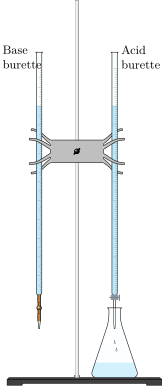
Pour \(0.1N\) \(\ce{HCl}\) solution into a clean acid burette up to above the “0” mark. Secure the burette on a burette clamp, as shown in Figure 5.6. Gently turn the stopcock to fill the tip of the burette with solution, then adjust the liquid level to the “0” mark or some definite mark below “0,” and record the exact reading. Pour the \(\ce{NaOH}\) solution of unknown concentration into a base burette, secure it on the clamp as well, fill the tip, adjust the liquid level, and record the exact reading.
Then place a clean Erlenmeyer flask below the burette. Release \(20\ \text{ml}\) of \(\ce{NaOH}\) solution from the base burette into the flask, and add 2 drops of phenolphthalein indicator; the solution immediately turns red. Next, move the flask under the acid burette and, as shown in Figure 5.6, add \(0.1N\) \(\ce{HCl}\) solution drop by drop while continuously swirling the flask to ensure thorough mixing. As the \(\ce{HCl}\) solution is added drop by drop, the \(\ce{OH^-}\) concentration in the flask gradually decreases, and the red color of the solution gradually fades. Finally, when the addition of a single drop of \(\ce{HCl}\) solution causes the solution to immediately become colorless, and the addition of a single drop of \(\ce{NaOH}\) solution causes the red color to reappear, this indicates that the gram-equivalents of acid and base in the solution are now equal. At this point, one should immediately stop the titration. Then accurately record the readings on both burettes, determine the volumes of \(\ce{NaOH}\) and \(\ce{HCl}\) solutions used, and calculate the concentration of the base using the formula \(N_1 V_1 = N_2 V_2\).
During the neutralization titration process, the point at which the acid and base have exactly reacted completely — that is, when the gram-equivalents of acid and base are exactly equal — is called the equivalence point. At the equivalence point, the solution is not necessarily neutral; it may be acidic or basic, depending on the nature of the salt produced, since some salts undergo hydrolysis. In the titration above, a strong acid and a strong base were used, and the resulting salt does not hydrolyze, so the solution is neutral at the equivalence point.
II. Heat of Neutralization
We know that chemical reactions are accompanied by energy changes, usually manifested as heat changes — that is, endothermic or exothermic phenomena. Experiments show that heat is released when acids and bases undergo neutralization reactions. When \(1\ \text{L}\) of \(1\ M\) hydrochloric acid reacts with \(1\ \text{L}\) of \(1\ M\) sodium hydroxide solution, \(13.7\ \text{kcal}\) of heat is released:
\[ \ce{NaOH(dilute) + HCl(dilute)} = \ce{NaCl(dilute) + H2O} + 13.7\ \text{kcal} \]
If \(1\ \text{L}\) of \(1\ M\) potassium hydroxide solution is used to neutralize \(1\ \text{L}\) of \(1\ M\) nitric acid solution, \(13.7\ \text{kcal}\) of heat is also released:
\[ \ce{KOH(dilute) + HNO3(dilute)} = \ce{KNO3(dilute) + H2O} + 13.7\ \text{kcal} \]
In dilute solution, when an acid and a base undergo a neutralization reaction that produces \(1\ \text{mol}\) of water, the reaction heat is called the heat of neutralization.
We have long known that the essence of a neutralization reaction is the combination of \(\ce{H^+}\) with \(\ce{OH^-}\) to form water. Therefore, the reactions above can all be represented by the same ionic equation:
\[ \ce{H^+ + OH^-} = \ce{H2O} \]
When a strong acid and a strong base undergo neutralization in dilute solution, \(1\ \text{mol}\) of \(\ce{H^+}\) reacting with \(1\ \text{mol}\) of \(\ce{OH^-}\) to form \(1\ \text{mol}\) of water always releases \(13.7\ \text{kcal}\) of heat.2
- Neutralization titration uses an acid (or base) of known equivalent concentration to determine the unknown concentration of a base (or acid), based on \(N_1 V_1 = N_2 V_2\)
- The equivalence point is reached when the gram-equivalents of acid and base are exactly equal; it is detected by the color change of an indicator
- The heat of neutralization is the heat released when a neutralization reaction produces \(1\ \text{mol}\) of water in dilute solution
- For strong acid + strong base neutralizations: \(\ce{H^+ + OH^-} = \ce{H2O}\), releasing \(13.7\ \text{kcal}\) (\(57.3\ \text{kJ}\)) per mole of water formed
Exercises for Section 6
Why can neutralization titration be used to determine the unknown equivalent concentration of an acid or base?
In acid-base neutralization titration, what role does the indicator play?
Why must the tip of the burette be completely filled with solution before beginning the titration?
Calculate the heat released in the following neutralization reactions.
If \(20\ \text{g}\) of sodium hydroxide is dissolved to form a dilute solution and reacted with excess dilute hydrochloric acid, how many kilocalories of heat are released?
If \(28\ \text{g}\) of potassium hydroxide is dissolved to form a dilute solution and reacted with excess dilute nitric acid, how many kilocalories of heat are released?
A \(20\ \text{ml}\) mixture of dilute \(\ce{HCl}\) and dilute \(\ce{HNO3}\) requires \(10.3\ \text{ml}\) of \(1N\) \(\ce{NaOH}\) solution for complete neutralization. When excess \(\ce{AgNO3}\) is added to the same mixed solution, the \(\ce{AgCl}\) precipitate, after washing and drying, weighs \(0.98\ \text{g}\). Find the mass of pure \(\ce{HCl}\) and pure \(\ce{HNO3}\) contained in \(1\ \text{L}\) of this mixed solution.
5.7 Section 7: Primary Cells and Metal Corrosion/Protection
I. Primary (Galvanic) Cells
We know that when substances undergo chemical reactions, the process is often accompanied by the interconversion of chemical energy with heat, light, and other forms of energy. In ordinary chemical reactions, this typically manifests as heat release or absorption, and some reactions also produce light, and so on. We will now study how chemical energy can be converted into electrical energy.
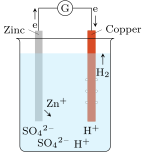
Insert a zinc strip and a copper strip in parallel into a beaker containing dilute sulfuric acid solution. Gas bubbles can be observed on the zinc strip, but none on the copper strip. Now connect the zinc and copper strips with a wire (Figure 5.7) and observe whether gas bubbles appear on the copper strip. Insert a galvanometer into the wire and observe whether the needle deflects.
The experimental results show that after connection with the wire, the zinc strip dissolves continuously, hydrogen gas is produced on the copper strip, and the galvanometer needle deflects. This demonstrates that when the copper and zinc strips are both immersed in dilute \(\ce{H2SO4}\), because zinc is more active than copper and loses electrons more readily, zinc is oxidized to \(\ce{Zn^{2+}}\) and enters the solution. Electrons flow from the zinc strip through the wire to the copper strip, and \(\ce{H^+}\) ions in solution gain electrons from the copper strip and are reduced to hydrogen atoms, which combine into hydrogen molecules and are released from the copper strip surface.
The process can be represented as follows:
Zinc strip: \(\ce{Zn - 2e} = \ce{Zn^{2+}}\) (oxidation reaction)
Copper strip: \(\ce{2H^+ + 2e} = \ce{2H}\) (reduction reaction)
\[ \ce{2H} = \ce{H2 ^} \]
This experiment fully demonstrates that the above oxidation-reduction reaction indeed produces an electric current through the transfer of electrons. A device that converts chemical energy into electrical energy in this way is called a galvanic cell (or primary cell), as shown in Figure 5.7. In a galvanic cell, the electrode from which electrons flow out is the negative electrode (such as the zinc strip), where the electrode material is oxidized. The electrode into which electrons flow is the positive electrode (such as the copper strip), where \(\ce{H^+}\) ions are reduced at the electrode surface.
By applying the principles of galvanic cells, people have manufactured various types of batteries, including dry cells, storage batteries, and high-energy batteries used in artificial satellites, rockets, and space television relay stations. Batteries have wide applications in daily life, industrial and agricultural production, and science and technology.
However, galvanic cell reactions can also cause metal corrosion, leading to metal loss. Let us now study the corrosion and protection of metals.
II. Metal Corrosion and Protection
Metal corrosion refers to the process by which metals or alloys undergo chemical reactions with surrounding gases or liquids, resulting in corrosion and loss of material. The most common type is electrochemical corrosion, in which impure metals (or alloys) come into contact with electrolyte solutions, galvanic cell reactions occur, and the more active metal atoms lose electrons and are oxidized. The corrosion of steel in humid air is the most common example of electrochemical corrosion.
We all know that steel does not corrode readily in dry air but corrodes quickly in humid air. Why? In humid air, a thin film of water is adsorbed on the steel surface, which promotes corrosion. Water is a weak electrolyte that ionizes to produce small amounts of \(\ce{H^+}\) and \(\ce{OH^-}\). At the same time, the dissolution of carbon dioxide from the air increases the \(\ce{H^+}\) concentration:
\[ \ce{H2O + CO2} \rightleftharpoons \ce{H2CO3} \rightleftharpoons \ce{H^+ + HCO3^-} \]
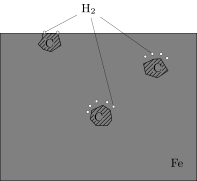
As a result, a thin film of electrolyte solution forms on the steel surface. This film, together with the iron and small amounts of carbon in the steel, constitutes a galvanic cell. Therefore, countless tiny galvanic cells form on the surface of these steel products (Figure 5.8). In these cells, iron is the negative electrode and carbon is the positive electrode. At the negative electrode, iron loses electrons and is oxidized:
\[ \ce{Fe - 2e} = \ce{Fe^{2+}} \]
At the positive electrode, \(\ce{H^+}\) ions in solution gain electrons and are reduced to hydrogen atoms, which combine into hydrogen molecules and are released from the carbon surface:
\[ \ce{2H^+ + 2e} = \ce{2H} \]
\[ \ce{2H} = \ce{H2 ^} \]
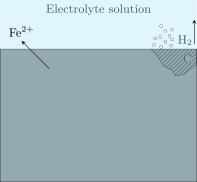
Steel corrodes in humid air through galvanic cell reactions — this is electrochemical corrosion (Figure 5.9).
The corrosion described above actually occurs in relatively strongly acidic solutions, and hydrogen gas is evolved during the corrosion process. This type of corrosion is usually called hydrogen-evolution corrosion.
Under typical conditions, if the water film adsorbed on the steel surface is only weakly acidic or neutral, then at the negative electrode iron still loses electrons and is oxidized to \(\ce{Fe^{2+}}\), but at the positive electrode, the principal reaction involves dissolved oxygen gaining electrons and being reduced:
\[ \ce{2Fe - 4e} = \ce{2Fe^{2+}} \]
\[ \ce{2H2O + O2 + 4e} = \ce{4OH^-} \]
Therefore, oxygen dissolved in the water film from the air can also promote the corrosion of steel. This type of corrosion is usually called oxygen-absorption corrosion. In practice, the corrosion of steel and other metals is primarily oxygen-absorption corrosion.
In addition to electrochemical corrosion, there is also chemical corrosion, in which metals react directly with the substances they contact (generally non-electrolytes). For example, the direct reaction of iron with oxygen at high temperatures, or the direct reaction of chlorine gas with iron or other metals in chemical plants — these are all chemical corrosion. The chemistry of such corrosion is relatively simple: it is merely an oxidation-reduction reaction between the metal and an oxidizing agent.
In essence, both electrochemical and chemical corrosion involve the loss of electrons by metal atoms (oxidation). However, electrochemical corrosion is accompanied by the generation of an electric current, while chemical corrosion is not. Under normal conditions, both types of corrosion often occur simultaneously, but electrochemical corrosion is far more prevalent than chemical corrosion.
Metal corrosion is an extremely common phenomenon. If metal daily utensils, production tools, machine parts, ship hulls, and the like are not properly maintained, they will corrode, resulting in massive metal losses. The additional losses caused by equipment failure due to corrosion — production shutdowns, reduced product quality, environmental pollution, harm to human health, and even serious accidents — are incalculable. Therefore, understanding the causes of metal corrosion and mastering methods of protection are of great practical significance.
Since metal corrosion is mainly caused by oxidation-reduction reactions between metals and surrounding substances, metal protection must naturally be considered from the perspectives of both the metal and the surrounding substances. Several commonly used industrial protection methods are described below.
1. Modifying the internal structure of the metal
For example, adding chromium, nickel, and other elements to ordinary steel to make stainless steel greatly increases the steel’s resistance to various forms of corrosive attack.
2. Applying protective coatings to metal surfaces
Covering the metal surface with a dense protective layer to isolate the metal product from surrounding substances is a widely adopted protection method.
Taking the protection of steel as an example, depending on the composition of the protective layer, there are several types:
Coating the steel surface with mineral oils, paints, or covering it with enamel, plastic, or other materials. For example, ship hulls, vehicle bodies, and buckets are often painted; automobile bodies are spray-painted; guns and machine parts are coated with mineral oils.
By electroplating, hot-dipping, or spray-coating methods, the steel surface is coated with a layer of corrosion-resistant metal such as zinc, tin, chromium, or nickel. These metals can all be oxidized to form a dense oxide film that prevents water and air from corroding the underlying steel. For example, commonly used galvanized sheet (white iron) is made by hot-dipping a thin layer of zinc onto steel sheet; tinplate used for making cans is produced by hot-dipping a thin layer of non-toxic, corrosion-resistant tin onto steel sheet; bicycle wheel rims are chrome-plated or nickel-plated by electroplating to provide both corrosion resistance and wear resistance.
Chemical methods are used to form a dense and stable oxide film on the steel surface. For example, in industry, oxidizing solutions are often used to form a dense black \(\ce{Fe3O4}\) film on the surface of machine parts, precision instruments, guns, and other steel products.
3. Electrochemical protection
One can also apply the chemical principles of galvanic cells to protect metals. As long as the galvanic cell reactions that cause electrochemical corrosion of the metal can be eliminated, corrosion can naturally be prevented. Electrochemical protection can be divided into two broad categories: anodic protection and cathodic protection. The more widely used is cathodic protection.
(1) Impressed-current cathodic protection
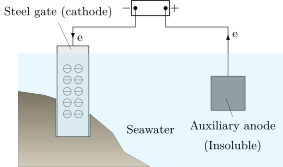
The basic principle of impressed-current cathodic protection can be simply represented by Figure 5.10. In this method, the steel equipment to be protected is made the cathode, and an insoluble electrode is used as an auxiliary anode. Both are placed in the electrolyte solution and connected to an external DC power source. After the current is applied, a large number of electrons are forced to flow toward the protected steel equipment, causing negative charge (electrons) to accumulate on the steel surface. This suppresses the loss of electrons from the steel, thereby preventing corrosion.3 For example, the combination of coatings and impressed current for the protection of steel sluice gates has achieved notable results.
(2) Sacrificial anode cathodic protection
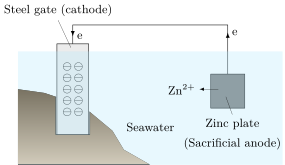
In the sacrificial anode4 cathodic protection method, a metal or alloy that loses electrons more readily is connected to the steel equipment to be protected. For example, for protecting steel sluice gates, this method is sometimes used. A metal more active than iron, such as zinc, is connected to the steel gate. When electrochemical corrosion occurs, it is the more active metal that corrodes, while the iron is protected (Figure 5.11). Typically, a certain number of zinc blocks are attached to the stern and below the waterline of a ship’s hull to prevent corrosion — this is an application of this method.
Currently, electrochemical protection methods are applied not only to the protection of steel equipment in seawater and waterways but also to the prevention of corrosion of cables, petroleum pipelines, underground equipment, and chemical plant equipment.
In addition, there are also corrosion-inhibitor methods, and others.
- A galvanic (primary) cell converts chemical energy to electrical energy via a spontaneous oxidation-reduction reaction: the more active metal is the negative electrode (oxidized), the less active metal is the positive electrode (reduction occurs)
- Electrochemical corrosion occurs when impure metals or alloys contact electrolyte solutions and form microscopic galvanic cells — the most common type is oxygen-absorption corrosion
- Chemical corrosion involves direct reaction of metals with oxidizing agents, without electric current
- Protection methods include: (1) alloying (e.g., stainless steel), (2) protective coatings (paint, plating, oxide films), (3) electrochemical protection (impressed-current or sacrificial-anode cathodic protection)
Exercises for Section 7
Using an example, explain what a galvanic cell is and why it can generate an electric current.
Why does the reaction of zinc with dilute sulfuric acid to produce hydrogen gas proceed faster with impure zinc than with pure zinc? Why does adding a small amount of copper sulfate solution to the sulfuric acid speed up the hydrogen-gas production reaction?
Why do steel products not rust easily when their surfaces are kept clean and dry? Why do ships corrode more rapidly in seawater than in river water? Why does a layer of \(\ce{Fe3O4}\) on a steel surface prevent corrosion, whereas a layer of rust (\(\ce{Fe2O3 * xH2O}\)) does not?
Explain the causes of the following phenomena:
An iron pillar immersed in water corrodes more readily at the waterline (where it contacts the water surface) than in the submerged portion.
When iron plates are riveted with aluminum rivets, the iron does not rust easily, but when riveted with copper rivets, it rusts easily.
After the plating layer is damaged, why is galvanized steel sheet (white iron) more corrosion-resistant than tinned steel sheet (tinplate)?
5.8 Section 8: Electrolysis and Electroplating
In Section 7, we studied galvanic cells and mainly discussed the conversion of chemical energy into electrical energy. In this section, we will discuss how electrical energy can be converted into chemical energy, as well as important applications of the principles of electrolysis.
I. Principles of Electrolysis
The electrical conduction of electrolyte solutions is different from that of metals. When a metal conducts electricity, no visible change occurs in the metal itself. When an electrolyte solution conducts electricity, distinct chemical changes occur in the electrolyte.
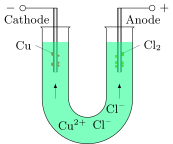
As shown in Figure 5.12, pour \(\ce{CuCl2}\) solution into a U-tube and insert two graphite (carbon) rods as electrodes. Place a piece of moist potassium iodide-starch test paper near the anode carbon rod to test for any gas released. Connect the DC power source and observe the phenomena occurring in the tube.
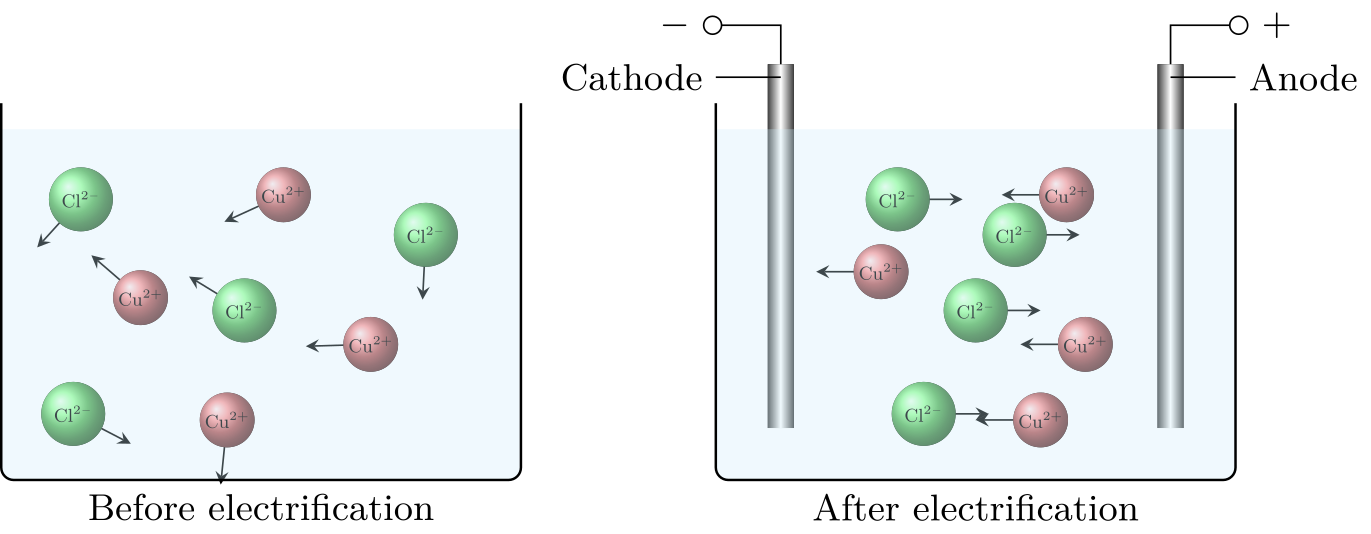
From the experiment, we can see that shortly after the DC power source is connected, a layer of copper is deposited on the cathode carbon rod, indicating that copper has been produced. At the anode carbon rod, gas bubbles are released. From its odor and its ability to turn moist potassium iodide-starch test paper blue, we can confirm that the gas released is chlorine. This tells us that under the action of the electric current, the copper chloride solution conducts electricity while simultaneously undergoing a chemical change, producing copper and chlorine gas.
Why does copper chloride decompose into copper and chlorine when electrified?
We know that copper chloride is a strong electrolyte that ionizes completely in water to form \(\ce{Cu^{2+}}\) and \(\ce{Cl^-}\):
\[ \ce{CuCl2} = \ce{Cu^{2+} + 2Cl^-} \]
Before the current is applied, \(\ce{Cu^{2+}}\) and \(\ce{Cl^-}\) move freely in the water. After the current is applied, these freely moving ions undergo directed motion under the influence of the electric field. According to the principle that opposite charges attract, the negatively charged chloride ions move toward the anode, and the positively charged copper ions move toward the cathode, as shown in Figure 5.13.
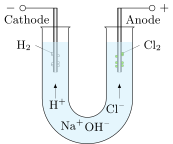
At the anode, chloride ions lose electrons and are oxidized to chlorine atoms, which then combine in pairs to form chlorine molecules released from the anode. At the cathode, copper ions gain electrons and are reduced to copper atoms, which are deposited on the cathode. Their respective reactions can be written as:
Anode: \(\ce{2Cl^- - 2e} = \ce{2Cl}\) (oxidation reaction)
\[ \ce{2Cl} = \ce{Cl2 ^} \]
Cathode: \(\ce{Cu^{2+} + 2e} = \ce{Cu}\) (reduction reaction)
The process by which an electric current is passed through an electrolyte solution, causing oxidation-reduction reactions at both the cathode and the anode, is called electrolysis. The apparatus that uses an electric current to cause oxidation-reduction reactions — that is, the device that converts electrical energy into chemical energy — is called an electrolytic cell (or electrolysis tank). The electrode connected to the negative terminal of the DC power source is the cathode of the electrolytic cell. During electrolysis, electrons flow from the negative terminal of the power source through the wire into the cathode. The electrode connected to the positive terminal is the anode. During electrolysis, electrons flow from the anode through the wire back to the positive terminal of the power source. In this way, the current passes through the solution by means of the directed movement of cations and anions in the solution. Therefore, the process of an electrolyte solution conducting electricity is the process of electrolysis. During electrolysis, cations gain electrons at the cathode (reduction reaction) and anions lose electrons at the anode (oxidation reaction).
The overall chemical equation for the electrolysis of copper chloride in aqueous solution is the sum of the anode and cathode reactions:
\[ \ce{Cu^{2+} + 2Cl^-} \xrightarrow{\text{electrolysis}} \ce{Cu + Cl2 ^} \]
In the description above of the electrolysis of copper chloride, \(\ce{H^+}\) and \(\ce{OH^-}\) in solution were not mentioned. In fact, although \(\ce{H^+}\) and \(\ce{OH^-}\) are present in small amounts, they do not participate in the electrode reactions. That is, in the copper chloride solution, in addition to \(\ce{Cu^{2+}}\) and \(\ce{Cl^-}\), there are also \(\ce{H^+}\) and \(\ce{OH^-}\). During electrolysis, both \(\ce{Cu^{2+}}\) and \(\ce{H^+}\) move toward the cathode, but because \(\ce{Cu^{2+}}\) gains electrons more readily than \(\ce{H^+}\), it is \(\ce{Cu^{2+}}\) that gains electrons at the cathode, depositing metallic copper. Both \(\ce{OH^-}\) and \(\ce{Cl^-}\) move toward the anode, but under these experimental conditions, \(\ce{Cl^-}\) loses electrons more readily than \(\ce{OH^-}\), so \(\ce{Cl^-}\) loses electrons at the anode to produce chlorine gas.
II. Applications of Electrolysis
1. Electrolysis of brine to produce chlorine gas and caustic soda
In industry, the electrolysis of saturated sodium chloride solution is used to produce caustic soda (\(\ce{NaOH}\)), chlorine gas, and hydrogen gas. The principle of electrolysis of brine is similar to that of \(\ce{CuCl2}\) solution described above.
Let us now carefully observe the following experiment.
Set up the apparatus as shown in Figure 5.14. Pour saturated salt solution into a U-tube, insert a carbon rod as the anode and an iron rod as the cathode. Add a few drops of phenolphthalein indicator to both sides of the tube, and use moist potassium iodide-starch test paper to test the gas produced at the anode. Connect the DC power source and observe the phenomena in the tube.
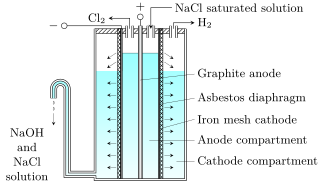
From the experiment, we can see that gas is released at both electrodes. The gas at the anode has a pungent odor and turns moist potassium iodide-starch test paper blue, confirming it is chlorine gas. The gas at the cathode is hydrogen. At the same time, the solution near the cathode turns red, indicating that a basic substance has formed in the solution.
This occurs because sodium chloride completely ionizes in the salt solution, and water molecules also weakly ionize, so four types of ions are present: \(\ce{Na^+}\), \(\ce{H^+}\), \(\ce{Cl^-}\), and \(\ce{OH^-}\).
\[ \ce{NaCl} = \ce{Na^+ + Cl^-} \]
\[ \ce{H2O} \rightleftharpoons \ce{H^+ + OH^-} \]
When the DC power source is connected, the negatively charged \(\ce{OH^-}\) and \(\ce{Cl^-}\) move toward the anode, and the positively charged \(\ce{Na^+}\) and \(\ce{H^+}\) move toward the cathode.
Under these electrolysis conditions, at the anode, \(\ce{Cl^-}\) loses electrons more readily than \(\ce{OH^-}\) and is oxidized to chlorine atoms, which combine in pairs to form chlorine molecules that are released:
\[ \ce{2Cl^- - 2e} = \ce{2Cl}\quad\text{(oxidation reaction)} \]
\[ \ce{2Cl} = \ce{Cl2 ^} \]
At the cathode, \(\ce{H^+}\) gains electrons more readily than \(\ce{Na^+}\), so \(\ce{H^+}\) continuously gains electrons and is reduced to hydrogen atoms, which combine to form hydrogen molecules released at the cathode:
\[ \ce{2H^+ + 2e} = \ce{2H}\quad\text{(reduction reaction)} \]
\[ \ce{2H} = \ce{H2 ^} \]
Because \(\ce{H^+}\) continuously gains electrons at the cathode and forms hydrogen gas, it disrupts the ionization equilibrium of water nearby. Water molecules continue to ionize to produce \(\ce{H^+}\) and \(\ce{OH^-}\); the \(\ce{H^+}\) is again consumed, and as a result, \(\ce{OH^-}\) accumulates near the cathode. Thus a sodium hydroxide solution forms near the cathode. The overall chemical equation for the electrolysis of saturated brine can be written as:
\[ \ce{2NaCl + 2H2O} \xrightarrow{\text{electrolysis}} \ce{2NaOH + H2 ^ + Cl2 ^} \]
Currently, Chinese industry mostly uses vertical diaphragm electrolytic cells, as illustrated in Figure 5.15. In this type of cell, the anode is made of metallic titanium or graphite, and the cathode is made of iron wire mesh with a layer of asbestos fibers adhered to it, serving as the diaphragm. This diaphragm separates the cell into an anode compartment and a cathode compartment. The diaphragm can prevent gas molecules from passing through but allows water molecules and ions to pass. This prevents mixing of the hydrogen produced at the cathode with the chlorine produced at the anode (which could cause an explosion), and also prevents the reaction of chlorine with sodium hydroxide to form sodium hypochlorite, which would reduce the yield and quality of caustic soda. The reaction of chlorine with sodium hydroxide is:
\[ \ce{2NaOH + Cl2} = \ce{NaClO + NaCl + H2O} \]
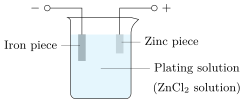
The raw salt solution must be purified to remove \(\ce{Mg^{2+}}\), \(\ce{Ca^{2+}}\), \(\ce{SO4^{2-}}\), and other ions, to prevent impurities from contaminating the product and to prevent insoluble impurities such as \(\ce{Mg(OH)2}\) from clogging the pores of the diaphragm. The purified concentrated brine continuously enters the anode compartment through an inlet tube, passes through the diaphragm into the cathode compartment. Chlorine gas is released from a tube at the top of the anode compartment, and hydrogen gas is released from a tube at the top of the cathode compartment. The electrolyte solution containing \(\ce{NaOH}\) and \(\ce{NaCl}\) (unreacted salt) is drained from the alkali outlet at the bottom of the cathode compartment. The outgoing mixed solution is then heated and evaporated; the less soluble \(\ce{NaCl}\) largely crystallizes out. After removing the \(\ce{NaCl}\), the concentrated \(\ce{NaOH}\) solution (liquid caustic soda) can be used directly in industry or further purified to obtain solid \(\ce{NaOH}\).
2. Electroplating
Electroplating is the process of depositing a thin layer of another metal or alloy onto the surface of certain metals using the principles of electrolysis. The main purposes of electroplating are to enhance corrosion resistance, improve appearance, and increase surface hardness. The plating metal is usually a metal that does not readily change in air or solution (such as chromium, zinc, nickel, or silver) or an alloy (such as bronze or brass).
During electroplating, the metal object to be plated is made the cathode, the plating metal is made the anode, and a solution containing ions of the plating metal is used as the plating solution. Under the action of direct current, the surface of the object to be plated becomes covered with a uniform, smooth, and dense plating layer. Let us use zinc plating as an example to illustrate the electroplating process.
Set up the apparatus as shown in Figure 5.16. In a large beaker, add zinc plating solution (a solution containing \(\ce{ZnCl2}\)). Use a zinc strip as the anode and the iron object to be plated as the cathode. Connect the DC power source for a few minutes, and a layer of zinc can be observed deposited on the surface of the plated object.
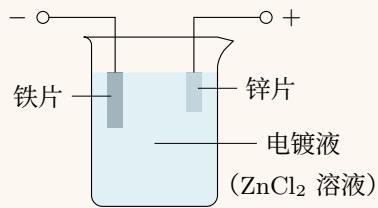
The main process of zinc plating described above can be represented as follows:
Before electrification:
\[ \ce{ZnCl2} = \ce{Zn^{2+} + 2Cl^-} \]
After electrification:
At the cathode: \(\ce{Zn^{2+} + 2e} = \ce{Zn}\) (reduction reaction)
At the anode: \(\ce{Zn - 2e} = \ce{Zn^{2+}}\) (oxidation reaction)
In addition to \(\ce{Zn^{2+}}\) and \(\ce{Cl^-}\), the plating solution also contains \(\ce{H^+}\) and \(\ce{OH^-}\) from the ionization of \(\ce{H2O}\). Under the controlled conditions of electroplating, these ions generally do not react.
As a result of electroplating, the zinc at the anode (plating metal) continuously decreases while the zinc at the cathode (on the plated object) continuously increases, and the amounts lost and gained are equal. Therefore, the \(\ce{ZnCl2}\) content of the solution remains unchanged.
Thus, the zinc-plating process involves oxidation-reduction reactions: \(\ce{Zn^{2+}}\) gains electrons at the cathode and \(\ce{Zn}\) loses electrons at the anode. Therefore, the electroplating process is essentially an electrolysis process. Its distinguishing feature is that the anode itself participates in the electrode reaction (losing electrons and dissolving).
To produce smooth, durable plating layers, the formulations of plating solutions used in industrial production are often very complex. In the past, silver plating and plating of other metals commonly used cyanide compounds to prepare plating solutions. Because \(\ce{CN^-}\) is highly toxic, it poses health hazards to electroplating workers, and the discharge of wastewater and exhaust gas containing \(\ce{CN^-}\) severely pollutes the environment. Therefore, active research is being conducted and cyanide-free plating solutions are gradually being adopted. The solution used in Experiment 5.6 is a cyanide-free plating solution.
In addition to electroplating metal products, plastics can also be electroplated. Since plastics are non-conductors, they cannot be directly electroplated. Before plating, the plastic surface must be pretreated to remove oils and impurities and to make the surface clean. Then a conductive metal film is deposited on the surface, after which the plastic can be electroplated as the cathode, just like metal electroplating. After a metal plating layer is applied, plastic products have the advantages of being lightweight, electrically conductive, and aesthetically pleasing. They can not only replace copper and aluminum metals but also reduce processing steps and lower costs. Therefore, plastic electroplating technology is currently being applied in electronics, optical instruments, machine tool buttons, consumer products, and other areas.
Other applications of the electrolysis principle include electrometallurgy, electrolytic refining, and so forth, which will be studied in subsequent courses.
- Electrolysis uses an electric current passed through an electrolyte solution to cause oxidation at the anode and reduction at the cathode — it converts electrical energy into chemical energy
- In an electrolytic cell, the cathode is connected to the negative terminal of the DC source (cations are reduced there); the anode is connected to the positive terminal (anions are oxidized there)
- Electrolysis of brine: \(\ce{2NaCl + 2H2O ->[electrolysis] 2NaOH + H2 ^ + Cl2 ^}\)
- Electroplating uses the plating metal as the anode and the object to be plated as the cathode; the anode dissolves while the cathode is plated, keeping the solution concentration constant
- The preferential discharge of ions at electrodes depends on their relative ease of gaining or losing electrons
Exercises for Section 8
What is electrolysis? What are the similarities and differences between electrolysis and electroplating?
Explain why, during the electrolysis of water (with a small amount of \(\ce{H2SO4}\) or \(\ce{NaOH}\) added), hydrogen gas and oxygen gas are produced at the cathode and anode, respectively. Write the chemical equations.
What are the advantages of electroplating? What industrial applications does it have?
Why must the electrolytic cell for electrolyzing salt solution have a diaphragm? Why does electrolysis of salt solution produce caustic soda, chlorine gas, and hydrogen gas? Write the chemical equation for the electrolysis of salt solution.
When electrolyzing a copper sulfate solution, what chemical changes occur at the cathode and anode? Write the equations for the reactions.
If we want to plate a layer of silver onto a copper product, what should be used as the cathode and anode of the electrolytic cell? What salt must the plating solution contain?
Content Summary
I. Strong and weak electrolytes
Strong electrolytes ionize completely into ions in aqueous solution. Strong acids, strong bases, and most salts are strong electrolytes.
Weak electrolytes only partially ionize into ions in aqueous solution, and un-ionized electrolyte molecules still exist in the solution. Weak acids, weak bases, and similar substances are weak electrolytes.
II. Ionization of weak electrolytes
1. Ionization equilibrium of weak electrolytes. The ionization of a weak electrolyte is a reversible process. In solution, the un-ionized electrolyte molecules and the ions produced by partial ionization exist in equilibrium. For example, the ionization of acetic acid:
\[ \ce{CH3COOH} \rightleftharpoons \ce{H^+} + \ce{CH3COO^-} \]
The state in which the rate of ionization of electrolyte molecules into ions equals the rate of recombination of ions into molecules is called ionization equilibrium.
Ionization equilibrium is a dynamic equilibrium. When conditions (concentration, temperature) change, the equilibrium shifts in the direction that tends to reduce the change.
2. Ionization degree.
\[ \text{Ionization degree}\ (\alpha) = \frac{\text{number of ionized electrolyte molecules}}{\text{total number of electrolyte molecules originally in solution}} \times 100\% \]
3. Ionization constant. When a weak electrolyte AB ionizes in aqueous solution:
\[ \ce{AB} \rightleftharpoons \ce{A^+} + \ce{B^-} \]
\[ K_\text{ionization} = \frac{[\ce{A^+}][\ce{B^-}]}{[\ce{AB}]} \]
where \([\ce{A^+}]\), \([\ce{B^-}]\), and \([\ce{AB}]\) represent the molar concentrations of \(\ce{A^+}\) ions, \(\ce{B^-}\) ions, and AB molecules, respectively, and \(K_\text{ionization}\) is the ionization constant of the AB solution.
Like ionization degree, the ionization constant can measure the relative strength of electrolytes. However, ionization degree depends on the concentration of the electrolyte solution, whereas the ionization constant does not depend on concentration.
III. Ion product of water and pH
1. Ion product of water. At room temperature, \([\ce{H^+}] \times [\ce{OH^-}] = 1 \times 10^{-14}\) in water. This constant is called the ion product of water.
2. pH.
The negative logarithm (base 10) of the \(\ce{H^+}\) concentration in aqueous solution is called the pH of the solution:
\[ \text{pH} = -\lg[\ce{H^+}] \]
IV. Hydrolysis of salts
The reaction of a salt’s ions with \(\ce{H^+}\) or \(\ce{OH^-}\) from the ionization of water to form a weak electrolyte is called the hydrolysis of salts. It is the reverse of a neutralization reaction. For example:
\[ \ce{CH3COONa + H2O} \underset{\text{neutralization}}{\stackrel{\text{hydrolysis}}{\rightleftharpoons}} \ce{NaOH + CH3COOH} \]
This can be written as an ionic equation:
\[ \ce{CH3COO^- + H2O} \underset{\text{neutralization}}{\stackrel{\text{hydrolysis}}{\rightleftharpoons}} \ce{CH3COOH + OH^-} \]
Comparison of hydrolysis behavior for different types of salts:
| Type of salt | Examples | Hydrolysis? | Solution acidity/basicity |
|---|---|---|---|
| Salt of strong acid + weak base | \(\ce{NH4Cl}\), \(\ce{Al2(SO4)3}\), \(\ce{FeCl3}\) | Yes | Acidic, pH \(< 7\) |
| Salt of strong base + weak acid | \(\ce{CH3COONa}\), \(\ce{Na2CO3}\), \(\ce{NaHCO3}\) | Yes | Basic, pH \(> 7\) |
| Salt of weak acid + weak base | \(\ce{CH3COONH4}\), \(\ce{NH4CN}\), \(\ce{(NH4)2S}\) | Yes | Neutral, acidic, or basic (depends on relative strength of acid and base) |
| Salt of strong acid + strong base | \(\ce{NaCl}\), \(\ce{KNO3}\), \(\ce{Na2SO4}\) | No | Neutral, pH \(= 7\) |
V. Equivalent concentration of acids/bases and neutralization titration
1. Gram-equivalent of an acid:
\[ \text{Gram-equivalent of acid} = \frac{\text{mass of 1 mol of acid (g)}}{\text{moles of}\ \ce{H^+}\ \text{provided by 1 mol of acid}} \]
2. Gram-equivalent of a base:
\[ \text{Gram-equivalent of base} = \frac{\text{mass of 1 mol of base (g)}}{\text{moles of}\ \ce{OH^-}\ \text{provided by 1 mol of base}} \]
3. Equivalent concentration. A solution’s concentration expressed as the number of gram-equivalents of solute per liter of solution. Commonly denoted by \(N\).
4. Acids and bases react in equal numbers of gram-equivalents.
5. Neutralization titration. Based on the formula \(N_\text{acid}V_\text{acid} = N_\text{base}V_\text{base}\), when an acid (or base) of known concentration is added to a base (or acid) solution of unknown concentration, the unknown concentration can be determined. This method is called neutralization titration.
6. Heat of neutralization. In dilute solution, the heat released when an acid and a base undergo a neutralization reaction that produces \(1\ \text{mol}\) of water is called the heat of neutralization.
VI. Galvanic cells, electrolysis, and electroplating
The reactions in galvanic cells, electrolysis, and electroplating are all oxidation-reduction reactions that occur at electrodes. A galvanic cell converts chemical energy into electrical energy. Electrochemical corrosion of metals is caused by galvanic cell reactions. Both electrolysis and electroplating convert electrical energy into chemical energy. The comparison between galvanic cells and electrolytic cells is as follows:
| Electrode names | Current direction | Electrode reactions | Energy conversion | |
|---|---|---|---|---|
| Galvanic cell | Positive and negative electrodes, determined by the electrodes themselves: the more active metal is the negative electrode; the less active metal is the positive electrode | Electrons flow from negative electrode to positive electrode; conventional current flows from positive to negative | Negative electrode: loses electrons (oxidation). Positive electrode: cations gain electrons (reduction) | Chemical energy \(\to\) electrical energy |
| Electrolytic cell | Cathode and anode, determined by the external power source: electrode connected to the negative terminal is cathode; electrode connected to the positive terminal is anode | Electrons flow from DC source’s negative terminal through wire to cathode; ions carry current through solution to anode; electrons flow from anode back to positive terminal | Cathode: cations that gain electrons most readily are reduced preferentially. Anode (inert): anions that lose electrons most readily are oxidized preferentially | Electrical energy \(\to\) chemical energy |

Review Problems
When diluting a concentrated solution of a weak electrolyte, why does the conductivity of the solution generally first increase and then gradually decrease?
When a small amount of acid or base is added to pure water, does the ion product of water change? Does the \(\ce{H^+}\) concentration change?
When \([\ce{H^+}] = 0.2\ M\) in a solution, what is its pH?
Which of the following solutions has the greatest \([\ce{H^+}]\)?
\(30\ \text{ml}\) of \(0.1\ M\) acetic acid
\(20\ \text{ml}\) of \(0.1\ M\) hydrochloric acid
\(10\ \text{ml}\) of \(0.1\ M\) sulfuric acid
Answer the following questions:
The pH values of two sodium hydroxide solutions of different concentrations differ by 1. Find the ratio of their \([\ce{OH^-}]\) values.
A hydrochloric acid solution has pH \(= 4\). To prepare a hydrochloric acid solution with pH \(= 5\), how many times the original volume of water should be added for dilution?
A solution may contain some of the following five anions: \(\ce{OH^-}\), \(\ce{Cl^-}\), \(\ce{NO3^-}\), \(\ce{CO3^{2-}}\), and \(\ce{SO4^{2-}}\). Samples of this solution are placed in three test tubes and the following experiments are performed:
Adding phenolphthalein to the first test tube turns the solution red. After heating and concentrating, adding concentrated \(\ce{H2SO4}\) and copper turnings, then heating further, produces a reddish-brown gas.
Adding \(\ce{Ba(NO3)2}\) solution to the second test tube produces a white precipitate.
Gradually adding dilute \(\ce{HNO3}\) to the third test tube produces a colorless gas that turns clear limewater turbid. Continuing to add dilute \(\ce{HNO3}\) until the solution is acidic, then adding \(\ce{Ba(NO3)2}\) solution produces no precipitate, and adding \(\ce{AgNO3}\) solution also produces no precipitate.
Based on these experiments, determine which ions are present in the solution. Explain your reasoning and write the ionic equations for the reactions.
If \(50\ \text{ml}\) of \(0.15N\) hydrochloric acid is mixed with \(25\ \text{ml}\) of \(0.15N\) \(\ce{NaOH}\) solution, find the pH of the resulting solution. (Assume that the volume of the mixed solution equals the sum of the original volumes.)
Ammonium sulfate, ammonium nitrate, and ammonium chloride are all white crystalline substances. How can they be distinguished from one another? Write the ionic equations.
Potassium chloride contains a small amount of potassium sulfate as an impurity. How can this impurity be removed? Write the relevant ionic equations.
At \(25\,{}^{\circ}\text{C}\), if \(0.5\ M\) ammonia solution is diluted with water to 1/10 of its original concentration, how does the \([\ce{OH^-}]\) change? How does the ionization degree change?
Calculate the pH values of the following solutions.
\(20\ \text{ml}\) of \(0.1\ M\) \(\ce{HCl}\) mixed with \(20\ \text{ml}\) of \(0.1\ M\) \(\ce{NaOH}\) solution
\(20\ \text{ml}\) of \(0.1\ M\) \(\ce{HCl}\) mixed with \(30\ \text{ml}\) of \(0.1\ M\) \(\ce{NaOH}\) solution
\(30\ \text{ml}\) of \(0.1\ M\) \(\ce{HCl}\) mixed with \(20\ \text{ml}\) of \(0.1\ M\) \(\ce{NaOH}\) solution
In solutions of \(\ce{CH3COOH}\) and \(\ce{CH3COONa}\) at the same molar concentration, which solution has the greater \([\ce{CH3COO^-}]\)? Why?
Draw diagrams to illustrate the positive and negative electrodes of a galvanic cell and the direction of electron flow, as well as the cathode and anode of an electrolytic cell and the direction of electron flow.
During electrolysis and electroplating, what reactions occur at the anode and what reactions occur at the cathode? Explain using the concepts of oxidation and reduction.
In the electroplating process, theoretically, does the concentration of the electrolyte solution change? Why? Can the same conclusion be drawn for the electrolysis process? Provide examples to illustrate.
Translator’s note: The “gram-equivalent” concept and “normal concentration” (\(N\)) used in this chapter are now largely obsolete in modern chemistry, having been replaced by the SI unit mole and molar concentration (\(M\) or mol/L). They are retained here as they appeared in the original 1983 textbook.↩︎
Translator’s note: In modern thermochemistry, the standard enthalpy of neutralization for strong acid-strong base reactions is \(-57.3\ \text{kJ/mol}\) (\(= -13.7\ \text{kcal/mol}\)).↩︎
The electron flow generated by metal oxidation is opposite in direction to the impressed current. As long as a sufficiently strong voltage is applied, the galvanic cell current produced by corrosion cannot be sustained, and corrosion therefore cannot occur. Since the metal to be protected is at the cathode in this protection scheme, the method is called impressed-current cathodic protection.↩︎
The protection principle here is the same as for galvanic cell reactions — at the negative electrode, an oxidation reaction occurs; the more active metal is commonly called the sacrificial anode, and the method takes its name from this.↩︎