4 Silicon and Colloids
After studying this chapter, you should be able to:
- Describe the position of the carbon family in the periodic table and explain the trend from nonmetallic to metallic character
- Explain the physical properties of crystalline silicon and its atomic crystal structure
- Describe the chemical properties of silicon and the industrial method for its preparation
- Compare the structures and physical properties of silicon dioxide and carbon dioxide using crystal theory
- Describe the chemical properties and uses of silicon dioxide, silicic acid, and silicates
- Outline the manufacture of cement and glass from silicate raw materials
- Define colloids and distinguish them from true solutions and suspensions based on particle size
- Explain the Tyndall effect, Brownian motion, electrophoresis, and coagulation of colloids
The carbon family elements belong to Group IVA of the periodic table, including carbon, silicon, germanium, tin, and lead. We have already studied carbon in junior high school chemistry. In this chapter, we will focus on silicon and its important compounds, as well as an introduction to colloids.
4.1 Section 1: Carbon Family Elements
The carbon family elements belong to Group IVA of the periodic table, which includes five elements: carbon, silicon, germanium, tin, and lead. The atomic numbers, atomic weights, and electron configurations of the carbon family elements are shown in Table 4.1.
The Group IVA elements occupy a middle position in the periodic table, between main-group elements that readily lose electrons and those that readily gain electrons, so they tend to form covalent compounds.
The outermost electron configuration of carbon family element atoms is \(ns^{2}np^{2}\). As the number of electron shells increases, the properties of the carbon family elements change in a regular pattern. Table 4.2 lists some important properties of the carbon family elements.
| Element | Symbol | Atomic number | Atomic weight | Electron configuration |
|---|---|---|---|---|
| Carbon | C | 6 | 12.01 | \(1s^2\; 2s^22p^2\) |
| Silicon | Si | 14 | 28.09 | \(1s^2\; 2s^22p^6\; 3s^23p^2\) |
| Germanium | Ge | 32 | 72.59 | \(1s^2\; 2s^22p^6\; 3s^23p^63d^{10}\; 4s^24p^2\) |
| Tin | Sn | 50 | 118.7 | \(1s^2\; 2s^22p^6\; 3s^23p^63d^{10}\; 4s^24p^64d^{10}\; 5s^25p^2\) |
| Lead | Pb | 82 | 207.2 | \(1s^2\; 2s^22p^6\; 3s^23p^63d^{10}\; 4s^24p^64d^{10}4f^{14}\; 5s^25p^65d^{10}\; 6s^26p^2\) |
| Element | Atomic radius (\(10^{-10}\ \text{m}\)) | First ionization energy (eV) | Main oxidation states | State and color | Density (g/cm³) | Melting point | Boiling point |
|---|---|---|---|---|---|---|---|
| C | 0.77 | 11.3 | +2, +4 | Colorless or black solid | 3.51 (diamond) / 2.25 (graphite) | \(3550\,{}^{\circ}\text{C}\) (diamond) / \(3652\)–\(3697\,{}^{\circ}\text{C}\) (graphite, sublimes) | \(4827\,{}^{\circ}\text{C}\) |
| Si | 1.17 | 8.2 | +4 | Colorless to brown solid | 2.32–2.34 | \(1410\,{}^{\circ}\text{C}\) | \(2355\,{}^{\circ}\text{C}\) |
| Ge | 1.22 | 7.9 | +2, +4 | Grayish-white solid | 5.35 | \(937.4\,{}^{\circ}\text{C}\) | \(2330\,{}^{\circ}\text{C}\) |
| Sn | 1.41 | 7.3 | +2, +4 | Silvery-white solid | 7.28 | \(231.9\,{}^{\circ}\text{C}\) | \(2260\,{}^{\circ}\text{C}\) |
| Pb | 1.75 | 7.4 | +2, +4 | Bluish-white solid | 11.34 | \(327.5\,{}^{\circ}\text{C}\) | \(1740\,{}^{\circ}\text{C}\) |
As the number of electron shells and nuclear charge increase in the carbon family elements, both their important physical and chemical properties undergo regular changes. The trend from nonmetallic character to metallic character going down the group is even more pronounced than in the nitrogen family. Carbon is clearly a nonmetal. Silicon, although it has a metallic appearance, exhibits predominantly nonmetallic behavior in chemical reactions and is generally regarded as a nonmetal. Germanium has stronger metallic character than nonmetallic character. Tin and lead are both metals.
The electronegativity of the carbon family elements is smaller than that of the halogen, oxygen, and nitrogen family elements in the same period.
In addition to the \(+4\) oxidation state, the carbon family elements can also exhibit a \(+2\) oxidation state. For carbon, silicon, germanium, and tin, the \(+4\) compounds are the more stable forms, whereas for lead, the \(+2\) compounds are more stable.
In nature, the carbon family elements exist in different forms. Carbon exists in the free state — such as diamond, graphite, and amorphous carbon — as well as in the combined state in various carbonates and in the vast number of organic compounds. Although the abundance of carbon in the Earth’s crust is not particularly high, it is the element that forms the greatest variety of compounds on Earth. Silicon exists in the Earth’s crust mainly in the form of oxygen-containing mineral compounds. Germanium is an uncommon element that is usually found together with certain metals in sulfide ores. Both tin and lead exist in nature only in the combined state. The main ore of tin is cassiterite (\(\ce{SnO2}\)), and the main ore of lead is galena (\(\ce{PbS}\)).
We have already studied carbon in junior high school chemistry. In what follows, we will focus on silicon and its important compounds; germanium, tin, and lead will not be discussed further.
- The carbon family elements (C, Si, Ge, Sn, Pb) are in Group IVA with outermost electron configuration \(ns^{2}np^{2}\)
- They occupy a middle position in the periodic table and tend to form covalent compounds
- The trend from nonmetallic to metallic character becomes more pronounced going down the group: C and Si are nonmetals, Ge is a metalloid, Sn and Pb are metals
- Carbon family elements exhibit both \(+4\) and \(+2\) oxidation states; for C, Si, Ge, and Sn the \(+4\) state is more stable, while for Pb the \(+2\) state is more stable
- Carbon forms the greatest variety of compounds; silicon exists mainly as oxides and silicates in the Earth’s crust
Exercises for Section 1
Draw a simplified atomic structure diagram for silicon. Write the electron-dot formula for silicon and its main oxidation state. Describe how silicon exists in nature.
Explain why most compounds of carbon and silicon are held together by covalent bonds.
4.2 Section 2: Silicon and Its Important Compounds
I. Silicon
We already know that in the Earth’s crust, silicon ranks second in abundance among all elements, after only oxygen. In nature, there is no free (elemental) silicon — it exists only in the combined state. Combined silicon is almost entirely in the form of silicon dioxide and silicates, which are widely distributed in various minerals and rocks of the Earth’s crust. Silicon is the principal element constituting minerals and rocks.
1. Physical Properties
Crystalline silicon is a colorless to brownish solid with metallic luster that is hard and brittle (see Table 4.2). The outermost electron configuration of a silicon atom is \(3s^{2}3p^{2}\), giving it 4 valence electrons. The structure of crystalline silicon is similar to that of diamond: each silicon atom forms 4 covalent bonds with 4 other silicon atoms, creating a regular tetrahedral arrangement. This structure, like diamond, is a network-type atomic crystal (Figure 4.1).1 This structure accounts for silicon’s relatively high hardness, melting point, and boiling point.
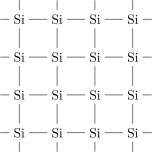
However, because the atomic radius of silicon is larger than that of carbon, the Si–Si bond length in crystalline silicon (\(2.35 \times 10^{-10}\ \text{m}\)) is greater than the C–C bond length in diamond, while the Si–Si bond energy (\(42.5\ \text{kCal/mol}\))2 is less than the C–C bond energy in diamond. Therefore, the hardness, melting point, and boiling point of crystalline silicon are all lower than those of diamond.
The electrical conductivity of silicon lies between that of metals and insulators. Silicon is an excellent semiconductor material and is used to manufacture semiconductor devices such as silicon rectifiers, transistors, and integrated circuits.
Germanium is similar to silicon and is also an important semiconductor material.
2. Chemical Properties
Silicon is a nonmetallic element. Many of its chemical properties are similar to those of carbon — when it combines with other elements, it forms covalent bonds.
Silicon is chemically rather unreactive. At room temperature, apart from fluorine gas, hydrofluoric acid, and strong alkali solutions, other substances such as oxygen, chlorine, sulfuric acid, and nitric acid do not react with silicon. When heated, silicon can react with certain nonmetals. For example, when finely ground silicon is heated, it burns to form silicon dioxide, releasing a large amount of heat:
\[ \ce{Si + O2 \xlongequal{\Delta} SiO2} \]
Silicon reacts with strong alkali solutions to produce silicates and release hydrogen gas:
\[ \ce{Si + 2NaOH + H2O = Na2SiO3 + 2H2 ^} \]
Under ordinary conditions, silicon and hydrogen cannot combine directly. Hydrides of silicon are usually prepared by indirect methods.
Like carbon, silicon can also form silicides with certain metals, so silicon can be used to make alloys. For example, ferrosilicon alloys are used as deoxidizers in steelmaking to remove oxygen. Steel containing \(4\%\) silicon has magnetic permeability and can be used to manufacture transformer cores. Steel containing about \(15\%\) silicon has acid resistance and can be used to manufacture acid-resistant equipment.
Industrially, silicon is produced by reducing silicon dioxide with carbon in an electric furnace:
\[ \ce{SiO2 + 2C \xlongequal{\text{high temp.}} Si + 2CO ^} \]
The silicon produced in this way is crude silicon containing small amounts of impurities. After purification, crude silicon can yield the high-purity silicon used as a semiconductor material.
II. Silicon Dioxide
1. Physical Properties
Silicon dioxide (\(\ce{SiO2}\)) is a hard, refractory solid. Together with other minerals, it constitutes many types of rock and is widely distributed in nature.
Natural silicon dioxide is divided into two broad categories: crystalline and amorphous. The main component of quartz is crystalline silicon dioxide. Pure quartz found in nature is a colorless, transparent hexagonal prismatic crystal — this crystal is what we commonly call rock crystal (quartz crystal).
Diatomaceous earth contains amorphous silicon dioxide. It is formed from the remains of dead diatoms3 and other tiny organisms that have been deposited and cemented together, producing a porous, lightweight, soft solid material. Because of its very large surface area, it has strong adsorption capacity and can serve as an adsorbent, a catalyst support,4 and a thermal insulation material.
Silicon dioxide and carbon dioxide differ greatly in their physical properties. For example, silicon dioxide has a high melting point and great hardness, whereas carbon dioxide is normally a gas, and solid carbon dioxide has a very low melting point. These differences between silicon dioxide and carbon dioxide are determined by their different structures. We already know that solid carbon dioxide is a molecular crystal. Between molecules there are only relatively weak intermolecular forces, so its melting point is very low. However, silicon dioxide is not a molecular crystal composed of individual “\(\ce{SiO2}\)” molecules — it is an atomic crystal. As shown in Figure 4.2, each Si atom forms 4 covalent bonds with 4 O atoms, so each Si atom is surrounded by 4 O atoms; at the same time, each O atom is bonded to 2 Si atoms.
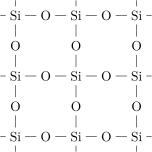
In reality, the silicon dioxide crystal is a three-dimensional network atomic crystal composed of silicon atoms and oxygen atoms in a \(1:2\) ratio. We conventionally use the chemical formula \(\ce{SiO2}\) to represent the composition of silicon dioxide. In the silicon dioxide crystal, the Si–O bond length is \(1.62 \times 10^{-10}\ \text{m}\), and the bond energy is \(88.2\ \text{kCal/mol}\).5 Because the Si–O bond energy is very high and the crystal forms a three-dimensional network, melting silicon dioxide — that is, breaking the crystal apart — requires a large amount of energy. Therefore, silicon dioxide has a very high melting point and great hardness.
2. Chemical Properties
Because the Si–O bond energy is very large, the chemical properties of silicon dioxide are very stable. It does not react with acids (except hydrofluoric acid). Silicon dioxide is an acidic oxide. However, silicon dioxide is insoluble in water and cannot react with water to form an acid. Silicon dioxide can react with basic oxides or strong bases to form salts:
\[ \ce{SiO2 + CaO \xlongequal{\text{high temp.}} CaSiO3} \]
\[ \ce{SiO2 + 2NaOH = Na2SiO3 + H2O} \]
Glass contains silicon dioxide, so it can be corroded by alkali solutions. In laboratories, reagent bottles for storing alkali solutions use rubber stoppers rather than glass stoppers — this is to prevent the glass from being corroded by the alkali, which would produce \(\ce{Na2SiO3}\) and cause the stopper to become cemented to the bottle.
3. Uses
Silicon dioxide has many uses. The relatively rare rock crystal found in nature can be used to manufacture important components for the electronics industry, optical instruments, and crafts.
Silicon dioxide is an important raw material for manufacturing optical fibers.
Relatively pure quartz can be used to make quartz glass. Quartz glass has a very small coefficient of thermal expansion — about 1/18 that of ordinary glass — and can withstand drastic temperature changes. It also has excellent acid resistance (except to \(\ce{HF}\)). Therefore, quartz glass is commonly used to manufacture high-temperature-resistant chemical instruments.
Quartz sand is often used as a raw material for glass and as a construction material.
III. Silicic Acid and Silicates
1. Silicic Acid
Silicic acid cannot be prepared by reacting silicon dioxide directly with water — it can only be prepared by reacting a corresponding soluble silicate with an acid.
When an aqueous solution of sodium silicate (\(\ce{Na2SiO3}\))6 reacts with hydrochloric acid, the resulting white gelatinous precipitate is called orthosilicic acid, usually represented by the formula \(\ce{H4SiO4}\). Orthosilicic acid is nearly insoluble in water; it is a weak acid and very unstable. When this white gelatinous material is dried in air, it loses some of its water and turns into a white powder. This substance is silicic acid, usually represented by the formula \(\ce{H2SiO3}\) (which can be thought of as \(\ce{H4SiO4} = \ce{H2SiO3} + \ce{H2O}\)). Silicic acid is also insoluble in water and is a weak acid — its acidity is even weaker than that of carbonic acid.
2. Silicates
The salts corresponding to silicic acid, orthosilicic acid, and various condensed acids formed by their dehydration are collectively called silicates. For example, sodium silicate (\(\ce{Na2SiO3}\)), forsterite (\(\ce{Mg2SiO4}\)), and kaolinite (\(\ce{Al2(Si2O5)(OH)4}\)) are all silicates. There are many types of silicates with complex structures — they are the principal components of rocks in the Earth’s crust. We can represent the composition of silicates in terms of silicon dioxide and metal oxides. For example:
- Sodium silicate: \(\ce{Na2SiO3}\) (\(\ce{Na2O * SiO2}\))
- Forsterite: \(\ce{Mg2SiO4}\) (\(\ce{2MgO * SiO2}\))
- Kaolinite: \(\ce{Al2(Si2O5)(OH)4}\) (\(\ce{Al2O3 * 2SiO2 * 2H2O}\))
Most silicates are insoluble in water. The most common soluble silicate is \(\ce{Na2SiO3}\), whose aqueous solution is commonly known as water glass (sodium silicate solution). Water glass is a colorless, viscous liquid and a mineral adhesive. It is neither flammable nor subject to corrosion. In the construction industry, it can be used as an adhesive, an admixture for acid-resistant cement, and other purposes. Wood and textiles that have been soaked in water glass acquire preservative properties and do not catch fire easily. Water glass can also be used as a refractory material.
The components of clay are also silicates. Orthoclase (\(\ce{KAlSi3O8}\)) in granite decomposes under the action of carbon dioxide and water to form clay and other substances. There are many types of clay with complex compositions (mainly kaolinite), and it is the principal mineral component of soil. Common types include kaolin7 and ordinary clay — the former contains fewer impurities and the latter more.
- Silicon ranks second in crustal abundance (after O); it exists only in the combined state as \(\ce{SiO2}\) and silicates
- Crystalline silicon has a diamond-like atomic crystal structure; it is an excellent semiconductor material
- Silicon is chemically unreactive at room temperature (except with \(\ce{F2}\), \(\ce{HF}\), and strong bases)
- \(\ce{SiO2}\) is a three-dimensional network atomic crystal with very high melting point and hardness
- \(\ce{SiO2}\) is an acidic oxide but is insoluble in water; it reacts with bases and basic oxides, but not with acids (except \(\ce{HF}\))
- \(\ce{H2SiO3}\) is a weak acid (weaker than \(\ce{H2CO3}\)), insoluble in water, prepared from \(\ce{Na2SiO3}\) + acid
- Water glass (\(\ce{Na2SiO3}\) solution) is a mineral adhesive used in construction and as a fire retardant
Exercises for Section 2
In the purification of crude silicon, the following method is commonly used: crude silicon is reacted with chlorine gas at high temperature to produce silicon tetrachloride (\(\ce{SiCl4}\)). The \(\ce{SiCl4}\) is purified by fractional distillation and then reduced with hydrogen to obtain pure silicon. Write the chemical equations for the reactions described above.
In what respects are the structures and physical properties of crystalline silicon and diamond similar, and in what respects do they differ?
How do carbon dioxide and silicon dioxide differ in their physical properties? Explain these differences from the perspective of their crystal structures.
How can you use chemical methods to test for quartz and limestone impurities mixed in quicklime? Write the relevant chemical equations.
A mixture of \(60\ \text{g}\) of \(\ce{SiO2}\) and \(20\ \text{g}\) of carbon is placed in an electric furnace and heated, causing the following reaction: \(\ce{SiO2 + 2C = Si + 2CO}\). Calculate:
What is the mass of each product in grams?
What is the volume of the \(\ce{CO}\) produced at STP, in liters?
Rewrite the following formulas in the oxide form:
Kaolinite: \(\ce{Al2(Si2O5)(OH)4}\)
Talc: \(\ce{Mg3(Si4O10)(OH)2}\)
Calcium zeolite: \(\ce{Ca(Al2Si3O10) * 3H2O}\)
How can silicic acid be prepared from quartz and other substances? Write the corresponding chemical equations.
4.3 Section 3: The Silicate Industry
The industry that uses silicon-containing substances as raw materials and processes them by heating to produce silicate products — such as cement, glass, and ceramics — is called the silicate industry. It occupies an important position in the national economy.
I. Cement
The main raw materials for ordinary Portland cement are limestone and clay. The limestone, clay, and other auxiliary raw materials are mixed in definite proportions, ground into a fine powder called the raw mix, and fed into a rotary kiln for calcination (Figure 4.3).
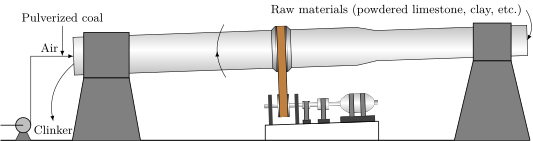
During calcination, fuel is injected from the lower end of the rotary kiln, while the raw materials enter from the upper end. Under the action of gravity, the materials gradually move downward, passing through the preheating zone, calcination zone, and sintering zone (where the temperature can reach \(1400\)–\(1500\,{}^{\circ}\text{C}\)). At high temperature, the raw materials undergo complex physical and chemical changes, becoming partially molten. After cooling, they solidify into hard lumps called clinker. The clinker is then mixed with an appropriate amount of gypsum (to regulate the rate of cement hardening) and ground into a fine powder — this is ordinary Portland cement. The main components of this cement are:
- Tricalcium silicate: \(\ce{3CaO * SiO2}\)
- Dicalcium silicate: \(\ce{2CaO * SiO2}\)
- Tricalcium aluminate: \(\ce{3CaO * Al2O3}\)
Cement is actually a mixture of these main components. Differences in the composition and crystalline form of cement directly affect its various key properties.
Cement has hydraulic properties. When cement is mixed with water, a reaction occurs, producing various hydrates and releasing a certain amount of heat. The hydrates gradually form a gelatinous mass and begin to solidify. Eventually, some of the gelatinous material transforms into crystals, and the interlocking gel and crystals produce a solid of great strength. This process is called the setting and hardening of cement.
Cement can harden both in air and under water. Therefore, it is not only a general construction material but also an indispensable building material for underwater engineering projects.
To improve the performance of cement and expand its range of applications, appropriate proportions of supplementary materials can be mixed into Portland cement clinker to produce various types of cement. For example, blast furnace slag Portland cement is made by adding a certain amount of blast furnace slag (whose main component is \(\ce{CaSiO3}\)) to Portland cement clinker. Zeolite rock cement is made by adding a certain amount of zeolite rock to the clinker.
A mixture of cement, sand, and water is called cement mortar. In construction, it is used as a bonding agent to bind bricks, stones, and other materials together. A mixture of cement, sand, crushed stone, and water in definite proportions, after hardening, is called concrete. It is commonly used to construct bridges, factories, and other large structures. The coefficient of thermal expansion of cement is nearly the same as that of iron, so concrete structures are often reinforced with steel bars to make the structures even more robust — this is called reinforced concrete.
II. Glass
The main raw materials for manufacturing ordinary glass are soda ash (\(\ce{Na2CO3}\)), limestone (\(\ce{CaCO3}\)), and quartz (\(\ce{SiO2}\)). Some specialty glasses also require lead oxide (\(\ce{PbO}\)) and borax (\(\ce{Na2B4O7 * 10H2O}\)). In the production of glass, the raw materials are crushed, mixed in appropriate proportions, and placed in a glass-melting furnace where they are heated at high temperature. After the raw materials melt, relatively complex physical and chemical changes occur. The main reactions involve silicon dioxide reacting with sodium carbonate and calcium carbonate to produce silicates and carbon dioxide:
\[ \ce{Na2CO3 + SiO2 \xlongequal{\text{high temp.}} Na2SiO3 + CO2 ^} \]
\[ \ce{CaCO3 + SiO2 \xlongequal{\text{high temp.}} CaSiO3 + CO2 ^} \]
Among the raw materials, quartz is used in the largest proportion. Therefore, ordinary glass is a substance obtained by melting \(\ce{Na2SiO3}\), \(\ce{CaSiO3}\), and \(\ce{SiO2}\) together. This substance is not crystalline — it is called a glassy material. It does not have a definite melting point but instead gradually softens over a range of temperatures. In the softened state, glass can be shaped into products of any form.
There are many types of glass. In addition to ordinary glass described above, there is borosilicate glass — a heat-resistant instrument glass with a small coefficient of thermal expansion that can withstand rapid heating and cooling. It has good chemical stability and resists corrosion by acids and bases, making it suitable for manufacturing chemical instruments. Lead glass has a high refractive index and is commonly used to make optical instruments. Colored glass is generally manufactured by adding certain metal oxides to the raw materials, so that the metal oxides are uniformly dispersed throughout the glassy material, giving the glass its characteristic color. For example, adding cobalt oxide (\(\ce{Co2O3}\)) produces blue glass; adding cuprous oxide (\(\ce{Cu2O}\)) produces red glass; and so on.
When ordinary glass is placed in an electric furnace and heated until it softens, then rapidly cooled, tempered glass is obtained. The mechanical strength of tempered glass is \(4\) to \(6\) times greater than that of ordinary glass, and it does not shatter easily. When it does break, the fragments have no sharp edges and are less likely to cause injury. Tempered glass is used to make windows for automobiles and trains.
Glass can also be made into fibers. Glass fibers have high strength and can serve as sound-insulating, heat-insulating, and electrical insulation materials. They can also be used to manufacture glass fiber reinforced plastics, among other products.
- The silicate industry uses silicon-containing raw materials heated to produce cement, glass, and ceramics
- Portland cement is made from limestone + clay, calcined in a rotary kiln at \(1400\)–\(1500\,{}^{\circ}\text{C}\); main components are \(\ce{3CaO * SiO2}\), \(\ce{2CaO * SiO2}\), and \(\ce{3CaO * Al2O3}\)
- Cement has hydraulic properties — it hardens both in air and under water
- Concrete = cement + sand + crushed stone + water; reinforced with steel bars it becomes reinforced concrete
- Ordinary glass is made from \(\ce{Na2CO3}\) + \(\ce{CaCO3}\) + \(\ce{SiO2}\); the product is a glassy (non-crystalline) material of \(\ce{Na2SiO3}\), \(\ce{CaSiO3}\), and \(\ce{SiO2}\)
- Tempered glass has \(4\)–\(6\times\) the mechanical strength of ordinary glass
Exercises for Section 3
What are the main chemical reactions that occur when the raw materials for ordinary glass are melted in a glass furnace? Write the chemical equations for the reactions.
Ordinary glass contains \(13\%\) \(\ce{Na2O}\), \(11.7\%\) \(\ce{CaO}\), and \(75.3\%\) \(\ce{SiO2}\). Calculate the mole ratio of the three oxides.
To produce one tonne of ordinary glass, how many tonnes each of soda ash, limestone, and silicon dioxide are needed (refer to the mole ratio obtained in Problem 2)? Also calculate the volume of carbon dioxide produced at a temperature of \(1200\,{}^{\circ}\text{C}\) and a pressure of \(750\ \text{mmHg}\).
4.4 Section 4: Colloids
In studying the previous sections, we have already encountered situations where certain substances form colloids under particular conditions. For example, silicic acid forms a transparent liquid when dispersed in water; certain metal oxides dispersed in glassy materials form colored glass; and so on. This section primarily introduces what colloids are and their important properties.
I. Colloids
In junior high school chemistry, we already studied solutions, suspensions, and emulsions. They are all mixtures formed by the particles of one substance (or several substances) being dispersed in another substance. We commonly call such mixtures disperse systems (dispersions). The substance dispersed as particles is called the dispersed phase (disperse phase); the substance in which the particles are dispersed is called the dispersion medium. For example, in a solution, the solute is the dispersed phase and the solvent is the dispersion medium — a solution is one type of disperse system. Suspensions and emulsions are also disperse systems, in which the small solid particles or liquid droplets are the dispersed phase and the solvent used is the dispersion medium.
A colloid is also a type of disperse system. In this system, the diameter of the dispersed-phase particles is intermediate between the diameter of solute molecules or ions in a true solution (generally less than \(10^{-9}\ \text{m}\)) and the diameter of particles in suspensions or emulsions (generally greater than \(10^{-7}\ \text{m}\)).
A disperse system in which the diameter of the dispersed-phase particles ranges from \(10^{-9}\) to \(10^{-7}\ \text{m}\) is called a colloid.
Pour \(20\ \text{mL}\) of distilled water into a beaker and heat until the water boils. Then add \(1\)–\(2\ \text{mL}\) of saturated iron(III) chloride (\(\ce{FeCl3}\)) solution to the boiling water. Continue boiling until the solution turns reddish-brown, then stop heating. Observe the colloid that has been prepared.
Take a large test tube and pour in \(10\ \text{mL}\) of \(0.01\ \text{M}\) potassium iodide (\(\ce{KI}\)) solution. Using a rubber-tipped dropper, add \(8\)–\(10\) drops of silver nitrate (\(\ce{AgNO3}\)) solution of the same concentration, swirling the test tube while adding. Observe the colloid that has been prepared.
The two experiments above can be represented by the following chemical equations:
\[ \ce{FeCl3 + 3H2O \xlongequal{\Delta} Fe(OH)3}\text{ (colloid)} + \ce{3HCl} \]
\[ \ce{KI + AgNO3 = AgI}\text{ (colloid)} + \ce{KNO3} \]
From these two experiments, one can observe that the colloid formed by dispersing iron(III) hydroxide in water is reddish-brown, and the colloid formed by dispersing silver iodide in water is pale yellow.
The colloidal particles in these two colloids are aggregates of many molecules of iron(III) hydroxide or silver iodide, respectively,8 and their diameters range from \(10^{-9}\) to \(10^{-7}\ \text{m}\).
Some substances have very large molecular diameters that reach the size of colloidal particles, and these substances can dissolve in water (or other solvents). When such a substance dissolves in water (or another solvent), it forms a colloid in which the colloidal particles are individual molecules.9
We often take advantage of the fact that colloidal particles have diameters in the range of \(10^{-9}\) to \(10^{-7}\ \text{m}\) to purify impure colloids: the impure colloid is placed in a container fitted with a semipermeable membrane,10 which allows smaller particles (such as molecules and ions) to pass through, thereby purifying the colloid.
Make a bag from semipermeable membrane material. Pour a mixture of \(10\ \text{mL}\) of starch colloid and \(5\ \text{mL}\) of salt solution into the bag. Then, as shown in Figure 4.4, tie the top of the bag shut with string, suspend it from a glass rod, and hang it in a beaker filled with distilled water.
After a few minutes, take two test tubes and draw \(5\ \text{mL}\) of liquid from the beaker into each. To one test tube, add a small amount of silver nitrate solution. To the other, add a small amount of iodine solution. Observe the changes that occur in the two test tubes.
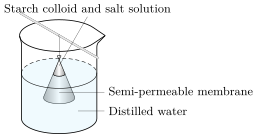
From the experiment, one can observe that a white precipitate appears in the test tube to which silver nitrate solution was added, while no change occurs in the test tube to which iodine solution was added. This demonstrates that chloride ions can pass through the pores of the semipermeable membrane, whereas the starch colloidal particles cannot. Similarly, experiments can verify that sodium ions also pass through the semipermeable membrane. This phenomenon shows that colloidal particles are larger than the ions or molecules of solutes in a true solution.
The operation of placing a colloid containing ionic or molecular impurities into a semipermeable membrane bag and immersing this bag in a solvent, so that the ions or molecules separate from the colloidal solution, is called dialysis. Dialysis can be used to purify certain colloids.
There are many types of colloids. Based on the nature of the dispersion medium, colloids can be classified as lyosols (liquid sols), aerosols, and solid sols:
- When the dispersion medium is a liquid, the colloid is called a lyosol (also called a sol). For example, the \(\ce{Fe(OH)3}\) and \(\ce{AgI}\) colloids prepared in the experiments above are both lyosols.
- When the dispersion medium is a gas, the colloid is called an aerosol. For example, fog, clouds, and smoke are all aerosols.
- When the dispersion medium is a solid, the colloid is called a solid sol. For example, smoky quartz and colored glass are both solid sols.
II. Important Properties of Colloids
In appearance, a colloid and a true solution are not obviously different. Although colloidal particles are much larger than the molecules or ions of a solute in solution, both can pass through filter paper. How, then, can we distinguish a colloid from a true solution? Below we introduce several important properties of colloids, some of which can be used to distinguish colloids from solutions.
1. The Tyndall Effect
When sunlight passes through a small hole in a window and enters a room, one can observe a bright “path” of light by looking perpendicular to the beam. This phenomenon is called the scattering of light. It occurs because as the beam travels through the air, it encounters many tiny dust particles, which cause some of the light to deviate from its original direction and scatter in all directions.
If a beam of light is passed through a colloid, a bright “path” can similarly be observed from the side. This too is caused by the scattering of light by colloidal particles (Figure 4.5). This phenomenon is called the Tyndall effect.11
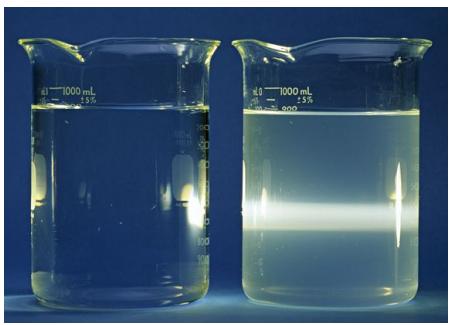
The left beaker contains a true solution; the right beaker contains a colloid.
When light passes through a true solution, this phenomenon is not observed. This method can therefore be used to distinguish a colloid from a true solution.
2. Brownian Motion
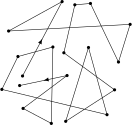
In 1827, Brown12 suspended pollen grains in water and observed them under a microscope. He found that the small pollen grains underwent continuous, random motion. This phenomenon is called Brownian motion (Figure 4.6).
When a sol is observed under an ultramicroscope,13 one can see that colloidal particles also undergo Brownian motion. This is because water molecules (or dispersion medium molecules) collide with colloidal particles from all directions. At any given instant, the forces acting on a colloidal particle from different directions are not equal, so the direction of the particle’s motion changes at every instant, resulting in continuous, random movement.
3. Electrophoresis
A U-tube is filled with reddish-brown \(\ce{Fe(OH)3}\) colloid, and an electrode is inserted into each arm of the U-tube (Figure 4.7). After passing direct current, one observes that the color near the cathode gradually deepens while the color near the anode gradually fades. This indicates that the \(\ce{Fe(OH)3}\) colloidal particles carry a positive charge and, under the influence of the electric field, move toward the cathode.
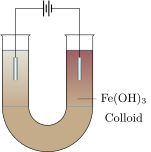
The directional movement of colloidal particles in a dispersion medium toward the cathode (or anode) under the influence of an applied electric field is called electrophoresis.
The phenomenon of electrophoresis demonstrates that colloidal particles carry electric charges. But why do colloidal particles carry charges? Generally speaking, it is because colloidal particles have a relatively large surface area and can adsorb cations or anions, thereby acquiring a positive or negative charge.
When a substance is dispersed into colloidal particles, the total surface area of the dispersed phase increases enormously. For example, a cube with each edge measuring \(1\ \text{cm}\) has a total surface area of \(6\ \text{cm}^{2}\). If this cube were dispersed into colloidal particles — say, tiny cubes with each edge measuring \(10^{-8}\ \text{m}\) — the total surface area would become \(600\ \text{m}^{2}\), an increase of one million times over the original. Because colloidal particles have such a large surface area, they possess a strong adsorption capacity.
Different types of colloidal particles adsorb ions of different charges. Some colloidal particles adsorb cations, while others adsorb anions. In general, colloidal particles of metal hydroxides and metal oxides adsorb cations and carry a positive charge; colloidal particles of nonmetal oxides and metal sulfides adsorb anions and carry a negative charge. Because colloidal particles are electrically charged, they undergo directional movement under the influence of an electric field, producing the phenomenon of electrophoresis.
4. Coagulation of Colloids
Because colloidal particles of the same type carry the same charge, the particles repel each other. Under normal circumstances, the particles do not readily aggregate, so colloids are relatively stable disperse systems that can be preserved for extended periods.
However, if a small amount of electrolyte is added to certain colloids, the cations or anions produced by ionization of the electrolyte neutralize the charges on the colloidal particles. This causes the colloidal particles to aggregate into larger clumps, forming a precipitate that settles out from the dispersion medium. This process is called coagulation (flocculation).
Place \(5\ \text{mL}\) of \(\ce{Fe(OH)3}\) colloid in a test tube. Add \(1\)–\(2\ \text{mL}\) of \(\ce{MgSO4}\) solution and shake. Observe the phenomenon that occurs.
From the experiment above, one can see that after \(\ce{MgSO4}\) solution is added to the \(\ce{Fe(OH)3}\) colloid, the colloid becomes turbid, indicating that the colloidal particles have undergone coagulation. This is because the \(\ce{SO4^{2-}}\) ions in the \(\ce{MgSO4}\) solution neutralize the charges carried by the \(\ce{Fe(OH)3}\) colloidal particles through electrostatic interaction, causing the colloidal particles to aggregate and precipitate out.
In addition to adding electrolytes, heating a colloid or mixing two colloids that carry opposite charges can also cause coagulation.
In general, when a colloid coagulates, a precipitate forms. However, for some colloids, when coagulation occurs, the colloidal particles and dispersion medium solidify together into a non-flowing, jelly-like mass. Such a substance is a gel. For example, the tofu we eat every day is a gel made by adding bittern (whose main component is \(\ce{MgCl2 * 6H2O}\)) or gypsum (\(\ce{CaSO4 * 2H2O}\)) solution to soy milk, causing the protein and water in the soy milk to coagulate together.
When hydrochloric acid is added to a sodium silicate solution, silicic acid precipitates. If this precipitate is heated to \(300\,{}^{\circ}\text{C}\) under reduced pressure, the silicic acid loses its water and becomes a porous, network-like material. Its main component is silicon dioxide containing about \(4\%\) water. This material is called silica gel. Silica gel is also a type of gel. Because of its large surface area and strong adsorption capacity, it can be used as a desiccant, an adsorbent, and a catalyst support.
Knowledge of colloids is of great importance to industry, agriculture, scientific research, national defense, and daily life. This is because many physiological phenomena in animals and plants must be explained using colloidal chemistry. In soil, many substances such as clay and humus often exist in colloidal form, so the chemical processes occurring in soil are closely related to colloid science. In the defense industry, certain explosives and propellants must be prepared as colloids. In metallurgy, ore beneficiation, crude oil dehydration, and the manufacturing processes of plastics, rubber, and synthetic fibers all make use of colloidal science. In daily life, colloids we frequently encounter and use include milk, soy milk, and porridge (foods); plastics and rubber products (household goods); cement (construction materials); and many others. Because of its wide-ranging and important applications, colloid science has developed into an independent discipline.
- A colloid is a disperse system with dispersed-phase particle diameters in the range of \(10^{-9}\) to \(10^{-7}\ \text{m}\)
- Colloids are classified as lyosols (liquid medium), aerosols (gas medium), or solid sols (solid medium)
- The Tyndall effect (light scattering) distinguishes colloids from true solutions
- Brownian motion is the continuous, random movement of colloidal particles caused by uneven collisions from dispersion medium molecules
- Electrophoresis shows that colloidal particles carry charges (positive or negative) due to selective ion adsorption on their large surface area
- Coagulation occurs when charges on colloidal particles are neutralized (e.g., by adding electrolytes, by heating, or by mixing oppositely charged colloids), causing particles to aggregate
- Dialysis (using a semipermeable membrane) can purify colloids by removing ions and small molecules
- Silica gel is a porous gel used as a desiccant, adsorbent, and catalyst support
Exercises for Section 4
When preparing \(\ce{Fe(OH)3}\) colloid, some \(\ce{FeCl3}\) remains dissolved in it. How can the \(\ce{FeCl3}\) be removed? Describe the process for testing whether \(\ce{Cl^{-}}\) ions are still present in the colloid after removal of \(\ce{FeCl3}\), and write the relevant ionic equation.
How can you experimentally distinguish between a true solution and a colloid?
Which of the following statements correctly explains the electrophoresis of colloidal particles?
Electrophoresis occurs because colloidal particles carry positive or negative charges.
Electrophoresis occurs because half the particles in a lyosol carry positive charges and the other half carry negative charges.
Electrophoresis is a result of Brownian motion.
Why can a colloid remain stable for a certain period of time?
Arsenic sulfide colloidal particles migrate toward the anode during electrophoresis. For each of the following substances, state whether adding it to arsenic sulfide colloid would cause coagulation:
\(\ce{Fe(OH)3}\) colloid
\(\ce{AlCl3}\) solution
Why does river water carrying suspended clay colloidal particles tend to deposit sediment and form sandbars (deltas) when it meets seawater?
Prepare a table comparing the differences among true solutions, colloids, and suspensions (or emulsions).
Content Summary
I. Carbon Family Elements
The carbon family elements belong to Group IVA of the periodic table, including five elements: carbon, silicon, germanium, tin, and lead. The outermost electron configuration of carbon family elements is \(ns^{2}np^{2}\). The electronegativity of the carbon family elements is smaller than that of the halogen, oxygen, and nitrogen family elements in the same period. The carbon family elements occupy a middle position in the periodic table, between main-group elements that readily lose electrons and those that readily gain electrons. In addition to the \(+4\) oxidation state, carbon family elements also exhibit a \(+2\) oxidation state.
Carbon exists in both the free and combined states; it is the element that forms the greatest variety of compounds on Earth. Silicon ranks second in crustal abundance and exists mainly in the form of oxygen-containing mineral compounds. Germanium is usually found together with certain metals in sulfide ores. Tin and lead both exist in nature in the combined state.
II. Silicon and Its Important Compounds
1. Silicon — Silicon has atomic number 14, with electron configuration \(1s^{2}2s^{2}2p^{6}3s^{2}3p^{2}\). A silicon atom has 4 valence electrons and can form 4 covalent bonds. The structure of crystalline silicon is similar to that of diamond — both are atomic crystals. Crystalline silicon and germanium are excellent semiconductors.
Silicon is chemically unreactive. At room temperature, apart from fluorine gas, hydrofluoric acid, and strong alkali solutions, other substances such as oxygen, chlorine, sulfuric acid, and nitric acid do not react with silicon. When heated, silicon reacts with oxygen. Silicon also reacts with strong alkali solutions to produce silicates.
2. Silicon dioxide — Natural silicon dioxide is divided into crystalline and amorphous forms. Crystalline silicon dioxide is an atomic crystal composed of silicon and oxygen atoms, with chemical formula \(\ce{SiO2}\). Silicon dioxide is insoluble in water. It is an acidic oxide that reacts with basic oxides and bases to form salts.
3. Silicic acid and silicates — Silicic acids include orthosilicic acid (\(\ce{H4SiO4}\)) and silicic acid (\(\ce{H2SiO3}\)). They are weak acids — their acidity is even weaker than that of carbonic acid. Silicic acid can be prepared by reacting sodium silicate with hydrochloric acid.
The salts corresponding to orthosilicic acid, silicic acid, and various condensed acids formed by their dehydration are collectively called silicates, such as sodium silicate (\(\ce{Na2SiO3}\)) and kaolinite (\(\ce{Al2(Si2O5)(OH)4}\)).
The most common soluble silicate is \(\ce{Na2SiO3}\), whose aqueous solution is commonly known as water glass.
4. The silicate industry — Cement can be manufactured from limestone and clay as the main raw materials. Ordinary glass can be manufactured from soda ash, limestone, and quartz as raw materials.
III. Colloids
1. Colloids — A disperse system in which the diameter of the dispersed-phase particles ranges from \(10^{-9}\) to \(10^{-7}\ \text{m}\) is called a colloid. Colloidal particles cannot pass through a semipermeable membrane, so dialysis can be used to purify colloids. Based on the state of the dispersion medium, colloids are classified as aerosols, lyosols (sols), and solid sols.
2. Properties of colloids — The properties of colloids include the Tyndall effect, Brownian motion, and electrophoresis. Under certain conditions (such as adding a small amount of electrolyte or heating), colloidal particles can aggregate and precipitate — this process is called coagulation of a colloid.
Review Problems
Both silicon and silicon dioxide belong to which type of crystal? What are their structural and property similarities?
Fill in the blanks: The bond length of crystalline silicon is ______ the bond length of diamond; therefore, the bond energy of diamond is ______ the bond energy of crystalline silicon; and the melting point of crystalline silicon is ______ the melting point of diamond.
Compare \(\ce{CO2}\) and \(\ce{SiO2}\) in terms of the main differences in their crystal structures and physical properties.
Complete the following chemical equations and indicate the reaction conditions.
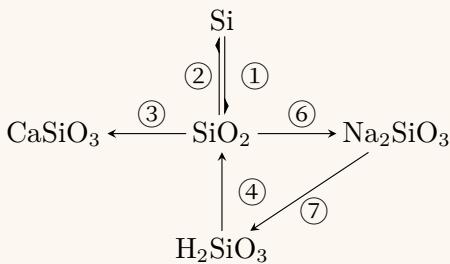
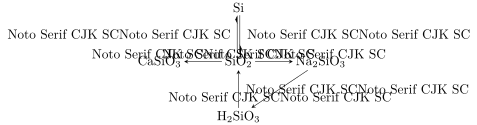
Figure 4.9: Reaction diagram for Review Problem 4 Answer the following questions briefly:
Why must water glass be stored in a sealed container?
Why must bottles storing sodium hydroxide not use glass stoppers?
The essential characteristic that distinguishes a colloidal solution from other disperse systems is ( ).
A. Colloidal particles carry electric charges
B. The Tyndall effect is produced
C. The diameter of the dispersed-phase particles is in the range \(10^{-9}\) to \(10^{-7}\ \text{m}\)
D. Colloidal particles undergo Brownian motion
E. Colloidal particles cannot pass through a semipermeable membrane
When an electrophoresis experiment is performed with iron(III) hydroxide colloid, the color near the anode becomes ______. To cause coagulation of the iron(III) hydroxide colloid, which of the following may be added?
Silicic acid colloid
\(\ce{Al(OH)3}\) colloid
Arsenic sulfide colloid
Magnesium sulfate solution
Distilled water
In Volume I (Chapter 3), the structure of diamond and the concept of atomic crystals were discussed.↩︎
Translator’s note: \(42.5\ \text{kCal/mol} \approx 178\ \text{kJ/mol}\).↩︎
Translator’s note: Diatoms are microscopic single-celled algae with silica-based cell walls. The Chinese text notes 硅藻 (guī zǎo).↩︎
Translator’s note: A catalyst support (载体) is a material with high surface area onto which the active catalyst is dispersed.↩︎
Translator’s note: \(88.2\ \text{kCal/mol} \approx 369\ \text{kJ/mol}\).↩︎
Translator’s note: Sodium silicate is commonly called 水玻璃 (shuǐ bōli, “water glass”) in Chinese.↩︎
Translator’s note: Kaolin (高岭土) is named after the village of Gaoling (高岭) near Jingdezhen in Jiangxi Province, China, where it was first mined for porcelain production.↩︎
Each colloidal particle is an aggregate (集合体) of many formula units or molecules, not a single molecule.↩︎
For example, starch and protein molecules are large enough to form colloidal particles individually when dissolved.↩︎
Translator’s note: A semipermeable (半透) membrane has pores large enough to allow small molecules and ions to pass through, but too small for colloidal particles.↩︎
Translator’s note: Named after John Tyndall (1820–1893), an Irish physicist who first explained this phenomenon.↩︎
Translator’s note: Robert Brown (1773–1858) was a Scottish botanist who first observed this phenomenon.↩︎
Translator’s note: An ultramicroscope (超显微镜) uses intense side illumination to detect light scattered by particles too small to be resolved by ordinary microscopes.↩︎