3 Reaction Rate and Chemical Equilibrium
After studying this chapter, you should be able to:
- Explain how chemical reaction rate is defined and measured using changes in concentration per unit time
- Describe how concentration, pressure, temperature, and catalysts affect reaction rate
- Define activation energy and explain the concept of effective molecular collisions
- Explain the nature of chemical equilibrium as a dynamic equilibrium in reversible reactions
- Write equilibrium constant expressions and use them to calculate equilibrium concentrations and conversion rates
- Apply Le Chatelier’s principle to predict how changes in concentration, pressure, and temperature shift a chemical equilibrium
- Describe how the principles of reaction rate and chemical equilibrium are applied in the ammonia synthesis industry
We have already studied a number of chemical reactions and know that they often require certain specific conditions. For example, in the previous chapter we learned that the combination of hydrogen and nitrogen to form ammonia must be carried out under high temperature, high pressure, and in the presence of a catalyst. Why does a reaction require particular conditions? This question must be examined from two perspectives: one is the speed at which the reaction proceeds, namely the question of chemical reaction rate; the other is the extent to which the reaction proceeds, namely the question of reaching chemical equilibrium. These two topics are not only essential theoretical knowledge for further study of chemistry, but also fundamental principles of chemical change that must be mastered when determining suitable conditions for chemical industrial production.
3.1 Section 1: Chemical Reaction Rate
Chemical Reaction Rate
Different chemical reactions proceed at different speeds. Some reactions — such as the explosive reaction of a hydrogen–oxygen mixture, or the neutralization of an acid with a base — are completed almost instantaneously. Others, such as the formation of petroleum, require hundreds of millions of years. The terms “fast” and “slow” here refer to reactions proceeding under specific conditions. Once we have mastered the principles governing chemical reactions, we can, according to the needs of scientific research, production, and daily life, take appropriate measures to speed up reactions that are originally slow — for example, accelerating the steelmaking process or the synthesis of resins and synthetic rubber — or to slow down reactions that are originally fast — for example, preventing the rusting of iron and steel, or preventing the aging of plastics and rubber. All of these are of great significance for developing production, reducing costs, and promoting modernization.
How do we measure the magnitude of a chemical reaction rate?
For certain reactions, we can usually make a qualitative judgment about the reaction rate by observing how quickly the reactants disappear and how quickly the products appear. For example, when a strip of magnesium is placed in a beaker containing dilute hydrochloric acid, the magnesium strip (reactant) disappears rapidly while hydrogen gas (product) is released very quickly. When an iron block is placed in hydrochloric acid of the same concentration, the iron block disappears more slowly and the hydrogen gas is released more slowly as well. Clearly, the first reaction proceeds much faster than the second.
How do we express chemical reaction rate more precisely, in quantitative terms? The rate of a chemical reaction is expressed in terms of the change in the amount (mol) of reactant or product per unit time (such as per second, per minute, or per hour). It is usually expressed as the decrease in reactant concentration or the increase in product concentration per unit time. Since concentration is generally measured in \(\text{mol/L}\), the units of reaction rate are \(\text{mol}\cdot\text{L}^{-1}\cdot\text{min}^{-1}\), or \(\text{mol}\cdot\text{L}^{-1}\cdot\text{s}^{-1}\), and so on.
A certain reactant has a concentration of \(2\ \text{mol/L}\). After 2 minutes of reaction, its concentration has decreased to \(1.8\ \text{mol/L}\) — that is, the reactant concentration decreased by \(0.2\ \text{mol/L}\) over 2 minutes. This means the average reaction rate over these 2 minutes is \(0.1\ \text{mol}\cdot\text{L}^{-1}\cdot\text{min}^{-1}\).
Factors Affecting Reaction Rate
Different chemical reactions have different reaction rates. For example, the neutralization reaction between an acid and a base is much faster than the synthesis of ammonia from nitrogen and hydrogen molecules. This tells us that the nature of the reacting substances is the primary factor determining the rate of a chemical reaction. However, external conditions also have a definite effect on reaction rate. Even for the same chemical reaction, different external conditions — such as concentration, pressure, temperature, and catalysts — lead to different reaction rates. Below, we examine several important conditions that affect chemical reaction rate.
1. Effect of Concentration on Reaction Rate
When we studied the properties of oxygen in junior high school, we observed that sulfur burns slowly in air with a faint pale-blue flame, but burns vigorously in pure oxygen with a bright blue-violet flame. This demonstrates that the reaction of sulfur with oxygen proceeds faster and more vigorously in pure oxygen than in air, because the concentration of oxygen molecules in pure oxygen is greater than in air. The following experiment shows that the same is true for reactions in solution.
Take two test tubes. To the first, add \(10\ \text{mL}\) of \(0.1\ \text{M}\) \(\ce{Na2S2O3}\) (sodium thiosulfate) solution. To the second, add \(5\ \text{mL}\) of \(0.1\ \text{M}\) \(\ce{Na2S2O3}\) solution and \(5\ \text{mL}\) of distilled water.
Take two more test tubes and add \(10\ \text{mL}\) of \(0.1\ \text{M}\) \(\ce{H2SO4}\) solution to each. Then simultaneously pour each acid solution into one of the \(\ce{Na2S2O3}\) tubes. Observe which tube becomes turbid first.
The experimental results show that the first test tube (with the higher \(\ce{Na2S2O3}\) concentration) becomes turbid first, followed by the second test tube.
Through numerous experiments it has been demonstrated: when other conditions remain unchanged, increasing the concentration of a reactant increases the reaction rate.
2. Effect of Pressure on Reaction Rate
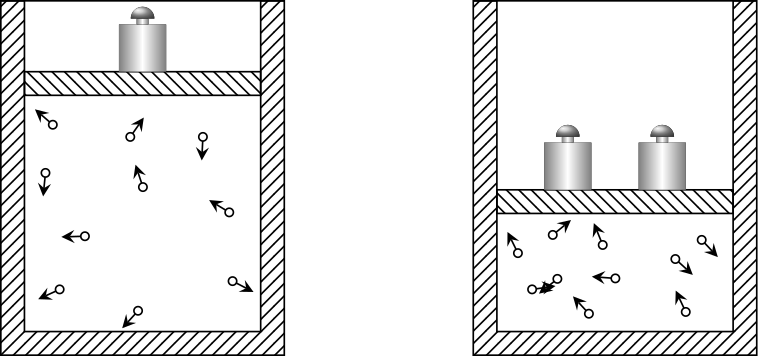
For gases, when the temperature is constant, the volume of a given amount of gas is inversely proportional to its pressure. That is, if the pressure on a gas is doubled, its volume is halved, and the number of molecules per unit volume doubles, as shown in Figure 3.1. Therefore, increasing the pressure means increasing the number of moles of reactant per unit volume — that is, increasing the concentration of the reactant — and thus increases the reaction rate. Conversely, decreasing the pressure causes the gas to expand, the concentration to decrease, and the reaction rate to decrease.
If the substances participating in the reaction are solids, liquids, or solutions, changing the pressure has very little effect on their volumes and therefore very little effect on their concentrations. In such cases, pressure can be considered unrelated to their reaction rates.
3. Effect of Temperature on Reaction Rate — Activation Energy
We know that many chemical reactions take place only upon heating. For example, coal in air — even in pure oxygen — cannot burn at room temperature; it can burn only when heated to a certain temperature, and once ignited, it burns ever more vigorously. A similar situation exists for reactions in solution.
Take two test tubes and add \(10\ \text{mL}\) of \(0.1\ \text{M}\) \(\ce{Na2S2O3}\) solution to each. Take two more test tubes and add \(10\ \text{mL}\) of \(0.1\ \text{M}\) \(\ce{H2SO4}\) solution to each. Pair one \(\ce{Na2S2O3}\) tube with one \(\ce{H2SO4}\) tube to form a group, giving two groups of two test tubes each.
Place one group of test tubes in cold water and the other group in hot water. After a short time, simultaneously mix the solutions within each group and carefully observe which mixed solution becomes turbid first — the one in hot water or the one in cold water.
The experimental results show that the mixed solution in the hot water becomes turbid first, followed by the one in the cold water. Why is this? Because the reaction between \(\ce{Na2S2O3}\) solution and dilute \(\ce{H2SO4}\) proceeds as follows:
\[ \ce{Na2S2O3 + H2SO4 = Na2SO4 + SO2 + S v + H2O} \]
or in ionic form:
\[ \ce{S2O3^{2-} + 2H+ = SO2 + S v + H2O} \]
The rate of the reaction can be measured by the time required for the formation of sulfur (which is insoluble in water and causes the solution to become turbid). The test tube in hot water, having a higher temperature and thus a faster reaction, becomes turbid first; the one in cold water, having a lower temperature and slower reaction, becomes turbid later. From this we can see that raising the temperature generally speeds up chemical reactions. Experimental measurements show that, as a rough rule, for every \(10\,{}^{\circ}\text{C}\) increase in temperature, the reaction rate typically increases by a factor of 2 to 4.
Why does changing the concentration of a reactant or changing the temperature alter the reaction rate?
The prerequisite for a chemical reaction to occur is that the reactant molecules (or ions) must come into contact with each other — they must collide. Otherwise, no chemical reaction can take place. Taking gas-phase reactions as an example, the number of molecular collisions in any gas is extraordinarily large. At \(1\ \text{atm}\) and \(500\,{}^{\circ}\text{C}\), in \(\ce{HI}\) gas at a concentration of \(0.001\ \text{mol/L}\), the number of molecular collisions reaches as many as \(3.5 \times 10^{28}\) per liter per second. If every collision led to a chemical reaction, the decomposition of \(\ce{HI}\) would be completed in an instant — but this is not the case. Furthermore, at room temperature and atmospheric pressure, a mixture of hydrogen and oxygen can be stored for a long time without any appreciable reaction occurring. Evidently, not every collision between reactant molecules leads to a chemical reaction. Collisions that actually result in a chemical reaction are very few. We call such collisions that do produce a chemical reaction effective collisions.
Why can some molecular collisions lead to a chemical reaction while others cannot? Because the process of a chemical reaction is one in which atoms in the reactant molecules rearrange to form product molecules — it is a process of breaking chemical bonds in reactant molecules and forming new chemical bonds in product molecules. During this process, the reactant molecules must possess sufficient energy for the chemical bonds to be weakened or broken upon collision, thereby enabling the chemical reaction to occur. Thus, the molecules that undergo effective collisions must possess relatively high energy. At a given temperature, gas molecules possess a certain average energy, but not all molecules have exactly the same energy — some have energy higher than the average, and some lower. For any given reaction, there is a fraction of molecules with energy higher than the average that are capable of undergoing effective collisions. These molecules are called activated molecules. The difference between the minimum energy that an activated molecule must possess and the average energy of the molecules is called the activation energy.
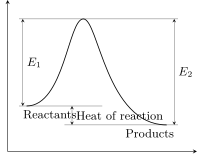
As shown in Figure 3.3: reactant molecules with average energy must absorb an amount of energy \(E_1\) to become activated molecules — this energy \(E_1\) is the activation energy of the reaction. As the activated molecules transform into product molecules, they release an amount of energy \(E_2\). Clearly, in the figure, \(E_2 > E_1\). Over the entire process of reactants becoming products, the net energy released is \(E_2 - E_1\), which is the heat of reaction. The reaction shown in Figure 3.3 is an exothermic reaction. Whether a reaction is exothermic or endothermic, there must be an activation process. The earlier example of coal in air needing to be heated before it can burn is precisely because heating promotes the activation of coal and oxygen molecules, enabling the oxidation reaction to occur. Once the reaction starts, the heat released by the reaction itself is sufficient to sustain the reaction, and no further external energy input is needed.
Different chemical reactions require different activation energies. If a reaction has a low activation energy, then at a given temperature the percentage of activated molecules is larger, and the reaction proceeds more easily.
When other conditions remain unchanged, for a given reaction, the percentage of activated molecules among the reactant molecules is fixed. Therefore, the number of activated molecules per unit volume is proportional to the total number of reactant molecules per unit volume — that is, proportional to the concentration of the reactant. When the reactant concentration increases, the number of molecules per unit volume increases and the number of activated molecules increases correspondingly. For instance, if originally there are 100 reactant molecules per unit volume with only 5 being activated molecules, then if the number of reactant molecules per unit volume increases to 200, there will be 10 activated molecules. The number of effective collisions per unit time therefore increases correspondingly, and the reaction proceeds faster.
At a fixed concentration, raising the temperature increases the energy of the reactant molecules. Some molecules that originally had lower energy now become activated molecules, thereby increasing the percentage of activated molecules among the reactant molecules. The number of effective collisions increases, and thus the reaction rate increases. Of course, raising the temperature also increases the speed of molecular motion, which increases the number of collisions between reactant molecules per unit time — this also speeds up the reaction somewhat, but it is not the primary reason for the increase in reaction rate.
4. Effect of Catalysts on Reaction Rate
We have already learned some introductory knowledge about catalysts and catalysis in our study of the laboratory preparation of oxygen, the industrial production of sulfuric acid, and the catalytic oxidation of ammonia. Now let us examine the relationship between catalysts and chemical reaction rate.
Add \(3\ \text{mL}\) of \(3\%\) hydrogen peroxide (\(\ce{H2O2}\)) solution and 3 or 4 drops of synthetic detergent solution (to produce bubbles that indicate gas evolution) to each of two test tubes. To one of the test tubes, add a small amount of \(\ce{MnO2}\). Observe the difference in the reaction phenomena between the two test tubes.
The experimental results show that in the test tube containing \(\ce{MnO2}\), gas bubbles are rapidly produced, whereas in the test tube without \(\ce{MnO2}\), bubbles appear slowly and are few. This is because \(\ce{MnO2}\) accelerates the decomposition of \(\ce{H2O2}\), producing oxygen more quickly and in greater quantity. After the reaction, the composition and mass of the \(\ce{MnO2}\) remain unchanged. Thus, \(\ce{MnO2}\) acts as a catalyst in the decomposition of \(\ce{H2O2}\).
\[ \ce{2H2O2 ->[\ce{MnO2}] 2H2O + O2 ^} \]
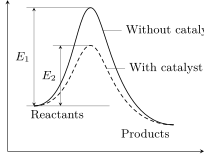
The reason a catalyst can increase the reaction rate is that it lowers the activation energy of the reaction, thereby enabling more reactant molecules to become activated molecules. This greatly increases the percentage of activated molecules per unit volume among the reactant molecules, increasing the reaction rate by factors of thousands or even millions. From Figure 3.4, we can clearly see the relationship between catalysts and reaction rate. In the figure, the solid curve represents the process of reactants becoming products without a catalyst, and \(E_1\) is the activation energy without a catalyst. The dashed curve represents the process with a catalyst, and \(E_2\) is the activation energy in the presence of the catalyst. Clearly, using a catalyst lowers the activation energy and thereby greatly increases the reaction rate. This is analogous to people needing to cross a steep, high mountain: the climb is difficult, slow, and few can make it. If a tunnel is bored through the base of the mountain, passing through the tunnel is easy, fast, and many more people can get through.

Why can an appropriate catalyst lower the activation energy of a reaction? Let us use the catalyst \(\ce{V2O5}\) in the Contact Process for manufacturing sulfuric acid, and the iron catalyst used in ammonia synthesis, as examples to illustrate how they lower activation energy.
In the production of sulfuric acid, the key step is how to convert \(\ce{SO2}\) into \(\ce{SO3}\) more rapidly. When \(\ce{V2O5}\) is used as the catalyst, some chemists believe the reaction proceeds in two steps:
\[ \ce{SO2 + V2O5 = SO3 + V2O4} \]
\[ \ce{V2O4 + SO2 + O2 = SO3 + V2O5} \]
Thus, using \(\ce{V2O5}\) as the catalyst allows a reaction that would proceed in one step to instead proceed in two steps. Experimental measurements show that this reduces the activation energy to roughly half of the original value, thereby greatly accelerating the reaction. From this we can see that a catalyst is not uninvolved in the chemical reaction — it is merely that its composition and mass are unchanged before and after the reaction.
In the synthesis of ammonia from hydrogen and nitrogen, when an iron catalyst is used, the catalyst adsorbs both hydrogen molecules and nitrogen molecules while simultaneously weakening the chemical bonds within those molecules. These bond-weakened molecules then collide with each other to form ammonia molecules. The use of an iron catalyst reduces the activation energy for the ammonia synthesis reaction to approximately one-quarter of the original value. Furthermore, because adsorption increases the concentration of reactants on the surface of the iron catalyst, this also increases the reaction rate. As a result, the reaction rate with the iron catalyst is tens of thousands of times greater than without a catalyst.
Catalysts occupy an extremely important position in modern chemistry and chemical industrial production. According to preliminary statistics, approximately \(85\%\) of chemical reactions require the use of catalysts. Especially in large-scale modern chemical production and the petrochemical industry, many reactions must rely on high-performance catalysts to be realized. However, it should be noted that certain substances, even in very small amounts, can drastically reduce or even destroy the catalytic ability of a catalyst when mixed in — this phenomenon is called catalyst poisoning. To prevent catalyst poisoning, the raw materials must undergo a series of purification processes.
The conditions that affect chemical reaction rate are numerous. In addition to temperature, concentration, pressure (for reactions involving gases), and catalysts, other factors such as light, ultrasound, lasers, radiation, electromagnetic waves, the particle size of reactants, diffusion rate, and solvent can also be important factors affecting reaction rate for certain chemical reactions. For example, powdered coal burns much faster than coal in lumps, and silver bromide rapidly decomposes when exposed to light.
Give examples from your studies or daily life to illustrate the conditions that affect reaction rate.
We have now examined several important conditions affecting reaction rate. However, in chemical research and industrial production, considering only reaction rate is not enough. For example, in the ammonia synthesis industry, in addition to requiring that nitrogen and hydrogen be converted to ammonia as quickly as possible, we also want nitrogen and hydrogen to be converted to ammonia as completely as possible. This involves another aspect of chemical reactions — chemical equilibrium. The next section will address this topic.
- Chemical reaction rate is measured by the change in concentration of a reactant or product per unit time, with units such as \(\text{mol}\cdot\text{L}^{-1}\cdot\text{min}^{-1}\)
- The nature of the reacting substances is the primary factor determining reaction rate
- Increasing concentration increases the number of activated molecules per unit volume, thus increasing the rate
- Increasing pressure (for gases) is equivalent to increasing concentration
- Raising temperature increases the percentage of activated molecules, thus increasing the rate
- Catalysts lower the activation energy, greatly increasing the percentage of activated molecules and the reaction rate
- Activation energy is the difference between the minimum energy required for effective collisions and the average molecular energy
- An effective collision is one that has enough energy and proper orientation to produce a chemical reaction
Exercises for Section 1
Give examples illustrating the practical significance of speeding up and slowing down reaction rates.
In the following reaction:
\[ \ce{CO + H2O <=> CO2 + H2} \]
the initial concentrations are \([\ce{CO}] = [\ce{H2O}] = 0.02\ \text{mol/L}\). After \(1\ \text{min}\), the measured \([\ce{CO}] = 0.005\ \text{mol/L}\). Calculate the reaction rate expressed in terms of \(\ce{CO}\) and in terms of \(\ce{H2}\).
Why does a lower activation energy lead to a higher reaction rate?
Burning charcoal in air is an exothermic reaction. Why must the charcoal first be ignited? After ignition, if heating is stopped, can combustion continue? Why?
On a piece of marble (whose main component is \(\ce{CaCO3}\)), drops of \(1\ \text{M}\) \(\ce{HCl}\) and \(0.1\ \text{M}\) \(\ce{HCl}\) are applied successively. Which reacts faster? If hot and cold hydrochloric acid of the same concentration are applied successively, which reacts faster? If marble pieces and marble powder are reacted with hydrochloric acid of the same concentration, which reacts faster?
In a reaction of iron with hydrochloric acid, what methods can be used to speed up the reaction? Design an experimental method to roughly measure the reaction rate.
Why do raising the temperature and increasing the reactant concentration both increase the reaction rate?
Why can the use of an appropriate catalyst increase the rate of certain reactions?
Give examples to illustrate the importance of catalysts in chemical industrial production.
Why does increasing the percentage of activated molecules among the reactant molecules increase the reaction rate? What methods can be used to increase this percentage?
3.2 Section 2: Chemical Equilibrium
Let us now study chemical equilibrium. Chemical equilibrium is primarily concerned with the laws governing reversible reactions — such as the extent to which a reaction proceeds and how various conditions affect the progress of the reaction.
Chemical Equilibrium Is a Dynamic Equilibrium
When a solid solute dissolves in a liquid solvent, a dissolution equilibrium is reached upon formation of a saturated solution. At that point, the dissolution process has not stopped — it is merely that the rates of dissolution and crystallization are equal. Therefore, dissolution equilibrium is a kind of dynamic equilibrium. What, then, is the situation for the reversible reactions we will study in chemistry? We can investigate this through the following reaction.
\[ \ce{2SO2 + O2 <=>[catalyst][\Delta] 2SO3} \]
At \(500\,{}^{\circ}\text{C}\) and \(1\ \text{atm}\), a mixture of 2 volumes of sulfur dioxide and 1 volume of oxygen is introduced into a sealed container equipped with a catalyst. After the reaction begins, the concentrations of \(\ce{SO2}\) and \(\ce{O2}\) gradually decrease while the concentration of \(\ce{SO3}\) gradually increases. Eventually, a mixture containing \(91\%\) (by volume) sulfur trioxide is obtained. At this point, the concentrations of the reactants \(\ce{SO2}\) and \(\ce{O2}\) and the product \(\ce{SO3}\) in the mixture no longer change.
Why does the product content stop increasing after the reaction has proceeded to a certain extent? In other words, why doesn’t the reaction go to completion? We can explain this using the changes in the forward and reverse reaction rates of the reversible reaction.
When the reaction first begins, the concentrations of \(\ce{SO2}\) and \(\ce{O2}\) are at their maximum, so the forward reaction rate — the rate at which they combine to form \(\ce{SO3}\) — is at its maximum. Meanwhile, the concentration of \(\ce{SO3}\) is zero, so the reverse reaction rate — the rate at which \(\ce{SO3}\) decomposes back into \(\ce{SO2}\) and \(\ce{O2}\) — is also zero. As the reaction proceeds, the concentrations of the reactants \(\ce{SO2}\) and \(\ce{O2}\) gradually decrease, and the forward reaction rate gradually decreases. At the same time, the concentration of the product \(\ce{SO3}\) gradually increases, and the reverse reaction rate gradually increases.
If the external conditions do not change, at a certain point the forward and reverse reaction rates become equal, and the concentrations of reactants and products no longer change. The mixture of reactants and products (referred to simply as the reaction mixture) is then in a state of chemical equilibrium.
If instead of starting from a mixture of \(\ce{SO2}\) and \(\ce{O2}\), we start with pure \(\ce{SO3}\) and allow it to react under the same conditions of temperature (\(500\,{}^{\circ}\text{C}\)), pressure (\(1\ \text{atm}\)), and catalyst, the \(\ce{SO3}\) decomposes into \(\ce{SO2}\) and \(\ce{O2}\). When equilibrium is reached, the mixture still contains \(91\%\) (by volume) \(\ce{SO3}\).
When equilibrium is reached, both the forward and reverse reactions continue to proceed. However, because at any given instant the number of \(\ce{SO3}\) molecules formed by the forward reaction (from \(\ce{SO2}\) and \(\ce{O2}\)) equals the number of \(\ce{SO3}\) molecules decomposed by the reverse reaction, the percentage composition of each component in the reaction mixture remains unchanged. Therefore, chemical equilibrium is a dynamic equilibrium.
A chemical equilibrium state is the state of a reversible reaction under fixed conditions in which the forward and reverse reaction rates are equal, and the percentage composition of each component in the reaction mixture remains constant.
The Equilibrium Constant
Let us use the reaction of carbon monoxide with steam at high temperature to produce carbon dioxide and hydrogen as an example to study the properties of chemical equilibrium.
In a sealed container, this reaction does not go to completion but instead reaches a state of chemical equilibrium.
\[ \ce{CO(g) + H2O(g) <=>[catalyst][\text{high temp.}] CO2(g) + H2(g)} \]
If \(0.01\ \text{mol}\) of \(\ce{CO}\) and \(0.01\ \text{mol}\) of \(\ce{H2O}\) (gas) are placed in a \(1\ \text{L}\) sealed container and heated to \(800\,{}^{\circ}\text{C}\), experiments show that when \(0.005\ \text{mol}\) each of \(\ce{CO2}\) and \(\ce{H2}\) have been produced, the reaction has reached equilibrium. The equilibrium mixture still contains \(0.005\ \text{mol}\) of \(\ce{CO}\) and \(0.005\ \text{mol}\) of \(\ce{H2O}\) (gas). This can be represented as follows:
| \(\ce{CO}\) | \(\ce{H2O}\) (gas) | \(\ce{CO2}\) | \(\ce{H2}\) | ||
|---|---|---|---|---|---|
| Moles at start of reaction | \(0.01\) | \(0.01\) | \(\xrightarrow{800\,{}^{\circ}\text{C}}\) | \(0\) | \(0\) |
| Moles at equilibrium | \(0.005\) | \(0.005\) | \(0.005\) | \(0.005\) |
Since the sealed container has a volume of \(1\ \text{L}\), the number of moles of each substance is numerically equal to its molar concentration (in \(\text{mol/L}\)). If we use the symbol \([\;]\) to denote the concentration of a substance, the example above can also be written as:
| \(\ce{CO}\) | \(\ce{H2O}\) (gas) | \(\ce{CO2}\) | \(\ce{H2}\) | ||
|---|---|---|---|---|---|
| Concentration at start (\(\text{mol/L}\)) | \(0.01\) | \(0.01\) | \(\xrightarrow{800\,{}^{\circ}\text{C}}\) | \(0\) | \(0\) |
| Concentration at equilibrium (\(\text{mol/L}\)) | \(0.005\) | \(0.005\) | \(0.005\) | \(0.005\) |
To further understand the characteristics of the equilibrium state for a reversible reaction, we can perform the following experiment with the reaction above. Suppose that in four separate \(1\ \text{L}\) sealed containers, different molar amounts of \(\ce{CO}\), \(\ce{H2O}\) (gas), \(\ce{CO2}\), and \(\ce{H2}\) are introduced, as shown in the “initial concentration” column of Table 3.1. The four sealed containers are heated to \(800\,{}^{\circ}\text{C}\) and allowed sufficient time. If the concentrations of the four substances in each container no longer change with time, then the reaction mixture in each container has reached equilibrium. The experimentally measured equilibrium concentrations are listed in the second column of Table 3.1. To investigate the relationship among the concentrations of the various substances in the equilibrium mixture, we use the product of the concentrations of all products as the numerator and the product of the concentrations of all reactants as the denominator, and calculate the ratio. The calculated values are listed in the third column of Table 3.1.
| Initial concentrations (\(\text{mol/L}\)) | Equilibrium concentrations (\(\text{mol/L}\)) | \(\dfrac{[\ce{CO2}][\ce{H2}]}{[\ce{CO}][\ce{H2O}]}\) at equilibrium | |||||||
|---|---|---|---|---|---|---|---|---|---|
| \([\ce{CO}]\) | \([\ce{H2O}]\) | \([\ce{CO2}]\) | \([\ce{H2}]\) | \([\ce{CO}]\) | \([\ce{H2O}]\) | \([\ce{CO2}]\) | \([\ce{H2}]\) | ||
| 1 | \(0.01\) | \(0.01\) | \(0\) | \(0\) | \(0.005\) | \(0.005\) | \(0.005\) | \(0.005\) | \(1.0\) |
| 2 | \(0\) | \(0\) | \(0.02\) | \(0.01\) | \(0.0067\) | \(0.0067\) | \(0.0133\) | \(0.0033\) | \(1.0\) |
| 3 | \(0.0025\) | \(0.03\) | \(0.0075\) | \(0.0075\) | \(0.0021\) | \(0.0296\) | \(0.0079\) | \(0.0079\) | \(1.0\) |
| 4 | \(0.01\) | \(0.03\) | \(0\) | \(0\) | \(0.0025\) | \(0.0225\) | \(0.0075\) | \(0.0075\) | \(1.0\) |
From the experimental data listed in Table 3.1, we can draw the following conclusion:
At a given temperature, a reversible reaction can reach equilibrium whether it starts from the forward reaction direction or the reverse reaction direction, and regardless of the initial concentrations of the reactants. At equilibrium, the product of the concentrations of the products divided by the product of the concentrations of the reactants gives a ratio — and this ratio is a constant. This constant is called the chemical equilibrium constant (or simply the equilibrium constant) of the reaction, denoted by \(K\). For example, at \(800\,{}^{\circ}\text{C}\):
\[ \frac{[\ce{CO2}][\ce{H2}]}{[\ce{CO}][\ce{H2O}]} = 1 \]
The value of the equilibrium constant \(K\) is 1.
To better understand the properties of the chemical equilibrium state, let us examine another example of a reversible reaction.
\[ \ce{H2 + I2(g) <=> 2HI} \]
In three separate \(1\ \text{L}\) sealed containers, different molar amounts of \(\ce{H2}\), \(\ce{I2}\), or \(\ce{HI}\) are introduced, as shown in the “initial concentration” column of Table 3.2. All three sealed containers are heated to \(445\,{}^{\circ}\text{C}\) and allowed sufficient time to reach equilibrium. The experimentally measured equilibrium concentrations are listed in the second column of Table 3.2. We then calculate different ratios using the product and reactant concentrations at equilibrium, and the results are listed in the third and fourth columns.
| Initial concentrations (\(\text{mol/L}\)) | Equilibrium concentrations (\(\text{mol/L}\)) | \(\dfrac{[\ce{HI}]}{[\ce{H2}][\ce{I2}]}\) | \(\dfrac{[\ce{HI}]^2}{[\ce{H2}][\ce{I2}]}\) | |||||
|---|---|---|---|---|---|---|---|---|
| \([\ce{H2}]\) | \([\ce{I2}]\) | \([\ce{HI}]\) | \([\ce{H2}]\) | \([\ce{I2}]\) | \([\ce{HI}]\) | |||
| 1 | \(0.01\) | \(0.01\) | \(0\) | \(0.0022\) | \(0.0022\) | \(0.0156\) | \(3323\) | \(50\) |
| 2 | \(0\) | \(0\) | \(0.01\) | \(0.0011\) | \(0.0011\) | \(0.0078\) | \(6446\) | \(50\) |
| 3 | \(0\) | \(0.0097\) | \(0.0349\) | \(0.0017\) | \(0.0114\) | \(0.0315\) | \(1625\) | \(51\) |
From the data in Table 3.2, we can see that if we divide the product concentration by the product of the reactant concentrations, as in:
\[ \frac{[\ce{HI}]}{[\ce{H2}][\ce{I2}]} \]
the ratio is not a constant. However, if we divide the square of the product concentration \([\ce{HI}]^2\) by the product of the reactant concentrations \([\ce{H2}][\ce{I2}]\):
\[ \frac{[\ce{HI}]^2}{[\ce{H2}][\ce{I2}]} \]
we find that under the three different conditions listed in the table, the ratio is still a constant, namely \(K = 50\). This constant is the equilibrium constant for this reaction at \(445\,{}^{\circ}\text{C}\).
For a general reversible reaction
\[ m\text{A} + n\text{B} \rightleftharpoons p\text{C} + q\text{D} \]
where A and B represent reactants, C and D represent products, and \(m\), \(n\), \(p\), and \(q\) represent the coefficients in front of the respective chemical formulas in the balanced equation, at a given temperature when equilibrium is reached, we can write:
\[ \frac{[\text{C}]^p [\text{D}]^q}{[\text{A}]^m [\text{B}]^n} = K \]
\(K\) is called the equilibrium constant of this reaction.
In the equilibrium constant expression, the concentrations of the products are customarily placed in the numerator and the concentrations of the reactants in the denominator. The exponent of each substance’s concentration equals the coefficient of that substance’s chemical formula in the balanced equation.
From the magnitude of the equilibrium constant \(K\), we can infer the extent to which a reaction proceeds. A larger \(K\) means that at equilibrium the ratio of product concentrations to reactant concentrations is larger — in other words, the reaction has proceeded more completely, and the conversion rate1 of the reactants is also larger. Conversely, a smaller \(K\) means the reaction has proceeded to a lesser extent, and the conversion rate is also smaller.
From the experimental facts studied earlier, we know that at a given temperature, the equilibrium constant of a reversible reaction does not change with changes in the concentrations of reactants or products. However, when the temperature changes, the situation is different — the equilibrium constant \(K\) changes with temperature.
For example, for the reaction of hydrogen with iodine to form hydrogen iodide:
\[ \ce{H2(g) + I2(g) ->[\Delta] 2HI(g)} \]
at different temperatures, the equilibrium constants are different: at \(350\,{}^{\circ}\text{C}\), \(K = 66.9\); at \(425\,{}^{\circ}\text{C}\), \(K = 54.4\); at \(490\,{}^{\circ}\text{C}\), \(K = 45.9\).
Therefore, when using the equilibrium constant, one must always note the temperature at which the reversible reaction takes place.
\(0.01\ \text{mol}\) of \(\ce{CO2}\) and \(0.01\ \text{mol}\) of \(\ce{H2}\) are placed in a \(1\ \text{L}\) sealed container and heated to \(1200\,{}^{\circ}\text{C}\). When \(0.006\ \text{mol}\) of \(\ce{CO}\) and \(0.006\ \text{mol}\) of \(\ce{H2O}\) (gas) have been produced, the reaction reaches equilibrium. Find the equilibrium constant of this reaction.
Solution:
| \(\ce{CO}\) | \(+\ \ce{H2O}\) (gas) | \(\ce{CO2}\) | \(+\ \ce{H2}\) | ||
|---|---|---|---|---|---|
| Moles at start | \(0\) | \(0\) | \(\xrightarrow{1200\,{}^{\circ}\text{C}}\) | \(0.01\) | \(0.01\) |
| Moles at equilibrium | \(0.006\) | \(0.006\) | \(0.01 - 0.006\) | \(0.01 - 0.006\) |
Since the container has a volume of \(1\ \text{L}\), the equilibrium concentrations of the reacting substances are:
\[ [\ce{CO}] = 0.006\ \text{mol/L}, \quad [\ce{H2O}] = 0.006\ \text{mol/L}, \quad [\ce{CO2}] = 0.004\ \text{mol/L}, \quad [\ce{H2}] = 0.004\ \text{mol/L} \]
\[ K = \frac{[\ce{CO}][\ce{H2O}]}{[\ce{CO2}][\ce{H2}]} = \frac{0.006 \times 0.006}{0.004 \times 0.004} = 2.25 \]
Answer: At \(1200\,{}^{\circ}\text{C}\), the equilibrium constant for this reaction is \(2.25\).
At a certain temperature, in a sealed container of volume \(1\ \text{L}\), \(\ce{N2}\) and \(\ce{H2}\) gases are mixed and react to produce \(\ce{NH3}\). Experimental measurements show that at equilibrium, the concentrations of \(\ce{N2}\) and \(\ce{H2}\) are each \(2\ \text{mol/L}\), and the concentration of \(\ce{NH3}\) is \(3\ \text{mol/L}\). Find the equilibrium constant for this reaction at this temperature, and the initial concentrations of \(\ce{N2}\) and \(\ce{H2}\).
Solution:
\[ \ce{N2 + 3H2 <=> 2NH3} \]
At this temperature, the equilibrium concentrations are: \([\ce{N2}] = 2\ \text{mol/L}\), \([\ce{H2}] = 2\ \text{mol/L}\), \([\ce{NH3}] = 3\ \text{mol/L}\).
\[ K = \frac{[\ce{NH3}]^2}{[\ce{N2}][\ce{H2}]^3} = \frac{3^2}{2 \times 2^3} = \frac{9}{16} = 0.563 \]
From the chemical equation, to produce \(3\ \text{mol}\) of \(\ce{NH3}\), \(1.5\ \text{mol}\) of \(\ce{N2}\) and \(4.5\ \text{mol}\) of \(\ce{H2}\) must be consumed. The initial concentrations of \(\ce{N2}\) and \(\ce{H2}\) equal the sum of the amount consumed and the amount remaining at equilibrium. Therefore:
\[ \text{Initial concentration of } \ce{N2} = 1.5 + 2 = 3.5\ \text{mol/L} \]
\[ \text{Initial concentration of } \ce{H2} = 4.5 + 2 = 6.5\ \text{mol/L} \]
Answer: The equilibrium constant at this temperature is \(0.563\). The initial concentration of \(\ce{N2}\) is \(3.5\ \text{mol/L}\), and the initial concentration of \(\ce{H2}\) is \(6.5\ \text{mol/L}\).
In a sealed container, a mixture of carbon monoxide and steam is heated, reaching the following equilibrium:
\[ \ce{CO + H2O(g) <=> CO2 + H2} \]
At \(800\,{}^{\circ}\text{C}\), the equilibrium constant equals \(1\). If \(2\ \text{mol}\) of \(\ce{CO}\) and \(10\ \text{mol}\) of \(\ce{H2O}\) are mixed and heated to \(800\,{}^{\circ}\text{C}\), what is the conversion rate of \(\ce{CO}\) to \(\ce{CO2}\)?
Since the equilibrium constant expression involves the concentrations at equilibrium, we must first determine the equilibrium concentrations of all substances.
Solution: Let \(x\) = moles of \(\ce{CO}\) converted to \(\ce{CO2}\) at equilibrium, and \(V\) = volume of the container.
| \(\ce{CO}\) | \(+\ \ce{H2O}\) (gas) | \(\ce{CO2}\) | \(+\ \ce{H2}\) | ||
|---|---|---|---|---|---|
| Concentration at start | \(\dfrac{2}{V}\) | \(\dfrac{10}{V}\) | \(\xrightarrow{800\,{}^{\circ}\text{C}}\) | \(0\) | \(0\) |
| Concentration at equilibrium | \(\dfrac{2-x}{V}\) | \(\dfrac{10-x}{V}\) | \(\dfrac{x}{V}\) | \(\dfrac{x}{V}\) |
Substituting the equilibrium concentrations into the equilibrium constant expression:
\[ K = \frac{[\ce{CO2}][\ce{H2}]}{[\ce{CO}][\ce{H2O}]} = \frac{\dfrac{x^2}{V^2}}{\dfrac{2-x}{V} \cdot \dfrac{10-x}{V}} = 1 \]
\[ x^2 = (2 - x)(10 - x) \]
\[ x^2 = 20 - 12x + x^2 \]
\[ 12x = 20, \qquad x = \frac{20}{12} = 1.66 \]
The percent conversion of \(\ce{CO}\) to \(\ce{CO2}\) is:
\[ \frac{1.66}{2} \times 100\% = 83\% \]
Answer: The conversion rate of \(\ce{CO}\) to \(\ce{CO2}\) is \(83\%\).
- A reversible reaction in a sealed container at constant conditions reaches chemical equilibrium when the forward and reverse rates become equal
- Chemical equilibrium is a dynamic equilibrium — both forward and reverse reactions continue at equal rates
- For \(m\text{A} + n\text{B} \rightleftharpoons p\text{C} + q\text{D}\), the equilibrium constant is: \(K = \dfrac{[\text{C}]^p[\text{D}]^q}{[\text{A}]^m[\text{B}]^n}\)
- A larger \(K\) indicates the reaction proceeds more completely (higher conversion rate)
- \(K\) is constant at a given temperature but changes when the temperature changes
Exercises for Section 2
Given that \(\ce{PCl5(g) <=> PCl3(g) + Cl2(g)}\) reaches equilibrium at \(230\,{}^{\circ}\text{C}\) with the following concentrations: \([\ce{PCl5}] = 0.47\ \text{mol/L}\), \([\ce{PCl3}] = 0.098\ \text{mol/L}\), \([\ce{Cl2}] = 0.098\ \text{mol/L}\). Find the equilibrium constant of this reaction.
Given that \(\ce{H2(g) + I2(g) <=> 2HI(g)}\) has an equilibrium constant \(K = 50\) at \(445\,{}^{\circ}\text{C}\), calculate the equilibrium constant at \(445\,{}^{\circ}\text{C}\) for the following reaction:
\[ \ce{2HI(g) <=> H2(g) + I2(g)} \]
At \(25\,{}^{\circ}\text{C}\), an equilibrium mixture of \(\ce{NO2}\) and \(\ce{N2O4}\) contains \(0.0125\ \text{mol/L}\) of \(\ce{NO2}\) and \(0.0321\ \text{mol/L}\) of \(\ce{N2O4}\). Find the equilibrium constant for this reaction.
At a certain temperature, \(2\ \text{mol}\) of \(\ce{COCl2}\) decomposes in a \(1\ \text{L}\) sealed container. At equilibrium, \(50\%\) of the \(\ce{COCl2}\) has decomposed into \(\ce{CO}\) and \(\ce{Cl2}\):
\[ \ce{COCl2(g) <=> CO(g) + Cl2(g)} \]
Find the equilibrium constant at this temperature.
In a \(1\ \text{L}\) sealed container, \(3\ \text{mol}\) of \(\ce{NO2}\) is placed. At a certain temperature, the following reaction occurs:
\[ \ce{2NO2(g) <=> N2O4(g)} \]
The equilibrium constant \(K = 7.15\). Find the number of moles of \(\ce{NO2}\) in the container at equilibrium.
In a sealed container, \(\ce{NO2}\) is heated to a certain temperature, and the following reaction occurs:
\[ \ce{2NO2 <=> 2NO + O2} \]
The equilibrium concentrations are: \([\ce{NO2}] = 0.06\ \text{mol/L}\), \([\ce{NO}] = 0.24\ \text{mol/L}\), \([\ce{O2}] = 0.12\ \text{mol/L}\). Find the equilibrium constant at this temperature and the initial concentration of \(\ce{NO2}\).
For the reaction:
\[ \ce{CO + H2O(g) <=> CO2 + H2} \]
the equilibrium constant at \(427\,{}^{\circ}\text{C}\) is \(9.4\). If the initial concentrations of carbon monoxide and steam are both \(0.01\ \text{mol/L}\), calculate the conversion rate of carbon monoxide under these conditions.
3.3 Section 3: Factors Affecting Chemical Equilibrium
A chemical equilibrium state can be maintained only under certain conditions. If, after a reversible reaction has reached equilibrium, the reaction conditions (such as concentration, pressure, or temperature) are changed, the percentage composition of the equilibrium mixture also changes until a new equilibrium state is reached. This is called a shift in chemical equilibrium (or equilibrium shift).
Below, we focus on how changes in concentration, pressure, and temperature affect chemical equilibrium.
Effect of Concentration on Chemical Equilibrium
When a chemical reaction has reached equilibrium and other conditions remain unchanged, changing the concentration of any reactant or product will alter the forward or reverse reaction rate, making them unequal, and thereby causing the equilibrium to shift.
In a small beaker, mix \(10\ \text{mL}\) of \(0.01\ \text{M}\) iron(III) chloride solution and \(10\ \text{mL}\) of \(0.01\ \text{M}\) potassium thiocyanate solution. The solution immediately turns red.
Divide this red solution equally among three test tubes. To the first test tube, add a small amount of \(1\ \text{M}\) iron(III) chloride solution. To the second test tube, add a small amount of \(1\ \text{M}\) potassium thiocyanate solution. Observe the color changes in these two test tubes and compare with the third test tube.
Iron(III) chloride reacts with potassium thiocyanate (\(\ce{KSCN}\)) to produce red iron(III) thiocyanate (\(\ce{Fe(SCN)3}\)) and potassium chloride. This reaction can be represented as follows:
\[ \ce{FeCl3 + 3KSCN <=> Fe(SCN)3 + 3KCl} \]
From the experiment above, we can see that when either iron(III) chloride solution or potassium thiocyanate solution is added to the equilibrium mixture, the color of the solution deepens in both cases. This demonstrates that increasing the concentration of either reactant promotes the shift of the chemical equilibrium in the forward direction, producing more iron(III) thiocyanate.
Other experiments also confirm that in a reaction at equilibrium, decreasing the concentration of any product shifts the equilibrium in the forward direction, while decreasing the concentration of any reactant shifts the equilibrium in the reverse direction.
From this we can conclude: when other conditions remain unchanged, increasing the concentration of a reactant or decreasing the concentration of a product shifts the equilibrium in the forward direction; increasing the concentration of a product or decreasing the concentration of a reactant shifts the equilibrium in the reverse direction.
In industrial production, it is common practice to use an excess of a readily available or low-cost reactant to ensure more complete utilization of a more expensive raw material. For example, in the sulfuric acid industry, excess air is commonly used to ensure thorough oxidation of sulfur dioxide.
Effect of Pressure on Chemical Equilibrium
In a reaction mixture at equilibrium, if any reactant or product is in the gaseous state, changing the pressure can often cause the chemical equilibrium to shift.
As shown in Figure 3.5, draw approximately \(20\ \text{mL}\) of a mixture of \(\ce{NO2}\) and \(\ce{N2O4}\) into a syringe (\(50\ \text{mL}\) or larger), so that the plunger reaches position I. After drawing in the gas, seal the narrow end with a rubber stopper. Then pull the plunger outward to position II. Observe the changes in color of the gas mixture as the plunger is repeatedly moved from II to I and from I to II.
Nitrogen dioxide (a brown gas) and dinitrogen tetroxide (a colorless gas) are in chemical equilibrium under certain conditions. In this reaction, every two volumes of \(\ce{NO2}\) that are consumed produce one volume of \(\ce{N2O4}\).
\[ \ce{2NO2(g) <=> N2O4(g)} \]
From Experiment 3.5 we can see that: when the syringe plunger is pulled outward, the volume inside increases, the gas pressure decreases, and the concentration decreases. The color of the mixture first becomes lighter, then gradually becomes deeper. The gradual deepening occurs because the equilibrium shifts in the reverse direction, producing more \(\ce{NO2}\). When the plunger is pushed inward, the volume decreases, the pressure increases, and the concentration increases. The color of the mixture first becomes deeper, then gradually becomes lighter. The gradual lightening occurs because the equilibrium shifts in the forward direction, producing more \(\ce{N2O4}\).
From the experiment above, we can see that: when other conditions remain unchanged, increasing the pressure shifts the chemical equilibrium in the direction that reduces the total gas volume; decreasing the pressure shifts the equilibrium in the direction that increases the total gas volume.
In some reversible reactions, the total volume of gaseous substances does not change before and after the reaction. For example:
\[ \ce{2HI(g) <=> H2(g) + I2(g)} \]
In such cases, increasing or decreasing the pressure does not cause the chemical equilibrium to shift.
The volumes of solids and liquids are very little affected by changes in pressure, and this effect can be neglected. Therefore, if the equilibrium mixture consists entirely of solids or liquids, changing the pressure does not shift the equilibrium.
Effect of Temperature on Chemical Equilibrium
In reversible reactions that are endothermic or exothermic, after the reaction mixture has reached equilibrium, changing the temperature can also cause the chemical equilibrium to shift.
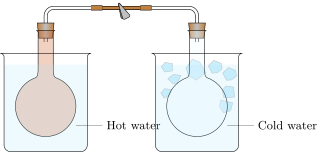
The apparatus is shown in Figure 3.6. Two connected flasks contain a mixture of \(\ce{NO2}\) and \(\ce{N2O4}\) that has reached equilibrium. Clamp the rubber tubing with a clip, then place one flask in hot water and the other in ice water (or cold water). Observe the changes in the color of the gas mixture.
In the reaction in which \(\ce{NO2}\) combines to form \(\ce{N2O4}\), the forward reaction is exothermic and the reverse reaction is endothermic.
\[ \ce{2NO2 <=> N2O4} + 13.6\ \text{kCal} \]
From the experiment above, we can see that when the gas mixture is heated, the color deepens, indicating that the concentration of \(\ce{NO2}\) has increased — the equilibrium has shifted in the reverse (endothermic) direction. When the gas mixture is cooled, the color lightens, indicating that the concentration of \(\ce{NO2}\) has decreased — the equilibrium has shifted in the forward (exothermic) direction.
From this we can conclude: when other conditions remain unchanged, raising the temperature shifts the chemical equilibrium in the endothermic direction; lowering the temperature shifts the equilibrium in the exothermic direction.
Le Chatelier’s Principle
The effects of concentration, pressure, and temperature on chemical equilibrium can be summarized in a single principle known as Le Chatelier’s principle2 (also called the Equilibrium Shift Principle): If a change is made to one of the conditions (such as concentration, pressure, or temperature) that affects a system at equilibrium, the equilibrium shifts in the direction that tends to reduce the effect of that change.
Since a catalyst increases both the forward and reverse reaction rates by the same factor, it has no effect on the position of chemical equilibrium — that is, it does not change the percentage composition of the reaction mixture at equilibrium. However, the use of a catalyst can greatly reduce the time required for the reaction to reach equilibrium.
- Equilibrium shift: when conditions change, the equilibrium adjusts to establish a new equilibrium state
- Concentration: increasing a reactant’s concentration (or decreasing a product’s) shifts equilibrium forward; the reverse also applies
- Pressure: increasing pressure shifts equilibrium toward the side with fewer gas moles; decreasing pressure shifts it toward the side with more gas moles
- Temperature: raising temperature shifts equilibrium in the endothermic direction; lowering temperature shifts it in the exothermic direction
- Le Chatelier’s principle: if a condition affecting equilibrium is changed, the equilibrium shifts to partially counteract that change
- Catalysts do not shift equilibrium — they only shorten the time needed to reach it
Exercises for Section 3
When the following reaction has reached equilibrium:
\[ \ce{2NO + O2 <=> 2NO2} + 27.02\ \text{kCal} \]
in which direction will the equilibrium shift if: (1) pressure is increased, (2) the concentration of \(\ce{O2}\) is increased, (3) the concentration of \(\ce{NO2}\) is decreased, (4) the temperature is raised? Briefly explain each answer.
How should the concentrations of reactants be changed to shift the following equilibrium in the forward direction? (The concentration of solid C does not change.)
\[ \ce{CO2 + C(s) <=> 2CO} \]
If raising the temperature shifts the equilibrium in the forward direction, is the reaction producing carbon monoxide exothermic or endothermic?
What effect do increasing pressure and raising temperature have on the following reactions at equilibrium? Explain.
\(\ce{2NO + O2 <=> 2NO2} + 27.02\ \text{kCal}\)
\(\ce{N2 + O2 <=> 2NO} - 43.2\ \text{kCal}\)
For the reaction:
\[ \ce{CO(g) + NO2(g) <=> CO2(g) + NO(g)} + 54.1\ \text{kCal} \]
at equilibrium, what happens if: (1) the temperature is raised? (2) the container volume is expanded to ten times its original value?
In the following reaction, what are the effects of raising or lowering the temperature on the equilibrium?
\[ \ce{H2S <=> H2 + S(s)} - 5\ \text{kCal} \]
In a sealed container, a mixture of carbon monoxide and steam is heated to reach the following equilibrium:
\[ \ce{CO + H2O(g) <=> CO2 + H2} \]
At \(500\,{}^{\circ}\text{C}\), the equilibrium constant \(K = 9\). If the initial concentrations of \(\ce{CO}\) and \(\ce{H2O}\) (gas) are both \(0.02\ \text{mol/L}\), find the conversion rate of \(\ce{CO}\) to \(\ce{CO2}\).
At a certain temperature, when the reaction \(\ce{H2 + Br2(g) <=> 2HBr}\) reaches equilibrium, the concentrations of the various substances are:
\[ [\ce{H2}] = 0.5\ \text{mol/L}, \qquad [\ce{Br2}] = 0.1\ \text{mol/L}, \qquad [\ce{HBr}] = 1.6\ \text{mol/L} \]
Find the initial concentrations of hydrogen and bromine (gas) and the equilibrium constant.
3.4 Section 4: The Ammonia Synthesis Industry
In this section, we will discuss how to apply the knowledge of chemical reaction rate and chemical equilibrium to study problems related to ammonia synthesis.
Applying Reaction Rate and Equilibrium Principles to Select Suitable Conditions for Ammonia Synthesis
The synthesis of ammonia is a reversible reaction that is exothermic and involves a decrease in the total gas volume.
\[ \ce{N2 + 3H2 <=> 2NH3} + 22.08\ \text{kCal} \]
\[ \text{(1 volume)} \quad \text{(3 volumes)} \quad \text{(2 volumes)} \]
From Le Chatelier’s principle, based on the reaction equation for ammonia synthesis, lowering the temperature and increasing the pressure both shift the equilibrium toward the production of ammonia, increasing the ammonia content in the equilibrium mixture.
The experimental data in Table 3.3 show how the ammonia content in the equilibrium mixture varies under different temperatures and pressures.
Below, we examine more specifically how changes in pressure, temperature, and other conditions can help increase the yield of ammonia.
1. Pressure
As noted above, the synthesis of ammonia is a reaction in which the gas volume decreases. Therefore, at a given temperature, increasing the pressure favors ammonia production. The experimental data in Table 3.3 confirm this point. However, the higher the pressure, the greater the power required, and the more stringent the requirements for material strength and equipment manufacturing. Ammonia synthesis plants typically operate at pressures of \(200 \sim 500\ \text{atm}\).
| Temperature Pressure | \(1\ \text{atm}\) | \(100\ \text{atm}\) | \(200\ \text{atm}\) | \(300\ \text{atm}\) | \(600\ \text{atm}\) | \(1000\ \text{atm}\) |
|---|---|---|---|---|---|---|
| \(200\,{}^{\circ}\text{C}\) | \(15.3\) | \(81.5\) | \(86.4\) | \(89.9\) | \(95.4\) | \(98.8\) |
| \(300\,{}^{\circ}\text{C}\) | \(2.2\) | \(52.0\) | \(64.2\) | \(71.0\) | \(84.2\) | \(92.6\) |
| \(400\,{}^{\circ}\text{C}\) | \(0.4\) | \(25.1\) | \(38.2\) | \(47.0\) | \(65.2\) | \(70.8\) |
| \(500\,{}^{\circ}\text{C}\) | \(0.1\) | \(10.6\) | \(19.1\) | \(26.4\) | \(42.2\) | \(57.5\) |
| \(600\,{}^{\circ}\text{C}\) | \(0.05\) | \(4.5\) | \(9.1\) | \(13.8\) | \(23.1\) | \(31.4\) |
2. Temperature
Since the synthesis of ammonia is an exothermic reaction, at a given pressure, raising the temperature decreases the equilibrium concentration of ammonia. Therefore, from the standpoint of ideal reaction conditions, a lower temperature favors ammonia synthesis. The experimental data in Table 3.3 also confirm this. However, if the temperature is too low, the reaction rate is very slow, and it takes a very long time to reach equilibrium — this is very uneconomical in industrial practice. Therefore, in actual production, the ammonia synthesis reaction is carried out at approximately \(500\,{}^{\circ}\text{C}\). (The choice of around \(500\,{}^{\circ}\text{C}\) is also because the industrial catalyst has its greatest activity at this temperature.)
3. Catalyst
Nitrogen and hydrogen combine extremely reluctantly. Even at high pressure and high temperature, although the reaction rate can be somewhat increased, it remains very slow. To accelerate the synthesis reaction, a catalyst is typically added to lower the activation energy so that the reactants can react more rapidly at a relatively lower temperature.
At present, the catalyst most commonly used in industrial ammonia synthesis is a multi-component catalyst with iron as the main component, also known as the iron catalyst.
In actual production, the ammonia that has been formed must be promptly separated from the gas mixture, and fresh nitrogen and hydrogen must be continuously added to the circulating gas.
Overview of the Ammonia Synthesis Industry
The ammonia synthesis industry is primarily the process of combining hydrogen and nitrogen from the feed gas to produce ammonia. Let us begin with the feed gas.
1. Preparation, Purification, and Compression of the Feed Gas
The nitrogen needed for ammonia synthesis is obtained entirely from air. There are generally two methods for obtaining nitrogen from air: one is to liquefy air and then fractionally distill it to separate nitrogen and oxygen; the other is to react the oxygen in air with carbon to produce carbon dioxide, and then remove the carbon dioxide to obtain nitrogen.
Hydrogen is obtained from water and fuel. Steam can be passed over a bed of red-hot coal (or coke), causing the steam to react chemically with carbon to produce carbon monoxide and hydrogen.
\[ \ce{C + H2O(g) ->[\Delta] CO + H2} \]
In industrial production, in the presence of a catalyst, carbon monoxide can further react with steam to produce carbon dioxide and hydrogen. After removal of the carbon dioxide, the desired feed gas is obtained.
\[ \ce{CO + H2O(g) <=>[catalyst][\Delta] CO2 + H2} \]
Fuels such as petroleum, natural gas, coke-oven gas (a byproduct from coking plants), and refinery gas (a byproduct from petroleum refineries) all contain large amounts of hydrocarbons. Under appropriate conditions, these hydrocarbons can react with oxygen or steam to produce carbon monoxide and hydrogen.
During the preparation of the feed gas, various impurities are often present. Since ammonia synthesis requires pure nitrogen and hydrogen, these impurities must be removed; otherwise, they would “poison” the catalyst used in ammonia synthesis. The process of removing impurities is called purification of the feed gas.
Because ammonia synthesis is carried out under high pressure, the nitrogen–hydrogen gas mixture must be compressed to high pressure using a compressor before it enters the synthesis reactor.
To summarize, the raw materials needed for ammonia synthesis are air, water, and certain fuels (including coal, natural gas, petroleum, etc.). Before synthesis, the feed gas must undergo preparation, purification, and compression.
2. The Synthesis of Ammonia
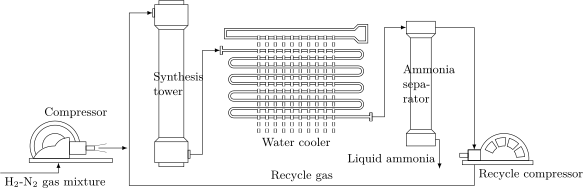
Figure 3.7 shows a simplified flow diagram for ammonia synthesis.
In the diagram, the nitrogen–hydrogen gas mixture is compressed and then enters the ammonia synthesis converter (synthesis tower). The chemical reaction takes place inside the converter under conditions of high pressure, a suitable temperature, and in the presence of a catalyst. This is an exothermic reaction.
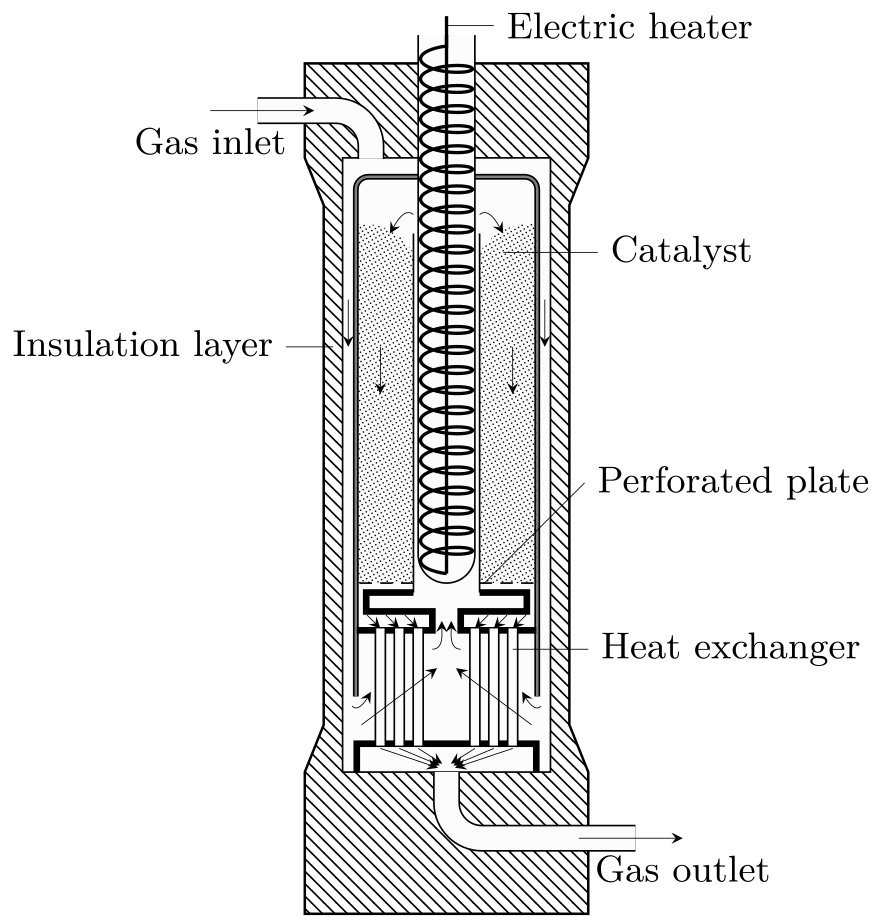
The construction of the synthesis converter, in addition to accommodating a thick bed of catalyst for effective catalysis, must also be able to withstand high pressure and allow temperature regulation. To meet these requirements, the converter has thick, pressure-resistant walls. Inside the converter, there are mainly two parts: the contact chamber and the heat exchanger. There are many types of ammonia synthesis converters. Figure 3.8 shows the internal structure of one type.
The converter is a thick-walled steel cylinder that can withstand high pressure. Its outer shell is wrapped in insulating material. The upper portion of the converter is the contact chamber, which holds granular catalyst. The lower portion is the heat exchanger.
The nitrogen–hydrogen gas mixture enters the converter from the top, flows downward through the gap between the converter wall and the contact chamber, and arrives at the lower heat exchanger. In the heat exchanger, the gas mixture flows in a winding path through the spaces between and around tubes, absorbing heat from the hot reacted gas inside the tubes. In this way, the temperature of the incoming gas mixture gradually rises. The preheated nitrogen–hydrogen gas mixture then flows through a wide central pipe at the top into the contact chamber, passing downward through the catalyst bed. At this point, a portion of the nitrogen and hydrogen combine to form ammonia. The reacted gas then passes downward through a perforated plate into the tubes of the heat exchanger, where it is cooled by the fresh incoming gas mixture flowing outside the tubes, and finally exits the converter through the gas outlet. Under normal operating conditions, the heat released by the reaction is sufficient to maintain the temperature of the contact chamber, and no additional heating is needed. If impurities in the reactant gas have been thoroughly removed, the catalyst can be used continuously for an extended period.
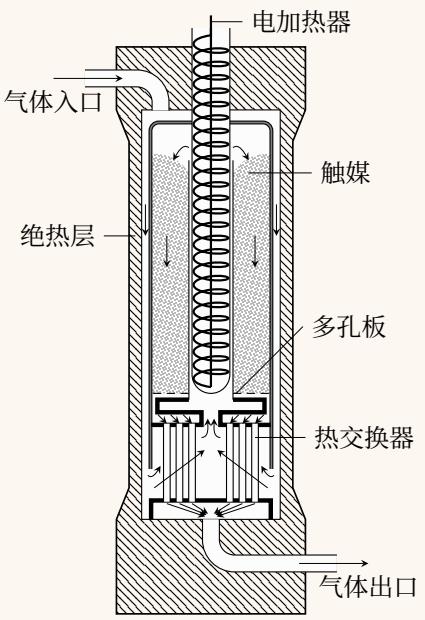
Figure 3.7 Schematic diagram of the internal structure of a type of ammonia synthesis converter.
3. Separation of Ammonia
The gas mixture leaving the synthesis converter typically contains approximately \(15\%\) ammonia. To separate the ammonia from the unreacted nitrogen and hydrogen, the gas mixture is passed through a condenser, where the ammonia is liquefied. The liquid ammonia is then separated in a gas–liquid separator and directed into a liquid ammonia storage tank. The gas leaving the separator is sent through a recirculating compressor and back into the synthesis converter.
The industrial process in which unreacted materials are separated from the product mixture after the reaction and returned to the reactor is called a recycle operation. By using recycle operations, even if the product content in the equilibrium mixture is not very large, the raw materials can still be fully utilized to manufacture the desired product.
China’s ammonia synthesis industry has developed rapidly, playing a very important role in supporting agricultural production and achieving agricultural modernization. China’s ammonia synthesis industry has not only seen continuous increases in output but has also achieved notable technological advances.
The ammonia synthesis industry is also of great significance to the chemical industry and the national defense industry.
We have already studied the principles of industrial ammonia synthesis. We also know that ammonia and many ammonium salts are very important chemical fertilizers, because nitrogen is one of the fundamental elements constituting proteins and one of the main nutrient elements for crop growth. Nature contains vast amounts of nitrogen — nitrogen gas makes up \(78\%\) of the total volume of the atmosphere — yet it cannot be directly utilized by plants. Nitrogen in the ammonium form, however, can be absorbed by plants. But to convert hydrogen and atmospheric nitrogen into ammonia requires, as described earlier, high pressure and a certain high temperature. This necessitates equipment and materials that can withstand high pressure and high temperature, as well as large amounts of power.
Could it be possible, then, to convert atmospheric nitrogen into ammonium nitrogen under normal temperature and pressure? Over the past sixty-plus years, scientists have made extensive efforts hoping to achieve ammonia synthesis under mild conditions, but have not yet succeeded. However, we know that certain leguminous plants have root nodule bacteria living symbiotically on their roots. These root nodule bacteria can fix nitrogen — that is, take up nitrogen from the air and convert it into ammonia and other compounds for direct absorption by the plants. This is called biological nitrogen fixation, and it occurs at normal temperature and pressure. In fact, the fixation of nitrogen gas on Earth is overwhelmingly carried out through biological nitrogen fixation. According to incomplete statistics, the nitrogen in industrially synthesized nitrogen fertilizer worldwide accounts for only \(20\%\) of total fixed nitrogen.
Can humans learn this ability from nature? This requires studying how to simulate biological functions — applying the principles of biological function to chemistry in order to improve existing chemical processes and create entirely new ones. If such simulation succeeds, it would not only greatly improve the efficiency of the nitrogen fertilizer industry and promote agricultural production, but would also have far-reaching implications for many other chemical industries.
- Ammonia synthesis (\(\ce{N2 + 3H2 <=> 2NH3} + 22.08\ \text{kCal}\)) is exothermic and involves a decrease in gas volume
- Pressure: high pressure (\(200\text{–}500\ \text{atm}\)) favors ammonia formation (shifts equilibrium toward fewer gas moles)
- Temperature: \({\sim}500\,{}^{\circ}\text{C}\) is used as a compromise — lower temperatures favor higher equilibrium yield, but the reaction rate would be too slow; \(500\,{}^{\circ}\text{C}\) also gives peak catalyst activity
- Catalyst: an iron-based multi-component catalyst greatly reduces activation energy
- Feed gas (\(\ce{N2}\) + \(\ce{H2}\)) is prepared from air, water, and fuels, then purified and compressed
- A recycle operation separates ammonia from the product stream and returns unreacted \(\ce{N2}\) + \(\ce{H2}\) to the converter
Exercises for Section 4
When the reaction \(\ce{N2 + 3H2 <=> 2NH3}\) reaches equilibrium, the concentrations of the substances in the reaction mixture are: \([\ce{N2}] = 3\ \text{mol/L}\), \([\ce{H2}] = 8\ \text{mol/L}\), \([\ce{NH3}] = 4\ \text{mol/L}\). Find the initial concentrations of \(\ce{N2}\) and \(\ce{H2}\) and the equilibrium constant for this reaction.
In the production of sulfuric acid, air is used to oxidize \(\ce{SO2}\) to \(\ce{SO3}\):
\[ \ce{2SO2 + O2 ->[\ce{V2O5}][400\text{--}500\,{}^{\circ}\text{C}] 2SO3} + 47\ \text{kCal} \]
Why does the industrial process use excess air, employ a catalyst, and operate at an appropriate temperature?
Content Summary
Chemical reaction rate concerns the change in the concentration of reactants or products per unit time. Chemical equilibrium concerns the direction in which a reaction proceeds and the extent to which it proceeds. Both of these topics are very important for future study of chemistry and for practical production applications.
I. Expression of Chemical Reaction Rate
Chemical reaction rate is usually expressed as the decrease in reactant concentration or the increase in product concentration per unit time. Concentration is generally expressed in \(\text{mol/L}\); time can be expressed in seconds, minutes, or hours depending on the speed of the reaction.
II. Important Conditions Affecting Chemical Reaction Rate
Whether reactants can undergo a chemical reaction and how fast the reaction proceeds depend first and foremost on the nature of the reacting substances. In addition, reaction rate is influenced by external conditions, the most important of which are temperature, concentration, pressure, and catalysts.
For reactants to interact, their molecules must collide with each other. The colliding molecules must possess sufficient energy for a chemical reaction to occur. Such collisions that lead to chemical reactions are called effective collisions. The difference between the minimum energy that an activated molecule must possess and the average molecular energy is called the activation energy. The greater the percentage of activated molecules among the reactant molecules, the more frequent the effective collisions, and the faster the reaction proceeds. Therefore, the speed of a reaction is determined by the frequency of effective collisions. Increasing the temperature, concentration, pressure (for gas-phase reactions), or using a good catalyst all increase the frequency of effective collisions among reactant molecules and thereby increase the reaction rate.
III. Chemical Equilibrium and Equilibrium Shift
At a given temperature, when a reversible reaction in a sealed container reaches the point where the forward and reverse reaction rates are equal, chemical equilibrium is attained. Chemical equilibrium is a dynamic equilibrium. At equilibrium, the concentrations of all components in the reaction mixture remain constant.
For a general reversible reaction:
\[ m\text{A} + n\text{B} \rightleftharpoons p\text{C} + q\text{D} \]
at equilibrium, the concentrations of all reacting species satisfy:
\[ \frac{[\text{C}]^p[\text{D}]^q}{[\text{A}]^m[\text{B}]^n} = K \]
\(K\) is called the equilibrium constant of the reaction. The equilibrium constant changes with temperature.
Le Chatelier’s principle (Equilibrium Shift Principle): If a change is made to one of the conditions (such as concentration, temperature, or pressure) that affects a system at equilibrium, the equilibrium shifts in the direction that tends to reduce the effect of that change. This can be stated specifically as follows:
- Concentration:
- Increasing reactant concentration or decreasing product concentration — equilibrium shifts in the forward direction
- Decreasing reactant concentration or increasing product concentration — equilibrium shifts in the reverse direction
- Temperature:
- Raising temperature — equilibrium shifts in the endothermic direction
- Lowering temperature — equilibrium shifts in the exothermic direction
- Pressure:
- Increasing pressure — equilibrium shifts toward the side with smaller total gas volume
- Decreasing pressure — equilibrium shifts toward the side with larger total gas volume
- Catalysts have no effect on the position of chemical equilibrium.
IV. The Ammonia Synthesis Reaction and Its Suitable Conditions
Because the synthesis of ammonia from nitrogen and hydrogen involves a decrease in gas volume and because nitrogen molecules are extremely unreactive, the industrial ammonia synthesis process must be carried out under high pressure, at an appropriate temperature (since the reaction is exothermic, the temperature must not be too high), and in the presence of a catalyst.

Review Problems
In a certain chemical reaction:
\[ \ce{A + B -> C} \]
The initial concentration of A is \(2\ \text{mol/L}\). After 2 minutes, the reaction reaches equilibrium and the concentration of A has decreased to \(1.5\ \text{mol/L}\). Express the reaction rate in terms of the change in concentration of A.
In the reaction \(\ce{N2 + 3H2 <=> 2NH3}\), after \(2\ \text{s}\) the concentration of \(\ce{NH3}\) has increased by \(0.6\ \text{mol/L}\). What is the reaction rate expressed in terms of the change in \(\ce{H2}\) concentration during this \(2\ \text{s}\) interval?
When crystals of \(\ce{HgCl2}\) and \(\ce{KI}\) are placed in a mortar and ground together, they react slowly and the color gradually turns red. However, when \(\ce{HgCl2}\) solution and \(\ce{KI}\) solution are mixed, red \(\ce{HgI2}\) precipitate forms immediately. Why?
The following values are equilibrium constants for various reactions. Which reaction proceeds closest to completion? Which reaction proceeds least completely?
\(K = 1\)
\(K = 10\)
\(K = 10^{-1}\)
\(K = 10^{10}\)
\(K = 10^{-10}\)
Are the following statements correct? Explain why or why not.
When a reversible reaction reaches equilibrium, the reverse reaction has stopped.
Using a catalyst in the ammonia synthesis reaction can increase the conversion rate of nitrogen.
Raising the temperature increases the rate of endothermic reactions and decreases the rate of exothermic reactions.
At constant temperature, increasing the concentration of reactants decreases the equilibrium constant; increasing the concentration of products increases the equilibrium constant.
Increasing pressure has no effect on the neutralization reaction of an acid and a base in solution.
At a certain temperature, the equilibrium constant for the reaction \(\ce{H2 + I2 <=> 2HI}\) is \(50\). At this temperature, hydrogen is allowed to react with iodine vapor. At the start of the reaction, the concentration of iodine vapor is \(1\ \text{mol/L}\). When equilibrium is reached, the concentration of hydrogen iodide is \(0.9\ \text{mol/L}\). Find the initial concentration of hydrogen.
For the reaction \(\ce{H2(g) + I2(g) <=> 2HI(g)}\), at a certain temperature the equilibrium constant \(K = 62.5\). If \(5\ \text{mol}\) of \(\ce{H2}\) and \(5\ \text{mol}\) of \(\ce{I2}\) are placed in a \(10\ \text{L}\) container at this temperature, calculate the equilibrium concentrations of \(\ce{H2}\), \(\ce{I2}\), and \(\ce{HI}\).
The reaction \(\ce{2HI(g) <=> H2(g) + I2(g)}\) has \(K = 0.016\) at \(500\,{}^{\circ}\text{C}\). If \(1\ \text{mol}\) of \(\ce{HI}\) is placed in a \(2\ \text{L}\) container at the start of the reaction, find the equilibrium concentrations of \(\ce{H2}\), \(\ce{I2}\), and \(\ce{HI}\).
In the production of sulfuric acid, the oxidation of sulfur dioxide to sulfur trioxide proceeds as follows:
\[ \ce{2SO2 + O2 <=> 2SO3} + 47\ \text{kCal} \]
Answer the following questions:
What effect does raising the temperature have on the above reaction? Why does industry typically carry out this reaction at \(400\text{–}500\,{}^{\circ}\text{C}\)?
What effect does increasing the pressure have on the above reaction? Why does industry typically operate near atmospheric pressure?
Why must the roaster gas be subjected to dust removal, scrubbing, and drying before it enters the contact chamber?
Why is the amount of air in the feed gas entering the contact chamber typically in excess?
Why is a suitable catalyst such as vanadium pentoxide (\(\ce{V2O5}\)) used?
Why does the tail gas leaving the absorption tower still contain a small amount of sulfur dioxide?
Translator’s note: The conversion rate (转化率) refers to the fraction of a given reactant that has been converted into product by the time equilibrium is reached. It is sometimes also called the “percent conversion” or “fractional conversion.”↩︎
Translator’s note: Henry Louis Le Chatelier (1850–1936) was a French chemist. The principle is also known as the Equilibrium Shift Principle.↩︎