2 The Nitrogen Family
After studying this chapter, you should be able to:
- Describe the general characteristics and trends in properties of the nitrogen family elements (N, P, As, Sb, Bi)
- Explain the physical and chemical properties of nitrogen gas, including its reactions with hydrogen, oxygen, and metals
- Describe the structure, properties, and laboratory preparation of ammonia, and explain the properties of ammonium salts
- Outline the industrial production of nitric acid by catalytic oxidation of ammonia
- Explain the physical and chemical properties of nitric acid, including its instability, oxidizing power, and reactions with metals and nonmetals
- Balance oxidation–reduction equations using the oxidation-state method
- Compare the allotropes of phosphorus (white and red phosphorus) and describe the properties of phosphoric acid and phosphates
2.1 Section 1: Nitrogen Family Elements
In the periodic table, the Group V main-group elements nitrogen (N), phosphorus (P), arsenic (As), antimony (Sb), and bismuth (Bi) are collectively known as the nitrogen family elements. The electron configurations of their atoms are shown in Table 2.1.
From the atomic structures of the nitrogen family elements, we can see that the outermost electron shell of each atom has the configuration \(ns^{2}np^{3}\). Therefore, their highest oxidation state in oxides is \(+5\). As the number of electron shells increases across the nitrogen family, the tendency to gain electrons gradually weakens while the tendency to lose electrons gradually strengthens. Consequently, their nonmetallic character gradually weakens and their metallic character gradually strengthens. Nitrogen and phosphorus exhibit relatively prominent nonmetallic character. Arsenic, although classified as a nonmetal, already shows some metallic character. Antimony and bismuth display relatively obvious metallic character.
Some important properties of the nitrogen family elements are listed in Table 2.2.
| Element | Symbol | Atomic number | Atomic mass | K | L | M | N | O | P |
|---|---|---|---|---|---|---|---|---|---|
| Nitrogen | N | 7 | 14.01 | \(1s^2\) | \(2s^22p^3\) | ||||
| Phosphorus | P | 15 | 30.97 | \(1s^2\) | \(2s^22p^6\) | \(3s^23p^3\) | |||
| Arsenic | As | 33 | 74.92 | \(1s^2\) | \(2s^22p^6\) | \(3s^23p^63d^{10}\) | \(4s^24p^3\) | ||
| Antimony | Sb | 51 | 121.8 | \(1s^2\) | \(2s^22p^6\) | \(3s^23p^63d^{10}\) | \(4s^24p^64d^{10}\) | \(5s^25p^3\) | |
| Bismuth | Bi | 83 | 209.0 | \(1s^2\) | \(2s^22p^6\) | \(3s^23p^63d^{10}\) | \(4s^24p^64d^{10}4f^{14}\) | \(5s^25p^65d^{10}\) | \(6s^26p^3\) |
| Element | Atomic radius (\(10^{-10}\ \text{m}\)) | First ionization energy (eV) | Principal oxidation states | State and color | Density | Melting point | Boiling point |
|---|---|---|---|---|---|---|---|
| N | 0.75 | 14.53 | \(-3, +1, +2, +3, +4, +5\) | Colorless gas | \(1.2506\ \text{g/L}\) | \(-209.86\,{}^{\circ}\text{C}\) | \(-195.8\,{}^{\circ}\text{C}\) |
| P | 1.10 | 10.484 | \(-3, +3, +5\) | White P: white or yellow solid; Red P: dark red powder | 1.82 (white P), 2.34 (red P) \(\text{g/cm}^3\) | \(44.1\,{}^{\circ}\text{C}\) (white P) | \(280\,{}^{\circ}\text{C}\) (white P) |
| As | 1.21 | 9.81 | \(-3, +3, +5\) | Grey As: grey solid | \(5.727\ \text{g/cm}^3\) (grey As) | \(817\,{}^{\circ}\text{C}\) (28 atm, grey As) | \(613\,{}^{\circ}\text{C}\) (sublimes, grey As) |
| Sb | 1.41 | 8.639 | \(+3, +5\) | Silvery-white metal | \(6.684\ \text{g/cm}^3\) | \(630.74\,{}^{\circ}\text{C}\) | \(1750\,{}^{\circ}\text{C}\) |
| Bi | 1.52 | 7.287 | \(+3, +5\) | Silvery-white or slightly reddish metal | \(9.80\ \text{g/cm}^3\) | \(271.3\,{}^{\circ}\text{C}\) | \(1560\,{}^{\circ}\text{C}\) |
From the position of the nitrogen family elements in the periodic table, we can see that their nonmetallic character is weaker than that of the oxygen family and halogen elements in the same period.
In this chapter, we will mainly study nitrogen and phosphorus.
Exercises for Section 1
What elements are included in the nitrogen family? Write the electron configurations for each of them.
How do the properties of the nitrogen family elements change as the number of electron shells increases?
Compare the acidity of phosphoric acid with that of nitric acid and arsenic acid (\(\ce{H3AsO4}\), a weak acid). Compare the acidity of phosphoric acid with that of sulfuric acid and perchloric acid (\(\ce{HClO4}\)).
2.2 Section 2: Nitrogen Gas
Nitrogen is an important element. It exists in the atmosphere as diatomic molecules, making up approximately \(78\%\) of the atmosphere by volume and \(75\%\) by mass. In addition to the atmosphere serving as a vast reservoir of nitrogen, nitrogen also exists in the combined state in many inorganic compounds (such as sodium nitrate and potassium nitrate) and in organic compounds (such as proteins and nucleic acids, both of which are essential substances for life). Industrially, nitrogen gas is usually obtained from air as the raw material. After liquefying the air, nitrogen is separated by taking advantage of the fact that the boiling point of liquid nitrogen is lower than that of liquid oxygen.
Physical properties of nitrogen gas
Pure nitrogen gas is a colorless, odorless gas that is slightly lighter than air (at standard conditions, \(1\ \text{L}\) of nitrogen gas has a mass of \(1.25\ \text{g}\)).
At 1 atm and \(-195.8\,{}^{\circ}\text{C}\), nitrogen becomes a colorless liquid. At \(-209.86\,{}^{\circ}\text{C}\), it becomes a snow-like solid.
The solubility of nitrogen gas in water is very small. Under ordinary conditions, approximately 0.02 volumes of nitrogen gas dissolve in 1 volume of water.
Chemical properties of nitrogen gas
The nitrogen molecule consists of two nitrogen atoms joined by sharing three pairs of electrons (Figure 2.1). The nitrogen molecule contains three covalent bonds:
\[ \genfrac{}{}{0pt}{2}{\scriptscriptstyle\times}{\scriptscriptstyle\times}\kern{-2pt}\overset{{\scriptscriptstyle\times}{\scriptscriptstyle\times}}{\ce{N}}\kern{-2pt}\genfrac{}{}{0pt}{2}{\scriptscriptstyle\times}{\scriptscriptstyle\times}\kern{-2pt}\genfrac{}{}{0pt}{2}{\cdot}{\cdot}\kern{-2pt}\overset{\cdot\cdot}{\ce{N}}\kern{-2pt}{:} \qquad \ce{N#N} \]
The bond energy of the triple bond is very large (\(226.3\ \text{kCal/mol}\)), greater than that of other diatomic molecules (for example, the bond energy of \(\ce{H2}\) is \(104.2\ \text{kCal/mol}\), and that of \(\ce{O2}\) is \(118.86\ \text{kCal/mol}\)). As a result, the nitrogen molecule is very stable. Under ordinary conditions, nitrogen gas is quite unreactive and does not easily undergo chemical reactions with other substances. However, at high temperatures, the nitrogen molecule acquires sufficient energy to break its covalent bonds and can then react with hydrogen, oxygen, metals, and other substances.
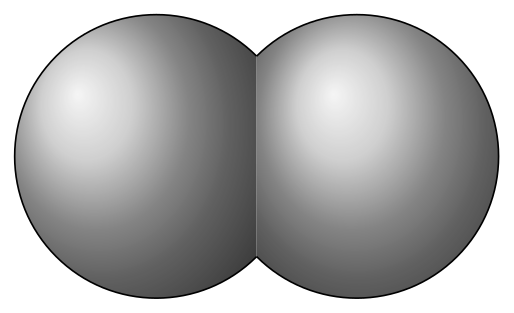
1. Reaction of nitrogen with hydrogen
Under conditions of high temperature, high pressure, and in the presence of a catalyst, nitrogen gas combines directly with hydrogen gas to form ammonia (\(\ce{NH3}\)).
\[ \ce{N2 + 3H2 <=>[high temperature, high pressure][catalyst] 2NH3} + 22.08\ \text{kCal} \]
This is the reaction principle used industrially to synthesize ammonia.
2. Reaction of nitrogen with oxygen
Under electrical discharge conditions, nitrogen gas combines directly with oxygen gas to form the colorless gas nitric oxide (\(\ce{NO}\)).
\[ \ce{N2 + O2 ->[\text{discharge}] 2NO} \]
Nitric oxide is insoluble in water. At room temperature, it readily combines with oxygen in the air to form the brown, pungent-smelling gas nitrogen dioxide (\(\ce{NO2}\)).
\[ \ce{2NO + O2 = 2NO2} \]
Therefore, during thunderstorms, small amounts of nitrogen dioxide are often produced in the atmosphere.
Nitrogen dioxide is toxic and highly soluble in water. When dissolved in water, it produces nitric acid and nitric oxide.
\[ \ce{3NO2 + H2O = 2HNO3 + NO} \]
Nitrogen dioxide molecules can also combine with each other to form the colorless gas dinitrogen tetroxide (\(\ce{N2O4}\)).
\[ \begin{array}{rl} \ce{2NO2} & \rightleftharpoons \ce{N2O4} \\ (\text{brown}) & \quad (\text{colorless}) \end{array} \]
Nitric oxide and nitrogen dioxide are two important oxides of nitrogen. In addition to these two, other nitrogen oxides include dinitrogen monoxide (\(\ce{N2O}\)), dinitrogen trioxide (\(\ce{N2O3}\)), dinitrogen tetroxide (\(\ce{N2O4}\)), and dinitrogen pentoxide (\(\ce{N2O5}\)). This shows that when nitrogen combines with oxygen under different conditions, it can form different oxides. In the five different oxides \(\ce{N2O}\), \(\ce{NO}\), \(\ce{N2O3}\), \(\ce{NO2}\), and \(\ce{N2O5}\), the oxidation states of nitrogen are \(+1\), \(+2\), \(+3\), \(+4\), and \(+5\), respectively. The highest oxidation state of nitrogen is \(+5\).
3. Reaction of nitrogen with certain metals
At high temperatures, nitrogen gas can combine with metals such as magnesium, calcium, strontium, and barium. For example, when magnesium burns in air, in addition to combining with oxygen to form magnesium oxide, it also combines with nitrogen to form a small amount of magnesium nitride (\(\ce{Mg3N2}\)).
\[ \ce{3Mg + N2 ->[\text{ignite}] Mg3N2} \]
Nitrogen fixation
The conversion of atmospheric nitrogen into nitrogen compounds is called nitrogen fixation. As described above, during thunderstorms nitrogen oxides are formed in the atmosphere — this is one natural nitrogen fixation process. The roots of leguminous plants often bear small nodules containing nitrogen-fixing bacteria that can convert atmospheric nitrogen into nitrates at normal temperature and pressure. This conversion is another natural nitrogen fixation process.
Industrially, the synthesis of ammonia from nitrogen gas and the preparation of nitrogen oxides under electrical discharge conditions, followed by the synthesis of nitric acid, are artificial nitrogen fixation processes.
Natural mineral deposits of nitrogen compounds are very scarce, and the combustion of fuels and the decay of organic matter constantly decompose nitrogen compounds, releasing nitrogen gas back into the atmosphere. Faced with the enormous demand for nitrogen compounds (nitrogen fertilizers, explosives, dyes, synthetic fibers, and other products all require nitrogen compounds as raw materials), research into artificial nitrogen fixation is of great importance today.
Uses of nitrogen gas
Large quantities of nitrogen gas are used industrially as raw material for ammonia synthesis, and from ammonia various nitrogen fertilizers and nitric acid can be produced. Nitrogen gas is therefore also an important chemical raw material. Because nitrogen gas is chemically unreactive, it can be used in place of noble gases as a protective atmosphere during metal welding. Nitrogen gas, or a mixture of nitrogen and argon, can be used to fill light bulbs to prevent the oxidation of the tungsten filament and to slow down its evaporation, making the bulb more durable. When grains and fruits are stored in a low-oxygen, high-nitrogen environment, pests are killed by oxygen deprivation, and plant seeds enter a state of dormancy with slowed metabolism. Nitrogen gas can therefore be used to preserve grains, fruits, and other agricultural products.
- Nitrogen gas (\(\ce{N2}\)) has a very stable triple bond (\(226.3\ \text{kCal/mol}\)), making it unreactive at room temperature but reactive at high temperatures.
- Nitrogen reacts with hydrogen (high temperature, high pressure, catalyst) to form \(\ce{NH3}\), with oxygen (discharge) to form \(\ce{NO}\), and with metals (e.g., Mg) to form nitrides.
- \(\ce{NO}\) is colorless and insoluble in water; \(\ce{NO2}\) is brown, toxic, and dissolves in water to give \(\ce{HNO3}\) and \(\ce{NO}\).
- Nitrogen has multiple oxidation states (\(+1\) to \(+5\)) in its various oxides.
- Nitrogen fixation is the conversion of atmospheric \(\ce{N2}\) into nitrogen compounds — it occurs naturally (lightning, nitrogen-fixing bacteria) and artificially (ammonia synthesis, arc process).
Exercises for Section 2
Why does nitrogen gas not readily react with other substances at room temperature, yet is able to react at high temperatures?
Air containing hydrogen sulfide and water vapor is passed successively through sodium hydroxide solution, concentrated sulfuric acid, and red-hot copper wire. What components does the final gas contain? Why? Write the chemical equations for the relevant reactions.
Five gas collection bottles contain the following gases respectively: chlorine, oxygen, nitrogen, carbon dioxide, and sulfur dioxide. Based on which properties can you distinguish them? Write the chemical equations for the relevant reactions.
How can you distinguish between nitrogen dioxide and bromine vapor?
2.3 Section 3: Ammonia and Ammonium Salts
I. Ammonia
1. Structure of the ammonia molecule
The outermost electron shell of a nitrogen atom has 5 electrons, with the electron configuration \(2s^{2}2p^{3}\). In the ammonia molecule, the 3 unpaired \(2p\) electrons of the nitrogen atom each form a shared electron pair with the \(1s\) electron of a hydrogen atom. That is, nitrogen is bonded to three hydrogen atoms by three covalent bonds:
\[ \ce{H-N(-H)-H} \]
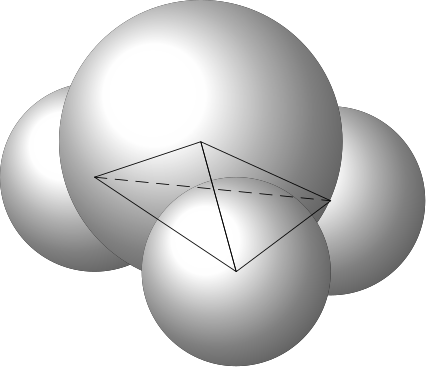
The N–H bonds in the ammonia molecule are polar bonds. Experimental measurements show that the ammonia molecule has a trigonal pyramidal structure, with the nitrogen atom at the apex and the three hydrogen atoms at the base. The bond angle between the N–H bonds is \(107^{\circ}18'\). Therefore, ammonia is a polar molecule (Figure 2.2).
2. Physical properties of ammonia
Ammonia is a colorless gas with a pungent odor. At standard conditions, the density of ammonia is \(0.771\ \text{g/L}\), making it lighter than air of the same volume.
Because the hydrogen atoms in ammonia are bonded to a nitrogen atom — an atom with high electronegativity and a relatively small atomic radius — ammonia molecules, like water molecules, can form hydrogen bonds with one another. The formation of hydrogen bonds increases the intermolecular forces between ammonia molecules, making ammonia easy to liquefy. At normal pressure, cooling to \(-33.5\,{}^{\circ}\text{C}\), or at room temperature under a pressure of \(7 \sim 8\ \text{atm}\), gaseous ammonia condenses into a colorless liquid, releasing a large amount of heat in the process. When liquid ammonia evaporates, it absorbs a large amount of heat, causing the surrounding temperature to drop sharply. For this reason, ammonia is commonly used as a refrigerant.
Ammonia dissolves extremely readily in water. At room temperature, approximately 700 volumes of ammonia dissolve in 1 volume of water. The aqueous solution of ammonia is called ammonia water.
3. Chemical properties of ammonia
(1) Reaction of ammonia with water
Fill a dry round-bottom flask with ammonia gas. Seal the flask with a stopper fitted with a glass tube and a dropper (the dropper is pre-filled with water). Immediately invert the flask and place the glass tube into a beaker containing water (to which a small amount of phenolphthalein solution has been added beforehand). Squeeze the rubber bulb of the dropper to release a small amount of water into the flask. The water from the beaker jets upward through the glass tube into the flask, forming a red fountain (Figure 2.3).
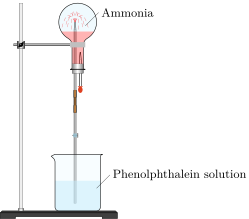
The experiment demonstrates that ammonia dissolves extremely readily in water. After a large amount of ammonia dissolves, the pressure inside the flask drops rapidly, and the external atmospheric pressure pushes the water from the beaker up into the flask, forming a fountain. At the same time, the water containing phenolphthalein turns red, indicating that ammonia water is basic.
Based on the experimental facts that heating concentrated ammonia water causes ammonia gas to escape and that ammonia water at low temperature can crystallize out the hydrate of ammonia — ammonia monohydrate (\(\ce{NH3 * H2O}\)) — we know that when ammonia dissolves in water, most of it combines with water to form ammonia monohydrate (\(\ce{NH3 * H2O}\)). \(\ce{NH3 * H2O}\) is formed by the combination of ammonia molecules and water molecules through hydrogen bonding.
Ammonia monohydrate is very unstable. Upon heating, it decomposes into ammonia and water:
\[ \ce{NH3 * H2O ->[\Delta] NH3 ^} + \ce{H2O} \]
Ammonia monohydrate can partially ionize to produce \(\ce{NH4+}\) and \(\ce{OH-}\), which is why ammonia water is weakly basic and can turn phenolphthalein solution red. The reaction of ammonia in water can be represented as follows:
\[ \ce{NH3 + H2O} \rightleftharpoons \ce{NH3 * H2O} \rightleftharpoons \ce{NH4+ + OH-} \]
It can also be expressed more simply as:
\[ \ce{NH3 + H2O} \rightleftharpoons \ce{NH4+ + OH-} \]
(2) Reaction of ammonia with acids
Dip one glass rod in concentrated ammonia water and another glass rod in concentrated hydrochloric acid. Bring the two glass rods close together (without touching), and dense white smoke is produced (Figure 2.4).
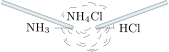
The white smoke consists of tiny crystals of ammonium chloride, formed by the combination of ammonia volatilized from the ammonia water with hydrogen chloride volatilized from the concentrated hydrochloric acid:
\[ \ce{NH3 + HCl = NH4Cl} \]
Ammonia similarly combines with other acids to form ammonium salts. For example, passing ammonia into nitric acid or sulfuric acid produces ammonium nitrate or ammonium sulfate:
\[ \ce{NH3 + HNO3 = NH4NO3} \]
\[ \ce{2NH3 + H2SO4 = (NH4)2SO4} \]
(3) Reaction of ammonia with oxygen
In the presence of a catalyst (such as platinum, iron oxide, or chromium oxide), ammonia reacts with oxygen as follows:
\[ \ce{4NH3 + 5O2 ->[\text{catalyst}][\Delta] 4NO + 6H2O} + 216.7\ \text{kCal} \]
Slowly pass air into a conical flask containing concentrated ammonia water. Bring a red-hot coiled platinum wire close to the liquid surface without letting the platinum wire contact the ammonia water (Figure 2.5). A brown gas can be observed forming in the conical flask, because the ammonia is oxidized to nitric oxide, which then reacts with oxygen to form nitrogen dioxide. At the same time, the platinum wire remains red-hot, because the reaction between ammonia molecules and oxygen molecules on the surface of the platinum wire is exothermic.
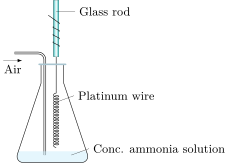
The above reaction is called the catalytic oxidation (or contact oxidation) of ammonia. It is the basis for the industrial production of nitric acid.
4. Laboratory preparation of ammonia
In the laboratory, ammonia is commonly prepared by heating a mixture of an ammonium salt and a base.
\[ \ce{2NH4Cl + Ca(OH)2 ->[\Delta] CaCl2 + 2NH3 ^} + \ce{2H2O} \]
Heat the mixture of ammonium chloride and slaked lime in a test tube. Collect the ammonia by holding an inverted dry test tube over the mouth of the heating tube (Figure 2.6). Place moist red litmus paper at the mouth of the collecting test tube; the color change of the paper indicates when the test tube is full of ammonia.
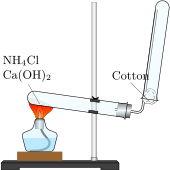
In the laboratory, to obtain dry ammonia, the ammonia produced is typically passed through soda lime1 to absorb the water vapor.
5. Uses of ammonia
Ammonia is an important industrial chemical product. It is not only the foundation of the nitrogen fertilizer industry but also a key raw material for manufacturing nitric acid, ammonium salts, soda ash, and other products. Ammonia is also a commonly used raw material in organic synthesis (for example, in the production of synthetic fibers, plastics, dyes, and other products). Additionally, ammonia is a widely used refrigerant.
II. Ammonium Salts
Ammonia reacts with acids to produce ammonium salts. Ammonium salts are compounds composed of ammonium ions (\(\ce{NH4+}\)) and acid radical ions. All ammonium salts are crystalline and soluble in water. The chemical properties of ammonium salts are as follows:
1. Thermal decomposition of ammonium salts
Heat ammonium chloride crystals in a test tube and observe the phenomenon (Figure 2.7).
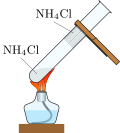
When heated, ammonium chloride decomposes into ammonia and hydrogen chloride. Upon cooling, they recombine to form ammonium chloride.
\[ \ce{NH4Cl ->[\Delta] NH3 ^ + HCl ^} \]
\[ \ce{NH3 + HCl = NH4Cl} \]
When heated, ammonium bicarbonate decomposes into ammonia, water, and carbon dioxide.
\[ \ce{NH4HCO3 ->[\Delta] NH3 ^ + H2O + CO2 ^} \]
Ammonium salts decompose readily upon heating, and in general, ammonia is released during decomposition.
2. Reaction of ammonium salts with bases
Ammonium salts react with bases to release ammonia gas. For example:
\[ \ce{(NH4)2SO4 + 2NaOH ->[\Delta] Na2SO4 + 2NH3 ^ + 2H2O} \]
This property is common to all ammonium salts. In the laboratory, this type of reaction is used to prepare ammonia, and it can also be used to test for the presence of ammonium ions.
Ammonium salts have important applications in industry and agriculture. Large amounts of ammonium salts are used as nitrogen fertilizers. Ammonium nitrate is also used to make explosives. Ammonium chloride is commonly used as a raw material in printing and dyeing and in manufacturing dry cells; it is also used in metal soldering to remove the thin oxide layer on metal surfaces.
- Ammonia (\(\ce{NH3}\)) has a trigonal pyramidal structure and is a polar molecule. Hydrogen bonding makes it easy to liquefy and extremely soluble in water (700 : 1 by volume).
- Ammonia water is weakly basic: \(\ce{NH3 + H2O} \rightleftharpoons \ce{NH3 * H2O} \rightleftharpoons \ce{NH4+ + OH-}\).
- Ammonia reacts with acids to form ammonium salts, and undergoes catalytic oxidation with \(\ce{O2}\) (over Pt) to form \(\ce{NO}\) — the basis for industrial nitric acid production.
- Lab preparation: heat \(\ce{NH4Cl}\) + \(\ce{Ca(OH)2}\) \(\xrightarrow{\Delta}\) \(\ce{NH3}{\uparrow}\).
- Ammonium salts decompose on heating (releasing \(\ce{NH3}\)) and react with bases to release \(\ce{NH3}\) — this is used to test for \(\ce{NH4+}\).
Exercises for Section 3
Concentrated sulfuric acid is commonly used as a drying agent for gases. Can it be used to dry ammonia gas? Why or why not?
When iodine is heated, it becomes vapor, and when iodine vapor is cooled, it becomes solid iodine again. When ammonium chloride is heated, it decomposes into gases that recombine into ammonium chloride upon cooling. Are these two phenomena essentially the same? Why or why not?
How can you use chemical methods to prove that ammonium sulfate is both an ammonium salt and a sulfate? Write the testing procedure, the observed phenomena, and the relevant chemical equations.
To prepare \(1\ \text{L}\) of ammonia water containing \(10\%\) ammonia (density \(0.96\ \text{g/cm}^3\)), what volume of ammonia gas (at standard conditions) is needed?
When 350 volumes (at standard conditions) of ammonia are dissolved in 1 volume of water, what is the mass percent concentration of this ammonia water? What is the molar concentration? (The density of this ammonia water is \(0.924\ \text{g/cm}^3\).)
Using \(10\ \text{g}\) each of calcium hydroxide and ammonium chloride, how many liters of ammonia gas can be produced at standard conditions? If all of this ammonia is dissolved to make \(500\ \text{mL}\) of ammonia water, what is the molar concentration of the solution?
2.4 Section 4: Industrial Production of Nitric Acid
Nitric acid is an important industrial chemical product. It is a key raw material for manufacturing explosives, dyes, plastics, nitrate salts, and many other chemical products.
The most important modern method for producing nitric acid is the catalytic oxidation of ammonia. The production process can be broadly divided into two stages: (1) oxidation of ammonia to form nitric oxide; (2) oxidation of nitric oxide to form nitrogen dioxide, which is then absorbed by water (or dilute nitric acid) to form nitric acid.
1. Oxidation of ammonia
Ammonia and purified air are mixed in a certain ratio and fed into an oxidation furnace (Figure 2.8). Inside the furnace, multiple layers of horizontal platinum–rhodium alloy gauze serve as the catalyst. At a high temperature of \(800\,{}^{\circ}\text{C}\), ammonia reacts with oxygen on the gauze surface to produce nitric oxide and water vapor, simultaneously releasing a large amount of heat.
\[ \ce{4NH3 + 5O2 ->[\ce{Pt-Rh}][\text{high temp.}] 4NO + 6H2O} + 216.7\ \text{kCal} \]
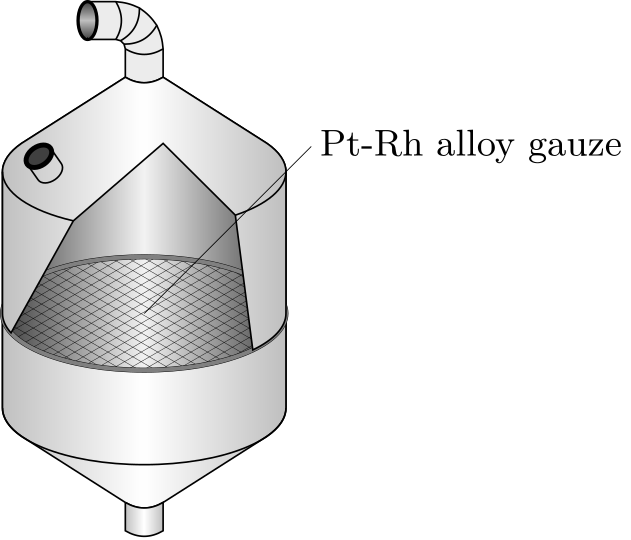
2. Formation of nitric acid
After cooling, the nitric oxide is oxidized to nitrogen dioxide by the oxygen in the air.
\[ \ce{2NO + O2 = 2NO2} + 27.02\ \text{kCal} \]
Finally, in an absorption tower, the nitrogen dioxide is absorbed by water to produce nitric acid.
\[ \ce{3NO2 + H2O = 2HNO3 + NO} + 32.5\ \text{kCal} \]
From this reaction, we can see that only two-thirds of the nitrogen dioxide is converted into nitric acid, while one-third is converted into nitric oxide. Therefore, additional air is commonly introduced during the absorption process so that the nitric oxide produced is re-oxidized to nitrogen dioxide, which dissolves in water to form more nitric acid and nitric oxide. Through repeated cycles of oxidation and absorption, the nitrogen dioxide can be nearly completely absorbed by water, maximizing the conversion to nitric acid.
The tail gas exiting the absorption tower still contains small amounts of unabsorbed nitric oxide and nitrogen dioxide. If these are released into the atmosphere without treatment, they would cause pollution and seriously harm human health and crop growth. To eliminate the pollution of the atmosphere by nitrogen oxides and to turn waste into a useful product, the tail gas is passed through an alkaline solution absorption tower, where it is absorbed by an alkaline solution to produce the important chemical raw material sodium nitrite:
\[ \ce{NO + NO2 + 2NaOH = 2NaNO2 + H2O} \]
The nitric acid produced by this method generally has a concentration of about \(50\%\). To obtain more concentrated nitric acid, magnesium nitrate (or concentrated sulfuric acid) can be used as a dehydrating agent. Distilling the dilute nitric acid in this way yields concentrated nitric acid with a concentration above \(96\%\).
- Industrial nitric acid production uses catalytic oxidation of ammonia in two stages:
- \(\ce{4NH3 + 5O2 ->[\ce{Pt-Rh}] 4NO + 6H2O}\) at \(800\,{}^{\circ}\text{C}\)
- \(\ce{NO -> NO2 -> HNO3}\) via oxidation and water absorption
- Only \(\frac{2}{3}\) of \(\ce{NO2}\) is converted per pass; repeated oxidation–absorption cycles maximize yield.
- Tail gas (\(\ce{NO}\)/\(\ce{NO2}\)) is absorbed by alkali to produce \(\ce{NaNO2}\), preventing atmospheric pollution.
Exercises for Section 4
Briefly describe the chemical reaction principles for the production of nitric acid by the oxidation of ammonia, and write the relevant chemical equations.
During thunderstorms, rainwater may contain trace amounts of nitric acid. People once imitated this natural process to produce nitric acid by the electric arc method. When air is passed through an electric arc between electrodes, the extremely high temperature causes nitrogen to be oxidized to nitric oxide. However, even at \(3000\,{}^{\circ}\text{C}\), only \(5\%\) (by volume) of \(\ce{NO}\) is formed. Due to the high electricity consumption and low yield, this method has gradually been replaced by other methods. Write the chemical equations for the production of nitric acid by the electric arc method.
In the production of nitric acid by ammonia oxidation, if the yield of converting ammonia to nitric oxide is \(96\%\) and the yield of converting nitric oxide to nitric acid is \(92\%\), how many tonnes of \(50\%\) nitric acid can be produced from \(10\ \text{t}\) of ammonia?
To prepare \(250\ \text{mL}\) of \(6\ \text{M}\) \(\ce{HNO3}\) solution, how many milliliters of \(65.3\%\) concentrated nitric acid (density \(1.4\ \text{g/cm}^3\)) are needed?
2.5 Section 5: Nitric Acid and Nitrates
I. Nitric Acid
1. Physical properties of nitric acid
Pure nitric acid is a colorless, volatile liquid with a pungent odor. Its density is \(1.5027\ \text{g/cm}^3\), its boiling point is \(83\,{}^{\circ}\text{C}\), and its freezing point is \(-42\,{}^{\circ}\text{C}\). It is miscible with water in all proportions. Commonly used concentrated nitric acid has a concentration of approximately \(69\%\). Concentrated nitric acid with a concentration above \(98\%\) produces a “fuming” phenomenon in air due to the evaporation of nitric acid, and is commonly called fuming nitric acid. This occurs because the nitric acid vapor released from the acid reacts with water vapor in the air to form extremely tiny droplets of nitric acid.
2. Chemical properties of nitric acid
Nitric acid is a strong acid. In addition to possessing the general properties common to all acids, it has its own distinctive characteristics.
(1) Instability of nitric acid
Nitric acid is very unstable and decomposes readily. Pure or concentrated nitric acid decomposes at room temperature when exposed to light, and decomposes even faster when heated.
\[ \ce{4HNO3 ->[\Delta] 2H2O + 4NO2 ^ + O2 ^} \]
The more concentrated the nitric acid, the more readily it decomposes. The nitrogen dioxide produced by decomposition dissolves in the nitric acid and gives it a yellow color. To prevent decomposition, nitric acid must be stored in brown bottles and kept in a dark, cool place.
(2) Oxidizing power of nitric acid
Nitric acid is a very powerful oxidizing agent. Both dilute and concentrated nitric acid possess oxidizing power and can undergo oxidation–reduction reactions with nearly all metals (except gold, platinum, and a few others) and with nonmetals.
Place copper pieces in two separate test tubes. Add a small amount of concentrated nitric acid to one and dilute nitric acid to the other. Observe the phenomena.
Both concentrated and dilute nitric acid react with copper. The reaction with concentrated nitric acid is vigorous and produces a reddish-brown gas. The reaction with dilute nitric acid is slower and produces a colorless gas that turns reddish-brown at the mouth of the test tube.
The chemical equations for these reactions are:
\[ \ce{Cu + 4HNO3}(\text{conc.}) = \ce{Cu(NO3)2 + 2NO2 ^ + 2H2O} \]
\[ \ce{3Cu + 8HNO3}(\text{dilute}) = \ce{3Cu(NO3)2 + 2NO ^ + 4H2O} \]
From these two reactions, we can see that when nitric acid reacts with metals, the nitrogen in the \(+5\) oxidation state gains electrons and is reduced to a nitrogen compound with a lower oxidation state. Unlike the reaction of hydrochloric acid with relatively active metals, hydrogen gas is not released. With the exception of gold, platinum, and a few other metals, nitric acid can oxidize virtually all metals to form nitrate salts.
It is worth noting that certain metals, such as aluminum and iron, undergo passivation in concentrated nitric acid at room temperature. This is because the concentrated nitric acid oxidizes their surface to form a thin, dense oxide film that prevents further reaction. For this reason, aluminum tank trucks can be used to transport concentrated nitric acid.
A mixture of concentrated nitric acid and concentrated hydrochloric acid (in a molar ratio of 1 : 3) is called aqua regia (royal water). Its oxidizing power is even stronger, and it can dissolve metals such as gold and platinum that are insoluble in nitric acid alone.
Nitric acid can also oxidize many nonmetals (such as carbon, sulfur, and phosphorus) and certain organic substances (such as turpentine and sawdust). For example:
\[ \ce{4HNO3 + C = 2H2O + 4NO2 ^ + CO2 ^} \]
3. Laboratory preparation of nitric acid
Because nitric acid is volatile, it can be prepared in the laboratory by heating a nitrate salt with concentrated sulfuric acid.
\[ \ce{NaNO3 + H2SO4}(\text{conc.}) = \ce{NaHSO4 + HNO3 ^} \]
II. Nitrates
Most nitrates are colorless crystals that are extremely soluble in water. Nitrates are unstable — upon heating, they decompose and release oxygen gas. Therefore, at high temperatures, nitrates act as strong oxidizing agents.
Heat potassium nitrate in a test tube until it melts. Insert a thin wooden splint with a glowing ember into the mouth of the test tube to test the gas released. At the same time, observe the color of the released gas and the color of the residue in the test tube.
Separately repeat the above experiment using copper(II) nitrate and silver nitrate crystals in place of potassium nitrate.
From the experiments, we can see that all nitrate salts decompose upon heating. In general:
Nitrates of relatively active metals (those before magnesium in the activity series) decompose upon heating to release oxygen gas and produce nitrite salts. For example:
\[ \ce{2KNO3 ->[\Delta] 2KNO2 + O2 ^} \]
Nitrates of metals between magnesium and copper in the activity series decompose upon heating to produce the metal oxide, nitrogen dioxide, and oxygen gas. For example:
\[ \ce{2Cu(NO3)2 ->[\Delta] 2CuO + 4NO2 ^ + O2 ^} \]
Nitrates of metals with very low activity (those after copper in the activity series) decompose upon heating to produce the free metal, nitrogen dioxide, and oxygen gas. For example:
\[ \ce{2AgNO3 ->[\Delta] 2Ag + 2NO2 ^ + O2 ^} \]
Because nitrates are oxidizing agents, potassium nitrate can be combined with the easily combustible powders of sulfur and charcoal to make black powder (gunpowder).
- Nitric acid (\(\ce{HNO3}\)) is a strong acid that is volatile, unstable (decomposes in light/heat releasing \(\ce{NO2}\)), and a powerful oxidizing agent.
- Concentrated \(\ce{HNO3}\) reacts with Cu producing \(\ce{NO2}\) (brown gas); dilute \(\ce{HNO3}\) reacts with Cu producing \(\ce{NO}\) (colorless).
- Al and Fe undergo passivation in concentrated \(\ce{HNO3}\); aqua regia (\(\ce{HNO3}\):\(\ce{HCl}\) = 1:3) dissolves Au and Pt.
- Nitrate decomposition depends on metal activity: active metals \(\to\) nitrite + \(\ce{O2}\); moderate metals \(\to\) oxide + \(\ce{NO2}\) + \(\ce{O2}\); least active metals \(\to\) free metal + \(\ce{NO2}\) + \(\ce{O2}\).
Exercises for Section 5
What similarities and differences exist among the properties of nitric acid, sulfuric acid, and hydrochloric acid? How can these three acids be experimentally distinguished from each other?
Write the chemical equations in sequence for the following transformations, and indicate the conditions under which each reaction occurs.
\[ \ce{N2 -> NH3 -> NO -> NO2 -> HNO3 -> NH4NO3} \]
What happens when a piece of copper is placed in each of the following acids? For those that react, write the chemical equation; for those that do not, explain why.
- Dilute hydrochloric acid
- Concentrated sulfuric acid
- Dilute sulfuric acid
- Concentrated nitric acid
- Dilute nitric acid
\(50\ \text{mL}\) of \(3.5\ \text{M}\) dilute nitric acid solution reacts with excess copper. How many grams of copper(II) nitrate are produced? Calculate the volume of nitric oxide gas produced at standard conditions.
Write the chemical equations for the thermal decomposition of each of the following four nitrate salts:
- \(\ce{NaNO3}\)
- \(\ce{Ca(NO3)2}\)
- \(\ce{Fe(NO3)2}\)
- \(\ce{Hg(NO3)2}\)
What is the molar concentration of a \(62\%\) nitric acid solution (density \(1.38\ \text{g/cm}^3\))? If \(100\ \text{mL}\) of this concentrated nitric acid is diluted to \(500\ \text{mL}\), what is the molar concentration of the resulting solution?
When sodium nitrate crystals are heated together with concentrated sulfuric acid and copper, what phenomenon occurs? Can this method be used to identify nitrate salts? Would this method work for very dilute nitrate solutions?
2.6 Section 6: Balancing Redox Reaction Equations
In junior high school chemistry, we learned about some oxidation–reduction reactions whose chemical equations were relatively simple. The coefficients of the reactants and products were small integers, and the equations were not difficult to balance by inspection. However, in senior high school chemistry, we encounter more complex oxidation–reduction reactions — such as the reactions of nitric acid with metals or nonmetals — whose equations are not easy to balance by inspection. How, then, can we balance these more complex equations?
We know that the essence of oxidation–reduction reactions is the transfer of electrons between atoms participating in the reaction (including the loss and gain of electrons as well as the displacement of shared electron pairs). Electron transfer between atoms can be expressed in terms of changes in oxidation states. Therefore, the chemical equations for oxidation–reduction reactions can be balanced by analyzing electron transfer or changes in oxidation states. Here, we will learn to balance equations using the oxidation-state method.
Balance the chemical equation for the reaction of copper with dilute nitric acid.
Solution:
Step 1. Write the chemical formulas of the reactants and products, and identify the oxidation states of the elements that undergo oxidation and reduction.
\[ \overset{0}{\ce{Cu}} + \ce{H}\overset{+5}{\ce{N}}\ce{O3} \longrightarrow \overset{+2}{\ce{Cu}}\ce{(NO3)2} + \overset{+2}{\ce{N}}\ce{O} + \ce{H2O} \]
Step 2. Identify the changes in oxidation states.
- Cu: \(0 \to +2\) (oxidation state increases by 2)
- N: \(+5 \to +2\) (oxidation state decreases by 3)
Step 3. Make the total increase in oxidation state equal to the total decrease.
The increase is 2 (for Cu) and the decrease is 3 (for N). To equalize them: \(2 \times 3 = 3 \times 2\), so the coefficient of Cu is 3 and the coefficient of NO is 2.
\[ 3\ce{Cu} + 2\ce{HNO3} \longrightarrow 3\ce{Cu(NO3)2} + 2\ce{NO} + \ce{H2O} \]
Step 4. Balance the remaining substances by inspection. In the reaction above, 6 \(\ce{NO3-}\) ions do not participate in the redox reaction, so the total coefficient of \(\ce{HNO3}\) should be 8. The coefficient of \(\ce{H2O}\) should be 4, because the 2 \(\ce{NO3-}\) ions reduced to NO release 4 oxygen atoms that combine with \(\ce{H+}\) from \(\ce{HNO3}\) to form water. After balancing, replace the arrow with an equals sign.
\[ \ce{3Cu + 8HNO3}(\text{dilute}) = \ce{3Cu(NO3)2 + 2NO ^ + 4H2O} \]
Balance the chemical equation for the reaction of carbon with nitric acid.
Solution:
Step 1. Write the chemical formulas of the reactants and products, and identify the oxidation states of the elements undergoing changes.
\[ \overset{0}{\ce{C}} + \ce{H}\overset{+5}{\ce{N}}\ce{O3} \longrightarrow \overset{+4}{\ce{N}}\ce{O2} + \overset{+4}{\ce{C}}\ce{O2} + \ce{H2O} \]
Step 2. Identify the changes in oxidation states.
- C: \(0 \to +4\) (oxidation state increases by 4)
- N: \(+5 \to +4\) (oxidation state decreases by 1)
Step 3. Make the total increase and total decrease equal. The increase is 4 and the decrease is 1, so the coefficient of \(\ce{NO2}\) is 4 and that of C is 1.
\[ \ce{C} + 4\ce{HNO3} \longrightarrow 4\ce{NO2} + \ce{CO2} + \ce{H2O} \]
Step 4. Balance the remaining substances by inspection and replace the arrow with an equals sign.
\[ \ce{C + 4HNO3 = 4NO2 ^ + CO2 ^ + 2H2O} \]
- The oxidation-state method balances redox equations in four steps:
- Write formulas and assign oxidation states to elements that change.
- Determine the increase and decrease in oxidation states.
- Adjust coefficients so that the total increase = total decrease.
- Balance remaining species by inspection.
- The total number of electrons lost always equals the total number gained — this is the fundamental principle behind the method.
Exercises for Section 6
Balance the following oxidation–reduction equations and identify which element is oxidized and which is reduced.
- \(\ce{SO2 + O2 -> SO3}\)
- \(\ce{P + Cl2 -> PCl3}\)
- \(\ce{NaBr + Cl2 -> NaCl + Br2}\)
- \(\ce{Fe + FeCl3 -> FeCl2}\)
- \(\ce{KClO3 -> KCl + O2}\)
Balance the following oxidation–reduction equations.
- \(\ce{Cu + H2SO4}(\text{conc.}) \ce{-> CuSO4 + SO2 + H2O}\)
- \(\ce{MnO2 + HCl}(\text{conc.}) \ce{-> MnCl2 + Cl2 + H2O}\)
- \(\ce{NH3 + O2 -> NO + H2O}\)
- \(\ce{NO2 + H2O -> HNO3 + NO}\)
- \(\ce{Mg + HNO3}(\text{dilute}) \ce{-> Mg(NO3)2 + NH4NO3 + H2O}\)
Balance the reaction of sodium peroxide with carbon dioxide.
\[\ce{Na2O2 + CO2 -> Na2CO3 + O2}\]
(Hint: The oxidation state of oxygen in sodium peroxide is \(-1\). In the reaction, one oxygen atom goes from \(-1\) to \(-2\), while the other goes from \(-1\) to \(0\).)
2.7 Section 7: Phosphorus, Phosphoric Acid, and Phosphates
I. Phosphorus
Different substances composed of the same element but with different properties are called allotropes. Phosphorus has several allotropes, of which the most important are white phosphorus and red phosphorus.
1. Physical properties of phosphorus
White phosphorus is a waxy solid that is highly toxic. It is insoluble in water but soluble in carbon disulfide. When white phosphorus is heated to \(260\,{}^{\circ}\text{C}\) in the absence of air, it converts into red phosphorus. Red phosphorus is a dark red powdery solid that is non-toxic. It is insoluble in both water and carbon disulfide. When red phosphorus is heated to \(416\,{}^{\circ}\text{C}\), it sublimes, and its vapor, upon cooling, converts back into white phosphorus.
2. Chemical properties of phosphorus
Phosphorus is chemically active and readily combines directly with oxygen, halogens, and many metals.
(1) Reaction of phosphorus with oxygen
Clamp an iron plate horizontally on an iron stand. Place small amounts of white phosphorus and red phosphorus at a distance from each other on the iron plate (Figure 2.9). Heat from below the red phosphorus and observe whether it is the red phosphorus or the white phosphorus that catches fire first.
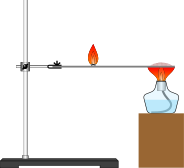
The experiment demonstrates that white phosphorus ignites far more easily than red phosphorus. The ignition temperature of white phosphorus is \(40\,{}^{\circ}\text{C}\), while that of red phosphorus is \(240\,{}^{\circ}\text{C}\). White phosphorus will catch fire from even slight friction or when heated to \(40\,{}^{\circ}\text{C}\). Therefore, white phosphorus must be stored in sealed containers; small quantities of white phosphorus are kept under water.
Although white phosphorus and red phosphorus have different ignition temperatures, both produce phosphorus pentoxide (\(\ce{P2O5}\)) upon combustion. Phosphorus pentoxide readily absorbs moisture and is a powerful drying agent.
White phosphorus oxidizes slowly in air even at room temperature, and this slow oxidation produces light — a glow that is clearly visible in the dark.
Like nitrogen, phosphorus has a highest oxidation state of \(+5\) in its oxides and chlorides, and an oxidation state of \(-3\) in its compounds with hydrogen and metals.
(2) Reaction of phosphorus with halogens
Because halogens have a higher electronegativity than phosphorus, phosphorus exhibits \(+3\) and \(+5\) oxidation states in its halides. When phosphorus burns in an insufficient amount of chlorine gas, it produces phosphorus trichloride.
\[ \ce{2P + 3Cl2 ->[\text{ignite}] 2PCl3} \]
When phosphorus burns in an excess of chlorine gas, it produces phosphorus pentachloride.
\[ \ce{2P + 5Cl2 ->[\text{ignite}] 2PCl5} \]
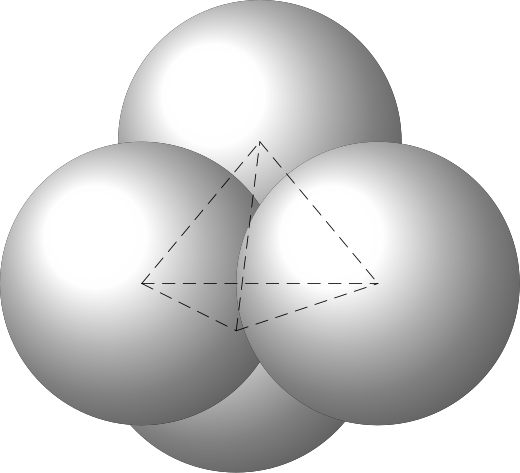
The differences in properties between white phosphorus and red phosphorus arise from their different structures. The white phosphorus molecule consists of four phosphorus atoms forming a \(\ce{P4}\) molecule in which the 4 phosphorus atoms are arranged at the 4 vertices of a regular tetrahedron. Each phosphorus atom is bonded to the other 3 phosphorus atoms in the molecule by covalent bonds (Figure 2.10). The structure of red phosphorus is far more complex than that of white phosphorus and will not be discussed here.
3. Occurrence and uses of phosphorus
Phosphorus is easily oxidized in air, so free phosphorus does not exist in nature. Phosphorus occurs mainly as phosphate salts in minerals. Additionally, animal bones, teeth, brain tissue, and nerve tissue all contain phosphorus. Plant fruits and buds also contain phosphorus. Phosphorus plays an important role in maintaining the normal biological functions of living organisms.
White phosphorus can be used to produce high-purity phosphoric acid. Red phosphorus is used mainly in manufacturing safety matches, in addition to its use in producing pesticides. The substance applied to the side of a matchbox is a mixture of red phosphorus, antimony trisulfide, and other materials, while the substance on the match head is generally a mixture of oxidizing agents (potassium chlorate, manganese dioxide) and flammable materials such as sulfur. When the two are rubbed together, the heat generated by friction ignites the red phosphorus in contact with potassium chlorate, which in turn ignites the flammable material on the match head, causing the match to light. In military applications, phosphorus is also used to manufacture smoke screens and incendiary devices.
II. Phosphoric Acid and Phosphates
Phosphorus pentoxide combines with water very readily, reacting vigorously and releasing a large amount of heat. Depending on the reaction conditions, it can produce metaphosphoric acid2 (\(\ce{HPO3}\)) or phosphoric acid (\(\ce{H3PO4}\)):
\[ \ce{P2O5 + H2O ->[\text{cold water}] 2HPO3} \]
\[ \ce{P2O5 + 3H2O ->[\text{hot water}] 2H3PO4} \]
Phosphoric acid is a colorless, transparent crystalline solid with a melting point of \(42.35\,{}^{\circ}\text{C}\). It is hygroscopic and highly soluble in water, being miscible with water in all proportions. Commercially available phosphoric acid is a colorless, viscous concentrated solution containing \(83\% \sim 98\%\) pure phosphoric acid. Phosphoric acid is non-toxic, whereas metaphosphoric acid is highly toxic.
Phosphoric acid is more stable than nitric acid and does not decompose easily. Industrially, phosphoric acid is produced by reacting sulfuric acid with calcium phosphate:
\[ \ce{Ca3(PO4)2 + 3H2SO4 = 2H3PO4 + 3CaSO4}{\downarrow} \]
After filtering off the calcium sulfate precipitate, the filtrate is the phosphoric acid solution.
Phosphoric acid does not exhibit oxidizing properties. It is a triprotic acid of moderate strength. It can form three types of salts: one normal (neutral) salt and two acid salts. For example:
| Type | Sodium salt | Calcium salt | Ammonium salt |
|---|---|---|---|
| Dihydrogen phosphate | \(\ce{NaH2PO4}\) | \(\ce{Ca(H2PO4)2}\) | \(\ce{NH4H2PO4}\) |
| Hydrogen phosphate | \(\ce{Na2HPO4}\) | \(\ce{CaHPO4}\) | \(\ce{(NH4)2HPO4}\) |
| Phosphate (normal salt) | \(\ce{Na3PO4}\) | \(\ce{Ca3(PO4)2}\) | \(\ce{(NH4)3PO4}\) |
All dihydrogen phosphates are soluble in water. Among the hydrogen phosphates and normal phosphates, except for those of potassium, sodium, and ammonium, nearly all are insoluble in water.
Phosphate salts are used extensively as phosphate fertilizers. The main component of natural phosphate rock is calcium phosphate, which is a mineral that is insoluble in water. The purpose of manufacturing phosphate fertilizers in the chemical industry is to process phosphate rock so that the insoluble normal salt is converted into the more soluble (in water or weak acid) acid salt, making it easier for plants to absorb.
- Allotropes of phosphorus: white phosphorus (waxy, toxic, ignites at \(40\,{}^{\circ}\text{C}\), \(\ce{P4}\) tetrahedral molecules) and red phosphorus (non-toxic, ignites at \(240\,{}^{\circ}\text{C}\), complex structure).
- Both forms burn to produce \(\ce{P2O5}\), a powerful drying agent.
- Phosphoric acid (\(\ce{H3PO4}\)) is a moderate-strength triprotic acid, non-oxidizing, and non-toxic. It forms three types of salts: dihydrogen phosphates (all soluble), hydrogen phosphates, and normal phosphates.
- All dihydrogen phosphates are soluble; most other phosphates (except K, Na, \(\ce{NH4+}\) salts) are insoluble.
- Industrial phosphoric acid: \(\ce{Ca3(PO4)2 + 3H2SO4 = 2H3PO4 + 3CaSO4}{\downarrow}\).
Exercises for Section 7
How do white phosphorus and red phosphorus differ in their properties? How can you prove that white phosphorus and red phosphorus are allotropes? What type of crystal is white phosphorus?
How can phosphoric acid be prepared from each of the following two starting materials: (1) phosphorus, (2) calcium phosphate? If you were to prepare \(500\ \text{g}\) of phosphoric acid, how many grams of phosphorus and how many grams of calcium phosphate would be needed, respectively? Are all the chemical reactions involved in the preparation oxidation–reduction reactions?
Given \(500\ \text{mL}\) of \(2.4\ \text{M}\) \(\ce{H3PO4}\) solution, how many milliliters of \(3\ \text{M}\) \(\ce{NaOH}\) solution must be added to completely convert all the \(\ce{H3PO4}\) into: (1) sodium dihydrogen phosphate, (2) disodium hydrogen phosphate, (3) trisodium phosphate?
When \(26.4\ \text{g}\) of ammonium sulfate is heated with excess sodium hydroxide, the released gas is completely absorbed by a solution containing \(39.2\ \text{g}\) of phosphoric acid. What salt is produced?
Write the chemical equations for each successive transformation:
\[ \ce{P -> P2O5 -> H3PO4 -> Ca3(PO4)2 -> Ca(H2PO4)2} \]
Content Summary
I. Nitrogen Family Elements
The nitrogen family elements belong to Group V of the main groups in the periodic table, comprising nitrogen, phosphorus, arsenic, antimony, and bismuth. The outermost electron configuration of their atoms is \(ns^{2}np^{3}\). Their nonmetallic character is weaker than that of the oxygen family and halogen elements in the same period.
II. Nitrogen Gas
Because the bond energy of the nitrogen molecule (\(\ce{N#N}\)) is very large, the molecule is very stable, and at room temperature nitrogen is quite unreactive. However, at high temperatures, nitrogen molecules can react with hydrogen, oxygen, metals, and many other substances.
Nitrogen forms many oxides, among which nitric oxide and nitrogen dioxide are the two most important.
III. Ammonia and Ammonium Salts
The ammonia molecule has a trigonal pyramidal structure and is a polar molecule. Because hydrogen bonds can form between ammonia molecules, ammonia is easy to liquefy. Because hydrogen bonds can also form between ammonia molecules and water molecules, ammonia is extremely soluble in water.
Ammonia water is weakly basic. The reaction of ammonia dissolving in water is:
\[ \ce{NH3 + H2O} \rightleftharpoons \ce{NH3 * H2O} \rightleftharpoons \ce{NH4+ + OH-} \]
Ammonia reacts with acids to form ammonium salts.
Ammonium salts decompose readily upon heating.
Ammonium salts react with bases:
\[ \ce{NH4+ + OH- ->[\Delta] NH3 ^ + H2O} \]
In the laboratory, this reaction is used to test for the presence of ammonium ions (\(\ce{NH4+}\)).
IV. Nitric Acid and Nitrates
In addition to possessing the general properties common to acids, nitric acid has the following special characteristics:
Instability. It decomposes readily when exposed to light or heat.
Oxidizing power. Nitric acid is a very powerful oxidizing agent that can undergo oxidation–reduction reactions with nearly all metals (except gold and platinum) and with nonmetals.
The industrial production of nitric acid by the ammonia oxidation method can be broadly divided into two stages: catalytic oxidation of ammonia to form nitric oxide, and then oxidation of nitric oxide to form nitrogen dioxide, which is absorbed by water to form nitric acid.
Nitrates are unstable — they decompose readily upon heating, releasing oxygen gas. Therefore, at high temperatures, nitrates are strong oxidizing agents.
V. Phosphorus, Phosphoric Acid, and Phosphates
Phosphorus has several allotropes, of which the most important are white phosphorus and red phosphorus.
Phosphorus can combine directly with oxygen, halogens, and other elements.
Phosphoric acid is a triprotic acid of moderate strength. It is more stable than nitric acid and does not decompose easily.
Phosphoric acid can form three types of salts: normal phosphates, hydrogen phosphates, and dihydrogen phosphates.
VI. Balancing Redox Equations by the Oxidation-State Method
First write the chemical formulas of the reactants and products and identify the oxidation states of the elements that undergo oxidation or reduction. Then determine the changes in oxidation states and adjust coefficients so that the total increase in oxidation state equals the total decrease. Finally, balance the remaining substances by inspection.
Review Problems
Explain the following phenomena:
- Why is concentrated nitric acid usually stored in brown bottles?
- When zinc reacts with dilute sulfuric acid, hydrogen gas is produced. However, when zinc reacts with dilute nitric acid, no hydrogen gas is released.
A white crystalline substance, when heated with sodium hydroxide, releases a colorless gas that turns moist red litmus paper blue. When heated with concentrated sulfuric acid, it also releases a colorless gas that turns moist blue litmus paper red. If the two gases come into contact, white smoke is produced. What substance might the original white crystal be? Write the chemical equations for the reactions described above.
How can you use air and water as raw materials to manufacture ammonium nitrate? Write the chemical equations for the relevant reactions and indicate the reaction conditions.
Copper(II) nitrate can be prepared by three methods: reacting copper with concentrated nitric acid, reacting copper with dilute nitric acid, and reacting copper oxide with nitric acid. If equal amounts of copper(II) nitrate are to be prepared by each of these three methods, will the amount of pure nitric acid consumed be the same? Which method uses the least nitric acid?
Based on the following changes in the oxidation state of nitrogen, write the chemical equation for each step. For steps (1) and (4), identify which substance is the reducing agent.
\[ \overset{0}{\ce{N}} \xrightarrow{(1)} \overset{-3}{\ce{N}} \xrightarrow{(2)} \overset{+2}{\ce{N}} \xrightarrow{(3)} \overset{+4}{\ce{N}} \xrightarrow{(4)} \overset{+5}{\ce{N}} \]
What similarities exist in the properties of sodium chloride and ammonium chloride? How can you separate ammonium chloride from a mixture of ammonium chloride and sodium chloride?
Given five bottles of white solids: sodium nitrate, ammonium sulfate, calcium carbonate, ammonium chloride, and sodium phosphate. How can you identify each using chemical methods? Describe the experimental procedures, the observed phenomena, and write the relevant chemical equations.
A \(250\ \text{mL}\) sample (at standard conditions) of a gaseous nitrogen oxide has a mass of \(0.33\ \text{g}\). Its composition contains \(53.5\%\) oxygen by mass. Determine its chemical formula.
A \(1\ \text{g}\) sample of a copper–silver alloy is dissolved in nitric acid. Hydrochloric acid is then added, producing \(0.35\ \text{g}\) of silver chloride precipitate. Calculate the percentage of copper and of silver in the alloy.
A mixture of \(10\ \text{mL}\) of nitric oxide and nitrogen dioxide is passed into a graduated cylinder filled with water and inverted in a water trough. After a short time, \(5\ \text{mL}\) of gas remains in the cylinder. Calculate the volumes of nitric oxide and nitrogen dioxide in the original gas mixture.
Balance the following oxidation–reduction equations:
- \(\ce{KMnO4 + HCl -> MnCl2 + KCl + H2O + Cl2}\)
- \(\ce{FeS2 + O2 -> Fe2O3 + SO2}\)