6 Magnesium and Aluminum
After studying this chapter, you should be able to:
- Describe the metallic bond and use it to explain the common physical properties of metals (electrical conductivity, thermal conductivity, malleability, and ductility)
- Compare the physical and chemical properties of magnesium and aluminum, including their reactions with nonmetals, acids, bases, and certain oxides
- Describe the properties and uses of important compounds of magnesium (magnesium oxide, magnesium chloride) and aluminum (aluminum oxide, aluminum hydroxide, potassium aluminum sulfate)
- Explain the amphoteric nature of aluminum oxide and aluminum hydroxide using equilibrium principles
- Describe the industrial process for smelting aluminum by electrolysis of a cryolite–alumina melt
- Define water hardness (temporary and permanent), and explain methods for softening hard water (chemical treatment and ion exchange)
Of the more than one hundred elements that have been discovered, roughly four-fifths are metallic elements. Metals are widely distributed in nature — whether in minerals, plants and animals, or water, one can always find varying amounts of metallic elements. A few metals with low chemical reactivity exist in nature as free elements, while chemically active metals always occur in the combined state. Metals can be classified in different ways. In the metallurgical industry, metals are commonly divided into two broad categories: ferrous metals (including iron, chromium, and manganese) and nonferrous metals (all metals other than iron, chromium, and manganese). Based on differences in density, metals can also be classified as heavy metals and light metals: those with a density greater than \(4.5\ \text{g/cm}^3\) are called heavy metals (such as copper, nickel, and lead), while those with a density less than \(4.5\ \text{g/cm}^3\) are called light metals (such as potassium, sodium, calcium, magnesium, and aluminum). In addition, metals can be divided into common metals (such as iron and aluminum) and rare metals (such as zirconium, hafnium, niobium, and molybdenum). This chapter focuses on two important metals: magnesium and aluminum. To better understand some of the general properties of metals, let us first study metallic bonding.
6.1 Section 1: Metallic Bonding
Metals share many common properties — they have a metallic luster, are opaque, conduct electricity and heat readily, and are malleable and ductile. How can we explain these common properties of metals?
When we studied ionic crystals, molecular crystals, and atomic crystals, we learned that each type of crystal has its own distinctive characteristics, which are generally determined by the crystal structure. Similarly, we can imagine that the common properties of metals are also determined by the structure of metals.
Metals (except mercury) are generally crystalline at room temperature. Figure 6.1 shows a schematic diagram of the crystal structure of aluminum. X-ray studies reveal that aluminum atoms are arranged like hard spheres stacked layer by layer in a very close-packed arrangement to form a crystal. Moreover, each aluminum atom is surrounded by a large number of other aluminum atoms. The structures of other metals are similar to that of aluminum — they too are crystals formed by the close packing of metal atoms, with each atom surrounded by many identical atoms.
How, then, are metal atoms bonded together to form metallic crystals?
We know that metal atoms have relatively few valence electrons and relatively low ionization energies, so metal atoms easily lose their electrons. Therefore, the actual structure of a metal consists of metal ions — formed when metal atoms release their electrons — stacked in a regular arrangement, with the released valence electrons moving freely throughout the entire crystal. These electrons are called free electrons. A relatively strong interaction exists between the metal ions and the free electrons, binding many metal ions together. This relatively strong interaction between metal ions and free electrons is called the metallic bond. We can picture the metallic bond as: “metal ions, having released their valence electrons, are immersed in a sea of free electrons.” A crystal of a pure element formed through metallic bonds is called a metallic crystal.
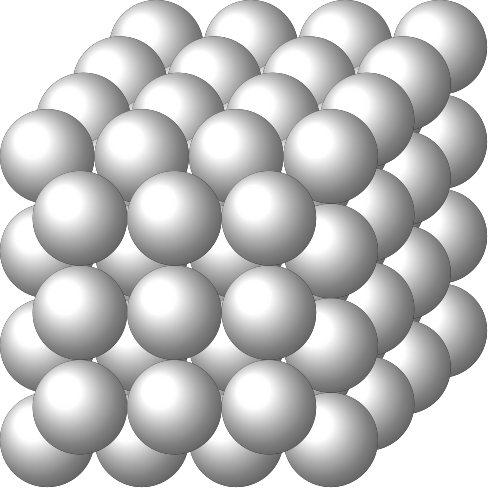
The metallic bond differs from the covalent bond in that the covalent bond has directionality, whereas the metallic bond does not. Metal atoms have relatively few valence electrons, yet each metal ion is surrounded by a large number of other metal ions. Therefore, the metallic bond cannot form shared electron pairs as covalent bonds do, because the few valence electrons of a single metal atom cannot simultaneously form shared pairs with the valence electrons of many surrounding metal atoms. Consequently, the free electrons in a metallic crystal do not belong exclusively to any particular metal ions but are shared by many metal ions, distributed nearly uniformly throughout the entire crystal.
Let us now use our knowledge of metallic bonding to briefly explain some of the common properties of metals.
Under normal conditions, the free electrons in a metallic crystal move in no particular direction. However, when an external electric field is applied, the free electrons undergo directed motion through the metallic crystal, thereby forming an electric current. This is why metals conduct electricity so readily.
The thermal conductivity of metals is also related to the motion of free electrons in the metallic crystal. As the free electrons move, they frequently collide with metal ions, causing energy exchange between the two. When one part of a metal is heated, the free electrons in that region gain energy and their speed increases. Through collisions, these free electrons transfer energy to other metal ions. In this way, metals use the motion of free electrons to transfer energy from higher-temperature regions to lower-temperature regions, until the entire piece of metal reaches a uniform temperature.
The malleability and ductility of metals can also be explained by the structural characteristics of metallic crystals. When an external force is applied to a metal, the layers slide relative to one another (Figure 6.2). However, because the metallic bond has no directionality, the metallic bonding between the layers is maintained even after sliding. Therefore, although the metal deforms under an external force, it does not fracture. This is why metals generally have varying degrees of malleability and ductility.

Above, we have explained some of the common properties of metals. However, different metals show great variation in certain properties (such as density, hardness, and melting point). These properties are related to the intrinsic characteristics of the metal atoms themselves, the packing arrangement of the atoms, and other factors.
- The metallic bond is the relatively strong interaction between metal ions and free electrons in a metallic crystal
- The metallic bond has no directionality — this is a key difference from covalent bonds
- Free electrons are shared by many metal ions and are distributed nearly uniformly throughout the crystal
- Electrical conductivity: free electrons undergo directed motion under an applied electric field
- Thermal conductivity: free electrons transfer energy from hot regions to cold regions through collisions with metal ions
- Malleability and ductility: layers of metal ions can slide past each other without breaking metallic bonds
Exercises for Section 1
What is the difference between a metallic bond and a covalent bond?
Why do metals conduct electricity, conduct heat, and exhibit malleability and ductility, whereas under ordinary conditions, ionic compounds do not possess these properties?
Consider the following five substances in the solid state: sodium, silicon, neon, sodium chloride, and ice. Which substance does each of the following descriptions of properties apply to?
Held together by intermolecular forces; has a very low melting point.
A good conductor of electricity; melting point around \(100\,{}^{\circ}\text{C}\).
A network crystal formed by covalent bonds; has a very high melting point.
A nonconductor, but can conduct electricity when molten.
Has hydrogen bonds in its crystal structure.
How does the mechanism of electrical conduction in metals differ from that in electrolyte solutions?
Give examples to illustrate the differences in structure and properties among ionic crystals, molecular crystals, atomic crystals, and metallic crystals.
6.2 Section 2: Properties of Magnesium and Aluminum
Magnesium and aluminum are both light metallic elements of the third period. The electron configuration of the magnesium atom is \(1s^2 2s^2 2p^6 3s^2\), and that of the aluminum atom is \(1s^2 2s^2 2p^6 3s^2 3p^1\). Both atoms have relatively few valence electrons, so their properties share some similarities. However, because their structures differ, their properties also exhibit many differences. For ease of comparison, we present the properties of magnesium and aluminum side by side.
I. Physical Properties
Table 6.1 lists some properties of the atoms and elemental forms of magnesium and aluminum.
| Property | Mg | Al |
|---|---|---|
| Atomic radius (\(10^{-10}\ \text{m}\)) | 1.60 | 1.43 |
| Ionic radius (\(10^{-10}\ \text{m}\)) | 0.66 | 0.51 |
| First ionization energy (eV) | 7.644 | 5.984 |
| Oxidation state | +2 | +3 |
| Color | Silver-white | Silver-white |
| Density (g/cm³) | 1.74 | 2.70 |
| Melting point | \(648.8\,{}^{\circ}\text{C}\) | \(660.4\,{}^{\circ}\text{C}\) |
| Boiling point | \(1090\,{}^{\circ}\text{C}\) | \(2467\,{}^{\circ}\text{C}\) |
| Hardness | Very soft | Relatively soft |
From Table 6.1, we can see that magnesium and aluminum are both silver-white metals with relatively low densities, relatively low melting points, and low hardness. Comparing the two, aluminum is slightly harder than magnesium, and both its melting point and boiling point are higher. This is mainly because the metallic bonds in magnesium and aluminum differ in strength. We know that the aluminum atom has more valence electrons than the magnesium atom, its nuclear charge is greater, and its atomic radius is smaller. Therefore, in aluminum crystals, the interaction between free electrons and aluminum ions is stronger. As a result, aluminum is harder than magnesium and has higher melting and boiling points.
Pure aluminum has excellent electrical conductivity. In the electrical power industry, it can partially replace copper for use in wires and cables. Aluminum has great malleability and ductility — it can be drawn into fine wires or rolled into thin sheets called aluminum foil. Aluminum foil can be used to package photographic film, candy, and other products. Aluminum powder mixed with certain oils can be used to manufacture silver-white anti-rust paint. An even more important use of aluminum is in forming alloys with many other elements. An alloy is a substance with metallic properties formed by melting together two or more metals (or a metal with a nonmetal). Alloys possess many superior physical, chemical, or mechanical properties compared to their component metals. Generally speaking, most alloys have melting points lower than those of any of their component metals. For example, an aluminum–silicon alloy (containing \(\text{Si}\ 13.5\%\)) has a melting point of \(564\,{}^{\circ}\text{C}\), which is lower than the melting point of either pure aluminum or silicon, and it also has a very small shrinkage rate upon solidification. Consequently, this alloy is well suited for casting. Another example is duralumin (containing \(\text{Cu}\ 4\%\), \(\text{Mg}\ 0.5\%\), \(\text{Mn}\ 0.5\%\), \(\text{Si}\ 0.7\%\)), whose strength and hardness are much greater than those of pure aluminum — nearly comparable to steel — while its density is much lower. There are many types of aluminum alloys, and they are widely used in the manufacture of automobiles, ships, and aircraft, as well as in everyday life.
The primary use of magnesium is also in manufacturing various light alloys. For example, alloys formed from magnesium with aluminum, copper, tin, manganese, titanium, beryllium, and other metallic elements (containing approximately \(80\%\) magnesium) have densities of only about \(1.8\ \text{g/cm}^3\), yet they possess high hardness and strength. Therefore, magnesium alloys are also important materials in the automobile and aircraft manufacturing industries.
II. Chemical Properties
Magnesium and aluminum atoms readily lose their outermost electrons to form cations.
\[ \ce{Mg - 2e -> Mg^{2+}} \]
\[ \ce{Al - 3e -> Al^{3+}} \]
Magnesium and aluminum are both relatively active metals and strong reducing agents. They can react with nonmetals, acids, and other substances. Aluminum can also react with strong base solutions.
1. Reactions with Nonmetals
At room temperature, both magnesium and aluminum react with oxygen in the air to form a dense, hard oxide film on their surfaces, causing the metals to lose their luster. However, this oxide film prevents further oxidation, giving both magnesium and aluminum corrosion resistance.
Magnesium can be ignited and burned in air, releasing a large amount of heat and emitting a dazzling white light. This property of magnesium is utilized in the manufacture of signal flares and similar devices.
\[ \ce{2Mg + O2 ->[\text{ignite}] 2MgO} + \text{heat} \]
Aluminum does not react with oxygen as readily as magnesium. However, when aluminum powder or aluminum foil is heated in oxygen, aluminum can also burn, releasing a large amount of heat and emitting a dazzling white light. In air, however, aluminum undergoes such vigorous reaction only at high temperatures.
\[ \ce{4Al + 3O2 = 2Al2O3} + \text{heat} \]
In addition to reacting with oxygen, magnesium and aluminum can also react with other nonmetals such as sulfur and the halogens.
2. Reactions with Acids
Both magnesium and aluminum react with dilute hydrochloric acid or dilute sulfuric acid to produce hydrogen gas. At room temperature, the surface of aluminum is passivated in concentrated nitric acid, forming a hard oxide film that prevents further reaction. For this reason, aluminum containers can be used to transport concentrated nitric acid.
3. Reactions with Bases
Magnesium does not react with bases, but aluminum can react with strong base solutions, producing hydrogen gas and an aluminate.
\[ \ce{2Al + 2NaOH + 2H2O = 2NaAlO2 + 3H2}{\uparrow} \]
4. Reactions with Certain Oxides
Magnesium can not only react with oxygen in the air but can also react with carbon dioxide, extracting the oxygen and liberating free carbon.
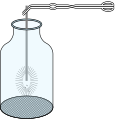
As shown in Figure 6.3, ignite a magnesium ribbon and lower it into a gas-collection bottle filled with carbon dioxide (the bottle contains a small amount of fine sand at the bottom). The magnesium ribbon burns vigorously, producing magnesium oxide, while the liberated carbon deposits on the inner wall of the gas-collection bottle.
The chemical equation for this reaction is:
\[ \ce{2Mg + CO2 ->[\text{combustion}] 2MgO + C} \]
Under certain conditions, aluminum can undergo an oxidation–reduction reaction with iron(III) oxide.
Fold two circular pieces of filter paper separately into funnel shapes and nest them together so that four layers overlap all around. Remove the inner paper funnel, cut a small hole at the bottom, moisten it with water, then nest it back into the other funnel and mount it on an iron ring (Figure 6.4). Place an evaporating dish containing sand beneath it. Mix \(5\ \text{g}\) of dry iron(III) oxide powder and \(2\ \text{g}\) of aluminum powder thoroughly, and place the mixture in the paper funnel. Add a small amount of potassium chlorate on top and insert a magnesium ribbon into the center of the mixture. Ignite the magnesium ribbon with a small wooden splint and observe the phenomena that occur.
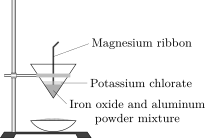
From the experiment, we observe that the magnesium ribbon burns vigorously, releasing a certain amount of heat that causes the iron(III) oxide powder and aluminum powder to react violently at an elevated temperature, releasing a large quantity of heat and emitting a dazzling glow. We can also see that the bottom of the paper funnel is burned through, and molten material drops into the sand. After cooling, when the outer layer of slag is removed, one can see that the material that fell is iron beads. This reaction is called the thermite reaction. During the reaction, the temperature can exceed \(2000\,{}^{\circ}\text{C}\), producing aluminum oxide and liquid iron.
\[ \ce{2Al + Fe2O3 = 2Fe + Al2O3} + \text{heat} \]
The mixture of aluminum powder and iron(III) oxide is commonly called thermite.
The principle of the thermite reaction can be applied in industrial production — for example, in welding steel rails. By adding certain amounts of iron alloys and iron nail filings to thermite and placing this mixture in a specially made crucible, upon ignition, a vigorous and complex chemical reaction immediately occurs, producing high-temperature molten steel and slag. The molten steel is then poured into a sand mold clamped over the gap between two rail ends, welding them together (Figure 6.5).
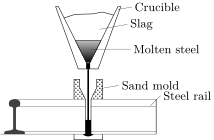
This welding method requires no electrical power supply, and the welding is fast with simple equipment — making it suitable for field operations. Using this method, relatively short rails (\(12.5\)–\(25\ \text{m}\)) can be welded into longer rails (about \(1000\ \text{m}\)), which is of great significance for constructing seamless railway tracks. In addition, the thermite welding method is also used industrially to weld large cross-section steel components.
Not only can aluminum powder and iron(III) oxide be used as thermite, but replacing iron(III) oxide with certain other metal oxides (such as \(\ce{V2O5}\), \(\ce{Cr2O3}\), \(\ce{MnO2}\), etc.) also produces a thermite mixture. When aluminum powder reacts with these metal oxides, sufficient heat is generated to bring the reduced metal to a molten state at elevated temperatures, allowing it to separate from the slag and yielding relatively pure metal. This method is commonly used industrially to smelt refractory metals such as vanadium, chromium, and manganese.
- Both magnesium and aluminum are relatively active light metals and strong reducing agents
- Both form dense, protective oxide films in air, giving them corrosion resistance
- Both react with dilute acids to produce hydrogen; aluminum is passivated by concentrated nitric acid
- Magnesium does not react with bases; aluminum reacts with strong base solutions to produce hydrogen and aluminates
- Magnesium burns in \(\ce{CO2}\): \(\ce{2Mg + CO2 -> 2MgO + C}\)
- The thermite reaction: \(\ce{2Al + Fe2O3 -> 2Fe + Al2O3}\) + heat; used for welding rails and smelting refractory metals
- An alloy is a substance with metallic properties formed by melting together two or more metals (or a metal with a nonmetal)
Exercises for Section 2
Magnesium and aluminum are both relatively active metals. Why are they not easily corroded?
Are the following statements correct? Why or why not?
Because carbon dioxide is an excellent fire extinguisher, it can be used to extinguish burning magnesium powder.
In chemical reactions, the magnesium atom can lose 2 electrons while the aluminum atom can lose 3 electrons; therefore, aluminum is more active than magnesium.
Write the chemical equations for the reactions of aluminum with sodium hydroxide solution and with dilute sulfuric acid, respectively. Then rewrite each chemical equation as a net ionic equation.
Which properties of aluminum are primarily responsible for each of the following uses?
Household aluminum pots
Concentrated nitric acid containers
Electrical wires
Packaging aluminum foil
Welding steel rails
Compare the physical and chemical properties of the elements of the third period. How can these properties be used to illustrate the trend in properties from left to right across the periodic table?
Write the net ionic equations for the reactions of sodium, magnesium, and aluminum each with an excess of dilute hydrochloric acid, and calculate:
When \(1\ \text{g}\) of each metal is used, which reaction produces the most hydrogen gas?
When \(0.1\ \text{mol}\) of each metal is used, which reaction produces the most hydrogen gas?
Balance the following chemical equations. Identify which substances are the oxidizing agents and which are the reducing agents. Calculate the mass of pure aluminum needed to produce \(1\ \text{mol}\) of each metal.
\(\ce{V2O5 + Al ->}\)
\(\ce{WO3 + Al ->}\)
\(\ce{Cr2O3 + Al ->}\)
\(\ce{Co3O4 + Al ->}\)
6.3 Section 3: Important Compounds of Magnesium and Aluminum; Aluminum Smelting
Both magnesium and aluminum are widely distributed in nature. Aluminum is the most abundant metallic element in the Earth’s crust, accounting for approximately \(7.7\%\) of the total mass of the crust. Magnesium reserves are also very abundant, accounting for approximately \(2.0\%\) of the crust’s total mass. Because both are relatively active metals, they exist in nature only in the combined state.
The principal magnesium-containing minerals include carnallite, dolomite, magnesite, magnesium sulfate, talc, and asbestos. In addition, seawater contains large quantities of magnesium salts.
The principal aluminum-containing minerals include feldspar, mica, bauxite, and alunite.
Below is a brief introduction to several important compounds of magnesium and aluminum.
I. Important Compounds of Magnesium
1. Magnesium Oxide (\(\ce{MgO}\))
Magnesium oxide can be produced by burning magnesium in air. Industrially, it is usually prepared by calcining magnesite (whose main component is \(\ce{MgCO3}\)):
\[ \ce{MgCO3 ->[\text{calcination}] MgO + CO2}{\uparrow} \]
Magnesium oxide is a very light, white powder with a melting point as high as \(2800\,{}^{\circ}\text{C}\). It is an excellent refractory material, commonly used to manufacture refractory bricks, refractory tubes, and crucibles.
Magnesium oxide is a basic oxide that reacts slowly with water to form magnesium hydroxide:
\[ \ce{MgO + H2O = Mg(OH)2} \]
2. Magnesium Chloride (\(\ce{MgCl2}\))
Magnesium chloride is a colorless, bitter-tasting, readily soluble crystalline substance that absorbs moisture from the air extremely easily and deliquesces. The tendency of crude table salt to absorb moisture and become damp in humid air is due to the small amount of magnesium chloride impurity it contains.
Electrolysis of molten magnesium chloride can produce metallic magnesium. Therefore, magnesium chloride is an important raw material for the production of magnesium.
Carnallite (\(\ce{KCl * MgCl2 * 6H2O}\)) contains magnesium chloride. When carnallite is dissolved and potassium chloride is extracted, the remaining solution can be concentrated to obtain hexahydrate magnesium chloride (\(\ce{MgCl2 * 6H2O}\)) crystals.
In addition to the large quantities of magnesium-containing minerals found on land, the ocean also stores vast amounts of magnesium salts. The average concentration of magnesium ions in seawater is \(0.13\%\), ranking third after chloride and sodium. Because the total volume of seawater is enormous, the ocean is one of the major sources of magnesium.
Below is a brief introduction to how magnesium is extracted from seawater.
Factories of this type use large volumes of seawater as raw material and are built along the coast. The general process begins by calcining seashells found on the beach to produce lime, which is then converted into lime milk. Seawater is channeled into waterways, and lime milk is added. Because the solubility of magnesium hydroxide is very low, magnesium hydroxide precipitates. After settling, washing, and filtering, magnesium hydroxide is obtained. At this point, if the magnesium hydroxide is calcined, magnesium oxide can be produced. Alternatively, if hydrochloric acid is added to the magnesium hydroxide, magnesium chloride is formed. After crystallization, filtration, and drying, the magnesium chloride is electrolyzed in an electrolytic cell to obtain metallic magnesium and chlorine gas. The chlorine gas can then be used to produce hydrochloric acid for reuse in the cycle.
In addition to the method described above, magnesium chloride can also be extracted from bittern — the liquid remaining after table salt has been crystallized. Bittern contains relatively large amounts of magnesium chloride and sodium chloride, lesser amounts of magnesium sulfate, and smaller quantities of potassium chloride, as well as small amounts of magnesium bromide. If lime is added to bittern, a magnesium hydroxide precipitate forms, which can then be processed into magnesium chloride using the method described above. Furthermore, by taking advantage of the different solubility properties of the various salts in water, the conditions of the solution can be changed to cause the salts to crystallize out separately.
II. Important Compounds of Aluminum
1. Aluminum Oxide (\(\ce{Al2O3}\))
The principal aluminum mineral found in nature is bauxite. Bauxite, also called alumina ore, is composed of monohydrate alumina (\(\ce{Al2O3 * H2O}\)), trihydrate alumina (\(\ce{Al2O3 * 3H2O}\)), and small amounts of iron oxide and silica impurities. Bauxite can be used to extract pure aluminum oxide. Aluminum oxide is a white, refractory substance and is the raw material for smelting aluminum. It is also a fairly good refractory material, suitable for manufacturing refractory crucibles, refractory tubes, and high-temperature laboratory instruments.
Corundum is naturally occurring colorless crystalline aluminum oxide. Corundum is very hard — second only to diamond. For this reason, it is often used to make grinding wheels, abrasive paper, and grinding stones for processing optical instruments and certain metal products. What are commonly known as sapphires and rubies are corundum crystals that contain small amounts of different oxide impurities. They can be used as bearings in precision instruments and watches.
Aluminum oxide is a typical amphoteric oxide. Freshly prepared aluminum oxide can react with acids to form aluminum salts and with bases to form aluminates.
\[ \ce{Al2O3 + 6H+ = 2Al^{3+} + 3H2O} \]
\[ \ce{Al2O3 + 2OH- = 2AlO2- + H2O} \]
Aluminum oxide is insoluble in water; therefore, it cannot be used to prepare aluminum hydroxide.
2. Aluminum Hydroxide (\(\ce{Al(OH)3}\))
Aluminum hydroxide is a white, gelatinous substance that is insoluble in water. Aluminum hydroxide can coagulate suspended matter in water and also has the ability to adsorb pigments. In the laboratory, aluminum hydroxide can be prepared by the reaction of an aluminum salt solution with ammonia solution.
Pour \(3\ \text{mL}\) of \(0.5\ \text{M}\) aluminum sulfate solution into a test tube. Add ammonia solution dropwise to the aluminum sulfate solution — a fluffy, white, gelatinous aluminum hydroxide precipitate forms. Continue adding ammonia solution until no more precipitate is produced. Filter and wash the precipitate with distilled water to obtain fairly pure aluminum hydroxide (retain most of it for the experiment below). Take a small amount of the aluminum hydroxide precipitate, place it in an evaporating dish, and heat it. Observe the decomposition of aluminum hydroxide.
The reactions in the above experiment can be represented as follows:
\[ \ce{Al^{3+} + 3NH3 * H2O = Al(OH)3 v + 3NH4+} \]
\[ \ce{2Al(OH)3 ->[\Delta] Al2O3 + 3H2O} \]
Divide the aluminum hydroxide precipitate prepared in the previous experiment between two test tubes. To one test tube, add \(2\ \text{M}\) hydrochloric acid dropwise; to the other, add \(2\ \text{M}\) sodium hydroxide solution dropwise. Observe the phenomena that occur in both test tubes.
Through the above experiment, we see that aluminum hydroxide dissolves in both acidic and strong basic solutions. This demonstrates that it can react with both acids and strong bases. The two reactions can be represented as follows:
\[ \ce{Al(OH)3 + 3H+ = Al^{3+} + 3H2O} \]
\[ \ce{Al(OH)3 + OH- = AlO2- + 2H2O} \]
Experiment confirms that aluminum hydroxide is a typical amphoteric hydroxide.
Why does aluminum hydroxide exhibit amphoteric behavior? We can provide a simple explanation using the principles of acid–base ionization and equilibrium shift.
The ionization equation for aluminum hydroxide can be written as follows:
\[ \ce{H2O + AlO2- + H+ <=> Al(OH)3 <=> Al^{3+} + 3OH-} \]
Aluminum hydroxide is a weak electrolyte — both its basic and acidic character are very weak. That is, it produces very few \(\ce{H+}\) and \(\ce{OH-}\) ions upon ionization. So why can it react with both acids and bases? This can be explained by the principle of equilibrium shift.
When acid is added to \(\ce{Al(OH)3}\), the \(\ce{H+}\) ions immediately react with the small amount of \(\ce{OH-}\) in solution to form water. This causes the aluminum hydroxide to undergo basic ionization, shifting the equilibrium to the right, thereby causing \(\ce{Al(OH)3}\) to dissolve continuously. Conversely, when base is added to \(\ce{Al(OH)3}\), the \(\ce{OH-}\) ions immediately react with the small amount of \(\ce{H+}\) in solution to form water. This causes the aluminum hydroxide to undergo acidic ionization, shifting the equilibrium to the left, and similarly causing \(\ce{Al(OH)3}\) to dissolve continuously.
3. Potassium Aluminum Sulfate (\(\ce{KAl(SO4)2}\))
Potassium aluminum sulfate is a salt composed of two different metal ions and one acid radical ion. Such a salt is called a double salt. When it ionizes, it dissociates into two types of metal cations.
\[ \ce{KAl(SO4)2 = K+ + Al^{3+} + 2SO4^{2-}} \]
The dodecahydrate of potassium aluminum sulfate (\(\ce{KAl(SO4)2 * 12H2O}\)), commonly known as alum, is also written as \(\ce{K2SO4 * Al2(SO4)3 * 24H2O}\). Alum is a colorless crystal that dissolves readily in water and undergoes hydrolysis; its aqueous solution is acidic.
\[ \ce{Al^{3+} + 3H2O <=> Al(OH)3}\ (\text{colloid}) + \ce{3H+} \]
The \(\ce{Al(OH)3}\) colloid produced by the hydrolysis of alum has a strong adsorptive capacity. It can adsorb suspended impurities in water and cause them to settle, making the water clear. For this reason, alum is a good water-purifying agent.
III. Aluminum Smelting
We already know that aluminum is the most abundant metal in the Earth’s crust, and it possesses many excellent properties that make it widely used in many fields. Although aluminum is abundant and widely used, the history of its discovery is not long. This is because aluminum is chemically active and difficult to reduce, making its extraction from ores quite challenging. More than a hundred years ago, people once used metallic sodium to reduce aluminum oxide to obtain metallic aluminum. Because sodium was very expensive at the time, aluminum was even more expensive — its price was comparable to that of gold. Consequently, aluminum was regarded as a rare and precious metal and was fashioned into the most prized awards and gifts. It was not until the late nineteenth century that a new method was invented for producing aluminum — the electrolysis of a molten mixture of cryolite1 and aluminum oxide — that aluminum could be smelted on a large scale. From that point on, the price of aluminum dropped dramatically, and aluminum finally gained widespread use. Today, this is still the method used in industry to produce aluminum.
The melting point of pure aluminum oxide is very high (approximately \(2045\,{}^{\circ}\text{C}\)), making it extremely difficult to melt. By using molten cryolite (\(\ce{Na3AlF6}\)) as a flux, aluminum oxide can be dissolved at around \(1000\,{}^{\circ}\text{C}\) in liquid cryolite to form a cryolite–alumina melt, which is then electrolyzed.
The main equipment for smelting aluminum is an electrolytic cell, as shown in Figure 6.6. The cell is rectangular in shape, with a steel shell on the outside and firebrick lining for insulation and heat retention. Carbon blocks form the cell lining; the bottom carbon blocks are connected to steel conducting bars beneath them and serve as the cathode. Two rows of carbon blocks with conducting rods, mounted vertically in the cell, serve as the anode. Between them is the cryolite–alumina melt.
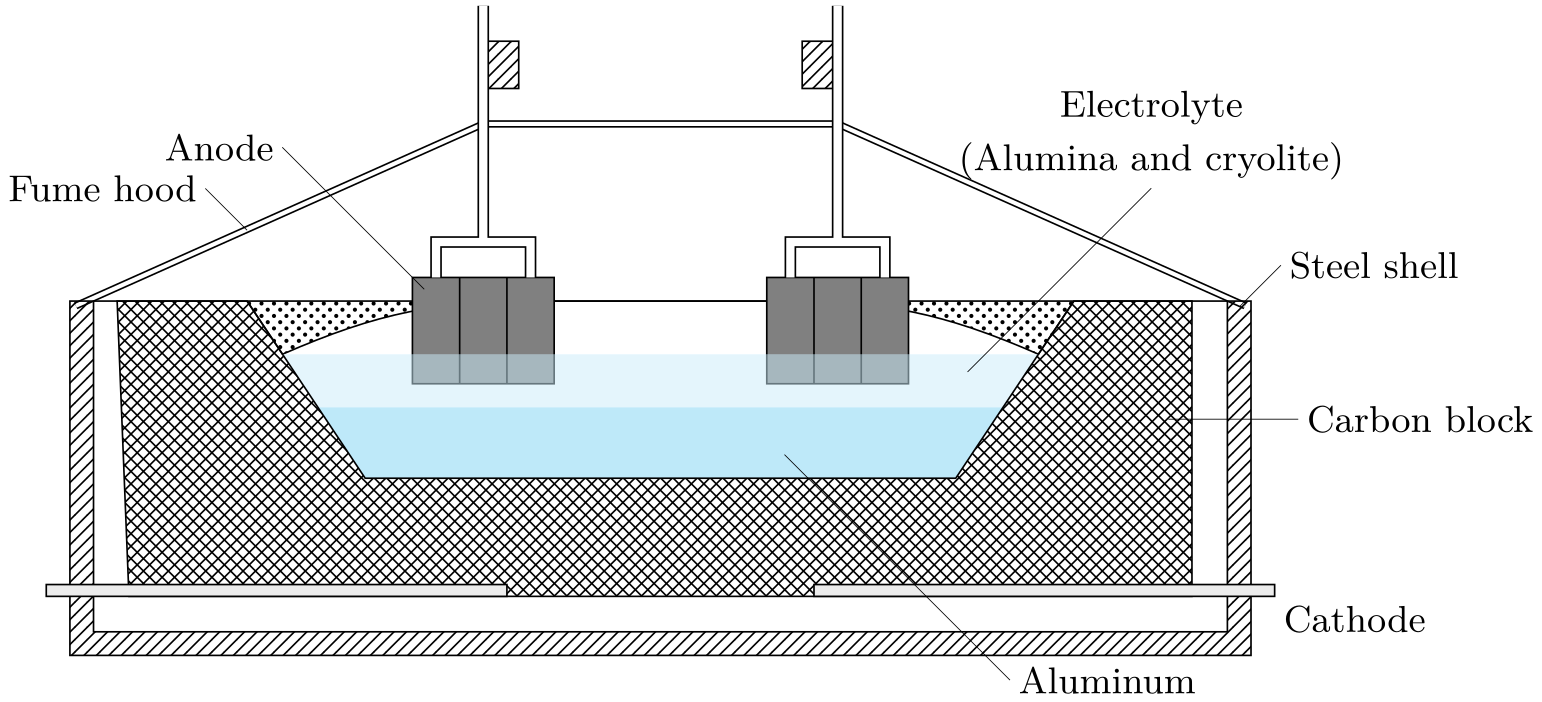
When direct current passes through the cryolite–alumina melt, very complex reactions occur. The reactions at the two electrodes can be simplified as follows:
At the cathode:
\[ \ce{4Al^{3+} + 12e = 4Al} \]
At the anode:
\[ \ce{6O^{2-} - 12e = 3O2} \]
Overall reaction:
\[ \ce{2Al2O3 ->[\text{electrolysis}] 4Al + 3O2}{\uparrow} \]
The oxygen gas produced at the anode immediately reacts with the carbon electrode, forming carbon dioxide.
\[ \ce{C + O2 = CO2}{\uparrow} \]
Therefore, during the electrolysis process, both aluminum oxide and the carbon blocks must be replenished periodically.
Because the temperature is around \(1000\,{}^{\circ}\text{C}\), the aluminum produced by electrolysis is in the liquid state inside the cell. The density of the cryolite–alumina melt is less than that of liquid aluminum, so the liquid aluminum accumulates at the bottom of the cell and can be drawn off periodically.
- Aluminum is the most abundant metal in the Earth’s crust (\(7.7\%\)); magnesium accounts for \(2.0\%\)
- \(\ce{MgO}\): white powder, mp \(2800\,{}^{\circ}\text{C}\), excellent refractory material; basic oxide
- \(\ce{MgCl2}\): soluble, hygroscopic; raw material for producing Mg by electrolysis of the melt
- Magnesium can be extracted from seawater or from bittern
- \(\ce{Al2O3}\): white, refractory; a typical amphoteric oxide (\(\ce{Al2O3 + 6H+ -> 2Al^{3+} + 3H2O}\); \(\ce{Al2O3 + 2OH- -> 2AlO2- + H2O}\))
- \(\ce{Al(OH)3}\): white gelatinous precipitate; a typical amphoteric hydroxide — dissolves in both acid and strong base
- Alum (\(\ce{KAl(SO4)2 * 12H2O}\)) is a double salt; the \(\ce{Al(OH)3}\) colloid produced by its hydrolysis acts as a water-purifying agent
- Aluminum smelting: electrolysis of \(\ce{Al2O3}\) dissolved in molten cryolite (\(\ce{Na3AlF6}\)) at about \(1000\,{}^{\circ}\text{C}\)
- Overall electrolysis equation: \(\ce{2Al2O3 ->[\text{electrolysis}] 4Al + 3O2}{\uparrow}\)
Exercises for Section 3
Use chemical equations to represent each step in the following conversions:
\(\ce{Mg -> MgO -> MgCl2 -> MgSO4 -> Mg(OH)2 -> MgCl2 -> Mg}\)
\(\ce{Al -> Al2O3 -> AlCl3 -> Al2(SO4)3 -> Al(OH)3 -> NaAlO2}\)
Although the surface of an aluminum pot is covered with a protective oxide film, why is it still inadvisable to wash it with alkaline water? Why is it unsuitable for cooking acidic foods?
A piece of magnesium–aluminum alloy is dissolved in hydrochloric acid. Excess sodium hydroxide solution is then added. In what forms do the magnesium and aluminum exist, respectively? Write the chemical equations for the reactions.
Two students each designed a scheme for preparing \(\ce{Al2S3}\). Judge which student’s scheme is correct and explain why.
Prepare it by reacting aluminum powder with sulfur powder at high temperature.
Prepare it by reacting sodium sulfide solution with aluminum chloride solution.
A white powder is known to be one of the following: magnesium chloride, magnesium hydroxide, or magnesium carbonate. Design an experiment to determine which substance it is.
A certain bauxite ore contains \(88\%\) aluminum oxide (\(\ce{Al2O3}\)). In theory, how many tonnes of this ore are needed to produce \(10\ \text{t}\) of metallic aluminum?
6.4 Section 4: Hard Water and Its Softening
I. Water Hardness
Water is an indispensable substance for daily life and agricultural and industrial production. The quality of water has a significant impact on production and daily life. Through prolonged contact with air, rocks, and soil, natural water dissolves many impurities — including inorganic salts, certain soluble organic substances, and gases. The dissolved inorganic salts include the hydrogen carbonates, carbonates, chlorides, sulfates, and nitrates of calcium and magnesium. In other words, natural water generally contains cations such as \(\ce{Ca^{2+}}\) and \(\ce{Mg^{2+}}\), and anions such as \(\ce{HCO3-}\), \(\ce{CO3^{2-}}\), \(\ce{Cl-}\), \(\ce{SO4^{2-}}\), and \(\ce{NO3-}\). The types and amounts of these ions vary in natural water from different locations.
Some natural water sources contain relatively large amounts of \(\ce{Ca^{2+}}\) and \(\ce{Mg^{2+}}\). When soap solution is added to such water, a precipitate forms.
Using two test tubes, separately take \(5\)–\(6\ \text{mL}\) each of distilled water and natural water. Add a small amount of soap solution to each and shake. Observe the phenomena that occur.
We can see that the test tube containing distilled water produces abundant foam with no precipitate. The test tube containing natural water produces less foam and a flocculent precipitate appears. This is because natural water contains \(\ce{Ca^{2+}}\) or \(\ce{Mg^{2+}}\), and soap reacts with \(\ce{Ca^{2+}}\) or \(\ce{Mg^{2+}}\) to produce substances insoluble in water.2 Different natural water sources contain varying amounts of these ions. Generally speaking, groundwater and spring water contain more \(\ce{Ca^{2+}}\) and \(\ce{Mg^{2+}}\), while river water, lake water, and rainwater contain less.
Water that contains a relatively large amount of dissolved \(\ce{Ca^{2+}}\) and \(\ce{Mg^{2+}}\) is called hard water; water that contains only a small amount or none of these ions is called soft water.
If the hardness of water is caused by calcium hydrogen carbonate or magnesium hydrogen carbonate, this hardness is called temporary hardness. Water with temporary hardness can be softened by boiling. When boiled, the calcium hydrogen carbonate in the water decomposes to form insoluble calcium carbonate:
\[ \ce{Ca(HCO3)2 ->[\Delta] CaCO3 v + CO2 ^ + H2O} \]
The magnesium hydrogen carbonate in the water first forms sparingly soluble magnesium carbonate precipitate:
\[ \ce{Mg(HCO3)2 ->[\Delta] MgCO3 v + CO2 ^ + H2O} \]
Although magnesium carbonate is sparingly soluble in water, a small amount can still dissolve (at \(18\,{}^{\circ}\text{C}\), its solubility is \(0.011\ \text{g}\), equivalent to \(110\ \text{mg/L}\)). Therefore, when heating is continued with prolonged boiling, magnesium carbonate undergoes hydrolysis, producing even less soluble magnesium hydroxide (at \(18\,{}^{\circ}\text{C}\), its solubility is \(0.00084\ \text{g}\), equivalent to \(8.4\ \text{mg/L}\)). In this way, the dissolved \(\ce{Ca^{2+}}\) and \(\ce{Mg^{2+}}\) in the water are converted to calcium carbonate and magnesium hydroxide precipitates that settle out. The hardness of the water is thereby reduced, softening the hard water.
If the hardness of water is caused by the sulfates or chlorides of calcium and magnesium, this hardness is called permanent hardness. Permanent hardness cannot be eliminated by heating. Most natural water possesses both temporary and permanent hardness simultaneously. Therefore, the hardness of water generally refers to the sum of both types of hardness.
II. Softening of Hard Water
High water hardness is harmful to both daily life and industrial production. If washing water is too hard, it not only wastes soap but also makes it difficult to clean clothes thoroughly. Drinking water with very high or very low hardness over a long period is not beneficial to human health. High hardness in boiler water is particularly harmful, especially high temporary hardness. After prolonged heating, the calcium and magnesium salts in the water deposit as scale on the inside of the boiler, greatly reducing the thermal conductivity of the metal pipes. This not only wastes fuel but can also cause localized overheating of the pipes. When the temperature exceeds what the metal can withstand, the boiler pipes may deform or be damaged. In severe cases, this can lead to boiler explosions. Many industrial sectors — such as textiles, dyeing, papermaking, and chemical engineering — all require soft water. Therefore, treating natural water to reduce or eliminate its hardness is very important.
The methods commonly used to soften hard water include the chemical treatment method and the ion exchange method.
1. Chemical Treatment Method
In the chemical treatment method, appropriate reagents are added to the water to convert the dissolved calcium and magnesium salts into substances that are nearly insoluble in water, which precipitate out and are removed — thereby achieving the goal of water softening. Commonly used reagents include lime, soda ash (sodium carbonate), and trisodium phosphate. Depending on the water quality requirements, one reagent or several reagents may be used simultaneously. For example, the lime–soda ash method uses lime and soda ash (\(\ce{Na2CO3}\)) to react with the dissolved \(\ce{Ca^{2+}}\) and \(\ce{Mg^{2+}}\) in the water, forming precipitates and thereby softening the hard water.
Lime reacts with calcium hydrogen carbonate and magnesium hydrogen carbonate in the water:
\[ \ce{Ca(HCO3)2 + Ca(OH)2 = 2CaCO3 v + 2H2O} \]
\[ \ce{Mg(HCO3)2 + 2Ca(OH)2 = 2CaCO3 v + Mg(OH)2 v + 2H2O} \]
Lime can also react with magnesium sulfate or magnesium chloride in the water, producing a magnesium hydroxide precipitate along with calcium sulfate or calcium chloride. In this way, the water hardness caused by \(\ce{Mg^{2+}}\) is converted to hardness caused by \(\ce{Ca^{2+}}\).
\[ \ce{MgSO4 + Ca(OH)2 = Mg(OH)2 v + CaSO4} \]
Adding soda ash can remove the water hardness caused by \(\ce{Ca^{2+}}\):
\[ \ce{CaSO4 + Na2CO3 = CaCO3 v + Na2SO4} \]
2. Ion Exchange Method
The ion exchange method is a modern method that uses ion exchange agents3 to soften water.
In industry, sulfonated coal4 (NaR) is commonly used as an ion exchange agent. Sulfonated coal is a black, granular substance that is insoluble in both acid and base. The cations in this substance can undergo ion exchange with cations of other substances in solution.
As shown in Figure 6.7, an ion exchange column is packed with sulfonated coal. Hard water is poured into the top of the column and allowed to flow slowly through the sulfonated coal. As the hard water passes through, the \(\ce{Ca^{2+}}\) and \(\ce{Mg^{2+}}\) in the hard water exchange with the \(\ce{Na+}\) of the sulfonated coal, thereby softening the hard water. The reactions can be represented as follows:
\[ \ce{2NaR + Ca^{2+} = CaR2 + 2Na+} \]
\[ \ce{2NaR + Mg^{2+} = MgR2 + 2Na+} \]
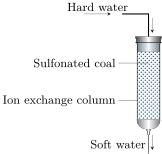
Take the natural water used in Experiment 6.5 and pass it through an ion exchange agent to soften it. Using a test tube, take \(5\)–\(6\ \text{mL}\) of the softened water, add a small amount of soap solution, and shake.
Through the experiment, we can see that after the hard water has been softened, shaking with soap solution produces abundant foam with no precipitate.
After all the \(\ce{Na+}\) in the sulfonated coal has been replaced by \(\ce{Ca^{2+}}\) and \(\ce{Mg^{2+}}\), the sulfonated coal loses its ability to soften hard water. However, by soaking it in an \(8\%\)–\(10\%\) sodium chloride solution, the \(\ce{CaR2}\) and \(\ce{MgR2}\) undergo ion exchange with \(\ce{Na+}\) again, regenerating NaR and restoring the sulfonated coal’s ability to soften hard water. This process is called regeneration. It can be represented as follows:
\[ \ce{CaR2 + 2Na+ = 2NaR + Ca^{2+}} \]
This method of softening hard water offers advantages over the chemical treatment method, including higher water quality, simpler equipment, smaller space requirements, and more convenient operation. For these reasons, it is currently in widespread use.
- Hard water contains relatively large amounts of \(\ce{Ca^{2+}}\) and \(\ce{Mg^{2+}}\); soft water contains little or none
- Temporary hardness: caused by \(\ce{Ca(HCO3)2}\) and \(\ce{Mg(HCO3)2}\); can be removed by boiling
- Permanent hardness: caused by sulfates and chlorides of Ca and Mg; cannot be removed by boiling
- Total hardness = temporary hardness + permanent hardness
- Chemical treatment (lime–soda ash method): \(\ce{Ca^{2+}}\) and \(\ce{Mg^{2+}}\) are precipitated as \(\ce{CaCO3}\) and \(\ce{Mg(OH)2}\)
- Ion exchange method: sulfonated coal (NaR) exchanges \(\ce{Na+}\) for \(\ce{Ca^{2+}}\) and \(\ce{Mg^{2+}}\); can be regenerated with \(\ce{NaCl}\) solution
- High water hardness is harmful: wastes soap, forms boiler scale, can cause boiler explosions
Exercises for Section 4
A certain well water contains both calcium sulfate and calcium hydrogen carbonate. How can it be softened? Write the relevant chemical equations.
Using the lime–soda ash method of water softening as an example, explain the chemical principle behind chemical water softening. Write the relevant chemical equations. Why does water softened by this method still retain a certain degree of hardness?
Answer the following questions:
Why does alum have a water-purifying effect? After treating hard water with alum, does the hard water become soft water?
Washing clothes with hard water increases the consumption of soap. Why?
If the \(\ce{HCO3-}\), \(\ce{SO4^{2-}}\), and \(\ce{Cl-}\) ions are removed from natural water, has the hard water been softened?
Content Summary
I. Metallic Bonding
The relatively strong interaction between metal ions and free electrons in a metallic crystal is called the metallic bond. The metallic bond has no directionality. The metallic bond is also a type of chemical bond.
Some common properties of metals — such as metallic luster, easy electrical conductivity, easy thermal conductivity, and malleability and ductility — can all be explained to a certain extent by the metallic bond.
II. Properties of Magnesium and Aluminum
1. Physical Properties
Magnesium and aluminum have low densities, are malleable and ductile, and aluminum conducts electricity well. Magnesium and aluminum can form alloys with many metals or certain nonmetals.
An alloy is a substance with metallic properties formed by melting together two or more metals (or a metal with a nonmetal).
2. Chemical Properties
Magnesium and aluminum can react with many nonmetals and with dilute hydrochloric acid (or dilute sulfuric acid). Aluminum is passivated in concentrated nitric acid.
Magnesium cannot react with bases; aluminum can react with strong base solutions to produce hydrogen gas.
Magnesium and aluminum can react with certain oxides:
Magnesium can react with carbon dioxide.
Aluminum can react with iron(III) oxide, producing aluminum oxide and liquid iron with the release of a large quantity of heat. The mixture of aluminum powder and iron(III) oxide is called thermite.
Replacing iron(III) oxide with certain other metal oxides (such as \(\ce{V2O5}\), \(\ce{Cr2O3}\), etc.) and reacting them with aluminum can produce certain metals (such as vanadium, chromium, etc.).
III. Important Compounds of Magnesium and Aluminum
Important compounds of magnesium include magnesium oxide and magnesium chloride. Magnesium chloride is the raw material for producing magnesium by electrolysis.
Important compounds of aluminum include aluminum oxide, aluminum hydroxide, and alum. Both aluminum oxide and aluminum hydroxide are amphoteric compounds. The reactions of aluminum hydroxide with acid and with strong base can be represented by the following ionic equations:
\[ \ce{Al(OH)3 + 3H+ = Al^{3+} + 3H2O} \]
\[ \ce{Al(OH)3 + OH- = AlO2- + 2H2O} \]
The ionization equation of aluminum hydroxide can be written as:
\[ \ce{H+ + AlO2- + H2O <=> Al(OH)3 <=> Al^{3+} + 3OH-} \]
Alum (\(\ce{KAl(SO4)2 * 12H2O}\)) is a double salt. Alum readily undergoes hydrolysis to produce \(\ce{Al(OH)3}\) colloid, so it is commonly used as a water-purifying agent.
IV. Aluminum Smelting
The smelting of aluminum involves dissolving pure aluminum oxide in molten cryolite (\(\ce{Na3AlF6}\)) as the electrolyte and carrying out electrolysis in an electrolytic cell. The chemical reaction during electrolysis is very complex, but can be simplified as:
\[ \ce{2Al2O3 ->[\text{electrolysis}] 4Al + 3O2}{\uparrow} \]
V. Hard Water and Its Softening
Water containing relatively large amounts of \(\ce{Ca^{2+}}\) and \(\ce{Mg^{2+}}\) is called hard water. Water containing little or no \(\ce{Ca^{2+}}\) and \(\ce{Mg^{2+}}\) is called soft water.
The hardness of water caused by the hydrogen carbonates of calcium and magnesium is called temporary hardness.
The hardness of water caused by the sulfates or chlorides of calcium and magnesium is called permanent hardness.
The total hardness of water is generally the sum of temporary hardness and permanent hardness.
Hard water is harmful to both daily life and industrial production. The commonly used methods for softening hard water include the chemical treatment method and the ion exchange method.
Review Problems
When magnesium burns in nitrogen gas, it produces magnesium nitride (\(\ce{Mg3N2}\)). Magnesium nitride reacts with water to produce magnesium hydroxide and ammonia gas. Write the chemical equations for these two reactions and calculate:
If \(1.2\ \text{g}\) of magnesium reacts completely with nitrogen gas, how many milliliters of nitrogen gas are required? (At \(17\,{}^{\circ}\text{C}\) and a pressure of \(750\ \text{mmHg}\).)
Under the same conditions of temperature and pressure, how many milliliters of ammonia gas can be obtained?
In a saturated aqueous solution containing solid \(\ce{Mg(OH)2}\), the following equilibrium is established:
\[ \ce{Mg(OH)2}\ (\text{solid}) \rightleftharpoons \ce{Mg^{2+}} + \ce{2OH-} \]
What happens to the amount of solid \(\ce{Mg(OH)2}\) when each of the following is added separately? Give a brief explanation.
Water
Solid \(\ce{Mg(OH)2}\)
Solid \(\ce{NaOH}\)
Hydrochloric acid
The solubility of aluminum hydroxide is very small, so the ions produced by its ionization are naturally very few. Why, then, does adding either acid or strong base cause aluminum hydroxide to dissolve completely, giving a completely transparent solution? Explain using the principle of equilibrium shift.
Using a solution containing \(\ce{Ag+}\), \(\ce{Al^{3+}}\), \(\ce{Ca^{2+}}\), and \(\ce{Mg^{2+}}\) ions, the following experiments are performed. Fill in the blanks:
Adding dilute hydrochloric acid to this solution produces a ______ precipitate.
Filtering the liquid from experiment (1) and adding ammonia solution to make the filtrate basic produces another precipitate. The precipitate is ______.
Filtering the liquid from experiment (2) and adding sodium carbonate to the filtrate produces a ______ precipitate.
Adding sodium hydroxide solution to the precipitate from experiment (2) until excess — part of the precipitate dissolves, producing ______; the undissolved part is ______.
Write the net ionic equations for all of the above chemical reactions.
To \(600\ \text{mL}\) of \(0.003\ \text{M}\) \(\ce{AgNO3}\) solution is added \(400\ \text{mL}\) of \(0.002\ \text{M}\) \(\ce{NaCl}\) solution. After the reaction, which of the following ions is most abundant in the solution?
\(\ce{NO3-}\)
\(\ce{Ag+}\)
\(\ce{Cl-}\)
\(\ce{Na+}\)
The table salt used in the electrolysis of brine contains the following impurities: sand, \(\ce{CaCl2}\), \(\ce{MgSO4}\), and \(\ce{CaSO4}\). How can these impurities be removed? Briefly describe the process and write the relevant net ionic equations.
General Review
Write down which type of crystal the elemental forms of the first three periods of elements belong to, based on your knowledge.
Among the following seven substances, indicate which are nonpolar molecules formed by nonpolar bonds ______; which are polar molecules formed by polar bonds ______; which are nonpolar molecules formed by polar bonds ______; which are ionic crystals formed only by ionic bonds ______; which are ionic crystals with both ionic and covalent bonds ______; which are ionic crystals with ionic bonds, covalent bonds, and coordinate bonds ______.
A. \(\ce{N2}\) B. \(\ce{NH3}\) C. \(\ce{NH4Cl}\) D. \(\ce{BaCl2}\) E. \(\ce{Ca(OH)2}\) F. \(\ce{CCl4}\) G. \(\ce{Cl2}\)
Based on the following physical properties, predict which type of crystal each substance forms in the solid state.
\(\ce{NaOH}\): melting point \(318.4\,{}^{\circ}\text{C}\), boiling point \(1390\,{}^{\circ}\text{C}\), easily soluble in water, conducts electricity when molten.
\(\ce{SO2}\): melting point \(-72.7\,{}^{\circ}\text{C}\), boiling point \(-10.08\,{}^{\circ}\text{C}\), easily soluble in water.
B (boron): melting point \(2300\,{}^{\circ}\text{C}\), boiling point \(2550\,{}^{\circ}\text{C}\), high hardness.
\(\ce{CH4}\): melting point \(-182.5\,{}^{\circ}\text{C}\), boiling point \(-164\,{}^{\circ}\text{C}\), easily soluble in organic solvents.
Are the following statements correct? Why or why not?
Red phosphorus can spontaneously ignite in air and is poisonous.
Phosphorus pentoxide readily absorbs water and can be used as a drying agent for ammonia.
Because phosphoric acid is a diprotic acid, it can form both normal salts and acid salts.
\(\ce{Ca(H2PO4)2}\) is more soluble in water than \(\ce{CaHPO4}\) and \(\ce{Ca3(PO4)2}\).
How can you distinguish among the following fertilizers: ammonium sulfate, ammonium bicarbonate, and potassium chloride?
What are the processes for nitrogen fixation in nature and in industry? Why is the synthesis of ammonia so important for agriculture, industry, and national defense?
For the catalytic oxidation of ammonia: \(\ce{4NH3 + 5O2 ->[\text{Pt}][800\,{}^{\circ}\text{C}] 4NO + 6H2O}\), which reaches equilibrium under certain conditions:
At this point, the reaction rates of ______ and ______ are equal, ______ remains constant, while ______ all continue to proceed. Therefore, chemical equilibrium is a ______ equilibrium.
In this reaction, Pt acts as a ______. It can lower the ______ and speed up ______, but it cannot cause ______ to shift.
If lowering the temperature shifts the above equilibrium toward the forward reaction, then the forward reaction is a(n) ______ reaction. If the heat of reaction per mole of ammonia oxidized is \(54.2\ \text{kCal}\), then the thermochemical equation for this reaction is ______.
If the concentration of oxygen is increased in the above equilibrium mixture, the equilibrium will shift toward the ______ direction.
Answer the following questions:
Since a catalyst cannot affect the shift of chemical equilibrium, why are catalysts often used in chemical production?
Since changes in concentration cannot change the equilibrium constant, why is the concentration of reactants often increased in reactions?
Since the synthesis of ammonia is an exothermic reaction and raising the temperature is unfavorable for the reaction to proceed toward ammonia formation, why do ammonia synthesis plants commonly use a reaction temperature of about \(500\,{}^{\circ}\text{C}\)?
At a certain temperature, for the reaction \(\ce{CO + H2O -> CO2 + H2}\), after equilibrium is reached, \(K = 1\). The initial concentration of CO is \(0.01\ \text{mol/L}\) and that of \(\ce{H2O}\) (gas) is \(0.03\ \text{mol/L}\). Find the equilibrium concentrations of the four substances and the conversion rate of CO.
At a certain temperature, \(0.1\ \text{mol}\) of \(\ce{SO2}\) and \(0.05\ \text{mol}\) of oxygen are placed in a sealed container with a volume of \(4\ \text{L}\). When equilibrium is reached, \(0.06\ \text{mol}\) of \(\ce{SO3}\) is obtained. Find the equilibrium constant at this temperature and the conversion rate of \(\ce{SO2}\).
At a certain temperature, \(0.64\ \text{mol}\) of hydrogen gas and \(0.64\ \text{mol}\) of iodine vapor are introduced into a \(10\ \text{L}\) container. When the reaction reaches equilibrium, \(1\ \text{mol}\) of hydrogen iodide gas has been formed. Find the equilibrium constant for the reaction at this temperature.
Silicon dioxide cannot dissolve in water. How can silicon dioxide be used as a starting material to prepare silicic acid? How can silicon dioxide be used as a starting material to prepare silicon?
Explain the following phenomena:
When egg white (a liquid sol) is poured into a hot pan, it immediately coagulates into a solid.
When sugar is added to soy milk, nothing happens other than sweetening; but when bittern (whose main component is \(\ce{MgCl2}\)) or gypsum (\(\ce{CaSO4 * 2H2O}\)) is added, coagulation occurs. Why?
When alum (\(\ce{KAl(SO4)2 * 12H2O}\)) is used to purify water, \(\ce{Al(OH)3}\) colloidal particles appear in the water. How are these particles formed? What role do they play in removing suspended impurities from the water?
During the electrolytic refining of copper, a crude copper plate (containing Ag and Zn impurities) is used as the anode, a pure copper plate as the cathode, and \(\ce{CuSO4}\) solution as the electrolyte. Answer the following questions:
Write the chemical reactions that occur at the cathode and anode.
Why is Zn not deposited at the cathode?
How does the copper deposited at the cathode differ in composition from the crude copper plate used as the anode?
Why can silver be recovered from the anode mud that accumulates near the anode?
Are the following statements correct? Explain your reasoning.
Because hydrochloric acid is a strong acid and acetic acid is a weak acid, when hydrochloric acid and acetic acid of the same equivalent concentration are used to neutralize the same volume and concentration of sodium hydroxide solution, more acetic acid is needed than hydrochloric acid.
When the pH of a solution decreases by one unit, \([\ce{H+}]\) increases 10-fold; when the pH decreases by 2 units, \([\ce{H+}]\) increases 20-fold.
Because salts of strong acids and strong bases do not undergo hydrolysis and their aqueous solutions are neutral, any salt whose aqueous solution is neutral must not undergo hydrolysis.
From Figure 5.2, among the 7 weak acids listed in the table, which has relatively stronger acidity and which has relatively weaker acidity?
Given that the ionization constant of acetic acid at room temperature is \(1.75 \times 10^{-5}\), calculate the degree of ionization for \(1\ \text{M}\), \(0.5\ \text{M}\), and \(0.1\ \text{M}\) acetic acid.
Calculate the pH of the following solutions:
\(0.1\ \text{M}\) \(\ce{HCl}\)
\(0.05\ \text{M}\) \(\ce{NaOH}\)
\(0.2\ \text{M}\) \(\ce{CH3COOH}\)
\(0.001\ \text{M}\) \(\ce{NH3 * H2O}\)
To \(10\ \text{mL}\) of \(0.5\ \text{M}\) \(\ce{HCl}\), add \(30\ \text{mL}\) of \(0.1\ \text{M}\) \(\ce{NaOH}\). Calculate the pH of the mixed solution.
When equal masses of magnesium and aluminum react separately with excess dilute \(\ce{H2SO4}\), is the amount of hydrogen gas produced the same? Why? When equal moles of magnesium and aluminum react separately with excess dilute \(\ce{H2SO4}\), is the amount of hydrogen gas produced the same? Why?
Translator’s note: Cryolite (\(\ce{Na3AlF6}\)) gets its name from the Greek kryos (frost) and lithos (stone), referring to its icy appearance. The Chinese name 冰晶石 (bīngjīng shí) literally means “ice crystal stone.”↩︎
The reaction of soap with \(\ce{Ca^{2+}}\) or \(\ce{Mg^{2+}}\) produces insoluble calcium or magnesium salts of fatty acids.↩︎
An ion exchange agent is a substance that can exchange its own ions with ions in a solution.↩︎
Sulfonated coal is ordinary coal that has been treated with hot sulfuric acid or fuming sulfuric acid. It is represented by the formula NaR, where R represents a complex anion.↩︎